
 Worksheets
Soil and waste systems-Chadderton -U14_PPS11
Total questions: 112
Worksheet time: 56mins
Which component primarily conveys discharge from fixtures vertically to the building drain?
Trap serving a single appliance
Vent pipe running to roof
Discharge stack carrying waste
Access fitting for inspection
In waste piping, what best describes flow conditions during simultaneous fixture discharge causing rapid level rise?
Steady laminar flow regime
Uniform plug flow state
Transient flow surge event
Constant turbulent stream
Which term refers to the negative pressure that can siphon water from a trap?
Permitted suction pressure
Smoke test pressure
Air static pressure increase
Induced syphonage effect
Which mechanism most directly leads to loss of water seal in a trap without external leakage?
Self-syphonage within trap
Rodding operations performed
Grease residues coating
Solid deposition accumulation
What is the primary role of ventilation in drainage stacks?
Reduce pipe slope requirements
Enhance rodding access points
Increase discharge unit counts
Equalize air pressure distribution
Which maintenance action is intended to clear blockages using flexible equipment through access points?
Inspection by camera
Scale removal chemical
Testing with smoke
Rodding of drains
Which characteristic is most relevant when selecting above‑ground waste pipe diameters?
Ranges of connected appliances
Sewer manhole spacing
Water supply main size
Trap seal depth standard
Which statement best identifies discharge units in pipe sizing?
Slope measurement metric
Vent termination capacity
Fixture load equivalence
Weights for pipe supports
What is the typical purpose of access fittings in soil and waste systems?
Increase air static pressure
Provide trap seal water
Connect vent to roof
Allow inspection and cleaning
Which condition is most likely when multiple fixtures drain causing pressure fluctuations in a stack?
Water seal strengthening
Grease and residues steadying
Line scale uniform deposition
Air pressure distribution variation
Which jointing consideration most affects durability of waste pipe connections?
Trap seal loss incidents
Rodding frequency scheduled
Smoke testing duration used
Materials and jointing compatibility
What design factor governs maximum permitted pipe run lengths for above‑ground waste?
Required slopes and diameters
Available rodding access points
Trap seal water temperature
Number of sewer laterals
Which test method evaluates system integrity without water flow by pressurizing with visible medium?
Solid deposition survey
Grease residue analysis
Smoke testing procedure
Discharge unit assessment
Which cause most directly leads to blockage in waste pipes of commercial kitchens?
Air static pressure increase
Self‑syphonage effect
Grease and residues buildup
Trap seal water loss
What outcome can result from insufficient venting near long waste branch runs?
Induced syphonage of traps
Improved air static pressure
Reduced solid deposition
Enhanced testing accuracy
Which design choice helps minimize solid deposition in horizontal drains?
Increase pipe slope modestly
Reduce vent cross‑section
Lower discharge unit counts
Add additional smoke tests
Which parameter should be checked when connecting waste pipes into a stack to prevent trap seal loss?
Connection elevation and angle
Rodding tool length used
Inspection schedule frequency
Sewer manhole depth
What does air static pressure refer to within a drainage system context?
Pressure of flowing water
Force from solid deposition
Pressure of air at rest
Vacuum created by rodding
Which routine activity supports self‑maintenance of building drainage systems?
Regular testing protocols
Unscheduled smoke releases
Trap seal water removal
Reducing pipe diameters
Which selection best aligns pipe material choice with jointing method requirements?
Copper with push‑fit seals
HDPE with threaded joints
PVC with solvent welding
Cast iron with soldering
Which term describes the highest point on the internal surface of a pipe?
Invert of the pipe interior
Crown of the pipe interior
Bench at the manhole base
Bedding around the pipeline
What is the function of benching in manholes?
Increase pipe internal pressure
Provide porous drainage paths
Create smooth curved surfaces
Raise the pipe crown level
Which description best defines a separate system in drainage?
Foul and surface-water discharged separately
Foul and surface-water in the same pipe
Only surface-water conveyed to stack
Only foul water conveyed to sewer
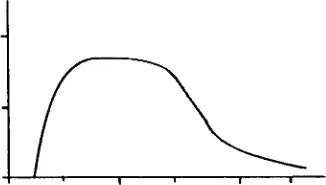
In waste pipes, what characterizes discharge from a sanitary appliance?
Short-duration surges or plugs
Constant uniform laminar flow
Long-duration steady turbulence
Cyclic pulsations every minute
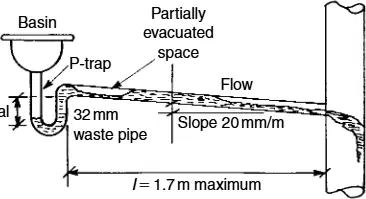
During discharge, why can a partially evacuated space appear near the end?
Pipe crown collapses under load
Air pressure exceeds trap seal
Water plug separates from air
Friction eliminates air entrainment
What problem can occur if inertia of discharge creates subatmospheric pressure in the trap?
Self-syphonage of the trap seal
Backflow of foul sewer gases
Hydraulic jump in vertical stack
Permanent blockage at manhole
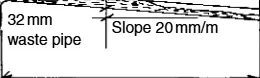
Which design avoids self-syphonage for a basin waste pipe of 32 mm diameter?
Limit length to 1.7 m at 20 mm/m slope
Increase crown height by 75 mm everywhere
Use benching at each branch junction
Reduce invert levels along the stack
How can the sloping waste pipe be extended up to 3 m without risking self-syphonage?
Raise trap seal depth to 100 mm
Reduce slope to below 10 mm/m
Add multiple manhole benches
Increase diameter to 40 mm after first 50 mm
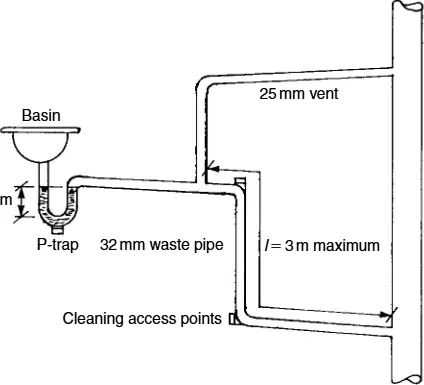
What is the purpose of the 25 mm open vent shown on longer waste runs?
Provide aeration and equalize pressures
Increase flow velocity at the crown
Divert surface-water to separate sewer
Raise static pressure near the invert
Where should vertical soil and vent stacks terminate relative to openings?
Below window head height by 300 mm
Flush with roof parapet level
900 mm above openings within 3 m
At ground level with grating
What effect does water entering a stack as a full-bore jet have on air?
Entrain air downward into the stack
Expel air upward to atmosphere
Increase crown corrosion rate
Eliminate suction at branches
Typical air flow rates induced by stack discharge can reach up to what relative to water volume flow?
A hundred times greater
Equal in magnitude
Half as much only
Ten times smaller
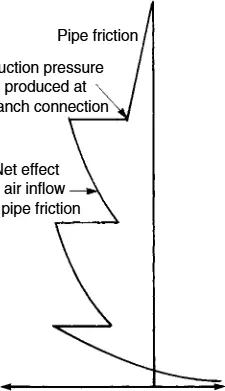
Restricted air passageways at branch connections primarily do what to static pressure?
Lower air static pressure further
Raise static pressure uniformly
Maintain atmospheric pressure always
Reverse flow direction instantly
What pressure condition is re-established at the stack base due to inflow at low-pressure region?
Vacuum exceeding -1000 Pa
Atmospheric static pressure
Negative gauge pressure persists
Superatmospheric suction only
If falling fluid tends to fill the pipe near the base, what can happen to static pressure?
Flow transitions to laminar regime
Static pressure drops indefinitely
Positive air static pressures develop
Trap seals increase automatically
What is the maximum permitted negative static pressure in the stack to protect trap seals?
−375 Pa at most
−75 Pa standard
−100 Pa typical
−1500 Pa safest
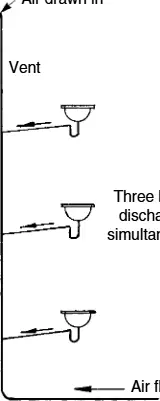
Which configuration best minimizes suction at branch connections during simultaneous discharges?
Place traps farther from the stack
Reduce pipe slope to nearly zero
Increase benching at manholes only
Provide vent to maintain air inflow
Which term describes the lowest point on the internal surface of a pipe?
Invert of the pipe interior
Crown of the pipe interior
Bedding around the pipe
Stack within the building
What is the role of subsoil drains in a site system?
Carry rainwater from roof areas
Provide ventilation for discharge stacks
Collect groundwater to discharge point
Convey water-borne waste to building
Which scenario best describes self-syphonage in a plumbing trap?
Positive pressure surge pushing seals outward
Seal evaporating during prolonged appliance disuse
Water seal sucked by long unvented gradients
Seal loss due to cross-flow between appliances
Induced syphonage is most likely when which condition occurs in a stack?
Fast waste flow past junctions on sloping ranges
High ambient temperature causing evaporation
Air admitted via anti-syphon trap passages
Detergent foaming stabilizes turbulent flows
What design restriction minimizes blow-out affecting traps near a stack base?
Avoid connections within lower 450 mm of stack
Increase trap water seal depth above 75 mm
Place vent terminal close to windy roof edges
Use sharp bends to dampen pressure surges
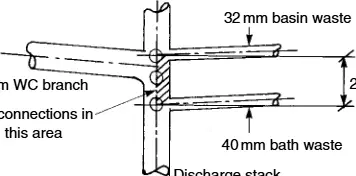
Cross-flow in vertical stacks is prevented by which connection practice shown?
Permit fittings in the hatched cross-flow region
Connect basin wastes opposite the discharge stack
Allow WC branches to discharge near bath wastes
Separate soil and vent pipe connections from wastes
Wind-induced effects can cause water seals to waver out. What siting measure mitigates this risk?
Locate vent terminals away from turbulent roof areas
Introduce continuous small rainwater inflows
Increase trap seal to 100 mm water gauge
Connect interceptors ahead of single-stack junctions
Which statement about bends and offsets in stacks is accurate?
Sharp bends can partly fill pipes causing fluctuations
Sharp bends reduce turbulence and stabilize pressures
Offsets eliminate need for additional ventilation
Bends near base should have minimum radius 50 mm
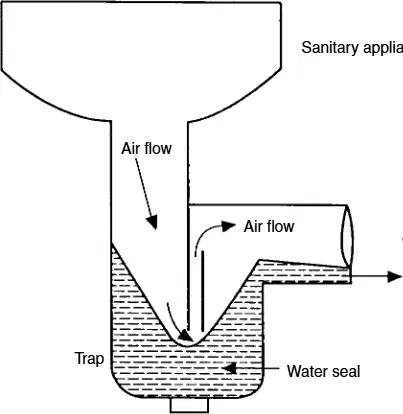
During excessive suction in a waste pipe, how does an anti-syphon trap maintain the seal?
Ventilation passage connects inlet and outlet pressures
Outlet is closed to stop water discharge entirely
Water seal increases via added stored volume
Trap blocks airflow preventing any syphon action
Which maintenance or operational issue directly risks capillary seal loss in traps?
Lint or hair remaining and blocking the capillary
Admission of rainwater into soil stacks
Pumped sewage lifting to higher street sewers
Underground drain surcharging with full flow
Which design requirement best minimizes blockages in building drainage installations?
Rely on frequent chemical flushing
Use smallest possible pipe diameters
Avoid inspection access points entirely
Ensure quick, quiet effluent removal
A design guide states solid transport from a WC is maintained when L/G equals 35 squared. What does increasing G while holding L constant imply?
Steeper drain reduces deposition risk
Flatter drain reduces deposition risk
Bigger pipe increases deposition risk
More bends reduce deposition risk
In design calculations, taking a bend as 5 m of straight pipe serves what purpose?
Increase allowable gradient arbitrarily
Account for deceleration at bends
Reduce pipe material estimates
Ignore frictional losses entirely

A WC is 16 m from the stack with one 90° bend; allowed fall is 150 mm. What is the intended gradient before checking against L/G = 35²?
0.013 from 11+5 over 35²
0.01714 from 21/35²
0.009375 from 0.15/16
0.014 from 0.15/11
When including the bend’s equivalent length, what is the total equivalent length for the sloping drain in Example 7.1?
11 m after relocation
21 m including 5 m bend
16 m excluding bends
26 m including two bends
Using the guide L/G = 35² for L = 21 m, what minimum gradient must be met?
0.014 from 0.15/11
0.013 from (11+5)/35²
0.009375 from 0.15/16
0.01714 from 21/35²
To meet both G = 0.15/L and L/G = 35², the distance L must satisfy a quadratic. Which rearranged form is correct before solving?
L² + 183.75 − 5L = 0
5L − L² + 183.75 = 0
L² − 5L + 183.75 = 0
L² + 5L − 183.75 = 0
After solving the quadratic, what relocation distance ensures the installed gradient is steeper than required to avoid deposition?
16 m from the stack
5 m from the stack
21 m from the stack
11 m from the stack

In the diagram of a branch serving multiple urinals, what slope range should the branch pipe be installed at to ensure proper flow?
Slope 0° to 1°
Slope 1° to 5°
Slope 5° to 10°
Slope 10° to 15°
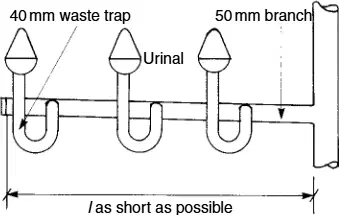
For a range of urinals, which branch diameter is indicated in the diagram connecting to the soil and vent stack?
40 mm branch
50 mm branch
75 mm branch
100 mm branch
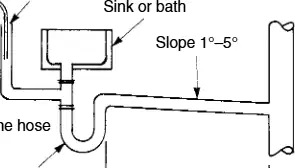
When connecting a sink or bath with a washing machine hose, what maximum horizontal branch length is shown before reaching the stack?
Up to 2.0 m
Up to 1.0 m
Up to 3.0 m
Up to 5.0 m
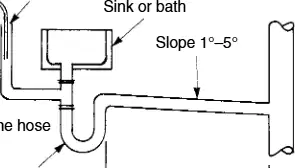
In the sink/bath branch diagram, what waste pipe diameter is specified between the appliance and the stack?
32 mm waste pipe
40 mm waste pipe
50 mm waste pipe
75 mm waste pipe
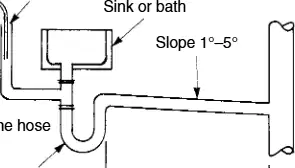
What design feature is explicitly shown between the washing machine hose and the branch to prevent backflow?
Vacuum breaker
Non-return valve
Trap primer
Air gap
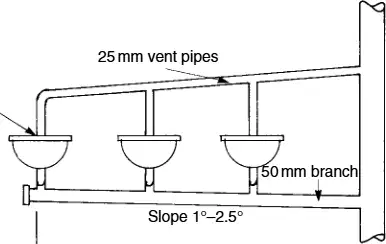
For a range of up to ten basins connected on a branch, what slope range is indicated along the branch?
Slope 5° to 10°
Slope 2.5° to 5°
Slope 0° to 1°
Slope 1° to 2.5°
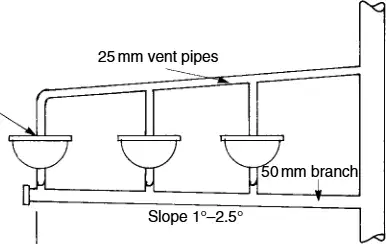
What maximum branch length is shown for the range of basins before connecting to the soil and vent stack?
Up to 7.5 m
Up to 5.0 m
Up to 12.0 m
Up to 10.0 m

Which vent pipe diameter is indicated above each basin in the multiple-basin branch diagram?
25 mm vent pipes
40 mm vent pipes
20 mm vent pipes
32 mm vent pipes
According to the discharge unit description, what is the typical discharge unit value for a bath (domestic use)?
7 discharge units
3 discharge units
4 discharge units
6 discharge units
A group consisting of WC, bath, sink, and two basins has a combined value of how many discharge units?
16 discharge units
10 discharge units
12 discharge units
14 discharge units
What maximum number of discharge units can a 100 mm diameter stack carry?
250 discharge units
500 discharge units
750 discharge units
1250 discharge units
Which stack diameter is stated to carry approximately 2500 discharge units?
100 mm diameter
125 mm diameter
200 mm diameter
150 mm diameter
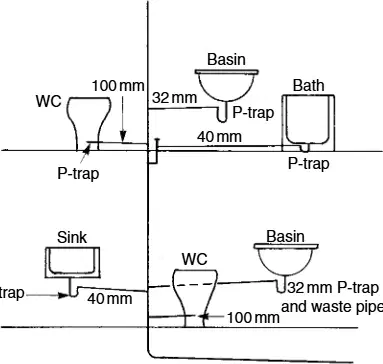
In the housing stack diagram, what waste pipe diameter is shown serving basins on the first floor?
32 mm waste pipe
100 mm waste pipe
40 mm waste pipe
50 mm waste pipe
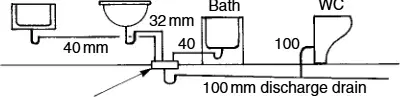
In the bungalow drainage diagram, what external component is indicated collecting wastes before the discharge drain?
Grease separator
Intercepting chamber
External trapped gulley
Air admittance valve
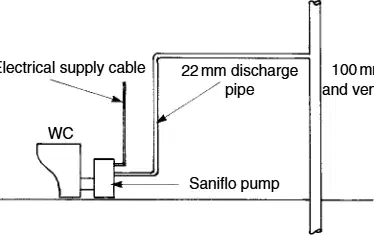
For the pumped WC discharge system, what discharge pipe diameter is shown from the pump to the stack?
32 mm discharge pipe
50 mm discharge pipe
40 mm discharge pipe
22 mm discharge pipe
Which material is typically used for 50 mm and above vent and discharge stacks in building drainage systems?
Pitch fibre for larger stacks
ABS for larger stacks
Copper for larger stacks
Cast iron for larger stacks
For galvanized steel waste pipes, what jointing method is standard in drainage installations?
Lead caulking joints
BSPT screwed joints
Solvent cement joints
Push-fit ring seal joints
Which jointing methods are associated with copper waste pipes and traps?
Driven taper with push-fit
Lead caulking with fibrous lead
Compression or capillary solder
Solvent cement and push-fit
Lead pipes used for waste and discharge stacks are commonly jointed by which technique?
Soldered or lead welded
Compression couplings
BSPT screwed threads
Push-fit ring seals
ABS pipework up to 50 mm waste and vent pipes is joined using which method?
Bronze welding or solder
Cold compound caulking
Compression fittings only
Solvent cement and push-fit
High-density polyethylene pipework up to 50 mm is typically connected using which approach?
BSPT screwed metal threads
Lead caulking with molten lead
Solvent cement and push-fit only
Push-fit ring seal and compression
Polypropylene pipes up to 50 mm are commonly jointed with which combination?
Lead caulking and cold compound
BSPT screwed and soldered
Solvent cement and push-fit
Push-fit ring seal and couplings
Unplasticized PVC over 50 mm soil and vent stacks, with vent pipes under 50 mm, are joined by which method?
Lead caulking and welding
BSPT screwed and solder
Compression fittings and taper
Solvent cement and push-fit
During installation inspections of drainage pipe runs, which action is most essential to ensure compliance?
Measure U-tube manometer pressure
Check joint quality and bracket security
Fill traps and insert air bags
Inject smoke through an oil generator
In air pressure testing of a vent stack, which sequence correctly reaches test pressure?
Screw BSPT joints, measure pressure drop with manometer
Fill traps, apply solvent cement, check for bubbles
Insert smoke cartridge, raise to low pressure, warn occupants
Insert rubber hose, hand-pump to 38 mm gauge, hold 3 min
Why is smoke testing considered less severe than air testing for existing stacks?
Lower pressure reduces material damage risk
Longer duration reveals more leak points
Eliminates the need for manometer readings
Higher pressure ensures stronger seals
Which maintenance practice best prevents recurring drainage issues in multi-storey buildings?
Annual replacement of entire sanitary pipework sections
Routine increase of discharge stack diameter each year
Periodic inspection and trap clearance with repainting
Only reactive repairs after major blockages occur
A corrosion-inhibited acid descaling fluid is specified for lime scale on sanitary appliances. Which composition aligns with best practice?
5% nitric acid and 5% phosphoric acid
30% sulfuric acid and 10% citric acid
15% inhibited hydrochloric acid and 20% orthophosphoric acid
20% acetic acid and 25% hydrofluoric acid
For removing grease and soap residues from a drainage system, which procedure is appropriate?
Use cold water only to reduce thermal shock risk
Add strong alkali pellets directly into traps
Flush 1 kg soda crystals dissolved in 9 l hot water
Inject compressed air alone without any solution
When using a kinetic ram gun to clear branch pipe blockages, what safety limitation should be observed?
Increase air pressure to dislodge hard lime scale deposits
Operate from any fixture regardless of access point location
Restrict use to soft material removal to avoid blow-back
Use repeatedly until pipework shows minor deformation
Which statement reflects sound planning before repeated blockage removal?
Avoid using access covers for inspection and testing
Ignore operator skill when selecting rodding method
Always escalate immediately to coring hard deposits
Investigate causes before repeated plunger attempts
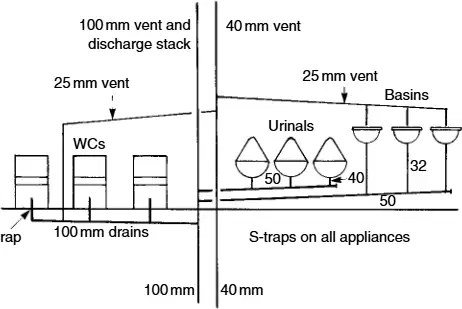
Example 7.2 states the stack carries 616 discharge units for a 22-storey block with two flats per floor and 14 DU per group. What capacity decision follows?
Reduce appliance groups to decrease DU below 300
Add second stack because 616 DU exceeds limit
Increase stack to 150 mm due to high DU value
Use a 100 mm soil and vent stack since limit is 750 DU

In the floor layout for two flats, what is the typical vent/discharge arrangement near WCs and basins?
No vent stack required due to deep S-traps
Dual 100 mm discharge stacks on each side of corridor
Single 25 mm vent serving all fixtures in both flats
100 mm vent and discharge stack central, 50 mm WC vent

Example 7.3 gives DU values: urinal 0.3, WC 14, basin 3. For three WCs, three basins, three urinals per floor over 14 storeys, which total DU is correct?
405 DU using 9 × (3×0.3 + 3×14)
616 DU using 22 × 2 flats × 14 DU
727 DU using 14 × (3×0.3 + 3×14 + 3×3)
750 DU using 15 × (2×14 + 4×3)
For the office block arrangement with long common waste pipe from basins (5 m, four bends), which venting recommendation applies?
Use 25 mm vent only to minimize friction losses
Increase basin trap depth from 32 mm to 50 mm
Add a 40 mm ventilating stack per BS 5572: 1978
Remove S-traps to reduce resistance at bends
Which technique is suitable for removing hard lime scale in 100 mm pipes without damaging pipework?
Hand plunger repeatedly until scale dissolves
Kinetic ram gun at maximum pressure to crack deposits
Coring and scraping mechanical tools under maintenance limits
Chemical soda solution designed for grease removal
List the ways in which an above-ground drainage installation satisfies its functional requirements.
By using only vertical stacks without branches
By ensuring adequate ventilation and trap seals
By applying high-pressure testing during operation
By minimizing pipe bends and junctions
Describe, with the aid of sketches, the ways in which the water seal can be lost from a trap and the precautions taken to avoid this happening.
Only by evaporation in unused traps
By induced siphonage and back-pressure, with venting precautions
By clogging due to solids, solved by larger traps
By corrosion of metal traps exclusively
Describe the types of fluid flow encountered in drainage pipework.
Only laminar flow in all conditions
Laminar and turbulent flows with transitional regimes
Turbulent flow exclusively in stacks
Spiral vortex flow unique to waste pipes
Outline the development of current drainage practice from the early Roman occupation of Britain.
It began with medieval open channels only
Roman practice discouraged any underground sewers
Modern drainage was invented in the 20th century solely
It evolved from Roman sewer concepts to modern vented stacks
State the meaning of the following terms: bedding; combined system; drain; sewer; manhole; separate system; stack; discharge pipe; vent.
They are standard drainage components and system types
They all refer to identical pipe materials
They are testing methods for waste systems
They are site excavation techniques only
Sketch the pipework layout for a typical group of sanitary appliances in a dwelling, where they are all connected into a stack. Show suitable pipe sizes, slopes and details of the connections at the stack.
Oversized level branches to prevent noise
Common untrapped connection to a sewer
Individual trapped wastes to a ventilated stack with graded branches
Single horizontal manifold without slope
A range of WCs is to be connected into a common branch pipe of outside diameter 125 mm fitted within a false ceiling 300 mm deep. It is intended that the furthest WC should be 18 m from the stack. The branch has a 90° bend between the last WC and the stack. Determine whether the proposed arrangement would be satisfactory. If it is not, calculate the maximum distance that could be allowed between the furthest WC and the stack.
Always satisfactory regardless of bend and length
Not satisfactory; reduce maximum distance below 18 m
Satisfactory only if pipe is increased to 200 mm OD
Satisfactory if bend radius exceeds 300 mm
State the meaning of the term ‘discharge unit’. How many WCs can be connected into a discharge stack of diameter 100 mm?
A measure of trap seal depth; up to two WCs
A fixture load metric; a limited number of WCs
A vent pipe size; unlimited WCs
A pipe roughness index; exactly four WCs
Sketch sections through four types of joint used in drainage pipework to show their constructional features, method of providing a seal, and thermal expansion facility.
Mortar joints with rigid seal only
Threaded metal joints exclusively
Mechanical, push-fit, solvent-weld, and flanged joints
Only welded joints without seals
Sketch the installation of a vertical discharge stack within a plasterboard service duct in a house, clearly showing suitable dimensions and support.
Braced stack with access doors and fire-stopped duct
Stack laid horizontally beneath floor
Unsupported stack inside cavity wall
Exposed stack in living room for easy access
Sketch and describe the methods of testing above-ground drainage installations.
Thermal tests using heated water only
Sounding tests without sealing pipes
Air and water tests applied to sealed sections
Only water flood tests are used
Describe the maintenance work needed to support the efficient operation of drainage installations in residences, laundries, canteens and hotels.
No maintenance is typically required
Regular inspection, cleaning, and trap seal checks
Monthly pressure testing without cleaning
Occasional repainting of pipes only
Draw a suitable sanitary pipework installation for a 10-storey block of flats with two groups of appliances on each floor connected to one stack. Show pipe sizes and routes.
Single unvented stack for all floors
Random routes chosen for minimal material
Dual ventilated stacks with graded branches per floor
Horizontal collector with pumps on each floor
A 20-storey office block is to have ranges of 5 basins, 5 urinals and 5 WCs on alternate floors. Draw a suitable pipework installation, stating pipe sizes and slopes.
Large horizontal drains without stacks
Multiple stacks sized by discharge units with proper gradients
One small stack serving all fixtures
Vent pipes omitted to reduce complexity
What is the principle design requirement for waste pipes from water appliances? 1. Pipes not leaking. 2. Must empty basin, sink or shower tray within 30 s. 3. Avoidance of long horizontal pipes. 4. Never reduce pipe diameter below waste outlet size. 5. Maintain water seal at trap of each appliance.
Only preventing leaks is required
Only 30 s emptying time matters
All listed requirements together
Only maintaining trap seals is essential
What type of water flow occurs in the waste pipe from a basin? 1. Turbulent. 2. Laminar. 3. Steady continuous stream along lower half of sloping pipes. 4. Water swirls clockwise down vertical and along sloping pipes, adhering to the walls of the pipe due to the Coanda effect. 5. Full-bore surge followed by dribbling.
Laminar predominates in small-bore basin wastes
Turbulent predominates in all basin wastes
Clockwise swirl and wall adhesion dominates
Full-bore surge then dribble is typical
Which of these is a problem that can occur in waste pipe systems? 1. There are no problems in a correctly designed system. 2. Pipes installed at too steep an angle create noise and suction problems. 3. Long horizontal waste pipes connecting to vertical stacks do not drain water away fast enough and cause flooding in baths and shower trays. 4. Self-siphonage from the trap due to inertia of water flow. 5. Self-siphonage due to leaks.
Only steep angles cause issues
Steep angles and long horizontals cause issues
Self-siphonage occurs only with leaks
No problems occur if designed well
Which is a cause of induced siphonage in a waste pipe? 1. Positive back-pressure from downstream pipes. 2. Low atmospheric air pressure. 3. Waste pipes running full. 4. High atmospheric air pressure. 5. Insufficient ventilation of vertical stack.
Positive back-pressure downstream
High atmospheric air pressure
Insufficient stack ventilation
Waste pipes running completely full
How are waste pipe system siphonage risks reduced? 1. Adequate ventilation to open air. 2. Installing larger diameter waste pipes than normally recommended. 3. Connecting every waste trap individually to the vertical stack. 4. Maintaining air-tightness of the drainage system. 5. Regular internal cleaning of all waste and drain systems.
Only larger diameters reduce risk
Ventilation and airtightness reduce risk
Individual trap connections are essential
Cleaning alone prevents siphonage
How are ground floor waste pipes connected into the sewer system? 1. Unvented direct connection. 2. Trapped pipe connects directly to a trapped outdoor gulley on sewer system. 3. Untrapped direct pipe connection to the foul sewer. 4. Trapped pipes at a steep gradient connect to the foul sewer. 5. Trapped pipes connect vertically to the foul sewer. 6. Trapped pipes at a shallow gradient connect to the foul sewer.
Untrapped direct connection to foul sewer
Trapped pipe to trapped outdoor gulley
Vertical trapped connection to foul sewer
Steep gradient trapped connection
How are above-ground drain systems tested to ensure adequate water seals remain in traps during normal use? 1. Each sanitary fitting filled, drained and remaining trap seal depth measured. 2. All sanitary fittings in a group filled then drained simultaneously. 3. Each section of waste pipe system sealed and pumped to an air pressure of 150 mm water gauge for 10 min, then air and water released. 4. Water pumped up stack to test effectiveness of water seals in traps. 5. Air pressure in stack and waste pipes hand-pumped to 38 mm water gauge. This pressure maintained for 3 min without further pumping.
Hand-pumped low-pressure air only
Measuring trap seals depth alone
Air and water tests with specified pressures
Simultaneous filling then draining only

