
 Worksheets
BI Fetal Pig Dissection Final
Total questions: 44
Worksheet time: 22mins
Name
Class
Date
1.
Which of the following terms means away from a point of reference?
a)
Distal
b)
Anterior
c)
Dorsal
d)
Left
e)
Lateral
2.
Which of the following terms means toward the side?
a)
Lateral
b)
Anterior
c)
Distal
d)
Dorsal
e)
Left
3.
Which of the following terms refer to the structures to the right of the dorsal midline?
a)
Right
b)
Anterior
c)
Distal
d)
Dorsal
e)
Left
4.
Which of the following terms mean toward the tail/rear?
a)
Posterior
b)
Anterior
c)
Distal
d)
Dorsal
e)
Left
5.
Which of the following terms refer to the structures to the left of the dorsal midline?
a)
Left
b)
Anterior
c)
Distal
d)
Dorsal
e)
Lateral
6.
Which of the following terms mean below or the lower side?
a)
Ventral
b)
Anterior
c)
Distal
d)
Dorsal
e)
Left
7.
Which of the following terms mean toward the head or front?
a)
Anterior
b)
Distal
c)
Dorsal
d)
Left
e)
Lateral
8.
Which of the following terms mean toward the midline?
a)
Medial
b)
Anterior
c)
Distal
d)
Dorsal
e)
Left
9.
Which of the following terms mean above or top side?
a)
Dorsal
b)
Anterior
c)
Distal
d)
Left
e)
Lateral
10.
Which of the following terms mean near a point of reference?
a)
Proximal
b)
Anterior
c)
Distal
d)
Dorsal
e)
Left
11.
Where does gas exchange take place in the Respiratory System?
a)
In the bronchioles and alveoli in the lungs.
b)
In the arteries and veins that to and from the heart.
c)
In the trachea.
d)
In the small vesicles located at the base of the lungs.
12.
What is the foramen ovale?
a)
The place on the body where the umbilical cord attaches from the placenta while the fetus is in utero.
b)
A hole between the two lungs that allows blood to pass from the left lung to the right lung.
c)
A hole in the septum of the heart which allows blood to pass from the right atrium to the left atrium while the fetus is in utero.
d)
The area of the liver where
13.
What is the thyroid responsible for?
a)
Producing thyroidine for regulating the release of other thyroid hormones.
b)
Producing thyroxine for regulating processes in the thoracic region of the body.
c)
Producing thyroxine for regulating metabolic rates.
d)
Controlling the release of endorphins throughout the body.
14.
What are the four regions of the stomach called. Select all that apply.
a)
Medial, lateral, distal, and proximal.
b)
Cardio, fondue, corpal, and prius.
c)
Cardiac, fundus, corpus, and pyloric.
d)
Cardiac, medial, distal, and pyloric.
15.
What is the function of the pancreas?
a)
It stores bile produced by the liver.
b)
It produces glucagon only.
c)
It produces insulin, glucagon, and somatostatin.
d)
It produces insulin only.
16.
What are the regions of the large intestine called?
a)
Colon, rectum, and anus.
b)
Spiral colon, ascending colon, descending colon, rectum and anus.
c)
Colon and rectum.
d)
Spiral colon, ascending colon, and descending colon.
17.
What is the function of glucagon?
a)
It increases blood glucose levels.
b)
It decreases blood glucose levels.
c)
It regulates the release of insulin.
d)
It regulates the release of somatostatin.
18.
What is the function of the spleen?
a)
It is a storage site for rugae.
b)
It stores bile produced by the liver.
c)
It filters the blood of old lymph cells and produces bile for the stomach.
d)
It filters the blood of old RBCs, makes new RBC and WBCs, and produces antibodies.
19.
Where is the cardiac sphincter located?
a)
At the entrance to the stomach.
b)
In the aorta.
c)
At the exit of the stomach.
d)
In the heart.
20.
What is the function of the nephrons in the kidneys?
a)
Filter blood to regulate salts, water, glucose, minerals, and pH for the maintenance of homeostasis.
b)
Secretion of the cellulase.
c)
Producing Vitamin K for absorption.
d)
Filtering old red blood cells out of the blood.
21.
What is the colon responsible for?
a)
Digestion of fats, proteins, and starches.
b)
Excreting water through the renal pelvis and out of the ureter.
c)
Regulating salt, water, glucose, minerals, and pH of the blood.
d)
Consolidating waste by removing water from it.
22.
What are the sections of the small intestine called?
a)
The duodenum and the jejunum only.
b)
The duodenum, jeju, and ileocecal.
c)
The duodenum, jejunum, and ileum.
d)
The duodenum and ileum only.
23.
What is the diaphragm responsible for?
a)
It is responsible for keeping your heart rate in the correct rhythm.
b)
It is responsible for contracting and relaxing the lungs to fill and expel air from them.
c)
It is responsible for signaling your stomach to start the process of digestion.
d)
It is responsible for oxygenating blood as it circulates through the body.
24.
What happens if the coronary arteries have a blockage?
a)
An irregular heartbeat can occur.
b)
An embolism in the brain can occur.
c)
A heart attack can occur.
d)
An embolism in the arteries of the lungs can occur.
25.
Which of the following answer choices correctly traces the flow of blood through the heart?
a)
Right atrium, tricuspid valve, left ventricle, pulmonary valve, pulmonary veins, lungs, left atrium, mitral valve, right ventricle, aortic valve, aorta, body.
b)
Left atrium, tricuspid valve, right ventricle, pulmonary valve, pulmonary arteries, lungs, right atrium, mitral valve, aortic valve, aorta, body.
c)
Right atrium, tricuspid valve, right ventricle, pulmonary valve, pulmonary arteries, lungs, pulmonary veins, left atrium, mitral valve, left ventricle, aortic valve, aorta, body.
d)
Left atrium, tricuspid valve, left ventricle, pulmonary valve, pulmonary veins, lungs, left atrium, mitral valve, right ventricle, aortic valve, aorta, body.
26.
What is the function of the small intestine?
a)
Breaks down fats, proteins, and starches from the digestive juice of the liver, pancreas, and small intestine.
b)
Provides storage for vitamins and minerals.
c)
Releases glucagon to regulate blood sugar.
d)
Absorbs water and salts from the material that has not yet been digested and gets rid of waste products.
e)
Option 3
27.
What does the meconium consist of ?
a)
Amniotic fluid.
b)
Food the fetus receives from the placenta.
c)
Amniotic fluid, mucous, and cells from the skin and digestive tract.
d)
Amniotic fluid and food that the fetus receives from the placenta.
28.
What are the bacteria that inhabit the colon responsible for?
a)
Fermentation of any remaining carbohydrates and production of vitamin K for absorbtion.
b)
Metabolizing vitamins K and C.
c)
Excreting cellulase.
d)
Filtering salts, water, glucose, and minerals out of the body.
29.
In humans, what has the caecum/cecum degenerated into?
a)
The iliocecal valve
b)
The thymus
c)
The appendix
d)
The colon
30.
What is the function of insulin?
a)
It regulates the release of glucagon.
b)
It increases blood glucose levels by allowing cells to release glucose.
c)
It decreases blood glucose levels by allowing cells to take in glucose.
d)
It regulates the release of somatostatin.
31.
What is the liver responsible for?
a)
It breaks down toxins, drugs, and waste products of protein metabolism.
b)
It breaks down toxins, drugs, and the waste products of protein metabolism as well as stores vitamins, iron, and glycogen.
c)
It is the body's designated storage area for new red blood cells.
d)
It is the storage site for vitamins, iron, and glycogen.
32.
What is the function of the gallbladder?
a)
It stores insulin released by the small intestine.
b)
It is a storage site for rugae.
c)
It is responsible for producing pepsin.
d)
It stores bile produced by the liver.
33.
What is the function of the cardiac sphincter?
a)
It prevents blood from flowing backwards between the blood and the heart.
b)
It allows food to enter the stomach and prevents it from going back up the esophagus.
c)
It prevents blood from flowing backwards between the right atrium and right ventricle in the heart.
d)
It allows food to move from the stomach to the small intestine.
34.
What is the function of rugae?
a)
They stretch to allow the small intestine to expand as it fills with food.
b)
They stretch to allow the large intestine to expand as it fills with food.
c)
They stretch to allow the stomach to expand as it fills with food.
d)
They stretch to allow the esophagus to expand as food passes through.
35.
What are the functions of the coronary artery and the coronary vein?
a)
They remove toxins from the blood stream.
b)
They supply and drain the cardiac muscle tissues of the heart.
c)
They provide oxygen to the body.
d)
They bring nutrients to the cardiac region of the stomach.
36.
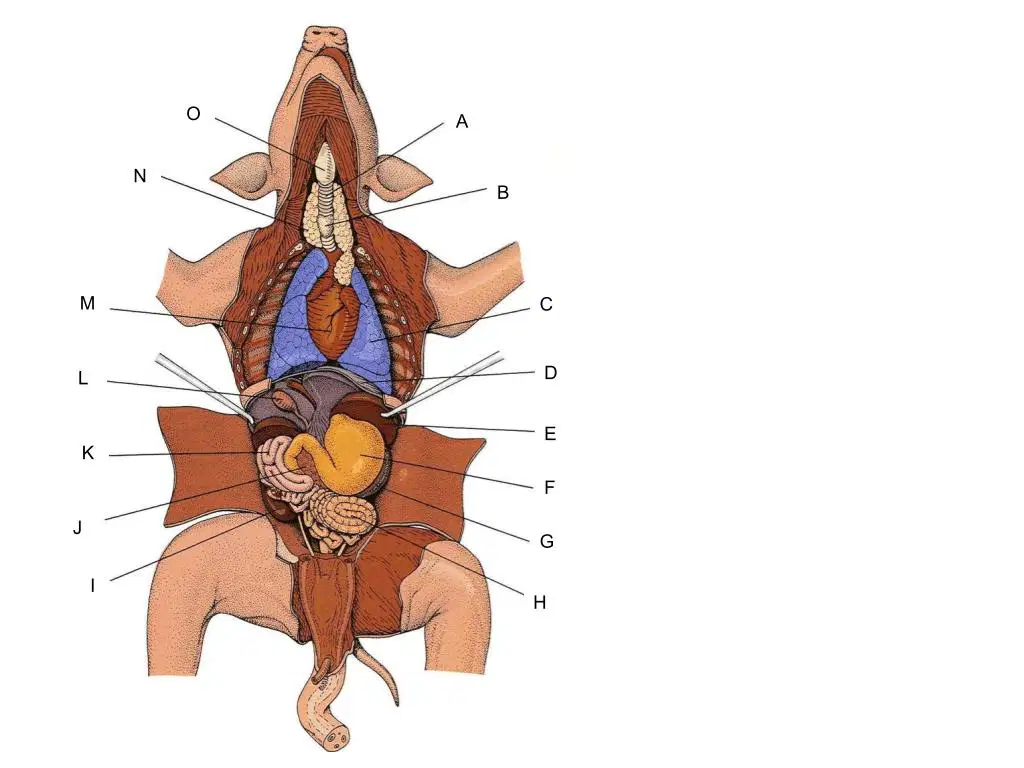
To which structure is the line labeled C pointing?
a)
Thymus
b)
Lungs
c)
Heart
d)
Pancreas
37.
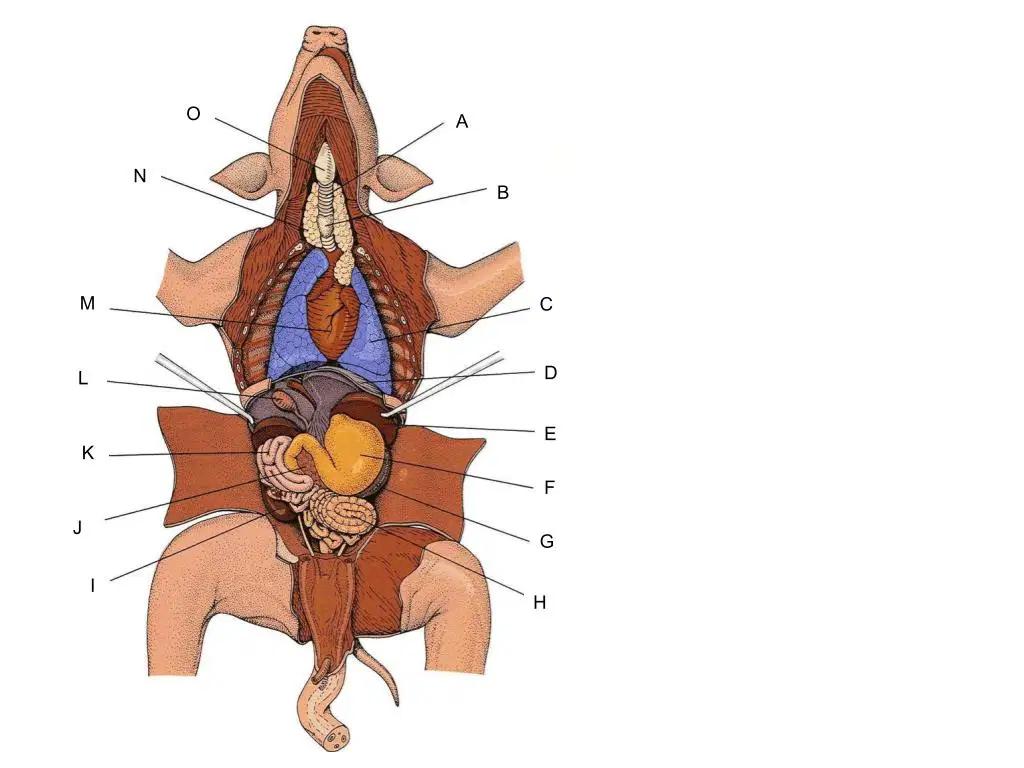
To which structure is the line labeled E pointing?
a)
The esophagus
b)
The diaphragm
c)
The stomach
d)
The liver
38.
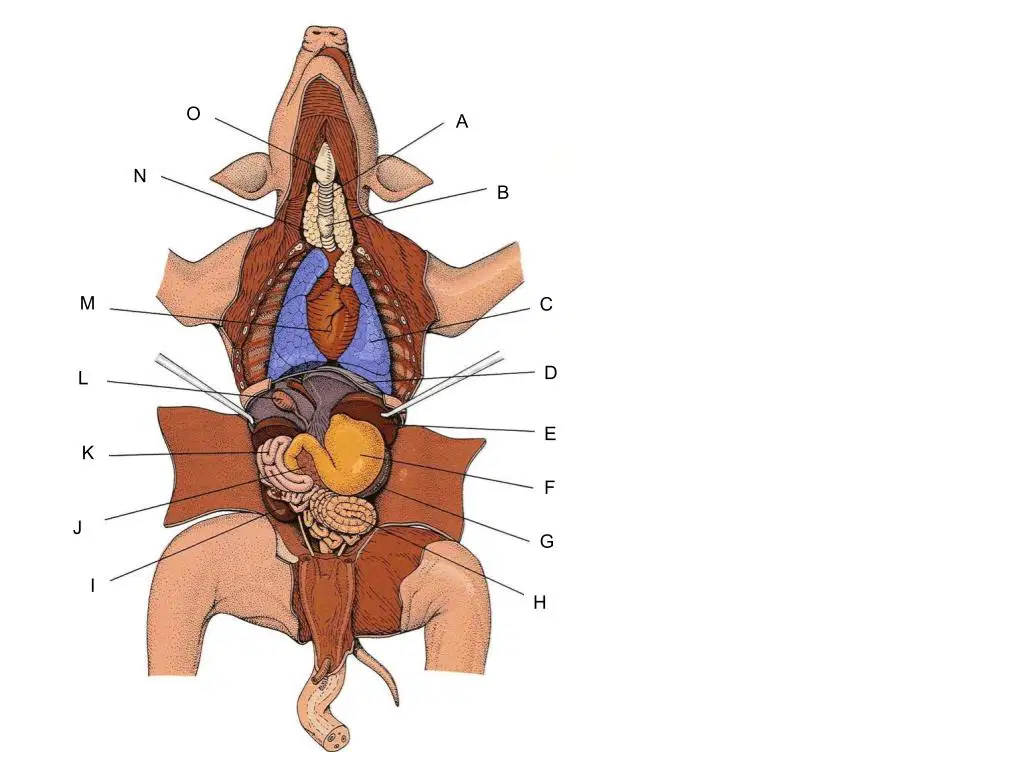
To which structure is the line labeled F pointing?
a)
The liver
b)
The urinary bladder
c)
The gallbladder
d)
The stomach
39.
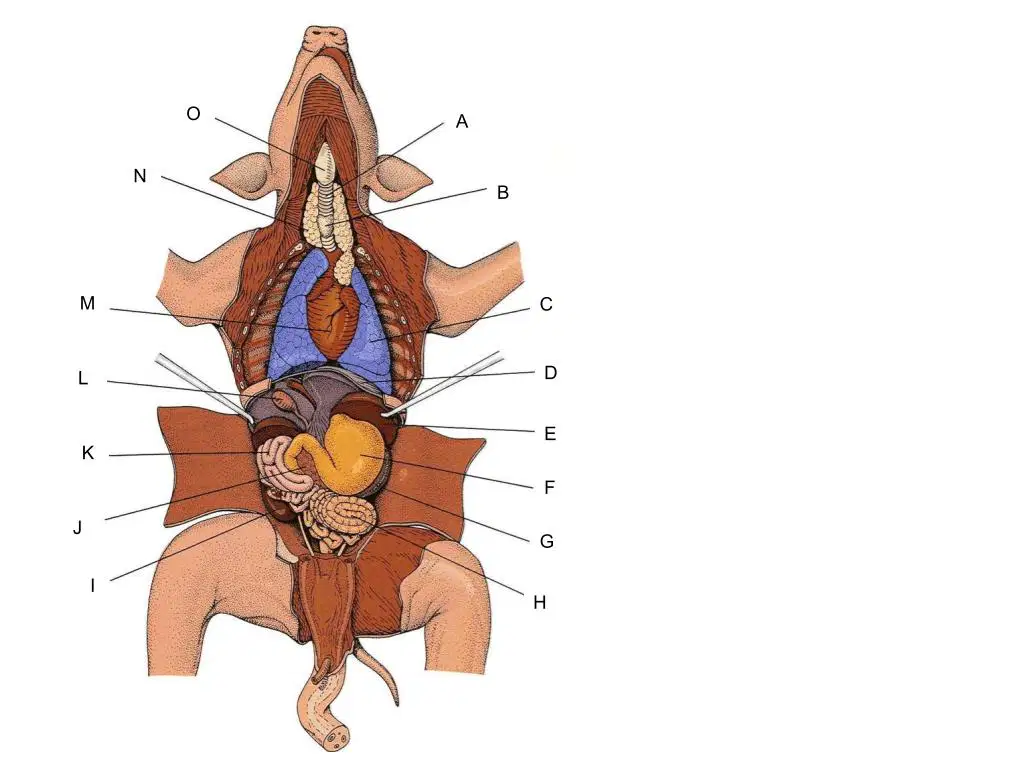
To which structure is the line labeled H pointing?
a)
The gallbladder
b)
The small intestine
c)
The large intestine
d)
The pancreas
40.
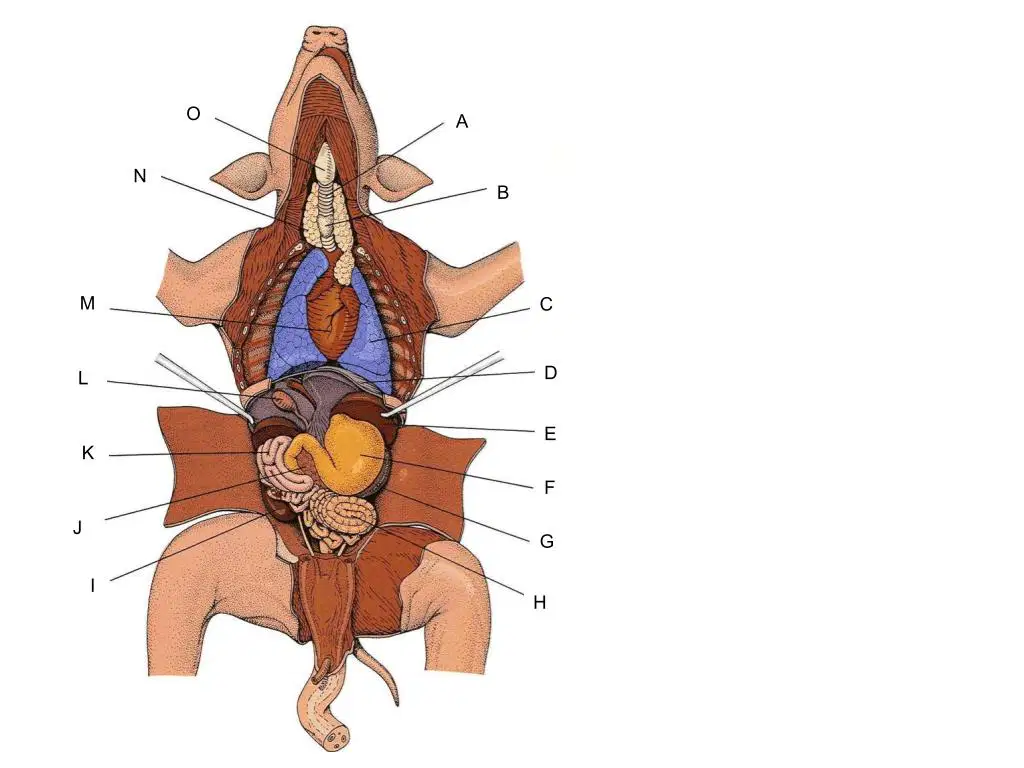
To which structure is the line labeled I pointing?
a)
The small intestine
b)
The stomach
c)
The gallbladder
d)
The kidney
41.
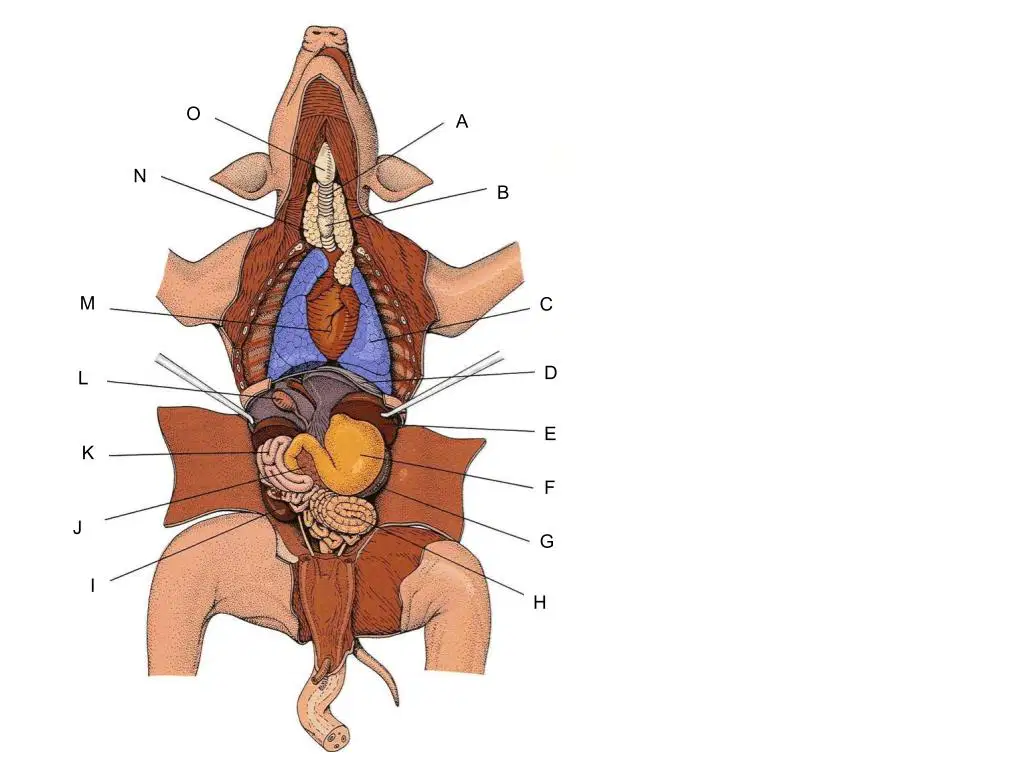
To which structure is the line labeled J pointing?
a)
The spleen
b)
The stomach
c)
The gallbladder
d)
The pancreas
42.
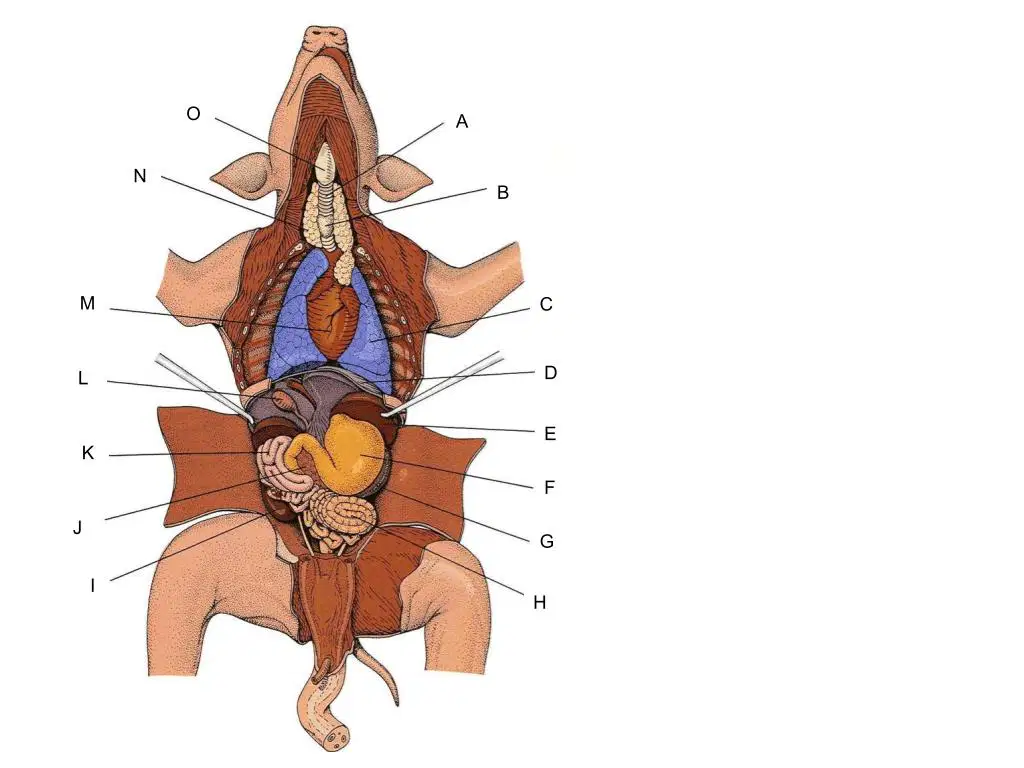
To which structure is the line labeled K pointing?
a)
The small intestine
b)
The large intestine
c)
The pancreas
d)
The spleen
43.
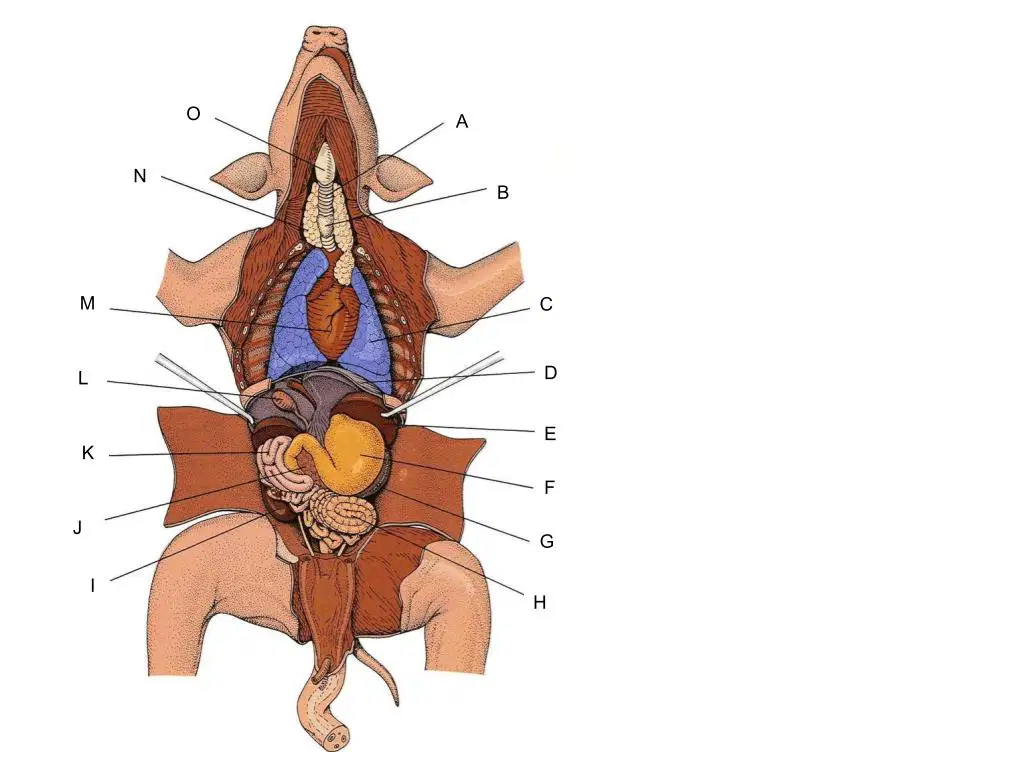
To which structure is the line labeled L pointing?
a)
The liver
b)
The gallbaldder
c)
The pancreas
d)
The spleen
44.
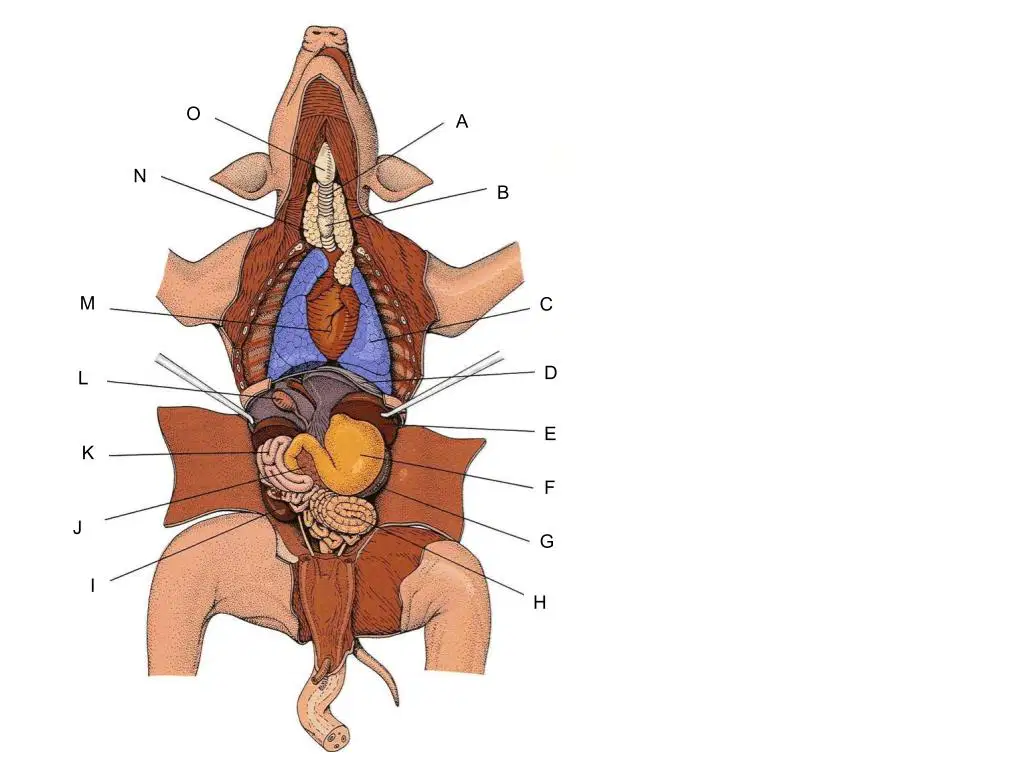
To which structure is the line labeled M pointing?
a)
The lungs
b)
The heart
c)
The thymus
d)
The thyroid
100 %

