
 Worksheets
NGSS Emphasized in Hawaii Volcanoes National Park Storyline
Total questions: 100
Worksheet time: 50mins
What scientific theory explains the age of crustal rocks by evaluating the movements of continental and oceanic crust?
Theory of Evolution
Theory of Plate Tectonics
Theory of Relativity
Theory of Gravity
HS-ESS2-1: Develop a model to illustrate how Earth’s internal and surface processes operate at different spatial and temporal scales to form continental and ocean-floor features. What do Earth's internal and surface processes help to form?
Continental and ocean-floor features
Atmospheric layers
Solar flares
Weather patterns
What process describes the cycling of matter within Earth's interior?
Thermal convection
Photosynthesis
Evaporation
Condensation
Construct an explanation based on evidence for how the availability of natural resources, occurrence of natural hazards, and changes in climate have influenced human activity. Which of the following factors have influenced human activity?
Availability of natural resources
Occurrence of natural hazards
Changes in climate
All of the above
Fill in the blank: Continental rocks can be older than ______ years.
4 billion
1 million
100 thousand
500 million
2 billion
Earth's systems are static and do not interact with each other.
True
False
What is the unifying theory that explains the movements of rocks at Earth's surface?
Plate tectonics
Continental drift
Seafloor spreading
Uniformitarianism
What are plate movements responsible for?
Most continental and ocean-floor features and the distribution of most rocks and minerals within Earth’s crust
The formation of clouds and rainfall patterns
The creation of wind currents in the atmosphere
The development of animal migration routes
Resource availability has guided the development of ________.
human society
weather patterns
animal migration
technological devices
Natural hazards and other geologic events have significantly altered the sizes of human populations and have driven human ________.
migrations
celebrations
inventions
festivals
Geologists use seismic waves and their reflection at interfaces between layers to probe structures deep in the ________.
planet
ocean
atmosphere
forest
What is the purpose of developing a model based on evidence in science and engineering practices?
To illustrate the relationships between systems or between components of a system.
To memorize scientific facts without understanding them.
To replace all experimental work in science.
To ignore the limitations of real-world systems.
Patterns: Empirical evidence is needed to identify ________.
patterns
opinions
guesses
assumptions
Stability and Change: Change and rates of change can be quantified and modeled over very short or very long periods of time.
True
False
Energy and Matter: Energy drives the cycling of matter within and between ________.
systems
atoms
cells
organisms
What is required to differentiate between cause and correlation and make claims about specific causes and effects?
Personal opinion
Empirical evidence
Anecdotal evidence
Assumptions
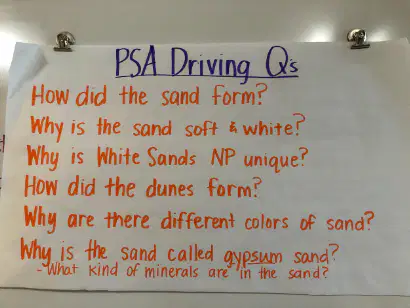
How did the sand form?
Sand formed from the weathering and erosion of rocks over time.
Sand formed from volcanic eruptions.
Sand formed from the decay of plants and animals.
Sand formed from chemical reactions in the ocean.
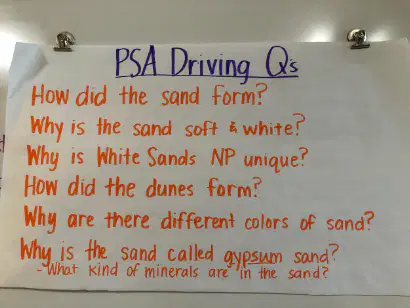
The sand is soft and white because:
it is made mostly of tiny pieces of coral and shells
it is made of volcanic rocks
it contains a lot of clay
it is covered with grass
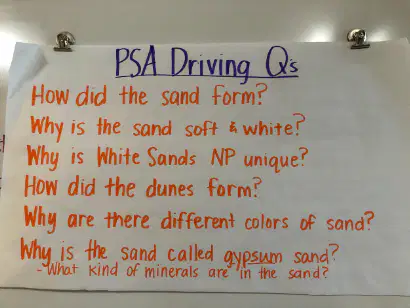
White Sands National Park is unique because:
it contains the largest gypsum dune field in the world.
it is the oldest national park in the United States.
it is located entirely underground.
it is known for its volcanic rock formations.
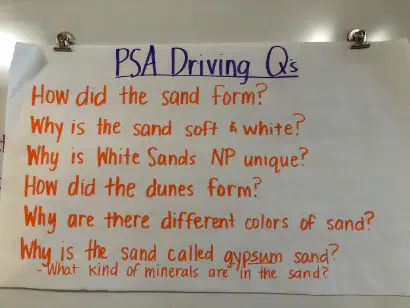
The dunes formed as a result of:
wind depositing sand over time
water freezing and thawing
volcanic eruptions
earthquakes shifting the ground
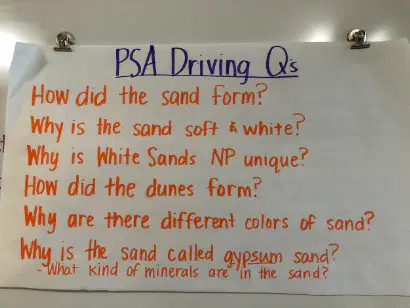
There are different colors of sand because:
sand is made from different minerals and materials
sand is always the same color everywhere
the color of sand depends only on the weather
sand changes color due to sunlight
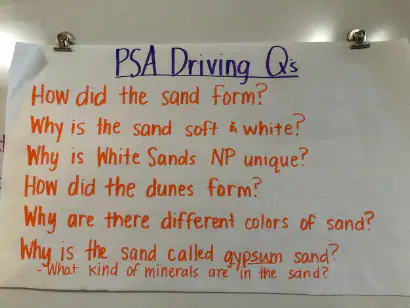
The sand is called gypsum sand because:
it is composed mainly of gypsum crystals.
it is found only in deserts.
it contains a lot of quartz.
it is white in color.
Lesson 3 - Why are many rocks in Hawaii dark? Which of the following is the most common type of rock found in Hawaii?
Scoria
Pumice
Basalt
Obsidian
Lesson 3 - Why are many rocks in Hawaii dark? Which rock sample is shiny and glassy in appearance?
Basalt
Scoria
Pumice
Obsidian
Lesson 3 - Why are many rocks in Hawaii dark? Fill in the blank: Pumice and scoria have holes called _______.
vesicles
crystals
minerals
pores
Most rocks found in Hawaii are dark in color.
True
False
Why are many rocks in Hawaii dark? Name two minerals that may be included in Hawaii rock samples.
Hornblende and biotite mica
Quartz and feldspar
Calcite and gypsum
Talc and muscovite
Why are many rocks in Hawaii dark? What are the three main types of rocks reviewed in the Types of Rocks Review Activity?
Sedimentary, igneous, and metamorphic
Granite, basalt, and limestone
Quartzite, marble, and slate
Sandstone, shale, and conglomerate
What types of rocks are commonly found in Hawaii?
Igneous rocks (especially basalt) are commonly found in Hawaii.
Sedimentary rocks (especially limestone) are commonly found in Hawaii.
Metamorphic rocks (especially marble) are commonly found in Hawaii.
Granite rocks are commonly found in Hawaii.
Based on this information, what can you infer about the texture of rocks that cool quickly?
They will form small crystals or have no crystals and/or vesicles.
They will form large, well-defined crystals.
They will have a glassy texture with large mineral grains.
They will show clear layering and banding patterns.
Why are many rocks in Hawaii dark?
Because they contain minerals found in mafic magma.
Because they are covered in volcanic ash.
Because they are always wet from rain.
Because they contain a lot of plant material.
Obsidian forms from felsic magma, but tends to be a dark color. Is obsidian an exception to the rule that felsic magma forms light-colored rocks?
True
False
Which of the following is the most essential sample to include in the Yosemite National Park lesson?
Basalt
Granite
Diorite
Gabbro
What type of rock is El Capitan primarily made of?
Basalt
Granite
Sandstone
Limestone
What determines the color of a rock?
The location where it is found
The minerals that form it
The size of the rock
The age of the rock
Meet Alex Honnold: In June 2017, Alex free solo climbed El Capitan in Yosemite National Park. As of March 2021, the entire National Geographic Documentary, Free Solo, is available on Disney+. What is the name of the documentary about Alex Honnold's climb?
Rock Climber
Free Solo
Yosemite Adventure
Granite Wall
What is a key characteristic of granite, the most common rock in Yosemite?
It is darker in color
It is lighter in color
It is red in color
It is metallic
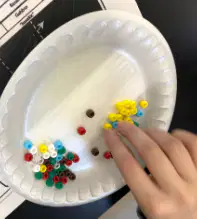
What do the beads represent in the crystal forming activity?
Types of rocks
Types of minerals
Types of crystals
Types of fossils
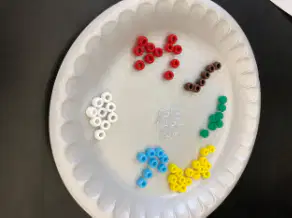
What does sorting the beads by color represent in the activity?
Sorting the beads by color represents how minerals group together to form visible mineral crystals in cooled rock.
Sorting the beads by color represents how rocks melt into magma.
Sorting the beads by color represents how fossils are formed in sedimentary rocks.
Sorting the beads by color represents how weathering breaks down rocks into soil.
Visible crystals were formed during the first activity because the rate of cooling was slow. This 'rock' would have cooled below the surface (intrusive).
Visible crystals were formed because the rate of cooling was slow, and the rock cooled below the surface (intrusive).
No visible crystals were formed because the rate of cooling was fast, and the rock cooled on the surface (extrusive).
Visible crystals were formed because the rate of cooling was fast, and the rock cooled on the surface (extrusive).
No visible crystals were formed because the rate of cooling was slow, and the rock cooled below the surface (intrusive).
Visible crystals were formed during the second activity because the rate of cooling was slow. This means the 'rock' would have cooled below the surface (intrusive), which differs from the first time when the 'rocks' cooled quickly and formed small or no crystals.
Visible crystals formed due to slow cooling below the surface (intrusive), unlike the first time with fast cooling.
No crystals formed because the cooling was fast and occurred on the surface (extrusive).
Large crystals formed because the cooling was rapid and happened on the surface (extrusive).
Small crystals formed due to slow cooling on the surface (extrusive), similar to the first time.
The texture of igneous rocks tells you about the rate of cooling. What does it indicate?
Rapid cooling results in fine-grained texture, while slow cooling results in coarse-grained texture.
Rapid cooling results in coarse-grained texture, while slow cooling results in fine-grained texture.
Texture does not indicate the rate of cooling.
All igneous rocks have the same texture regardless of cooling rate.
What is the term for large crystals formed in igneous rocks that cool slowly?
Coarse grain
Fine grain
Porphyritic
Glassy
When comparing igneous rocks from oceanic and continental crusts, what type of crust is basaltic and what type is granitic?
Oceanic crust is basaltic and continental crust is granitic.
Oceanic crust is granitic and continental crust is basaltic.
Both oceanic and continental crusts are basaltic.
Both oceanic and continental crusts are granitic.
Which type of crust is more dense?
Oceanic crust
Continental crust
Which of the following lists the correct steps to measure the volume of an irregularly shaped rock using water displacement?
Fill a graduated cylinder with water, record the initial volume, add the rock, record the new volume, subtract the initial volume from the new volume.
Weigh the rock, fill a beaker with water, add the rock, record the weight difference.
Place the rock in a pan, measure its dimensions, calculate the volume using a formula.
Fill a graduated cylinder with water, add the rock, multiply the water level by the rock's weight.
The main connection students are expected to make while reading the article 'Geology for Rock Climbers' is to rocks and real-life applications, understanding why some rocks are easier to climb than others. What is this connection?
Understanding why some rocks are easier to climb than others
Learning about famous rock climbers
Identifying different types of climbing equipment
Exploring the history of rock climbing
The volcanoes of Hawaii are formed by a ________ and the plate is moving over it.
hot spot
rift valley
subduction zone
mid-ocean ridge
Only the island named Hawaii forms the state of Hawaii.
True
False
Which of the following lists three observations about the status (active or extinct) and location of volcanoes in Hawaii?
Some volcanoes in Hawaii are active, some are extinct, and they are located on different islands.
All volcanoes in Hawaii are extinct and located on the same island.
All volcanoes in Hawaii are active and located underwater.
Volcanoes in Hawaii are only found on the mainland and are all dormant.
Which islands have active/extinct volcanoes in your model?
Hawaii, Iceland, and Japan
Greenland, Madagascar, and Tasmania
Borneo, Sri Lanka, and Cuba
Bali, Fiji, and Malta
Why does 'x' island no longer have a risk of a volcano erupting?
Because the volcano is extinct.
Because the island is now underwater.
Because the volcano has moved to another location.
Because the island is protected by a barrier.
Which island is the youngest/oldest?
Hawaii is the youngest, Kauai is the oldest.
Maui is the youngest, Oahu is the oldest.
Oahu is the youngest, Hawaii is the oldest.
Kauai is the youngest, Maui is the oldest.
This geological feature is forming in the middle or on the edge of a plate.
Middle of a plate
Edge of a plate
Both middle and edge
Neither middle nor edge
Which island is the youngest?
Hawaii
Maui
Oahu
Kauai
There is no risk of the volcano erupting on Kauai because:
Kauai's volcano is extinct.
Kauai's volcano erupts regularly.
Kauai has no volcanoes.
Kauai's volcano is dormant.
Where is the hotspot currently located? What evidence supports your claim?
The hotspot is currently located beneath the Hawaiian Islands, as evidenced by the chain of volcanic islands formed over millions of years.
The hotspot is currently located beneath the Andes Mountains, as evidenced by the presence of active volcanoes.
The hotspot is currently located beneath the Himalayas, as evidenced by frequent earthquakes.
The hotspot is currently located beneath the Rocky Mountains, as evidenced by geothermal activity.
The Pacific Plate is moving in which direction, and what evidence supports this claim?
Northwest; supported by the alignment of volcanic island chains like the Hawaiian Islands.
Southeast; supported by the formation of the Andes Mountains.
Northeast; supported by the movement of the San Andreas Fault.
Southwest; supported by the subduction beneath the Philippine Plate.
Indicate where the next island will most likely form. What evidence supports your decision?
The next island will most likely form over a hotspot, as evidenced by volcanic activity.
The next island will most likely form in the middle of a tectonic plate, as evidenced by earthquake patterns.
The next island will most likely form along a transform boundary, as evidenced by fault lines.
The next island will most likely form near a subduction zone, as evidenced by deep ocean trenches.
Big Island continues to get larger, however Maui gets smaller each year. Why? Describe the changes as destructive or constructive.
Big Island is experiencing constructive changes while Maui is undergoing destructive changes.
Both islands are experiencing constructive changes.
Big Island is experiencing destructive changes while Maui is undergoing constructive changes.
Both islands are experiencing destructive changes.
Are there other plates and how are they shaping Earth's surface?
Yes, there are other plates and they shape Earth's surface by causing earthquakes, mountain formation, and volcanic activity.
No, there are no other plates and Earth's surface remains unchanged.
Yes, but they do not affect Earth's surface in any way.
No, plates only exist beneath the oceans and do not shape Earth's surface.
What forces cause the plates to move?
Gravity
Magnetic forces
Convection currents in the mantle
Wind
Why are the plates moving in different directions?
Because of convection currents in the mantle.
Because of the Earth's magnetic field.
Because of the rotation of the Earth.
Because of the presence of water on Earth.
Which specialist uses the Global Earthquake and Volcanoes Map and the Map of Active Volcanoes for their research?
Volcanologist
Oceanographer
Seismologist
Geologist
Which website would an Oceanographer use for their research?
ArcGIS
Relief Map
Jumbo Seismic Monitor
Map of Active Volcanoes
Which specialist uses the Relief Map and Vertical Land Movement website for their research?
Volcanologist
Oceanographer
Seismologist
Geologist
Which specialist uses the Jumbo Seismic Monitor for their research?
Volcanologist
Oceanographer
Seismologist
Geologist
What color should be used for Trenches on the map?
Blue
Purple
Green
Red
What color should be used for Mid-Ocean Ridges on the map?
Brown
Purple
Orange
Green
What color should be used for Earthquakes on the map?
Green
Red
Blue
Brown
What color should be used for Deep Earthquakes on the map?
Orange
Blue
Purple
Red
What color should be used for Volcanoes on the map?
Red
Green
Brown
Blue
What color should be used for Mountains on the map?
Brown
Purple
Orange
Green
Earthquakes occur at all ________ boundaries. Fill in the blank.
plate
river
forest
mountain
Where do volcanoes form? Choose the correct option.
At all plate boundaries
At subduction boundaries
At mid-ocean ridges
At transform boundaries
Oceanic plates always subduct because they are ________ than continental plates.
more dense
less dense
thicker
older
Volcanoes form on the crust that is not subducting.
True
False
Deep sea trenches and mid-ocean ridges can form at the same location.
True
False
In the plate boundary model activity, what does the upper cookie of the sandwich cookie represent?
Lithosphere
Asthenosphere
Lower mantle
In the plate boundary model activity, what does the cream filling of the sandwich cookie represent?
Lithosphere
Asthenosphere
Lower mantle
In the plate boundary model activity, what does the lower cookie of the sandwich cookie represent?
Lithosphere
Asthenosphere
Lower mantle
Breaking the top cookie and sliding the top portion over the cream filling represents the movement of a plate sliding over the asthenosphere. This sliding can cause ________, like the ones that formed Hawaii.
hotspots
earthquakes
mountain ranges
volcanoes
When the two cookie pieces are slid past each other, this plate movement represents a ________ boundary.
transform
convergent
divergent
subduction
When the two cookie pieces are moved away from each other, this represents a ________ boundary.
divergent
convergent
transform
reverse
When the two broken cookie pieces are squeezed together, this represents a ________ boundary.
convergent
divergent
transform
passive
What materials will you use in your plate boundary model?
Materials to use in their model (e.g., clay, cardboard, paper, etc.)
Types of plate boundaries (e.g., convergent, divergent, transform)
Steps to build a volcano model
Names of tectonic plates
What is the plate boundary type represented in your model?
Plate boundary type (e.g., convergent, divergent, transform)
Weather pattern (e.g., rainy, sunny, cloudy)
Rock type (e.g., igneous, sedimentary, metamorphic)
Ocean current direction (e.g., northward, southward, eastward)
What are the two types of crust involved in your plate boundary model?
Both types of crust involved (e.g., oceanic, continental)
Only oceanic crust
Only continental crust
Neither oceanic nor continental crust
How will you show the motion of the plates in your model?
Description of how the motion of the plates will be shown (e.g., arrows, moving parts)
List the types of rocks found near the plates
Explain the color of the plates
Describe the temperature changes in the plates
What geological features occur at the plate boundary type in your model?
All geological features that occur at the boundary type (e.g., mountains, trenches, earthquakes)
Only volcanoes are found at all plate boundaries.
No geological features occur at plate boundaries.
Plate boundaries only create oceans.
Describe how and why the geological features occur at the plate boundary in your model.
Description of how/why the geological features occur (e.g., subduction causes trenches)
Description of the climate at the plate boundary
Explanation of the types of rocks found only at plate boundaries
List of animals living near the plate boundary
What is a real-world location where the boundary occurs, as shown in your model?
A real-world location where the boundary occurs (e.g., San Andreas Fault, Mid-Atlantic Ridge)
The Sahara Desert
The Amazon Rainforest
Mount Everest
Volcanoes have different types of eruptions because:
the composition of magma and gas content vary
all volcanoes are the same
volcanoes erupt only once
the shape of the volcano does not matter
What similarities/differences are there between the groups of volcanoes?
The groups of volcanoes can be compared based on their shapes, eruption styles, and locations.
All volcano groups have identical eruption patterns and shapes.
Volcano groups differ only in their color and not in any other aspect.
There are no similarities or differences between volcano groups.
Where do explosive volcanoes tend to be located?
Continental crust at subduction boundaries
Oceanic crust at mid-ocean ridges
Hot spots in the middle of tectonic plates
Continental crust at transform boundaries
Where do quiet volcanoes tend to be located?
Oceanic crust and/or middle of plates
Continental crust near mountain ranges
Desert regions far from water
Polar ice caps
Which of the following materials is needed for the Types of Magma activity?
Maple syrup or honey
Sugar cubes
Sand
Salt
Which of the following materials is needed for the Types of Magma activity?
Vegetable oil
Vinegar
Baking soda
Lemon juice
Which of the following materials is needed for the Types of Magma activity?
Water
Milk
Juice
Soda
Which of the following materials is needed for the Types of Magma activity?
Textbook
Notebook
Calculator
Ruler

