wayground logo

Free Printable Worksheets

NEW

Font size

S
M
L
XL
Worksheets

Semester 1 Exam

Total questions: 51

Worksheet time: 26mins
Name
Class
Date
1.
Which of the following is NOT a description of the results of a physical reaction?
a)
A new substance with different properties is formed
b)
The substance changes from liquid to solid at a low temperature
c)
The reaction can be reversed to get back the original substance
2.
What happens to water molecules when a large quantity of thermal energy is added to water in the liquid state?
a)
The more thermal energy added, the greater the attraction between molecules
b)
The molecules gain kinetic energy, move father apart, and become a gas
c)
Each water molecule gives up kinetic energy and eventually stops moving
3.
In science, the term "heat" is used to describe which of the following?
a)
The motion of atoms or molecules within a substance
b)
The transfer of thermal energy from one object to another
c)
The average temperature of a system over time
4.
When thermal energy is removed from a system, what happens to the temperature and the average kinetic energy of the system?
a)
Temperature decreases, average kinetic energy increases
b)
Temperature decreases, average kinetic energy decreases
c)
Temperature increases, average kinetic energy increases
5.
Which of the following changes made to a sample of liquid would result in an increase in the distance between the individual molecules of the substance?
a)
Transferring the substance to a smaller container
b)
Adding thermal energy to the substance
c)
Changing the phase of matter from liquid to solid
6.
Which of the following statements best describes the relationship between temperature and kinetic energy of particles in a substance?
a)
As kinetic energy increases, temperature decreases
b)
As kinetic energy decreases, temperature increases
c)
As kinetic energy increases, temperature increases
7.
a)
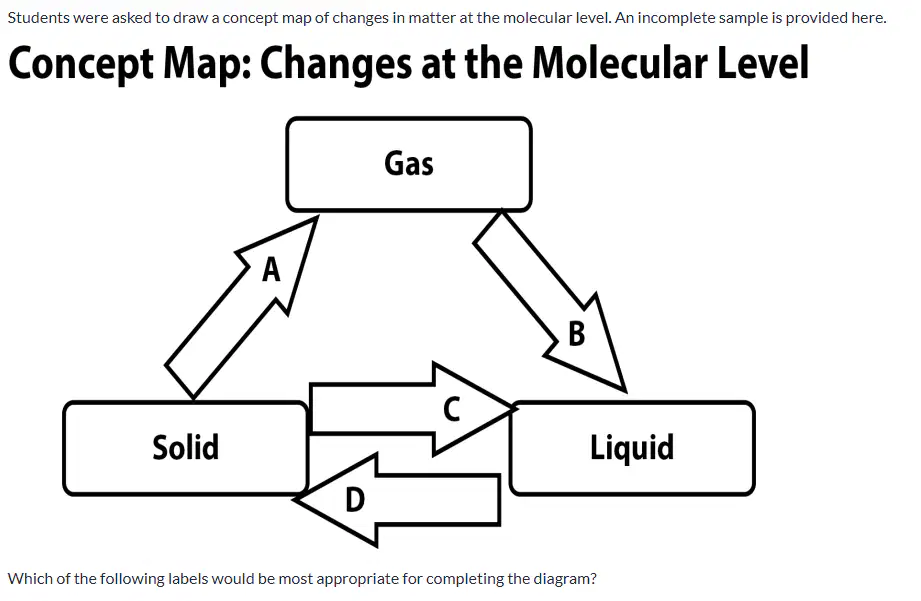
Arrow A = particles become more tightly packed
b)
Arrow B = the pressure of the substance increases
c)
Arrow C = kinetic energy of particles increases
8.
Two chemicals are combined in a beaker and react. What data would provide the best evidence for determining if the reaction absorbed or released thermal energy?
a)
The temperature inside the beaker before and after the reaction
b)
Whether or not light and sound were produced during the reaction
c)
How long it took for the reaction to take place once the chemicals combined
9.
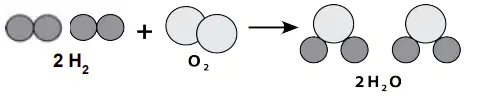
Hydrogen and oxygen react to form water. At an atomic level, how do we know that a chemical reaction has occurred?
a)
Hydrogen molecules are negative and oxygen positive
b)
Hydrogen molecule are positive and oxygen negative
c)
The hydrogen and oxygen atoms regroup into a new molecule.
10.
Which of the following statements is true?
a)
Cutting paper is an example of a chemical reaction because a new substance is formed and the process cannot be undone
b)
Burning paper is an example of a chemical reaction because a new substance is formed and the process cannot be undone
c)
Melting ice is an example of a chemical reaction because a new substance if formed and the process cannot be undone
11.

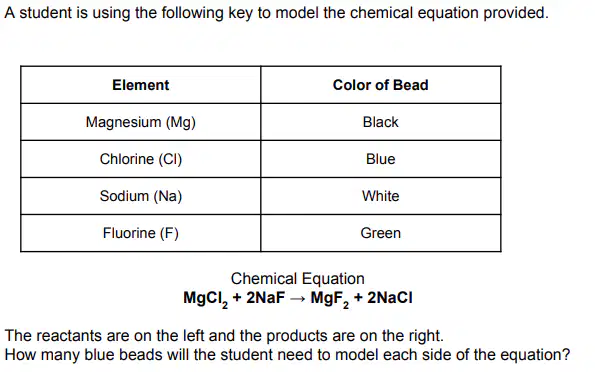
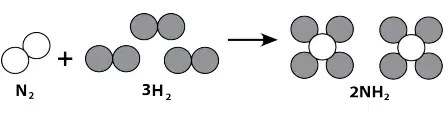
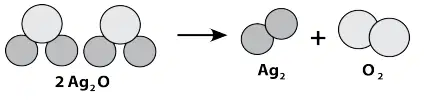
The reactants are on the left and the products are on the right. How many blue beads will the student need to model each side of the equation?
a)
2 for the products and 2 for the reactants
b)
2 for the products and 1 for the reactants
c)
1 for the products and 2 for the reactants
12.
Students want to gather evidence for the claim that the number of atoms present before a chemical reaction is equal to the number of atoms present after the chemical reaction. They decide to react vinegar and baking soda in a sealed plastic bag. Which of the following would provide the evidence the students need?
a)
The mass of the plastic bag, baking soda, and vinegar before the reaction was equal to the mass after the reaction
b)
Bubbles were produced during the reaction, which meant that a gas was being produced
c)
The plastic bag did not change in any way, indicating that it was not involved in the reaction
13.
Which of the following is true regarding the atoms involved in a chemical reaction?
a)
The same number of each type of atom will always be present before and after a chemical reaction takes place
b)
Some of the atoms present before the reaction will always be lost during a chemical reaction
c)
During a chemical reaction, atoms will always be combined into much larger molecules
14.
Which of the following atomic models of chemical reactions correctly demonstrates the Law of Conservation of Matter?
a)
Option 1
b)
Option 2
c)
Option 3
15.
Which of the following is the best description of the results of a chemical reaction?
a)
A new substance with different properties is formed
b)
The substance changes from liquid to solid at a low temperature
c)
The reaction can be reversed to get back the original substance
16.
Rust forming on a piece of iron is an example of which of the following:
a)
A physical change because the process can't be reversed
b)
The natural process of decay as metallic ions age
c)
A chemical change because oxygen atoms from the atmosphere bonded with the iron atoms
17.
In a chemical process, atoms that make up a substance are regrouped into different _____________ to form new substances with different properties
a)
molecules
b)
precipitate
18.
A _____________ increase or decrease and the production of light are both signs that a chemical reaction may have occurred
a)
evidence
b)
temperature
19.
A _______________ is a solid substance that forms and separates from a solution and may indicate that a chemical reaction has occurred
a)
precipitate
b)
color
20.
An unexpected change in ________________ is a sign that a chemical reaction may have occurred.
a)
size
b)
color
21.
Substances giving off a smell, or ______________ while being combined is also an indicator of a chemical reaction.
a)
odor
b)
reactant
22.
When you combine two different liquids you notice that a white solid has formed in the liquid. Has a chemical reaction taken place?
a)
Yes
b)
No
c)
I am clueless
23.

The production of which of the listed materials would require growing plants?

a)
Nylon fibers
b)
Glass
c)
Paper
24.

The data in this table can be used as evidence to support the claim that all of these fuels...

a)
made of natural materials
b)
are very costly to produce
c)
exist in the same state of matter
25.
Which of the following best describes a synthetic material?
a)
Petroleum is refined through a chemical process to produce plastic that is carved into a figure.
b)
A tree is cut down, carved into a shape, then burned to add color
c)
Sand is struck by lightning causing it to turn into glass that is then carved into a figure.
26.

Medicines made of plant parts are renewable resources because...
a)
plants can be grown in a short amount of time
b)
plants are mixed together to create them
c)
they are used to help illness
27.
Food, wool, and leather come from which natural resource?
a)
Animals
b)
Water
c)
Minerals
28.

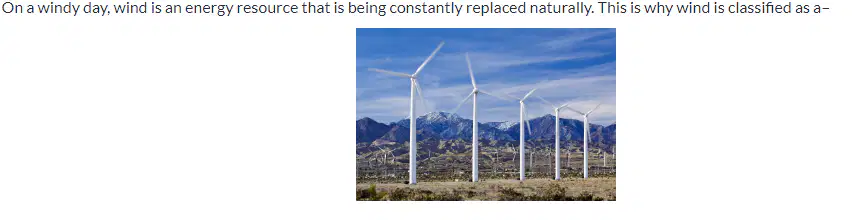
On a windy day, wind is an energy resource that is being constantly replace naturally. This is why wind is classified as a ...
a)
synthetic resource
b)
renewable resource
c)
nonrenewable resource
29.

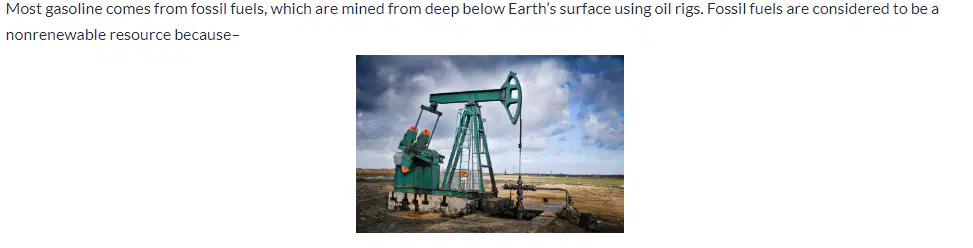
Most gasoline comes from fossil fuels, which are mined from deep below the Earth's surface using oil rigs. Fossil fuels are considered to be a nonrenewable resource because...
a)
there are alternative resources to using them
b)
the resource can be replaced in a short amount of time
c)
it takes millions of years to replace the resource
30.
Which of the following statements is true?
a)
Cutting paper is an example of a chemical reaction because a new substance is formed and the process cannot be undone
b)
Freezing water is an example of a chemical reaction because a new substance is formed and the process cannot be undone
c)
Burning paper is an example of a chemical reaction because a new substance is formed and the process cannot be undone.
31.
What is the best explanation for what happens during a chemical reaction?
a)
The mass of the reactants must be more than the mass of the products
b)
The atoms are rearranges to form different substances with new unique properties
c)
The number of atoms of each element gets smaller.
32.

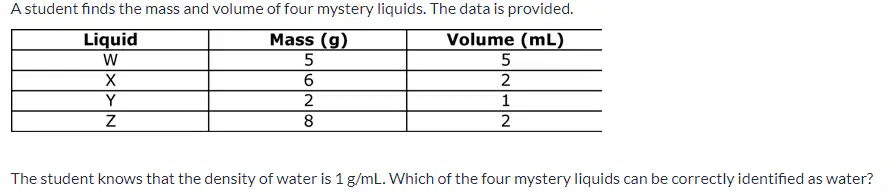
Use the formula for density to solve this!
a)
W
b)
X
c)
Y
33.

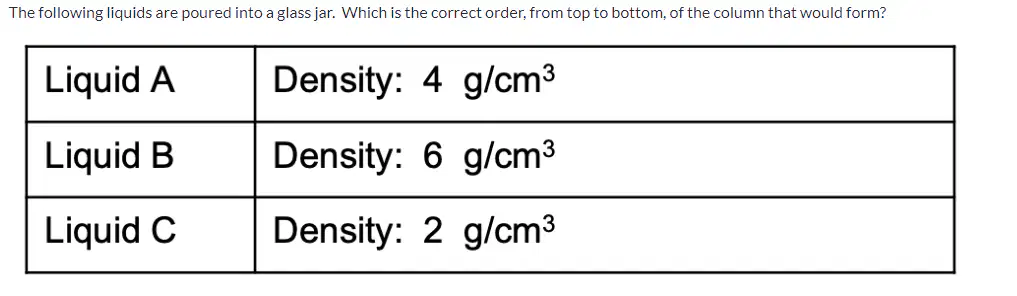
The following liquids are poured into a glass jar. Which is the correct order, from top to bottom, of the column that would form?
a)
Liquid C, A, B
b)
Liquid C, B, A
c)
Liquid B, A, C
34.

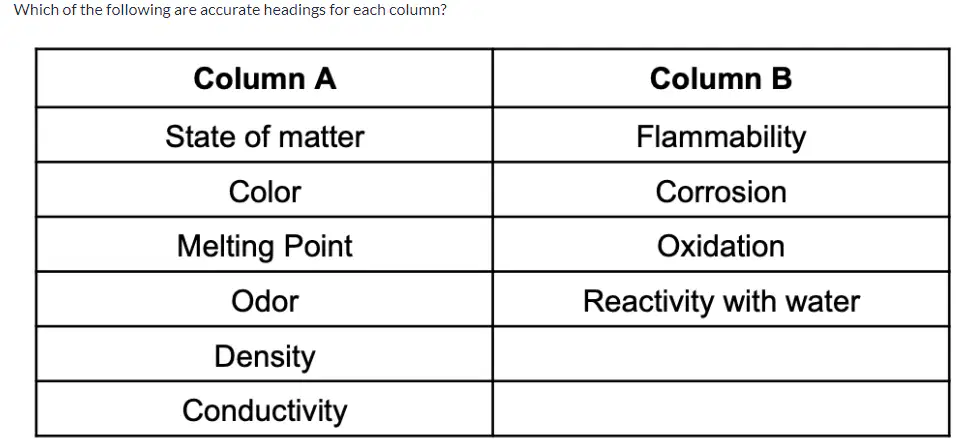
Which of the following are accurate headings for each column?
a)
Column A= Physical Properties; Column B= Chemical Properties
b)
Column A= Chemical Properties; Column B = Physical Properties
c)
Column A= Observable Properties; Column B = Non-observable properties
35.

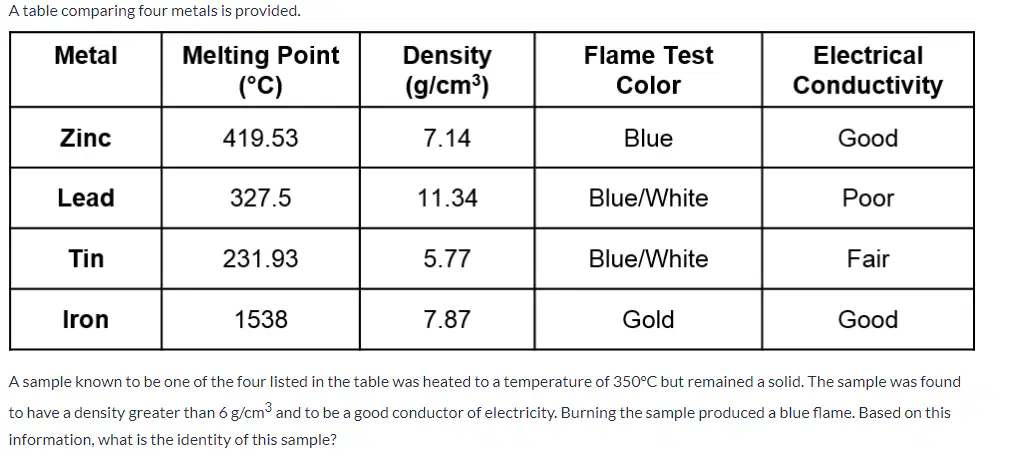
A sample known to be one of the four listed in the table was heated to a temperature of 350 degrees C but remained solid. The sample was found to have a density greater than 6g/cm^3 and to be a good conductor of electricity. Burning the sample produced a blue flame. Based on this information, what is the identity of this sample?
a)
Zinc
b)
Lead
c)
Tin
36.
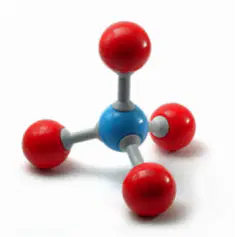
This is a picture of a methane molecule, CH₄ What color is/are the Hydrogen atoms?
a)
blue
b)
red
c)
yellow
37.
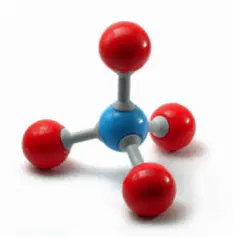
This is a picture of a methane molecule, CH₄ What color is/are the Carbon atoms?
a)
blue
b)
red
c)
gray
38.
Which of the following best explains the relationship between molecules and atoms?
a)
Atoms have smaller parts, called molecules
b)
Molecules are made up of two or more atoms
c)
Molecules are atoms that have no mass
39.
How many hydrogen atoms are needed to bond with nitrogen to create one molecule of ammonia, NH₃?
a)
1
b)
2
c)
3
40.
If one carbon atom chemically combined with one oxygen atom, which of the following chemical formulas would it represent?
a)
C₂0
b)
CO₂
c)
CO
41.
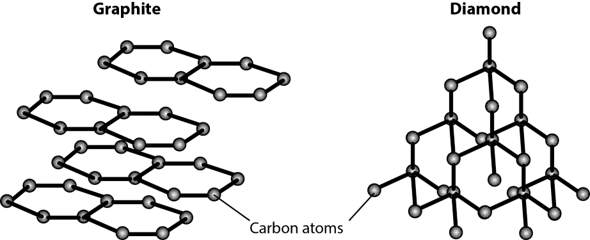
Graphite is a soft, dark material often used as a lubricant. Diamond is often a clear, hard crystal. Which of the following best explains the difference in these materials?
a)
The arrangements of the atoms of each one
b)
The elements of which each one is made
c)
The number of atoms each one is made of
42.
Two chemicals are combined in a beaker and react. What data would provide the best evidence for determining if the reaction absorbed or release thermal energy?
a)
The masses of the substances before and after the reaction
b)
The temperature inside the beaker before and after the reaction
c)
Whether or not light and sound were produced during the reaction
43.
Students are challenged to design cold packs for treating injuries. To do this they must find a chemical reaction that absorbs heat energy. The ideal chemical reaction will reach a temperature in the range of 0°C to 4°C and maintain that temperature for a minimum of 20 minutes. Based on the information provided in the table, and a room temperature of 25°C, which reaction best fits the criteria of the design challenge?
a)
Chemical Reaction 1
b)
Chemical Reaction 2
c)
Chemical Reaction 3
44.

When a reaction absorbs heat, the product of the reaction becomes hotter. This is called an ________________ reaction.

a)

Thermal Energy

b)

Exothermic

c)

Endothermic

d)

Heat

45.

When a reaction releases heat, the product of the reaction.

a)

Thermal Energy

b)

Exothermic

c)

Endothermic

d)

Heat

46.

The total kinetic energy of the tiny particle that make up matter

a)

Thermal Energy

b)

Exothermic

c)

Endothermic

d)

Heat

47.

Energy that is shifted from warmer to cooler temperatures between two substances

a)

Thermal Energy

b)

Exothermic

c)

Endothermic

d)

Heat

48.

The distinct form of matter.

a)

Solid

b)

Liquid

c)

Gas

d)

State

49.

Particles move freely at a very fast speed

a)

Solid

b)

Liquid

c)

Gas

d)

State

50.

Particles move around and slide past each other in a given area.

a)

Solid

b)

Liquid

c)

Gas

d)

State

51.

Particles that vibrate close together in a substance

a)

Solid

b)

Liquid

c)

Gas

d)

State