

wayground logo

Free Printable Worksheets

Font size

S
M
L
XL
Worksheets

2025 Fall Biology Semester Review

Total questions: 80

Worksheet time: 40mins
Name
Class
Date
1.
What is the standard unit of lenght in the metric system?
a)
liter
b)
meter
c)
gram
d)
inch
2.
If you do not understand a direction or part of a lab procedure, you should
a)
ask the instructor before proceeding
b)
figure it out as you do the lab
c)
try several methods until something works
d)
skip it and go on to the next part
3.
What are some lab safety equipment. (mark all that apply)
a)
goggles
b)
fire blanket
c)
water
d)
eye wash station
4.
What is the standard unit of mass in the metric system?
a)
liter
b)
meter
c)
gram
d)
inch
5.
I can eat in the lab.
a)
True
b)
False
6.
The simplest grouping of more than one kind of organism in the biosphere is
a)
a population.
b)
a community.
c)
an ecosystem.
d)
a species.
7.
Plants are
a)
primary producers.
b)
primary consumers.
c)
herbivores.
d)
omnivores.
8.
Only 10 percent of the energy stored in an organism can be passed on to the next trophic level. Of the remaining energy, some is used for the organism’s life processes, and the rest is
a)
used in reproduction.
b)
stored as body tissue.
c)
stored as fat.
d)
eliminated as heat.
9.
The repeated movement of water between Earth’s surface and the atmosphere is called
a)
the water cycle.
b)
the condensation cycle.
c)
precipitation.
d)
evaporation.
10.
Each of the following is an abiotic factor in the environment EXCEPT
a)
plant life.
b)
soil type.
c)
rainfall.
d)
temperature.
11.
The branch of biology dealing with interactions among organisms and between organisms and their environment is called
a)
economy.
b)
modeling.
c)
recycling.
d)
ecology.
12.
What is the standard unit for volume in the metric system?
a)
liter
b)
meter
c)
gram
d)
inch
13.
A cell placed in a hypertonic solution will:
a)
Gain water and swell
b)
Lose water and shrink
c)
Stay the same size
d)
Stop all cell transport
14.
Which of the following best describes diffusion?
a)
Movement of particles from low concentration to high concentration
b)
Movement of particles from high concentration to low concentration
c)
Movement of water across a membrane
d)
Movement of particles using energy
15.
What are groups of different populations living togther in the same place at the same time called?
a)
population
b)
community
c)
organism
d)
biome
16.
What are the ecological levels of organization from largest to the smallest?
a)
organism, population, community, ecosystem, biome, biosphere
b)
biosphere, biome, ecosystem, community, population, organism
c)
population organism, ecosystem, community, biosphere, biome
d)
biome, biosphere, community, ecosystem, organism, population
17.
Which type of transport requires energy (ATP)?
a)
Diffusion
b)
Osmosis
c)
Facilitated diffusion
d)
Active transport
18.
This organisms role during Primary Succession is to break down rook and rebuild soil.
a)
Pioneer Species
b)
Primary Species
c)
Proud Species
d)
Pondering Species
19.
Which relationship(s) demostrate(s) parasitism? (Mark all that apply)
a)
mosquito eating human blood
b)
suckerfish eating shark scraps
c)
tapeworm living in dogs
d)
bacteria living in legume roots
20.
A cell placed in a hypertonic solution will:
a)
Gain water and swell
b)
Lose water and shrink
c)
Stay the same size
d)
Stop all cell transport
21.
When a bee visits a flower for nectar, pollen grains stick to their legs. The bee takes this pollen later and pollinates another one. This is an example of
a)
mutualism
b)
parasitism
c)
commensalism
d)
predation
22.
Endocytosis and exocytosis are both examples of this type of active transport
a)
Passive transport
b)
Osmosis
c)
Bulk transport
d)
Facilitated diffusion
23.
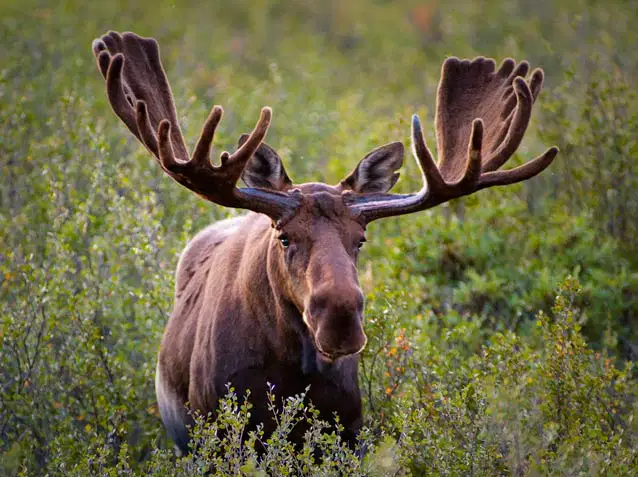
How might moose hunting affect the population of the plants they eat? (Assuming ONLY moose ate that type of plant).
a)
The plant isn't affected.
b)
That plant population decreases because the moose are eating more.
c)
The population of that plant increases because there are fewer moose eating them
d)
The plant goes extinct because the moose are pollinators
24.
A network of food chains that shows the transfer of energy.
a)
Food chain
b)
Food Web
c)
Biomass Pyramid
d)
Ecological Succession
25.
succession that occurs in an area with previous life
a)
ecological succession
b)
pioneer species
c)
primary succession
d)
secondary succession
26.
Another name for the Citric Acid Cycle.
a)
Calvin Cycle
b)
Water-spliting Cycle
c)
Light Cycle
d)
Glucose Cycle
27.
A cell placed in a isotonic solution will:
a)
Gain water and swell
b)
Lose water and shrink
c)
Stay the same size
d)
Stop all cell transport
28.
The light dependant cycle is also called the ______________ cycle.
a)
water spliting
b)
Calvin
c)
glucose building
d)
sunshine
29.
Which statement about passive transport is TRUE?
a)
It requires ATP
b)
It moves molecules against the concentration gradient
c)
It moves molecules from high to low concentration
d)
It only moves water
30.
Glucose is made in the ___________ cycle.
a)
Calvin
b)
water spliting
c)
sunshine
d)
dependant
31.
Choose the electron carriers (mark all that apply).
a)
NADP+
b)
NADPH
c)
ATP+
d)
ADP
32.
The energy currency of the cell.
a)
ATP
b)
NAD
c)
ABC
d)
FAP
33.
Fermentation is an _________ process.
a)
anaerobic
b)
aerobic
c)
loud
d)
quiet
34.
In the figure below, why might the candle in jar A burn longer than the candle in jar B?
a)
Carbon dioxide produced by the plant allows the candle to burn longer.
b)
Chlorophyll produced by the plant allows the candle to burn longer.
c)
Glucose produced by the plant allows the candle to burn longer.
d)
Oxygen produced by the plant allows the candle to burn longer.
35.
Which of the following is NOT a step in the light-dependent reactions?
a)
High-energy electrons move through the electron transport chain.
b)
Pigments in photosystem II absorb light.
c)
ATP synthase allows H+ ions to pass through the thylakoid membrane.
d)
ATP and NADPH are used to produce high-energy sugars.
36.
Look at the figure below. All of the following are parts of an ADP molecule EXCEPT
a)
structure A.
b)
structure B.
c)
structure C.
d)
structure D
37.
The products of photosynthesis are the
a)
products of cellular respiration.
b)
reactants of cellular respiration.
c)
products of glycolysis.
d)
reactants of fermentation.
38.
In eukaryotes, electron transport occurs in the
a)
mitochondria.
b)
nucleus.
c)
cell membrane.
d)
cytoplasm.
39.
Lactic acid fermentation occurs in
a)
bread dough.
b)
any environment containing oxygen.
c)
muscle cells when in heavy use.
d)
two of these
40.
All of the following is a true statement about ATP EXCEPT?
a)
ATP consists of ribose, adenine, and three phosphate groups.
b)
ADP is produced when ATP releases energy.
c)
ATP provides energy for the mechanical functions of cells.
d)
Used ATP is discarded by the cell as waste.
41.
Photosynthesis happens in this part of the plant.
a)
chloraplasts
b)
transpiration
c)
pollen
d)
root
42.
Osmosis is the movement of
a)
carbon
b)
water
c)
electrons
d)
ATP
43.
The Calvin cycle takes place in the
a)
stroma.
b)
photosystems.
c)
thylakoid membranes.
d)
chlorophyll molecules.
44.

Which organelle is responsible for producing most of the cell's ATP?

a)

Nucleus

b)

Golgi apparatus

c)

Mitochondria

d)

Ribosome

45.

What process describes the movement of water vapor from plants to the atmosphere?

a)

Condensation

b)

Transpiration

c)

Evaporation

d)

Precipitation

46.

Which of the following is an example of a biotic factor in an ecosystem?

a)

Bacteria

b)

Temperature

c)

Water

d)

Sunlight

47.

Which organelle is responsible for producing energy in the form of ATP in eukaryotic cells?

a)

Mitochondria

b)

Nucleus

c)

Ribosome

d)

Chloroplast

48.

What is the process by which plants convert sunlight into chemical energy?

a)

Fermentation

b)

Respiration

c)

Transpiration

d)

Photosynthesis

49.

Which of the following is an example of passive transport across a cell membrane?

a)

Exocytosis

b)

Endocytosis

c)

Osmosis

d)

Active transport

50.

Which organelle is responsible for photosynthesis in plant cells?

a)

Mitochondria

b)

Chloroplast

c)

Nucleus

d)

Vacuole

51.

Which of the following is an example of an abiotic factor?

a)

Grass

b)

Bacteria

c)

Sunlight

d)

Rabbit

52.

What process describes the movement of water across a selectively permeable membrane?

a)

Active transport

b)

Endocytosis

c)

Osmosis

d)

Facilitated diffusion

53.

Which process allows water to move across a cell membrane without using energy?

a)

Exocytosis

b)

Endocytosis

c)

Osmosis

d)

Active transport

54.

What is the main role of ATP in cellular activities?

a)

Building cell membranes

b)

Transporting oxygen

c)

Providing energy for cell functions

d)

Storing genetic information

55.

Which of the following organisms is considered a primary consumer?

a)

Grass

b)

Rabbit

c)

Wolf

d)

Mushroom

56.

Which process in plants converts solar energy into chemical energy?

a)

Fermentation

b)

Photosynthesis

c)

Transpiration

d)

Respiration

57.

What is the main function of mitochondria in eukaryotic cells?

a)

Protein synthesis

b)

Energy production

c)

Photosynthesis

d)

Cell division

58.

Which of the following best describes mutualism?

a)

Both organisms benefit

b)

Neither organism benefits

c)

One organism benefits, the other is harmed

d)

One organism benefits, the other is unaffected

59.

Which of the following is NOT a function of ATP in cells?

a)

Provides energy for cellular processes

b)

Stores genetic information

c)

Drives active transport

d)

Powers muscle contraction

60.

Which process moves substances from an area of low concentration to high concentration across a membrane?

a)

Facilitated diffusion

b)

Osmosis

c)

Diffusion

d)

Active transport

61.

Which of the following is a biotic factor in an ecosystem?

a)

Sunlight

b)

Bacteria

c)

Temperature

d)

Water

62.

Which process allows water to move across a cell membrane without using energy?

a)

Endocytosis

b)

Osmosis

c)

Exocytosis

d)

Active transport

63.

Which organelle is responsible for breaking down food and releasing energy in animal cells?

a)

Vacuole

b)

Nucleus

c)

Mitochondria

d)

Chloroplast

64.

What is the main product of photosynthesis that provides energy for living organisms?

a)

Water

b)

Carbon dioxide

c)

Glucose

d)

Oxygen

65.

Which molecule is produced as a result of photosynthesis?

a)

ATP

b)

Glucose

c)

Carbon dioxide

d)

Oxygen

66.

What is the main pigment involved in capturing light energy for photosynthesis?

a)

Chlorophyll

b)

Hemoglobin

c)

Melanin

d)

Keratin

67.

Which part of the plant cell contains the thylakoid membranes where light-dependent reactions occur?

a)

Cell wall

b)

Nucleus

c)

Chloroplast

d)

Mitochondria

68.

Which process occurs in the mitochondria to generate energy for the cell?

a)

Photosynthesis

b)

Cellular respiration

c)

Fermentation

d)

Transpiration

69.

Which of the following is NOT a product of the light-dependent reactions of photosynthesis?

a)

Glucose

b)

NADPH

c)

ATP

d)

Oxygen

70.

What is the main function of chlorophyll in plant cells?

a)

Transport nutrients

b)

Store water

c)

Protect the cell

d)

Absorb sunlight for photosynthesis

71.

Which process moves molecules from an area of low concentration to high concentration using energy?

a)

Facilitated diffusion

b)

Osmosis

c)

Active transport

d)

Passive transport

72.

What is the main function of chlorophyll in photosynthesis?

a)

Produce glucose

b)

Store water

c)

Absorb sunlight

d)

Release oxygen

73.

Which of the following best describes a pioneer species?

a)

A species that is the last to colonize an area

b)

A species that breaks down rock and helps form soil

c)

A species that only lives in aquatic environments

d)

A species that depends on other organisms for food

74.

Which process allows water to move across a cell membrane without using energy?

a)

Exocytosis

b)

Active transport

c)

Osmosis

d)

Endocytosis

75.

Which of the following is an example of an abiotic factor in an ecosystem?

a)

Soil

b)

Grass

c)

Fungi

d)

Bacteria

76.

What is the main function of chlorophyll in photosynthesis?

a)

Transporting water

b)

Producing glucose

c)

Absorbing sunlight

d)

Releasing oxygen

77.

Which of the following organisms is considered a primary consumer?

a)

Grass

b)

Rabbit

c)

Wolf

d)

Mushroom

78.

Which of the following processes does NOT require energy from ATP?

a)

Facilitated diffusion

b)

Active transport

c)

Cell division

d)

Muscle contraction

79.

Which of the following is an example of an abiotic factor in an ecosystem?

a)

Fungi

b)

Bacteria

c)

Sunlight

d)

Grass

80.

What is the main function of chlorophyll in photosynthesis?

a)

Absorbing sunlight

b)

Producing glucose

c)

Transporting water

d)

Releasing oxygen
