
 Worksheets
MOY Word Parts and Their Meanings
Total questions: 60
Worksheet time: 31mins
encephal/o ____________
suffix that means pain or sensitivity
combining form that means back or to hold back
prefix that means half
combining form that means brain
combining form that means gray matter
somat/o ____________
prefix that means half
combining form that means brain
combining form that means body
suffix that means pain or sensitivity
combining form that means back or to hold back
suffix that means formation - ________________
genesis
lysis
ectomy
itis
combining form that means water - ________________
hydr/o
lip/o
neur/o
oste/o
suffix that means condition of growth or development - ________________
trophy
lysis
pathy
stasis
suffix that means flow or excessive discharge - ________________
-rrhea
-itis
-emia
-algia
suffix that means childbirth - ________________
-partum
-emia
-itis
-lysis
combining form that means uterus - ________________
hyster/o
nephr/o
gastr/o
arthr/o
combining form that means birth - ________________
nat/i
cyt/o
derm/o
hemat/o
the fertilization of the female sex cell by a sperm - ________________
conception
ovulation
menstruation
implantation
a sex cell - ________________
gamete
zygote
chromosome
enzyme
a hormone responsible for male secondary sex characteristics - ________________
testosterone
estrogen
progesterone
insulin
the lower portion of the uterus - ________________
cervix
fundus
endometrium
fallopian tube
branches that extend from the neuron cell body and receive electrical signals from other neurons - ________________
Dendrites
Axons
Synapses
Myelin Sheath
a long, thin projection that transmits electrical signals from the neuron cell body out toward the neuron's terminals - ________________
Axon
Dendrite
Synapse
Cell body
a covering that provides electrical insulation for nerve fibers - ________________
Myelin Sheath
Axon Terminal
Dendrite
Synaptic Cleft
the division of the nervous system that comprises the brain and spinal cord - ________________
Central Nervous System
Peripheral Nervous System
Autonomic Nervous System
Somatic Nervous System
the depressions in the cerebral cortexes - ________________
Sulci
Gyri
Fissures
Lobes
a division of the nervous system that controls unconscious bodily functions - ________________
Autonomic Nervous System
Somatic Nervous System
Central Nervous System
Peripheral Nervous System
three layers of connective tissue that protect the brain and spinal cord - ________________
Meninges
Cerebrum
Cerebellum
Medulla oblongata
clear, colorless mucous membrane that lines the eyelids and covers the anterior portion of the eyeball - ________________
conjunctiva
cornea
sclera
retina
A thin layer of tissue that lines the posterior of the eye internally; contains photoreceptors - ____________
retina
cornea
lens
sclera
A tiny pit in the eye that contains only cones and is the area of sharpest vision - ____________
fovea centralis
optic disc
cornea
lens
The auditory canal - ____________
external acoustic meatus
cochlea
tympanic membrane
semicircular canals
Olfactory receptor cells are involved with the sense of _____
taste
smell
hearing
touch
The ____ nervous system controls the 'rest-and-digest' response.
Somatic
Autonomic
Sympathetic
Parasympathetic
After reaching the trachea, inhaled air proceeds to the ____.
bronchi, then the bronchioles, and then the alveoli
larynx, then the alveoli, and then the bronchioles
alveoli, then the bronchioles, and then the bronchi
bronchioles, then the bronchi, and then the alveoli
____ is a condition of bluish tint to the skin due to lack of oxygen circulation to body tissues.
Atelectasis
Empyema
Sinusitis
Cyanosis
The respiratory system works with the cardiovascular system to deliver ______ to all the cells of the body and to remove ______.
oxygen, carbon dioxide
carbon dioxide, oxygen
nutrients, waste
glucose, water
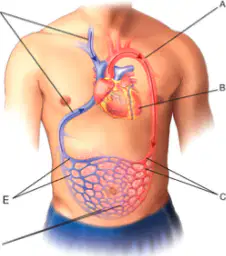
Match the following structures with the letters shown on the illustration. Identify the structure labeled A
Venule
Capillaries
Arterioles
Heart
Artery
The ________ ventricle pumps blood into the lungs, and the ________ ventricle pumps blood to the rest of the body.
right, left
left, right
left, left
right, right
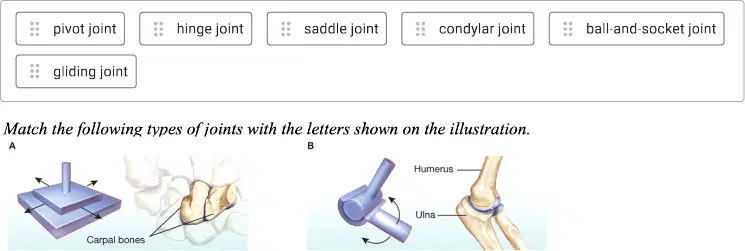
Match the following types of joints with the letters shown on the illustration.
saddle joint
hinge joint
ball-and-socket joint
pivot joint
condylar joint
The marrow inside cancellous bone produces _____
yellow fat cells
synovial fluid
red blood cells
cartilage cells
The ribs that attach to the cartilage of the ribs above them are called _____
floating ribs
fixed ribs
true ribs
false ribs
The joints between cranial bones are called _____
sutures
fissures
amphiarthroses
synovial joints
In military time, midnight is written as ____
0000 or 2400
2400
1200
0000 or 1200
Drag the following combining forms to the correct meaning for each word part. Rib - ________________ Stomach - ________________ Muscle - ________________ Intestines - ________________ Flesh/Connective Tissue - ________________ Liver - ________________ Nerve - ________________ Heart - ________________
Rib - Cost/o Stomach - Gastr/o Muscle - My/o Intestines - Enter/o Flesh/Connective Tissue - Sarc/o Liver - Hepat/o Nerve - Neur/o Heart - Cardi/o
Rib - My/o Stomach - Hepat/o Muscle - Neur/o Intestines - Sarc/o Flesh/Connective Tissue - Enter/o Liver - Cost/o Nerve - Cardi/o Heart - Gastr/o
Rib - Neur/o Stomach - Sarc/o Muscle - Cost/o Intestines - Hepat/o Flesh/Connective Tissue - Cardi/o Liver - Enter/o Nerve - Gastr/o Heart - My/o
Rib - Enter/o Stomach - Cardi/o Muscle - Sarc/o Intestines - My/o Flesh/Connective Tissue - Hepat/o Liver - Gastr/o Nerve - Cost/o Heart - Neur/o
Match the following terms and identifying phrases. Options: Prone, Sims', Lateral, Semi-Fowlers, Supine 1. lying flat with face down ________________ 2. lying on the side with the hip and knee straight, and the other hip and knee bent or flexed ________________ 3. left or right lying position ________________ 4. semi-sitting position with head of bed elevated 30-45 degrees ________________ 5. lying flat with face up ________________
A. 1. Prone 2. Sims' 3. Lateral 4. Semi-Fowlers 5. Supine
B. 1. Supine 2. Lateral 3. Sims' 4. Prone 5. Semi-Fowlers
C. 1. Lateral 2. Prone 3. Semi-Fowlers 4. Supine 5. Sims'
D. 1. Semi-Fowlers 2. Supine 3. Prone 4. Sims' 5. Lateral
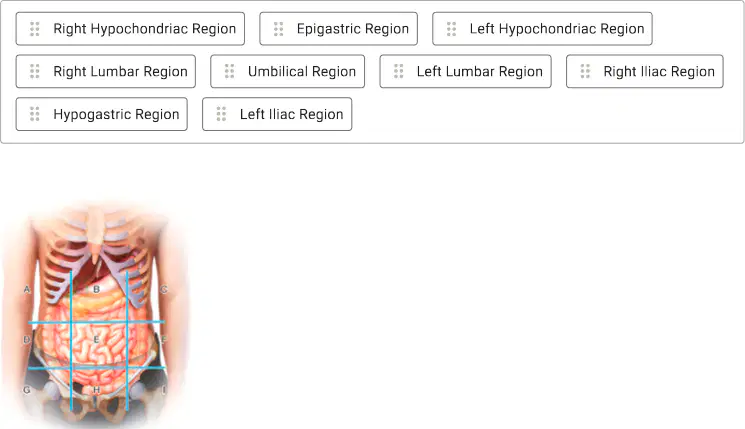
Match the following abdominal regions with their positions in the illustration.
Section A - Epigastric Region, Section B - Umbilical Region, Section C - Hypogastric Region, Section D - Right Hypochondriac Region
Section A - Hypogastric Region, Section B - Epigastric Region, Section C - Umbilical Region, Section D - Left Hypochondriac Region
Section A - Umbilical Region, Section B - Right Hypochondriac Region, Section C - Epigastric Region, Section D - Hypogastric Region
Section A - Left Hypochondriac Region, Section B - Hypogastric Region, Section C - Epigastric Region, Section D - Umbilical Region
Which substance is responsible for the skin's pigmentation or color?
Melanin
Keratin
Collagen
Sebum
Where in the skin are hair follicles located?
Subcutaneous layer
Dermis
Epidermis
Hypodermis
Match the following prefixes and suffixes with their meanings
peri- ____________________
Around, surrounding
Before, in front of
Within, inside
After, behind
Match the following prefixes and suffixes with their meanings
tachy- ____________________
fast/irregular
slow
large
small
Match the following prefixes and suffixes with their meanings.
-ar ____________________
Pertaining to
Condition of
Study of
Inflammation of
Match the following prefixes and suffixes with their meanings.
-algia ____________________
Pain
Inflammation
Swelling
Tumor
Match the following prefixes and suffixes with their meanings.
-ectomy ____________________
Surgical removal
Inflammation
Study of
Tumor
-itis ____________________
inflammation
infection
swelling
pain
The sagittal plane divides the body vertically into equal left and right sections.
True
False
A pathogen that does not cause disease unless the immune system is weakened is ____.
infectious
opportunistic
nosocomial
idiopathic
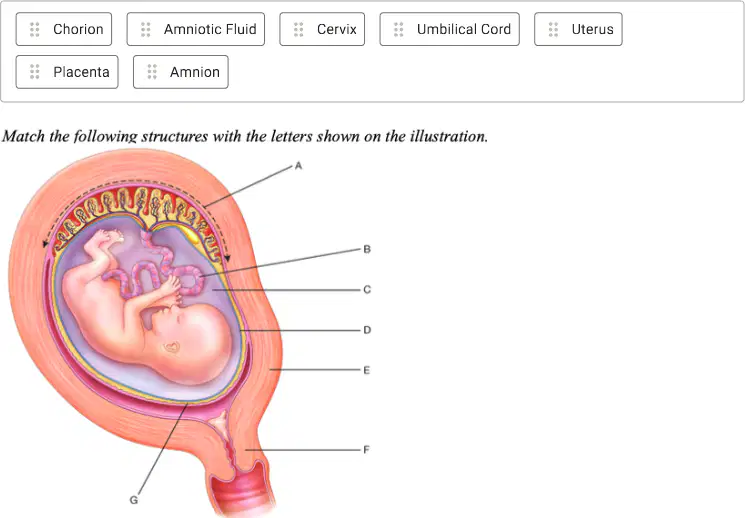
Match the following structures with the letters shown on the illustration. What structure does letter A represent?
Placenta
Amnion
Yolk sac
Allantois
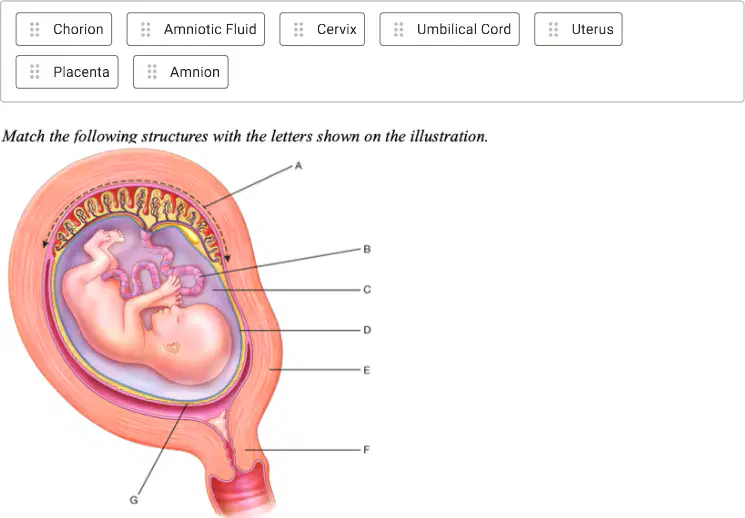
Match the following structures with the letters shown on the illustration. What structure does letter B represent?
Amnion
Chorion
Yolk sac
Umbilical Cord
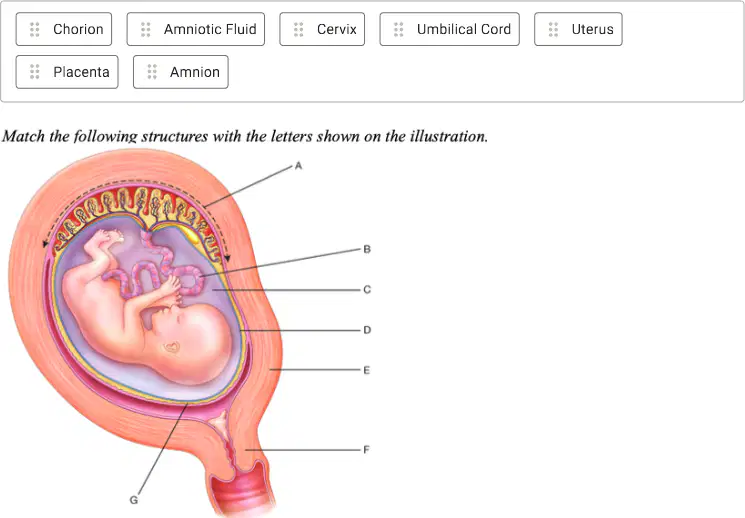
Match the following structures with the letters shown on the illustration. Structures: Chorion, Amniotic Fluid, Cervix, Umbilical Cord, Uterus, Placenta, Amnion. What structure does letter C represent?
Amniotic Fluid
Placenta
Cervix
Umbilical Cord
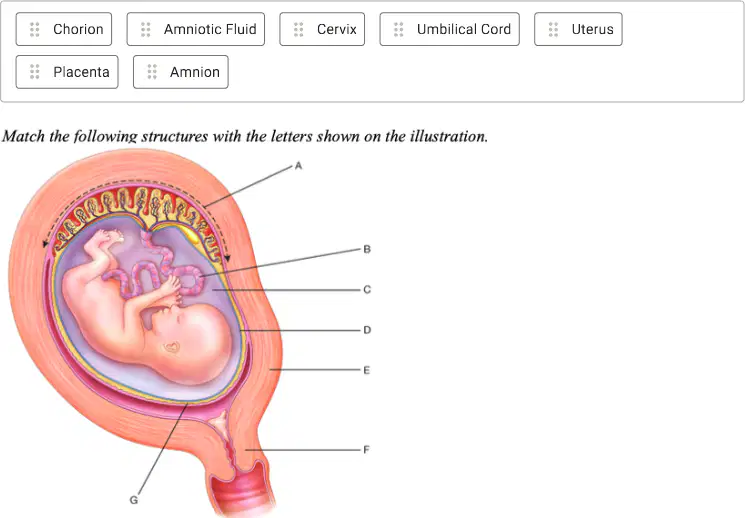
Match the following structures with the letters shown on the illustration. What structure does letter D represent?
Placenta
Amniotic sac
Umbilical cord
Yolk sac

Match the following structures with the letters shown on the illustration. Structures: Chorion, Amniotic Fluid, Cervix, Umbilical Cord, Uterus, Placenta, Amnion. What structure does letter E represent?
Umbilical Cord
Placenta
Amniotic Fluid
Cervix
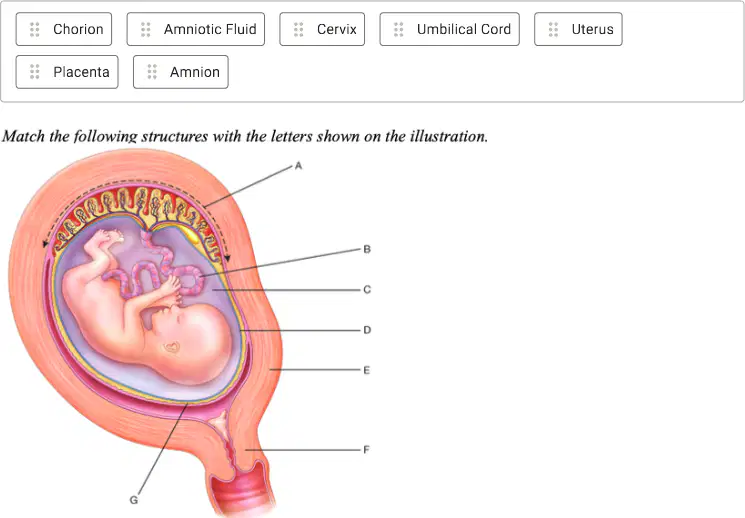
Match the following structures with the letters shown on the illustration. What structure does letter F represent?
Uterus
Ovary
Fallopian Tube
Cervix
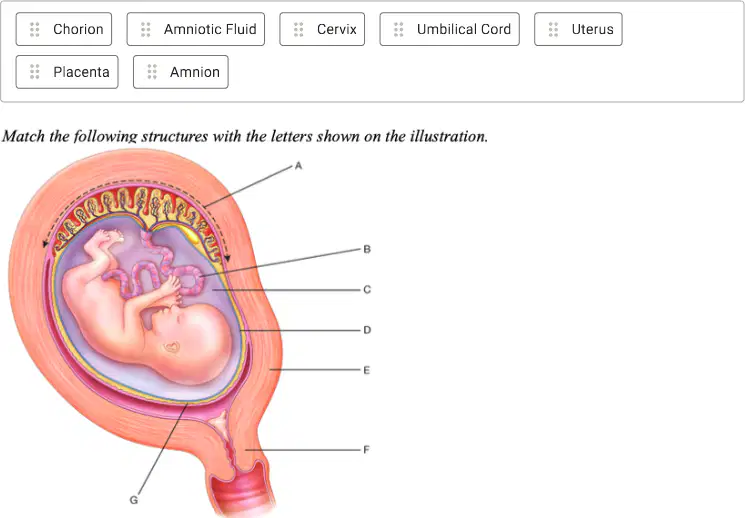
Match the following structures with the letters shown on the illustration. What structure does letter G represent?
Chorion
Ovary
Uterus
Fallopian tube
What does the term proximal mean?
Near the midline
Near the point of origin
Near the side of the body
Away from the point of origin
Which three healthcare careers are most likely involved in Diego Vitalis's journey from intake to discharge after sustaining a compound femur fracture and quadriceps muscle tear during a soccer game?
Nurse, Biomedical Scientist, Diagnostic/Therapeutic Specialist
Nurse, Physical Therapist, Healthcare Administrator
Nurse, Radiologic Technologist, Healthcare Operations Manager
Nurse, Biomedical Scientist, Healthcare Operations Manager



