
 Worksheets
Exam: Muscular Anatomy
Total questions: 20
Worksheet time: 14mins
Match each of the following muscle types to their correct description.
Smooth
Muscle which has uniform arrangement, is non-striated and contractions are involuntary
Cardiac
Muscle which has a branched structure, has striations and contractions are involuntary
Skeletal
Muscle which has a cylindrical structure, has striations and contractions are voluntary
Skeletal muscles are only organized by location and function.
True
False
Select the correct answer from the choices provided in the underlined sections. (a) is a movement downward. (b) is a movement upward.
Claire is bending her elbow to reduce the angle between her forearm and upper arm. Which type of movement is Claire performing?
Extension
Flexion
Depression
Elevation
When body temperatures are too low, the body will produce heat by shivering.
True
False
Select the correct answer from the choices provided in the underlined sections.
(a) is the ability of a muscle to return to its original length when relaxed. (b) is the ability of the muscle to respond to a stimulus.
Which of the following is the name of the connective tissue which surrounds a myofibrils?
Perimysium
Epimysium
Endomysium
Myosin
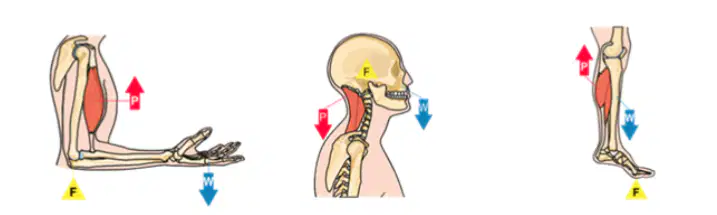
Using the word bank, label the levers in the body by their appropriate class.
Class I
Middle diagram (head/neck)
Class II
Right diagram (leg)
Class III
Left diagram (arm)
Cardiac muscle is also referred to as the myocardium.
True
False
Which of the following best describes tension?
A. A pulling force transmitted through an object with forces acting on opposite sides
B. A pushing force transmitted through an object acting on one side
C. The ability of a force to cause rotation on a lever
D. The ability of a force to cause pushing on a lever
The tendon of a skeletal muscle which attaches to the bone being moved is called the ___________.
Origin
Body
Insertion
Head
Mickey is studying smooth muscles for his anatomy class. The teacher has asked him to list places where he would find smooth muscle in the body. Which of the following should Mickey include in the list?
Biceps femoris
Gluteus maximus
Heart walls
Wall of the stomach
Select all of the following which are aided by trunk muscles.
Core body movements
Digestion
Moving and supporting the vertebral column
Respiration
Select the correct answer from the choices provided in the underlined sections.
The (a) is the main muscle responsible for movement. The (b) muscle support movement by contributing force and stability. The (c) muscle opposes the action and relaxes when the agonist is contracted.
A repeating unit of actin and myosin is called a sarcomere.
True
False
Match the following types of movements to their correct definition.
Abduction
Movement away from the midline of the body
Internal rotation
Rotation of the structure towards the midline of the body
External rotation
Rotation of the structure away from the midline of the body
Adduction
Movement towards the midline of the body
Skeletal muscles are attached to bones by:
ligaments
tendons
bone marrow
ATP
Movement, stability, and heat production are functions of this system
skeletal
muscular
nervous
respiratory
Moving a body part away from the midline of the body
abduction
adduction
flexion
extension
Pointing toes down
Dorsiflexion
Plantar flexion
abduction
adduction

