
 Worksheets
IB SEHS Fall Final Exam Review
Total questions: 80
Worksheet time: 44mins
“Individual differences in characteristic patterns of thinking, feeling & behaving” defines (a)
Personality traits:
relatively stable and enduring
permanent
change a lot
stay the same across different situations and environments
Personality influenced by “nature” and “nurture”. What does this mean?
Nature = genetic influences
Nurture = environmental influences
Nature = mood
Nurture = level of motivation
Nature = coaching style Nurture = amount of practice
Nurture = genetic influences on personality
Nature = environmental influences
trait anxiety vs state anxiety?
Both refer to moment-to-moment emotional changes during performance.
Trait anxiety = temporary
State anxiety = long-term predisposition to experience anxiety.
Trait = generally anxious across many situations
State = feels anxious only in certain situations
Trait anxiety = poor preparation
state anxiety = caused by environmental distractions.
What are limitations of using self-reporting tests to measure pre-competition anxiety in athletes? (select all that apply)
the time the test is given will affect results
people might not answer honestly
it has to be repeated
opposite of emotional stability
Neuroticism
Extraversion
Conscientiousness
Openness
The extent to which individuals draw / gain energy from interacting with other people.
Openness to experience
Conscientiousness
Extroversion
Agreeableness
Neuroticism
how well someone relates to other people & maintains relationships
Openness to experience
Conscientiousness
Extroversion
Agreeableness
Neuroticism
how much a person views situations as distressing, anxiety-inducing, etc.
Openness to experience
Conscientiousness
Extroversion
Agreeableness
Neuroticism
individual’s willingness to try new things, be vulnerable and think originally
Openness to experience
Conscientiousness
Extroversion
Agreeableness
Neuroticism
tendency to control impulses, behave in socially acceptable ways, follow expectations, commit to goal directed behavior
Openness to experience
Conscientiousness
Extroversion
Agreeableness
Neuroticism
high conscientiousness and openness behaviors?
stay calm and help teammates
stay quiet and listen to instructions
Help others and give consistent effort
consistent effort and listen to instructions
aspect of personality that explains how individuals manage challenging and pressurized situations: ______ _________
(a)
Big 5 personality traits strongly associated with mental toughness? (select all that apply)
Agreeableness
Extroversion
Conscientiousness
Low neuroticism
conscientiousness is strongly correlated with this component of mental toughness:
Confidence
Appraisal of challenges
Commitment
Resilience
Viewing challenges as opportunities for improvement
Commitment
Appraisal of challenge
Perceived control
Resilience
when you feel like you can influence the outcome of a situation
Resilience
Commitment
Appraisal of challenges
Perceived control
ability to bounce back / recover from mistakes or failures
Perceived control
Resilience
Commitment
Appraisal of challenges
Which best describes the relationship between mental toughness and experiencing stress or depression?
Positive correlation
Negative correlation
No relationship
Can not be determined
5 components of mental toughness?
Focus, control, relaxation, composure, optimism, self-belief
Openness to experience, conscientiousness, extraversion, agreeableness, neuroticism
Appraisal of challenges, commitment, confidence, perceived control and resilience
Autonomy, competence, relatedness, self-determination, self-regulation
How is mental toughness developed?
pushing through all challenges
Psychological skills training
Experiencing failure
Ego motivational climates
“A relatively permanent change in behavior brought about by experience” defines (a)
Distinguish between open loop theory and closed loop theory.
Open loop theory = quick, pre-planned movements executed without feedback
Closed loop theory = slow movements, feedback used during movement to make corrections
Open loop theory = continuous feedback to adjust movement
Closed loop theory = occurs without sensory input
Both need feedback but differ only in movement speed
Open loop theory = only simple skills
Closed loop theory = only complex skills
recall schema is primarily responsible for:
Evaluating the movement outcome
Initiating a motor response with specific parameters
Comparing sensory feedback with the expected outcome
Storing a perceptual trace for the feeling of the movement
How is the information processing model of motor learning exemplified by schema theory?
By suggesting that each movement is stored as a separate, specific motor program that is retrieved unchanged during performance
By proposing that generalized motor programs are stored in memory and modified through recall and recognition schemas using feedback from previous performances
By explaining that movement emerges through perception–action coupling as performers adapt to affordances created by task and environmental constraints
By emphasizing self-organization of movement patterns through representative learning design without reliance on stored motor programs
linear (traditional) pedagogy?
coach directs learning by demonstrating skills, prescribing technique, and providing frequent instructions and feedback
learners independently explore movement solutions with minimal coach input
practice design emphasizes variability and athlete decision-making
athletes control the learning process through adaptation to environmental constraints
Which of the following are true about the cognitive phase of learning? (select all that apply)
known as the verbal phase because learners use verbal instructions, self-talk and feedback to understand the skill
The fastest rate of skill improvement occurs in this phase
Performance is inconsistent and movements are not efficient
learner knows what to do and has a clear mental image of what the skill looks like
Can self-detect movement errors but still needs feedback from a coach to make corrections
Which phase are they likely in?
Cognitive
Associative
Autonomous
athletes in the __ phase of learning can focus on advanced tactics or strategies such as faking out their opponent because motor programs are well learned & performed without conscious thought
Autonomous
Cognitive
Associative
An athlete & coach work together to solve a problem with a given set of constraints.
Linear
Non-linear
“an opportunity for action provided by the environment” according to ecological dynamics theory of motor learning
Decision making
Input
Affordance
Response selection
example of an environmental constraint?
Size of the ball
Peer pressure
Self-organization
Rules of the game
examples of task constraints?
Decision making; Adapting equipment
Adapting rules; Quality of playing surface
Decision making; Tempo of game
Adapting rules; Adapting equipment
Theory that views movement as a complex interaction between the body, the task and the environment.
Ecological systems theory
Schema theory
Open-loop theory
Closed-loop theory
Benefits of a constraints-led approach to skill acquisition? (select all that apply)
Mastering the correct technique
Enhanced problem solving and creativity
Greater adaptability to adjust movements to changing situations
Better attentional focus toward relevant external cues
The delayed response to a second stimulus that is presented while a first stimulus is still being processed.
response time
reaction time
psychological refractory period
Type of transfer: volleyball serve to a tennis serve
Skill to skill
Practice to performance
Stage to stage
Whole–part–whole
transfer type: using factual knowledge that you have learned to execute a skill efficiently?
Skill to skill
Practice to performance
Stage to stage
Principles to skills
abilities to skill transfer in tennis?
Hitting against a ball machine
Understanding the biomechanics of hitting
Training for strength to improve hitting
Hitting right-handed and left-handed
attentional focus used when developing a strategic game plan?
Internal, narrow
Internal, broad
External, narrow
External, broad
attentional focus required to hear a starting gun?
Internal, narrow
Internal, broad
External, narrow
External, broad
high need to achieve (NACH) behavior
Avoid future challenges
Increased effort and persistence to improve performance
Decreased motivation
2 Situational factors that a coach can manipulate to increase "approach" behavior according to need achievement theory?
probability of success
incentive value of success
fear of failure
motivation to succeed
behavior of Need to Avoid Failure (NAF) people?
Select moderately challenging tasks that provide feedback on ability
Avoid competition with much stronger opponents
Approach tasks with 50:50 probability of success and high incentive value
Approach tasks that are very easy or very difficult to avoid failure and protect self-esteem
have a self-referenced perception of success and focus on self-improvement and mastery
Ego-oriented
Task-oriented
Feel like success = winning
ego oriented
task oriented
performance and well-being are predicted by:
The extent to which autonomy, competence and relatedness are satisfied
The quantity of intrinsic or extrinsic motivation
Which statement describes amotivation?
Participation driven by enjoyment of the activity
Participation motivated by external rewards
Lack of motivation due to no perceived link between effort and outcome
Motivation regulated by internal goals and values
Type of motivation when you do something because it will help you achieve your goals: (select 2)
controlled
autonomous
intrinsic
extrinsic
Motivation type when you do something to avoid a punishment (choose 2)
extrinsic
controlled
autonomous
intrinsic
Which psychological need is being satisfied when you see that you are improving?
Amotivation
Autonomy
Competence
Relatedness
Need that is satisfied when you have choices and can help make decisions?
Competence
Autonomy
Relatedness
Confidence
psychological need supported when a coach checks in on athletes and how they are feeling?
Competence
Autonomy
Relatedness
Confidence
Which option correctly describes the motivation continuum from lowest to highest self-determination?
Amotivation → Controlled → Autonomous
Controlled → Amotivation → Autonomous
Autonomous → Controlled → Amotivation
Intrinsic → Extrinsic → Amotivation
Which example of extrinsic motivation will most likely enhance intrinsic motivation?
positive verbal feedback
trophy / prize
money
IGrouping players based on their ability level, Rewarding effort above outcome, Encouraging competition between teammates
Mastery Climate
Ego Climate
Which type of motivational climate is fostered if a coach implements the following: Task – personalized tasks & goals for athletes, Authority – involve athletes in decisions, Recognition – recognize improvement & effort, Grouping – Mixed ability, cooperative groups, Evaluation – Self-referenced/Individual, Time – flexible time to complete tasks
Autonomous Climate
Mastery Climate
Ego Climate
Determined Climate
Ego climate (select 2)
effective in the short term
promotes team & individual growth
anxiety inducing
effective long term
Which is an example of a problem-focused coping strategy?
A golfer studying the course before a tournament
A sprinter meditating before a race
A hockey player enjoying time with friends before a game
A gymnast practicing with a large crash mat
goals that focus on improving technique
Task
Performance
Outcome
Process
"the level of physical and psychological activation" defines (a)
Which of the following will not demonstrate a positive, linear relationship between arousal and performance?
Elite Athletes
Novice Athletes
Simple (gross) motor skills
Complex (fine) motor skills
Which of the following best describes the influence of drive theory on an elite athlete’s performance?
Arousal has no effect on performance for elite athletes.
Their performance will steadily improve as arousal continues to increase because elite athletes do not experience “choking.”
High arousal negatively affects performance because the correct dominant response is not well-learned.
High arousal positively affects performance because the correct dominant response is well-learned.
According to the inverted-U theory, performance is optimized for most athletes at:
Low levels of arousal
High levels of arousal
Moderate levels of arousal
Both low and high levels of arousal
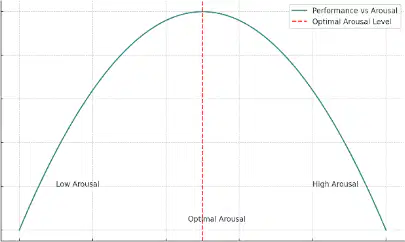
Refer to the graph. A high jumper performs best when their arousal level is moderate (x ≈ 5). Which best explains why performance might decline if arousal increases further?
Excessive arousal may impair motor coordination, leading to poor takeoff technique
High arousal boosts adrenaline, allowing faster execution of technical skills
The athlete’s anaerobic threshold is exceeded, reducing available oxygen for power output
Elevated arousal enhances muscle recruitment, improving jump height
An individual with high neuroticism likely has a _____ IZOF than someone with low neuroticism.
Equal
Similar
Lower
Higher
Measurements of heart rate variation, blood pressure, and the galvanic skin response are all:
Objective measures of cognitive anxiety
Objective measures of somatic anxiety
Subjective measures of cognitive anxiety
Subjective measures of somatic anxiety
catastrophe theory: a sudden and dramatic drop in an athlete’s performance occurs when...
Low physiological arousal and low cognitive anxiety
High physiological arousal and low somatic anxiety
High physiological arousal and high cognitive anxiety
Low physiological arousal and high cognitive anxiety
Under the catastrophe theory, if an athlete’s cognitive anxiety is low, their performance will follow a pattern most similar to the:
Drive theory
Reversal theory
Inverted-U hypothesis
Self determination theory
Which type of anxiety includes experiencing negative symptoms of physiological arousal such as rapid heart rate, sweating, and butterflies?
Cognitive anxiety
Somatic anxiety
Psychological anxiety
Arousal
How is cognitive anxiety measured?
Objectively with physical measurements and data
Subjectively with physical measurements and data
Objectively with self-report questionnaires
Subjectively with self-report questionnaires
Strategies that seek to alter the stressor
Avoidance focused coping
Emotion focused coping
Problem focused coping
coping strategy for managing uncontrollable stressors?
Avoidance focused
Problem focused
Emotion focused
Which coping skill is best for controlling heart rate?
Breathing techniques
Self talk
Imagery
Social support
Why might two athletes respond differently to the same arousal level?
Because arousal only impacts novice athletes
Because perception of arousal varies based on personality and coping skills
Because arousal only affects physiology, not psychology
Because arousal is unrelated to sport performance
Which of the following best explains the difference between a performance goal and a process goal?
Performance goals focus on beating others, while process goals focus on personal bests.
Performance goals are measurable standards, while process goals emphasize the actions or techniques used.
Performance goals are always short-term, while process goals are always long-term.
Performance goals apply only in competition, while process goals apply only in training.
Norm-referenced goals where you are compared against others. (example: being selected for a team or winning 1st place)
Performance goal
Long-term goal
Outcome goal
Process goal
goals that focus on technique and skill execution
Short-term goal
Outcome goal
Performance goal
Process goal
which meets SMART goal criteria?
Ill get better at shooting free throws
Within 8 weeks, I will increase my free-throw shooting percentage from 65% to 75% by completing three focused practice sessions per week.
During the remainder of the season, I will practice free throws more consistently to become a more confident shooter.
By the end of the season, I will demonstrate better shooting technique during games.
Goal setting and self-talk are:
(select all that apply)
Coping skills for stress and anxiety
Psychological skills that need to be practiced
Controlled distraction strategies used to maintain focus.

