
 Worksheets
Final Exam APUSH
Total questions: 174
Worksheet time: 1hrs 27mins
“Barbarians [are] . . . , in the proper and strict sense of the word, dull witted and lacking in the reasoning powers necessary for self-government. They are without laws, without king, etc. For this reason they are by nature unfitted for rule.
“[Some] barbarians . . . have a lawful, just, and natural government. Even though they lack the art and use of writing, they are not wanting in the capacity and skill to rule and govern themselves. . . . Thus they have kingdoms, communities, and cities that they govern wisely according to their laws and customs. . . .
“. . . It does not necessarily follow that [Native Americans] are incapable of government and have to be ruled by others, except to be taught about the Catholic faith and to be admitted to the holy sacraments. They are not ignorant, inhuman, or bestial. Rather, long before they had heard the word Spaniard they had properly organized states, wisely ordered by excellent laws, religion, and custom. They cultivated friendship and . . . lived together in populous cities in which they wisely administered the affairs of both peace and war justly and equitably, truly governed by laws that at very many points surpass ours. . . .
“. . . [Was] the war of the Romans against the [ancient] Spanish justified in order to free them from barbarism? . . . Do you think that the Romans, once they had [conquered] the wild and barbaric peoples of Spain, could with secure right divide all of you [Spaniards] among themselves [in encomiendas] . . . ? And do you then conclude that the Romans could have stripped your rulers of their authority and consigned all of you, after you had been deprived of your liberty, to wretched labors, especially in searching for gold and silver [mines]. . . ? Is this the way to impose the yoke of Christ on Christian men?”
Bartolomé de Las Casas, Spanish Catholic religious leader, In Defense of the Indians, circa 1550
One piece of evidence Las Casas used to support his claim about Native American societies in the third paragraph is that they
had developed large urban areas
were ignorant of Europe before they encountered the Spanish
Sought friendly trading relations with the Spanish
did not practice Christianity
Bartolomé de Las Casas, Spanish Catholic religious leader, In Defense of the Indians, circa 1550
Which of the following claims in the first and second paragraph of the excerpt did Las Casas use to support his overall argument about the capabilities of Native Americans?
Native Americans believed that the Spanish were “barbarians.”
Spain’s European rivals were more like “barbarians” than Native Americans were.
Spain’s behavior toward Native Americans could be called “barbarian.”
Native American societies did not meet the definition of "barbarian"
Bartolomé de Las Casas, Spanish Catholic religious leader, In Defense of the Indians, circa 1550
Which of the following describes a piece of evidence for Las Casas’ claim in the fourth paragraph about the similarity between ancient Spanish people and Native Americans?
The ancient Spanish had a right to their own freedom.
The ancient Spanish were Christians when the Romans arrived.
The ancient Spanish had no laws or political rulers.
The ancient Spanish were used by the Romans as laborers.
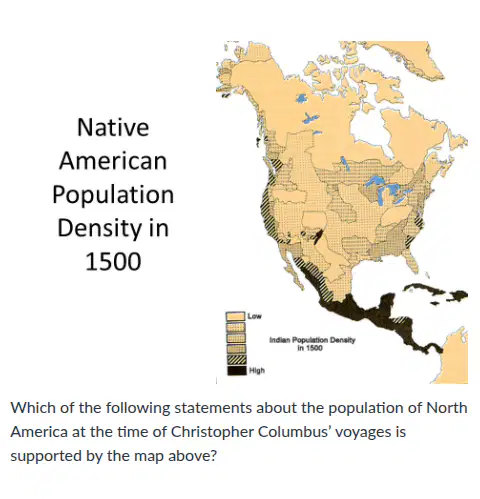
The most densely populated regions of North America would eventually become part of New France.
The most densely populated regions of North America would eventually become part of New Spain.
The American Indian population was distributed uniformly throughout North America.
Compared with other areas of North America, relatively few American Indians lived in the Southeast.
“The development of a plantation economy, beginning in the sixteenth century, transformed Africa, America, Europe, and Asia, too. It displaced the old silk trade and shifted the increasingly dynamic center of the world economy westward to the Atlantic. . . .
“The Atlantic economy supplied eager European consumers with mildly addictive . . . crops like tobacco and coffee, along with sugar. . . . The Atlantic plantation system transformed these three [products] into items of general consumption. . . . Investors prospered, and capital for further economic development accumulated in the [home country]. The governments found funding and motive to develop sea power. The Americas had lucrative export crops and developed a society based on a system of labor exploitation of Africans, and Africa suffered the transport of eleven million of its people to the New World.”
Thomas Bender, historian, A Nation Among Nations: America’s Place in World History, 2006
Which of the following claims does the excerpt make about changes that occurred as a result of new interactions in the Atlantic region?
African kingdoms were the largest purchasers of goods produced in the Americas.
Native Americans amassed fortunes as Europeans paid high prices for rare goods.
Europeans developed new methods of conducting trade and making profits.
Merchants from Asia dominated trade throughout the sixteenth century.
Thomas Bender, historian, A Nation Among Nations: America’s Place in World History, 2006
The second paragraph of the excerpt makes which of the following claims about the introduction to Europe of new crops from the Americas?
They stimulated economies across Europe.
They required little labor to produce.
hey replaced traditional agricultural products.
They remained relatively unpopular.
Thomas Bender, historian, A Nation Among Nations: America’s Place in World History, 2006
The excerpt makes the overall argument that the Atlantic economy
contributed to the collapse of European empires
eliminated competition between European nations
contributed to the persistence of feudal economic systems
drove long-lasting economic shifts across Europe, Africa, and the Americas
“[Before European contact] Cahokia [in present-day Missouri] and such other major centers as those now known as Coosa and Etowah in Georgia, Moundville in Alabama, and Natchez in Mississippi were home to highly stratified societies, organized as chiefdoms and characterized by a sharp divide between elites and commoners. . . . Surrounding networks of agricultural hamlets provided food to support the urban centers. . . .
“From the Ohio River through most of present-day Canada and down the coast to the Chesapeake were speakers of Algonquian languages. . . . Nearly everywhere [here], villages composed of 500 to 2,000 people were the norm. . . .
“[This] Indian country was decentralized and diverse, but not disconnected. . . . Routes of trade and communication, most of them millennia old and following the great river systems, crisscrossed the continent. The goods that moved along them were, for the most part, few and rare. . . . Some closely neighboring people might exchange crucial resources—corn, for instances, for meat or fish.”
Daniel K. Richter, historian, Facing East from Indian Country: A Native History of Early America, 2001
Which of the following best describes the economic system that supported the Native American villages discussed in the second paragraph of the excerpt?
Seminomadic hunting
Settled subsistence farming
Trade and manufacturing of luxury goods
Migration and colonization of new territories
The climate in North America discouraged the development of large settlements.
Native American agriculture encouraged the growth of socially diversified urban areas.
An arid climate led Native Americans to construct irrigation projects in the Mississippi River valley.
Military power helped Native American hunters and gathers to conquer expansive cities.
Daniel K. Richter, historian, Facing East from Indian Country: A Native History of Early America, 2001
Most archaeologists and historians believe that the first peoples who colonized the Americas came from
Asia
Africa
Middle East
Western Europe
Daniel K. Richter, historian, Facing East from Indian Country: A Native History of Early America, 2001
Which of the following most supported the development of the commerce described in the third paragraph?
Native Americans constructed extensive road networks.
Native Americans in the Northeast of North America formed extensive empires.
Maize cultivation spread northward from Mexico.
Metal tools became valuable objects in Native American religions.
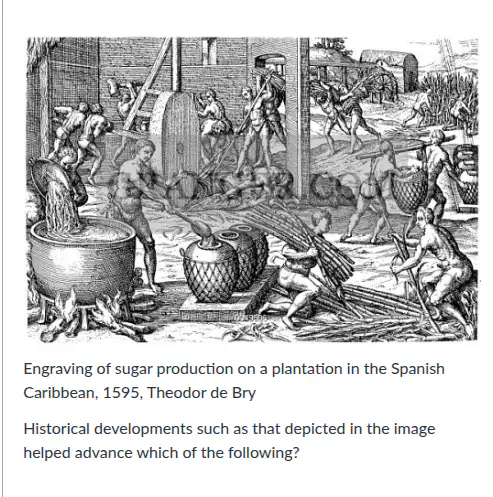
The spread of Spanish influence in the Western Hemisphere
The shift in European economies from capitalism to feudalism
The funding of Christopher Columbus’s expeditions to the Caribbean
The conquest of the European continent by Spain
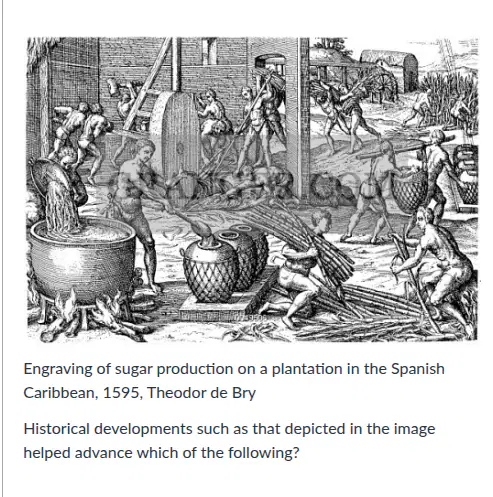
Developments such as that depicted in the image most directly led to which of the following?
The importation of enslaved Africans to the Caribbean
The settling of the eastern North American seaboard by the Spanish
The spread of Spanish missionaries into portions of Florida
The increasing use of indentured servants in the Caribbean
Engraving of sugar production on a plantation in the Spanish Caribbean, 1595, Theodor de Bry
Which of the following most directly contributed to the development depicted in the image?
The search for new sources of wealth in the Caribbean
The emerging European naval capabilities in the Caribbean
The spread of diseases native to the Americas to enslaved African plantation laborers
The North American reliance on imports from the Caribbean
Engraving of sugar production on a plantation in the Spanish Caribbean, 1595, Theodor de Bry
The most important factor that enabled the Spanish to conquer native peoples in Mexico and New Spain in the sixteenth century was the
introduction of trade goods that drove wedges between native peoples and set them to war against each other
introduction of cattle and pigs, which disrupted native patterns of agriculture
introduction of European diseases to which native peoples were not resistant
introduction of Christianity, which weakened the solidarity of native peoples
“Objection 5: But what warrant have we to take that land, which is and has been of long time possessed of others, the sons of Adam?
“Answer: That which is common to all is proper to none. This savage people rule over many lands without title or property; for they enclose no ground, neither have they cattle to maintain it, but remove their dwellings as they have occasion, or as they can prevail against their neighbors. And why may not Christians have liberty to go and dwell amongst them in their waste lands and woods….Secondly, there is more than enough for them and us. Thirdly, God has consumed the natives with a miraculous plague, whereby the greater part of the country is left void of inhabitants. Fourthly, we shall come in with good leave of the natives.”
John Winthrop, General Considerations for the Plantation in New England with an Answer to Several Objections…, 1629
Which European approach to colonization is most consistent with the arguments in the excerpt above?
Using trade alliances and intermarriage with American Indians to acquire products for export to Europe
Integrating a coherent hierarchal imperial structure and pursing economic aims
Sending men and women to acquire land and populate settlements while having relatively hostile relationships with the native inhabitants
Establishing tight control over the colonization process to convert and/or exploit the native populations
“Objection 5: But what warrant have we to take that land, which is and has been of long time possessed of others, the sons of Adam?
“Answer: That which is common to all is proper to none. This savage people rule over many lands without title or property; for they enclose no ground, neither have they cattle to maintain it, but remove their dwellings as they have occasion, or as they can prevail against their neighbors. And why may not Christians have liberty to go and dwell amongst them in their waste lands and woods….Secondly, there is more than enough for them and us. Thirdly, God has consumed the natives with a miraculous plague, whereby the greater part of the country is left void of inhabitants. Fourthly, we shall come in with good leave of the natives.”
John Winthrop, General Considerations for the Plantation in New England with an Answer to Several Objections…, 1629
The author of the excerpt above was most interested in
generating great wealth for the king in England.
converting American Indians to Christianity.
participating in the fur trade with the native communities.
justifying the takeover of American Indian lands.
“Objection 5: But what warrant have we to take that land, which is and has been of long time possessed of others, the sons of Adam?
“Answer: That which is common to all is proper to none. This savage people rule over many lands without title or property; for they enclose no ground, neither have they cattle to maintain it, but remove their dwellings as they have occasion, or as they can prevail against their neighbors. And why may not Christians have liberty to go and dwell amongst them in their waste lands and woods….Secondly, there is more than enough for them and us. Thirdly, God has consumed the natives with a miraculous plague, whereby the greater part of the country is left void of inhabitants. Fourthly, we shall come in with good leave of the natives.”
John Winthrop, General Considerations for the Plantation in New England with an Answer to Several Objections…, 1629
The North American colonial settlements referenced in the passage above tended to
develop staple crop economies based on slave labor.
be dedicated to converting American Indians to Christianity.
establish like-minded, close-knit, homogeneous communities.
be economically, religiously, and ethnically diverse.
“Objection 5: But what warrant have we to take that land, which is and has been of long time possessed of others, the sons of Adam?
“Answer: That which is common to all is proper to none. This savage people rule over many lands without title or property; for they enclose no ground, neither have they cattle to maintain it, but remove their dwellings as they have occasion, or as they can prevail against their neighbors. And why may not Christians have liberty to go and dwell amongst them in their waste lands and woods….Secondly, there is more than enough for them and us. Thirdly, God has consumed the natives with a miraculous plague, whereby the greater part of the country is left void of inhabitants. Fourthly, we shall come in with good leave of the natives.”
John Winthrop, General Considerations for the Plantation in New England with an Answer to Several Objections…, 1629
What was the impact of the “miraculous plague” mentioned in the excerpt above?
It stimulated cultural and demographic change.
It collapsed the fur trade and lessened access to trade goods.
It led to European accommodation with some aspects of American Indian culture.
It increased British colonists’ acceptance of intermarriage with native peoples.
“…Whereas the enforcing of the conscience in matters of religion has frequently fallen out to be of dangerous consequence in those commonwealths where it has been practiced, and for the more quiet and peaceable government of this Province, and the better to preserve mutual love and amity among the inhabitants thereof. Be it therefore enacted that no person or persons whatever in the Province…professing to believe in Jesus Christ, shall from henceforth be any ways troubled, molested, or discountenanced for or in respect of his or her religion nor in the free exercise thereof within the Province…nor in any way compelled to the belief or exercise of any other religion against his or her consent, so [long] as they not be unfaithful to the Lord Proprietary, or molest or conspire against the civil government established in this Province under him…”
Maryland Act Concerning Religion, 1644
William Hand Browne, ed., Archives of Maryland (Baltimore: Maryland Historical Society, 1883).
The passage above was most likely written in response to
the growth of autonomous political communities based on English models.
the ethnic and religious diversity of the middle colonies.
the expanding social networks of the Atlantic World.
Protestant evangelism in North America.
“…Whereas the enforcing of the conscience in matters of religion has frequently fallen out to be of dangerous consequence in those commonwealths where it has been practiced, and for the more quiet and peaceable government of this Province, and the better to preserve mutual love and amity among the inhabitants thereof. Be it therefore enacted that no person or persons whatever in the Province…professing to believe in Jesus Christ, shall from henceforth be any ways troubled, molested, or discountenanced for or in respect of his or her religion nor in the free exercise thereof within the Province…nor in any way compelled to the belief or exercise of any other religion against his or her consent, so [long] as they not be unfaithful to the Lord Proprietary, or molest or conspire against the civil government established in this Province under him…”
Maryland Act Concerning Religion, 1644
William Hand Browne, ed., Archives of Maryland (Baltimore: Maryland Historical Society, 1883).
The ideas expressed in the passage above most clearly show the influence of which of the following?
A strong belief in British cultural superiority
Resistance to imperial control in the British colonies
Greater religious independence in the colonies
The British government’s indifference to colonial governance
"In the name of God, Amen. We, whose names are underwritten, the Loyal Subjects of our dread Sovereign Lord, King James, by the Grace of God, of England, France and Ireland, King, Defender of the Faith, e&.
Having undertaken for the Glory of God, and Advancement of the Christian Faith, and the Honour of our King and Country, a voyage to plant the first colony in the northern parts of Virginia; do by these presents, solemnly and mutually in the Presence of God and one of another, covenant and combine ourselves together into a civil Body Politick, for our better Ordering and Preservation, and Furtherance of the Ends aforesaid; And by Virtue hereof to enact, constitute, and frame, such just and equal Laws, Ordinances, Acts, Constitutions and Offices, from time to time, as shall be thought most meet and convenient for the General good of the Colony; unto which we promise all due submission and obedience.
In Witness whereof we have hereunto subscribed our names at Cape Cod the eleventh of November, in the Reign of our Sovereign Lord, King James of England, France and Ireland, the eighteenth, and of Scotland the fifty-fourth. Anno Domini, 1620."
The Mayflower Compact, 1620
The Mayflower Compact suggests that religious culture among British North American colonists was influenced by:
Interest in commerce and business
Reliance on agriculture
Puritan self-government religious congregation
The king
How was the Mayflower Compact seen as a stepping stone to the creation of the US Constitution?
It gave freedom of worship
It laid out a Bill of Rights
First American government model
Allowed for free expression
The Mayflower Compact, 1620
What facts in the article support the argument that the Pilgrims were democratic?
Renewed efforts to stamp out discrimination
It allowed for a civil union between people
Everyone got to vote
Supported their royal charter to the mother country
“I conceive there lies a clear rule... that the elder women should instruct the younger and then I must have a time wherein I must do it.
“If any come to my house to be instructed in the ways of God what rule have I to put them away?”
“The power of the Holy Spirit dwelleth perfectly in every believer, and the inward revelations of her own spirit, and the conscious judgment of her own mind are of authority paramount to any word of God.”
Anne Hutchinson, 1630s
The excerpts from Anne Hutchinson best represent which of the following developments in the Massachusetts Bay Colony in the 1630s?
Efforts by colonial women to establish independent communities separate from men
Growing disagreement over the expansion of legal rights in the colonial charter
Growing challenges by dissenters to civil authorities
Efforts to raise the level of education for young girls and women
"Various are the reports and conjectures of the causes of the present Indian war. Some impute it to an imprudent zeal in the magistrates of Boston to Christianize those heathen before they were civilized and enjoining them the strict observation of their laws...Some believe there have been vagrant and Jesuitical priests, who have mad it their business, for some years past, to go from Sachem to Sachem, to exasperate the Indians against the English and to bring them into a confederacy, and that they were promised supplies from France and other parts to extirpate (eradicate) the English nation out of the continent of America."
Edward Randolph, report of King Philip's War (Metacom's War) in New England, 1676
The confederacy formed to "exasperate the Indians against the English" was motivated primarily by which of the following?
Forced religious conversion of Wampanoags by Puritan missionaries
Intermarriage with the English which threatened Wampanoag cultural independence
Dispossession of Wampanoag land and threats to their sovereignty
Fraudulent trade deals between the leaders of Plymouth Colony and the Wampanoags
"Various are the reports and conjectures of the causes of the present Indian war. Some impute it to an imprudent zeal in the magistrates of Boston to Christianize those heathen before they were civilized and enjoining them the strict observation of their laws...Some believe there have been vagrant and Jesuitical priests, who have mad it their business, for some years past, to go from Sachem to Sachem, to exasperate the Indians against the English and to bring them into a confederacy, and that they were promised supplies from France and other parts to extirpate (eradicate) the English nation out of the continent of America."
Edward Randolph, report of King Philip's War (Metacom's War) in New England, 1676
Compared with French and Spanish interactions with American Indians, English interaction with American Indians more often promoted
assimilation of American Indians into colonial societies
separation between the groups
cultural blending
respect for political alliances
Edward Randolph, report of King Philip's War (Metacom's War) in New England, 1676
Which of the following best characterizes relations between the English and American Indians in New England following Metacom's War?
Dramatic decline and dispersion of the American Indian population
Religious freedom for the English and American Indians
Peaceful accommodation between both groups
Recognition of American Indian property and land rights
The French colonies in North America and the Middle Colonies had very similar settler populations.
toleration of religious diversity in the Middle Colonies was made a necessity because of patterns of migration
English conquests in the Middle Colonies were harsher than the conquests of other Europ0ean empires in the Americas
The spread of Enlightenment values was the main reason that pluralism developed in the Middle Colonies.
Which of the following describes Landsman's overall argument in the excerpt?
The Middle Colonies faced similar challenges in governing diverse colonists after they became English.
The Middle Colonies were more different from each other than the English colonies in other regions.
The Middle Colonies were similar to each other because they developed plantation agriculture.
The Middle Colonies differed from French colonies because they depended on Native American commerce.
Neal Salisbury, historian, “The Indians’ Old World: Native Americans and the Coming of Europeans,” 1996
A direct result of European exploration of North America during the 1500s and early 1600s was the
smaller role played by Spain in European affairs.
introduction of new animals and crops to North America.
decline of African slavery in North America.
large-scale migration of American Indians to Europe.
Neal Salisbury, historian, “The Indians’ Old World: Native Americans and the Coming of Europeans,” 1996
Which of the following types of evidence would best support the argument in the excerpt?
Diaries from British settlers in Philadelphia
Spanish government reports about American Indians
Artifacts from American Indian settlements
Shipping inventories from trade between Liverpool and Boston
Bartolomé de Las Casas, 1552
An implication of Las Casas’ argument is that a major cause of the decline of the native populations in the Americas after 1492 was the
importation of European and African wildlife to the Americas
epidemics brought to the Americas by Europeans.
large-scale clashes between native armies and the Spanish
resistance of indigenous groups to religious conversion
Bartolomé de Las Casas, 1552
In their colonization of the Americas, the Spanish used the Encomienda system to
limit intermarriage between Spaniards and Native Americans
draft Native Americans into the Spanish military
organize and regulate Native American labor.
improve trade relations with Native Americans
Bartolomé de Las Casas, 1552
Which of the following most directly resulted from the change in the Native American population described by Las Casas?
The Spanish introduced new crops into the Americas, altering the native diet.
Laborers on Hispaniola launched a large-scale rebellion against their Spanish oppressors.
The remaining native groups established alliances with the Spanish colonists.
The Spanish imported Africans as a new source of labor.
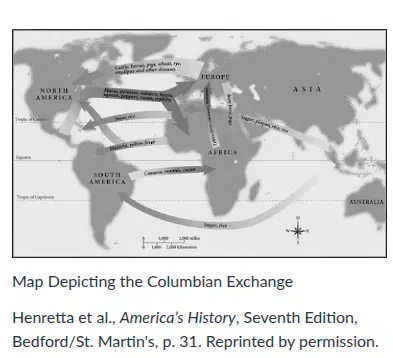
Native peoples and Africans in America maintained their political and cultural autonomy.
most native societies developed a mixed agricultural and hunter-gather economy.
American Indians began the spread of maize cultivation from present-day Mexico northward into the American Southwest.
there were far-reaching effects on native settlement patterns as well as on economic, social, and political developments.
Map Depicting the Columbian Exchange
Henretta et al., America’s History, Seventh Edition, Bedford/St. Martin's, p. 31. Reprinted by permission.
As a result of the process illustrated above, what major shift occurred in the Spanish colonies’ encomienda system?
There were many new converts to Christianity.
Social, religious, political, and economic competition with other European nations developed.
The Spanish began debating the proper treatment of American Indians.
Indian labor was gradually replaced with African slavery.
Map Depicting the Columbian Exchange
Henretta et al., America’s History, Seventh Edition, Bedford/St. Martin's, p. 31. Reprinted by permission.
Which of the following most directly resulted from the arrival of American crops in the Old World?
The development of permanent villages
European population growth
Widespread deadly epidemics
rowing mistrust on both sides of the Atlantic
Map Depicting the Columbian Exchange
Henretta et al., America’s History, Seventh Edition, Bedford/St. Martin's, p. 31. Reprinted by permission.
Based on the map above, what was the primary reason for the growth of the Columbian Exchange?
Spain’s attempts to establish tight control over the process of colonization in the Western Hemisphere.
European attempts to change American Indian beliefs on basic social issues.
Improvements in technology and more organized methods for conducting international trade.
Europeans using their belief in white cultural superiority to justify their subjugation of Africans and American Indians.
“In colonial New England, two sets of human communities which were also two sets of ecological relationships confronted each other, one Indian and one European. They rapidly came to inhabit a single world, but in the process the landscape of New England was so transformed that the Indians’ earlier way of interacting with the environment became impossible. The task before us is not only to describe the ecological changes that took place in New England but to determine what it was about Indians and colonists—in their relations both to nature and to each other—that brought those changes about.”
William Cronon, historian, Changes in the Land: Indians, Colonists, and the Ecology of New England, 1983
During the colonial era, which of the following was a widespread effect of the interactions between European colonists and American Indians described in the excerpt?
Confinement of American Indians to government sponsored reservations.
Increased intensity of warfare between the two groups.
Efforts to assimilate American Indians into White society through land policies and schooling.
Forced migration of American Indians to territories beyond the Mississippi River.
William Cronon, historian, Changes in the Land: Indians, Colonists, and the Ecology of New England, 1983
Which of the following best supports the general argument in the excerpt about how Europeans changed North America?
The establishment of fenced fields on family farms.
The efforts to restrict settlement beyond the Appalachian Mountains.
The emergence of racially and culturally mixed populations.
The spread of maize culture.
“In 1680 Pueblo leaders united most of their communities against the European intruders....In a matter of weeks, the Pueblos had eliminated Spaniards from New Mexico above El Paso. The natives had killed over 400 of the province’s 2,500 foreigners, destroyed or sacked every Spanish building, and laid waste to the Spaniards’ fields. There could be no mistaking the deep animosity that some natives, men as well as their influential wives and mothers, held toward their former oppressors.... Some Pueblo leaders...urged an end to all things Spanish as well as Christian. After the fighting subsided, they counselled against speaking Castilian or planting crops introduced by the Europeans.”
David J. Weber, historian, The Spanish Frontier in North America, 1992
English colonization patterns in North American differed most from Spanish colonization in that the English
adopted some of Native Americans’ more egalitarian views on the roles of women.
enjoyed relatively peaceful relations with Native Americans.
more often settled as families and rarely intermarried with Native Americans.
relied more on coerced labor from Native Americans.
David J. Weber, historian, The Spanish Frontier in North America, 1992
The conflict described in the excerpt led primarily to which of the following changes in Spanish colonial policy?
Removal of Native Americans to reservations.
Widespread use of warfare to maintain control of Native Americans.
Greater accommodation to Native American cultures.
Scaling back of the Spanish presence in North America.
David J. Weber, historian, The Spanish Frontier in North America, 1992
Which of the following most shaped the events described in the excerpt?
The importance of Old World crops to the subsistence of Spanish colonial subjects.
The demands of the encomienda system in the Spanish colonies.
The establishment of African slavery in the Spanish colonies.
The amount of Spanish intermarriage with Native Americans.
“[S]ince a report had been made to the king on the fertility of the soil by [Sieur de Monts] and by me on the feasibility of discovering the passage to China, . . . his Majesty directed Sieur de Monts to make a new outfit, and send men to continue what he had commenced. . . . He was also influenced by the hope of greater advantages in case of settling in the interior, where the people are civilized,... than along the sea-shore, where the [natives] generally dwell. From this course, he believed the king would derive an inestimable profit; for it is easy to suppose that Europeans will seek out this advantage rather than those of a jealous and intractable disposition to be found on the shores.”
Samuel de Champlain, French explorer, 1604
French exploration of North America, as reflected in the excerpt, most directly contributed to which of the following?
Population decline in France as a result of migration to the American colonies.
The ongoing shift from feudalism to capitalism in Western Europe.
Western European acceptance of the racial and cultural equality of American Indians.
An economy based on agricultural surpluses in French North America.
Samuel de Champlain, French explorer, 1604
The French most differed from the Spanish in relations with American Indians in that the French
developed stronger alliances with American Indians.
converted more American Indians to Catholicism.
more frequently enslaved American Indians
did not intermarry with American Indians
“I said everything to them I could to divert them from their idolatries, and draw them to a knowledge of God our Lord. Moctezuma replied, the others assenting to what he said, that they had already informed me they were not the aborigines of the country, but that their ancestors had emigrated to it many years ago; and they fully believed that after so long an absence from their native land, they might have fallen into some errors; that I having more recently arrived must know better than themselves what they ought to believe; and that if I would instruct them in these matters, and make them understand the true faith, they would follow my directions, as being for the best. Afterwards, Moctezuma and many of the principal citizens remained with me until I had removed the idols, purified the chapels, and placed the images in them, manifesting apparent pleasure.”
Letter from Hernán Cortés to Charles V, Holy Roman Emperor and King of Spain, on his interaction with the Mexica (Aztecs), 1520
Moctezuma’s statement that the Mexica “were not the aboringines of the country” most likely refers to which of the following developments?
Use of the encomienda system by the Mexica before the arrival of the Spanish.
Widespread deadly epidemics before the arrival of the Spanish.
The presence of different and complex societies before European contact.
The development of African slavery in the Spanish colonies.
Letter from Hernán Cortés to Charles V, Holy Roman Emperor and King of Spain, on his interaction with the Mexica (Aztecs), 1520
The interaction between Cortés and Moctezuma most strongly demonstrates Cortés’
desire for increased power and status
consolidation of plantation-based agriculture.
support for the European shift from feudalism to capitalism
promotion of long-distance trade
Letter from Hernán Cortés to Charles V, Holy Roman Emperor and King of Spain, on his interaction with the Mexica (Aztecs), 1520
Which of the following was a primary feature of social relations established in the Spanish colonies in the Western Hemisphere?
The emergence of racially mixed populations mingling European settlers, Native Americans, and Africans
The development of a rigid racial hierarchy
A close-knit, homogenous society with a thriving mixed economy of agriculture and commerce based on export crops
The growth of friendship and cooperation with native peoples
John Smith, English explorer relating events in the Virginia colony, 1608
Smith most likely wrote his account for which of the following reasons?
To promote an alliance between colonists in Virginia and colonists elsewhere in the Americas
To increase support for the colony from the monarchy and investors
To recruit missionaries to come to the Virginia colony
To encourage the Virginia colonists to abandon the colony
John Smith, English explorer relating events in the Virginia colony, 1608
Smith’s account of the hardships experienced in the Virginia colony most directly encouraged which of the following changes in subsequent settlements?
Intensified efforts to find gold and other precious metals
Creation of the encomienda labor system
Expanded collaboration with the Spanish
Increased attention to farming and agriculture
John Smith, English explorer relating events in the Virginia colony, 1608
Smith’s description of the Pamunkey people’s interactions with the Virginia colonists best serves as evidence of which of the following characteristics of American Indians along the Eastern Seaboard in the 1600s?
Complex societies with permanent settlements
A dependence on English trade goods
Elaborate caste systems
Decreased populations due to epidemic disease
John Smith, English explorer relating events in the Virginia colony, 1608
The Virginia colonists’ interactions with American Indians, as described in the excerpt, most directly contributed to which of the following?
English colonists became primarily concerned with converting American Indians to Christianity
The English sought political alliances with American Indians in an attempt to establish equal sovereignty for both groups
English colonists routinely intermarried with American Indians in an effort to blend the cultures of both groups
English relations with American Indians became mostly hostile and characterized by conflict
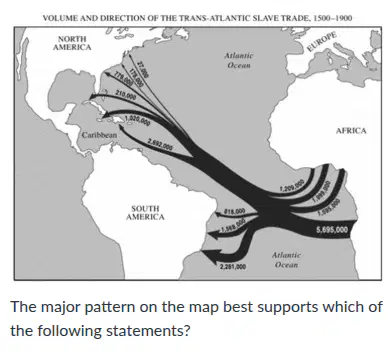
Enslaved Africans were more likely to live on large plantations in North America than in the Caribbean.
British colonies in North America typically had a lower demand for slave labor than did the colonies of other European countries.
Fewer people lived in the British colonies than in the Spanish colonies.
Africans in North America were more likely to resist slavery than were Africans in South America.
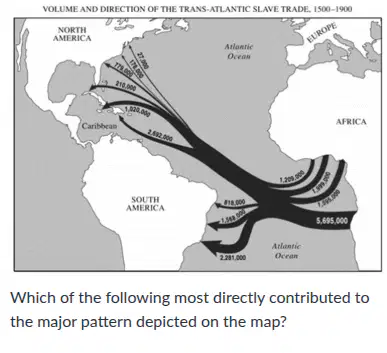
Demand for crops produced in the Americas
The spread of ideas associated with the European Enlightenment
Africans’ adaptation to the culture of the Western Hemisphere
The growth of the fur trade in the North American colonies
Excerpts from "Nathaniel Bacon, His Manifesto Concerning the Present Troubles in Virginia," which was composed and issued during the July 1676 "convention" held at Middle Plantation.
According to the excerpt, one of Nathaniel Bacon’s main issue’s in the dispute was
The perceived failure of Virginia’s governor to protect the frontier from Indian raids.
the under-representation of the back country in Virginia’s legislature.
the refusal of large planters to honor the terms of contracts with former indentured servants.
the jailing of individuals for failure to pay taxes during a time of economic hardship
Excerpts from "Nathaniel Bacon, His Manifesto Concerning the Present Troubles in Virginia," which was composed and issued during the July 1676 "convention" held at Middle Plantation.
Bacon’s Rebellion was supported mainly by
those protesting the increased importation of African slaves.
young men frustrated by their inability to acquire land
people from Jamestown only.
the planter class of Virginia
Excerpts from "Nathaniel Bacon, His Manifesto Concerning the Present Troubles in Virginia," which was composed and issued during the July 1676 "convention" held at Middle Plantation.
As a result of Bacon’s Rebellion,
planters began to look for less troublesome laborers.
Nathaniel Bacon was named to head the Virginia militia.
African slavery was reduced.
Governor Berkeley was promoted by the King.
Jay Gitlin, historian, “Empires of Trade, Hinterlands of Settlement,” 1994
The relationship between American Indians and the French described in the excerpt was most similar to the relationship between American Indians and the
Dutch
British
Spanish
Portuguese
Jay Gitlin, historian, “Empires of Trade, Hinterlands of Settlement,” 1994
Which of the following evidence could best be used to support Gitlin’s argument in the excerpt?
Military conflicts between the French, Dutch, British, and Spanish.
Intermarriage between French colonists and American Indians.
European efforts to arm American Indians.
The use of slave labor to produce sugar in Louisiana.
Hugh Jones, The Present State of Virginia, 1724
The labor system described in the first paragraph of the excerpt was most similar to the labor system used for
mining in New Spain
whaling in New England
acquiring furs in New France
producing sugar in the Caribbean
Hugh Jones, The Present State of Virginia, 1724
The development described in the excerpt represented which of the following long-term trends in Virginia?
The Anglicization of colonial culture
The hardening of racial divisions
The dominance of subsistence farming
The oversupply of indentured laborers
Hugh Jones, The Present State of Virginia, 1724
The economy of the Middle Colonies differed from the economy of Virginia described in the excerpt in that the Middle Colonies more often
engaged in trans-Atlantic commerce
purchased land from Native Americans
imported enslaved Africans
relied on enslaved labor in the cities
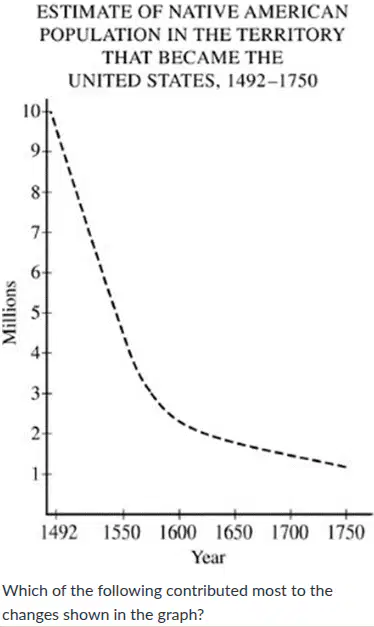
Warfare with Europeans
Loss of territory and access to natural resources
The introduction of new diseases
The introduction of new plants and animals
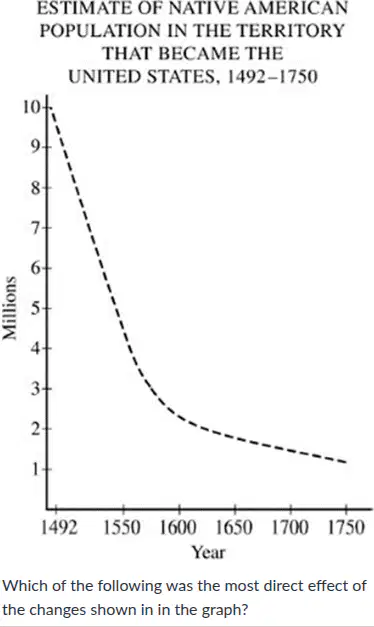
European settlers were able to gain control over Native American lands.
Conflicts among Native American groups became more intense.
Trade between European settlers and Native Americans expanded.
European settlers relied mainly on indentured servants and enslaved Africans for labor.
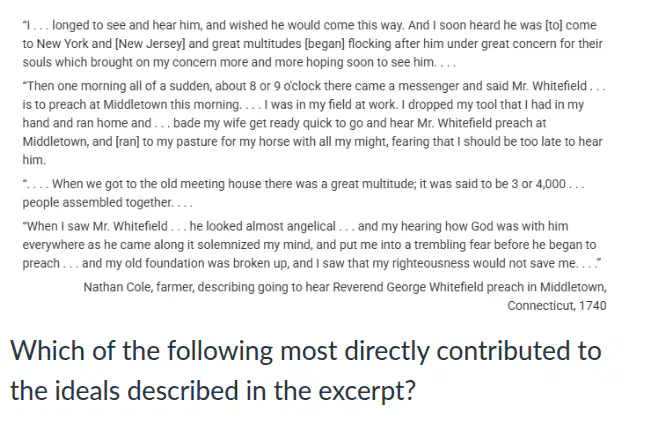
The large number of enslaved people in the colonies expanded the influence of non-European cultural traditions.
The increasing social mobility of colonists encouraged the promotion of religious revivals emphasizing hierarchy and authority.
The British colonies became part of a trans-Atlantic print culture that facilitated the spread of European ideas.
The widespread production of cash crops contributed to increasing prosperity throughout the colonies.
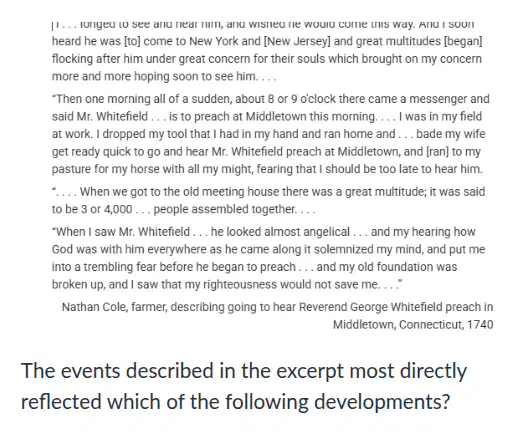
The exchange of Enlightenment ideas between Europe and the Americas
Concerns about political corruption among colonial officials
Efforts across New England to convert Native Americans
The spread of the First Great Awakening from Britain to North America
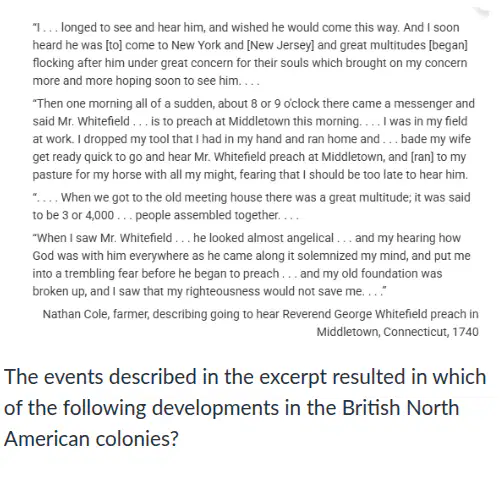
Colonial assemblies attempted to assert more independence from Britain.
Britain enacted mercantilist policies to protect its economy from competition.
Protestant evangelicalism furthered the Anglicization of the colonies.
Religious leaders in New England expanded support for the abolitionist movement.
“These colonies ought to regard the act with abhorrence. For who are a free people? Not those over whom government is reasonably and equitably exercised but those who live under a government, so constitutionally checked and controlled, that proper provision is made against its being otherwise exercised. The late act is founded on the destruction of constitutional security.… In short, if they have a right to levy a tax of one penny upon us, they have a right to levy a million upon us. For where does that right stop?...To use the words of Mr. Locke, ‘What property have we in that, which another may, by rights take, when he pleases, to himself?’…We are therefore—I speak it with grief—I speak with indignation—we are slaves.”
John Dickinson, Letter from a Farmer, 1768
John Dickinson, Letters from a Farmer in Pennsylvania to the Inhabitants of the British Colonies (New York: The Outlook Company, 1903), 75–78.
The passage above was written in response to
British efforts to tax the colonies.
calls for a stronger central government.
the perceived corruption of the British government.
debates over the issue of slavery.
John Dickinson, Letter from a Farmer, 1768
John Dickinson, Letters from a Farmer in Pennsylvania to the Inhabitants of the British Colonies (New York: The Outlook Company, 1903), 75–78.
Which of the following historical developments most directly precipitated the conditions leading to the argument in the passage above?
The spread of French revolutionary ideas throughout Europe
The growth of the Atlantic economy during the 18th century
The indifference of the British government to colonial governance
The large British debt incurred from the Seven Years’ War
"Virtual Representation," 1775
The image above can best be seen as depicting
the support of colonial independence by European allies.
loyalist opposition to colonial independence movements.
the dangerous influence of the French Revolution.
the British government constraining colonial rights.
"Virtual Representation," 1775
Which of the following turning points set the stage for the controversy depicted in the cartoon above?
Britain’s victory over France in North America
The American Revolutionary War
The spread of French revolutionary ideas throughout Europe
The signing of the Declaration of Independence
"Virtual Representation," 1775
The American independence movement was least fueled by
the fear of attack from other European powers.
colonial economic concerns.
the impact of revivals and evangelical ideas.
Enlightenment political thought.
-Resolutions of the Stamp Act Congress, 1765
The resolution of the Stamp Act Congress expressed respect for which person or group?
the King
residents of England
leaders in Parliament
colonial merchants
-Resolutions of the Stamp Act Congress, 1765
The Stamp Act placed on the colonies was a tax that was
indirect
to regulate trade
to support a church
direct
-Resolutions of the Stamp Act Congress, 1765
Which of the following was a direct British response to the colonial views expressed by the Stamp Act Congress?
Coercive Act
Sugar Act
Declaratory Act
Quartering Act
-Instructions to the Virginia Delegates to the First Continental Congress, Williamsburg, 1774.
Which of the following actions by the colonists is most similar to the one recommended in the excerpt above?
the Massachusetts Circular Letter
the Committees of Correspondence
The Boston Massacre
The Boston Tea Party
-Instructions to the Virginia Delegates to the First Continental Congress, Williamsburg, 1774.
Which of the following is the underlying goal of the colonists in the excerpt?
win political representation
educe the overall level of taxes
promote free trade
declare independence
Albany Plan of Union, 1754
Documents Illustrative of the Formation of the Union of the American States, ed. Charles C. Tansill. (Washington, D.C.: Government Printing Office, 1927) House Document No. 398.
The excerpt above is best understood in the context of the
spread of European conflicts to North America.
increasing economic exchanges within the “Atlantic World.”
Anglicization of the British colonies
resistance to imperial control in the British colonies.
Albany Plan of Union, 1754
Documents Illustrative of the Formation of the Union of the American States, ed. Charles C. Tansill. (Washington, D.C.: Government Printing Office, 1927) House Document No. 398.
The authors of the excerpt above were most likely motivated by
the British government’s relative indifference to colonial governance.
Britain’s desire to maintain a viable North American empire.
resistance to imperial control.
the political thought of the Enlightenment.
Albany Plan of Union, 1754
Documents Illustrative of the Formation of the Union of the American States, ed. Charles C. Tansill. (Washington, D.C.: Government Printing Office, 1927) House Document No. 398.
The excerpt above is indicative of which of the following?
The colonial production of commodities that were valued in Europe
An ideology critical of perceived corruption in the imperial system
Growing mistrust on both sides of the Atlantic
The colonists having grown accustomed to a large measure of autonomy
Paul Johnson, historian, A History of the American People, 1997
Britain attempted to pay for the debt resulting from the Seven Years’ War (French and Indian War) by
sponsoring expeditions to locate valuable resources
increasing taxes on goods bought and sold in the colonies
charging immigrants a fee to relocate to North America
selling ships from its navy to colonial merchants
Paul Johnson, historian, A History of the American People, 1997
The British government attempted to restrict westward settlement following the Seven Years’ War (French and Indian War) in order to
minimize conflicts with Native Americans
discourage immigration to the North American colonies
give French settlers time to leave Canadagive French settlers time to leave Canada
give French settlers time to leave Canadagive French sett
Paul Johnson, historian, A History of the American People, 1997
Which of the following contributed to the outbreak of the Seven Years’ War (French and Indian War) in North America?
Spanish attempts to end British control of the trans-Atlantic slave trade
Efforts by Britain to monopolize tobacco sales in Europe
Britain’s desire to enact new taxes on Native American nations
Intensified competition between France and Britain over colonies
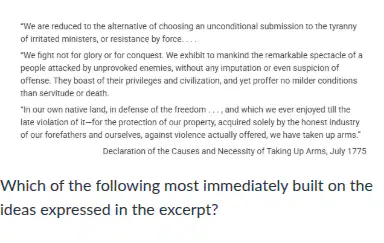
The writing of The Federalist papers
The drafting of the United States Constitution
The publication of the pamphlet Common Sense
The issuing of George Washington’s Farewell Address
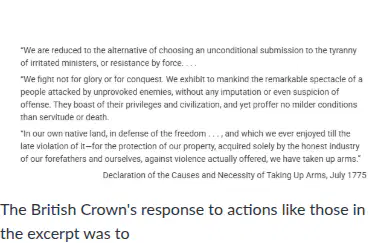
agree to meet with colonial representatives
appoint a new prime minister
adopt a new form of imperial government
declare the American colonies to be in open rebellion
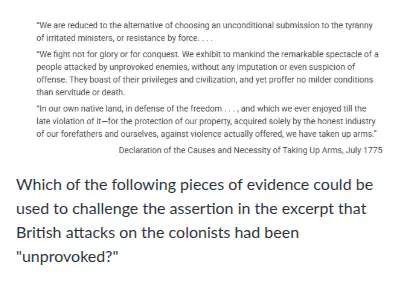
Efforts by Quakers and Germans in the mid-Atlantic colonies to promote pacifism and remain neutral
The outbreak of skirmishes between Patriot and Loyalist forces throughout the southern colonies
A series of popular boycotts, mob protests, and violence against royal officials
The extension of a petition of reconciliation by members of the Second Continental Congress
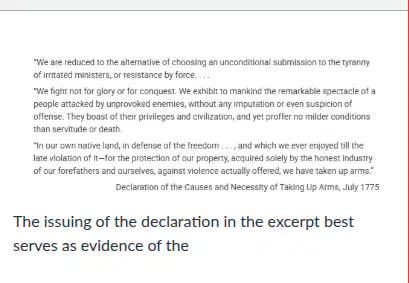
Patriot inclusion of abolitionism as a goal of the resistance
efforts of colonists to protect their rights as English subjects
colonial demand for complete independence from Britain
desire of the majority of colonists to launch offensive attacks against the British
The Navigation Act of 1660
The policies stated in the above law can best be seen as an example of
mercantilism
mercantilism
Enlightenment thinking
communism
capitalism
The Navigation Act of 1660
What accounts most for the scant success of the above law in modifying English colonial behavior in North America?
Decades of the British government’s relative indifference to colonial governance
The presence of slavery and growing colonial wars
Weak economic growth and the lack of external competition
The rejection of Anglicanism in the colonies
The Navigation Act of 1660
Which of the following had the most impact in shaping colonial resistance to the above law?
Political thought shaped by the Enlightenment
Colonial dedication to mercantilist principles
Conflicts with American Indian groups
The growth of the African slave trade
The Navigation Act of 1660
After the Seven Years’ War, Britain shifted its position on imperial regulations to
promote greater colonial migration to the West.
end trading, commerce, and negotiations with American Indians.
alleviate its massive debt from the war.
find ways to safeguard its borders and maintain neutral trading rights.
-Alexander Hamilton, “A Proposal to Arm and Then Free the Negroes,” 1779.
For some the Revolutionary War was also a civil war because of the role played in the war by the
Quakers
Native Americans
African Americans
Loyalists
-Alexander Hamilton, “A Proposal to Arm and Then Free the Negroes,” 1779.
Which of the following was the primary reason for Hamilton's call for African American soldiers?
The Declaration of Independence called for equal rights
The British were recruiting African Americans
The New York militia was short of troops
General Washington trusted that blacks would make good soldiers
John Dickinson, Letter from a Farmer, 1768
John Dickinson, Letters from a Farmer in Pennsylvania to the Inhabitants of the British Colonies (New York: The Outlook Company, 1903), 75–78.
Which group would most likely have supported the sentiments expressed in the passage above?
Whigs in the 1830s & 1840s
Loyalists in the 1770s & 1780s
Republicans in the 1850s & 1860s
Backcountry rebels in the 1780s & 1790s
The Sedition Act, 1798
Excerpted text from congressional bill, July 14, 1798.
The excerpt above best serves as evidence of the
challenges faced by traditional imperial systems
influence of Enlightenment ideals.
difficulty of creating a multiethnic American identity.
bitter political debates of the 1790s.
The Sedition Act, 1798
Excerpted text from congressional bill, July 14, 1798.
Passage of the above legislation was most consistent with the sentiments of
Thomas Paine’s Common Sense.
the Declaration of Independence.
British laws passed after the end of the Seven Years’ War.
the Articles of Confederation.
The Sedition Act, 1798
Excerpted text from congressional bill, July 14, 1798.
The legislation above was passed in response to which of the following challenges?
The constant fear of Indian attacks along the border
The threat posed by foreign alliances and entanglements
The potential for loyalist criticism and sabotage
The limitations of the Articles of Confederation
Mercy Otis Warren, Observations on the New Constitution, and on the Federal and State Conventions, by a Columbian Patriot, Boston, 1788.
The excerpt above most clearly reflects the
limitations of the Articles of Confederation.
fears many people had of centralized federal power.
challenge posed by democracy to traditional imperial systems.
growth of a more participatory democracy.
Mercy Otis Warren, Observations on the New Constitution, and on the Federal and State Conventions, by a Columbian Patriot, Boston, 1788.
The excerpt above was most clearly written in response to
concern that hereditary privilege would replace individual talent.
debates over the ratification of the United States Constitution.
fears of the impact of revolutionary ideas from France, Haiti, and Latin America
compromises at the Constitutional convention over representation.
Mercy Otis Warren, Observations on the New Constitution, and on the Federal and State Conventions, by a Columbian Patriot, Boston, 1788.
The arguments expressed in the passage above most clearly warn against the perceived dangers of
republicanism.
democracy.
limited government.
a strong central government.
-Thomas Jefferson (anonymously), Kentucky Resolution, Nov. 1798.
The Kentucky and Virginia Resolutions were issued in reaction to the
the revelations about the XYZ Affair
the declaration of the Proclamation of Neutrality
passage of the Alien & Sedition Acts
ratification of the Bill of Rights
-Thomas Jefferson (anonymously), Kentucky Resolution, Nov. 1798.
The dispute involving the Kentucky Resolutions demonstrated that some people had rejected Washington's warning against
encouraging sectional difference
forming permanent foreign alliances
creating a national bank
getting involved in European affairs
-Thomas Jefferson (anonymously), Kentucky Resolution, Nov. 1798.
Which individual or group would be the strongest supporter of the Kentucky Resolution?
John Adams
Alexander Hamilton
Democratic-Republicans
Federalists
George Washington, Farewell Address, 1796
From James D. Richardson, ed., A Compilation of the Messages and Papers of the Presidents (Washington, D.C.: U.S. Government Printing Office, 1896–1899), 1:205–216 passim.
The speech above best reflects which of the following continuities in United States history?
Debates over the relationship between federal and state governments
Debates over the proper role of political parties
Debates over how to properly interpret the Constitution
Debates over the relationship between the executive and legislative branches
George Washington, Farewell Address, 1796
From James D. Richardson, ed., A Compilation of the Messages and Papers of the Presidents (Washington, D.C.: U.S. Government Printing Office, 1896–1899), 1:205–216 passim.
Which of the following most directly prompted the arguments in the speech above?
Disagreements over the French Revolution and foreign policy
Internal unrest and backcountry rebellions against federal taxation
The French withdrawal from North America and renewed Indian attacks
Debates over calls to abolish slavery and expand democracy
Secretary of War Henry Knox, 1789
From Henry Knox to George Washington, July 7, 1789, in American State Papers, Class II: Indian Affairs (Washington, DC: Gales and Seaton, 1832), 1:52–54.
The proposals outlined in the excerpt above are most similar to the prior approach of which European country toward American Indians in the 1600s and 1700s?
Spain
England
Portugal
France
Secretary of War Henry Knox, 1789
From Henry Knox to George Washington, July 7, 1789, in American State Papers, Class II: Indian Affairs (Washington, DC: Gales and Seaton, 1832), 1:52–54.
The excerpt above is most clearly a response to
American Indian tribes’ worldviews on land and gender roles.
the competition and violent conflict for land in the West among white settlers, American Indian tribes, and Mexican Americans.
American Indian tribes repeatedly adjusting their alliances with Europeans, other tribes, and the federal government.
the failure of the Constitution to define the relationship between American Indian tribes and the federal government.
Secretary of War Henry Knox, 1789
From Henry Knox to George Washington, July 7, 1789, in American State Papers, Class II: Indian Affairs (Washington, DC: Gales and Seaton, 1832), 1:52–54.
During the late 1700s, which of the following was the most difficult challenge for most American Indian groups?
Navigating frontier conflicts between England, Spain, and US
treaty disputes and seizure of indian lands
gaining free navigation of the Mississippi River
Unwanted attention to assimilate Indian groups into American Society
-Jonathan Mayhew, church minister, “On Unlimited Submission to Rulers,” 1750.
According to Mayhew, the people should be willing to challenge abuses by the
church ministers
slave owners
royal governors
king
-Jonathan Mayhew, church minister, “On Unlimited Submission to Rulers,” 1750.
Which of the following possible influences on Mayhew is most clearly reflected in his statement?
The Great Awakening
The ideas of the Enlightenment
The rulings by royal governors
The teachings in colonial colleges
-Jonathan Mayhew, church minister, “On Unlimited Submission to Rulers,” 1750.
Mayhew would probably apply his warning, “not use our liberty for a cloak of maliciousness” to
The Mayflower Compact
he Act of Toleration
he Zenger case
Bacon’s Rebellion
-Jonathan Mayhew, church minister, “On Unlimited Submission to Rulers,” 1750.
What was the context in which Mayhew was writing?
democratic practices were slowly decreasing
the Great Awakening was making authorities stronger
estriction on voting were becoming tighter
opposition to British rule of the colonies was increasing
“Wherefore, security being the true design and end of government, it unanswerably follows that whatever form thereof appears most likely to ensure it to us, with the least expense and greatest benefit, is preferable to all others…. Here too is the design and end of government, Freedom and Security.”
-Thomas Paine, Common Sense, 1776
“[G]overnments are instituted among Men, deriving their just powers from the consent of the governed. That whenever any Form of Government becomes destructive of these ends, it is the Right of the People to alter or to abolish it, and to institute new Government, laying its foundation on such principles and organizing its powers in such form, as to them shall seem most likely to effect their Safety and Happiness.”
-Thomas Jefferson, Declaration of Independence, 1776
The excerpts were written in response to the
colonial governments’ attempts to extend political rights to new groups.
British government’s attempt to assert greater control over the North American colonies.
British government’s failure to protect colonists from attacks by American Indians.
colonial governments’ failures to implement mercantilist policies.
“Wherefore, security being the true design and end of government, it unanswerably follows that whatever form thereof appears most likely to ensure it to us, with the least expense and greatest benefit, is preferable to all others…. Here too is the design and end of government, Freedom and Security.”
-Thomas Paine, Common Sense, 1776
“[G]overnments are instituted among Men, deriving their just powers from the consent of the governed. That whenever any Form of Government becomes destructive of these ends, it is the Right of the People to alter or to abolish it, and to institute new Government, laying its foundation on such principles and organizing its powers in such form, as to them shall seem most likely to effect their Safety and Happiness.”
-Thomas Jefferson, Declaration of Independence, 1776
The ideas about government expressed by Paine and Jefferson are most consistent with which of the following?
The belief in Manifest Destiny.
The principle of religious freedom.
The concept of hereditary rights and privileges.
The ideas of Enlightenment.
The principles expressed by Paine and Jefferson best account for which of the following features of the United State during and immediately after the American Revolution?
The development of factions and nascent political parties.
The growth of conflict between wealthy elites and poor farmers and laborers.
The relatively limited powers of the Articles of Confederation.
The rapid expansion of frontier settlements.
Mary Elizabeth Norton, historian, “The Philadelphia Ladies Association,”
American Heritage, 1980
The women described in the excerpt would have most typically engaged in which of the following activities during the Revolutionary era?
Writing plays in support of independence
Joining militias so that they could fight on the front lines of battle.
Producing goods for the Patriot cause.
Campaigning for the right to vote as a wartime measure.
Mary Elizabeth Norton, historian, “The Philadelphia Ladies Association,”
American Heritage, 1980
Which of the following pieces of evidence could best be used to support the argument in the excerpt?
Correspondence between husbands and wives involved in Revolutionary politics.
A record of deeds and land titles held by widows during the American Revolution.
Statistics showing the changes in average family size before and after the Revolution.
Studies comparing the literacy rates for men and women during the Revolutionary Era.
Mary Elizabeth Norton, historian, “The Philadelphia Ladies Association,”
American Heritage, 1980
During and immediately after the Revolutionary era, which of the following resulted most directly from the efforts of women such as those described in the excerpt?
The creation of a national network of abolitionist societies.
The ideal that women would teach republican values.
The reform laws regarding women’s property ownership.
The extension of voting rights to women nationwide.
Chief Justice John Marshall, McCullough v. Maryland, 1819
Which of the following did NOT result from the Supreme Court ruling above or similar rulings by the Supreme Court in the early 1800s?
The Court determining the meaning of the Constitution
The promotion of regional interests over national concerns
The recognition of federal power over state laws
The assertion of the primacy of the judiciary
“Many years after his first election to the presidency, Thomas Jefferson commented that ‘the revolution of 1800’ was as ‘real a revolution in the principles of our government as that of 1776 was in its form.’…For him the election of 1800 was a turning point because it marked a turning back to the true republican spirit of 1776.…Within the Jeffersonian framework of assumptions and beliefs, three essential conditions were necessary to create and sustain such a republican political economy: a national government free from any taint of corruption, an unobstructed access to an ample supply of open land, and a relatively liberal international commercial order that would offer adequate foreign markets for America’s flourishing agricultural surplus.”
Drew R. McCoy, The Elusive Republic: Political Economy in Jeffersonian America, 1980
Drew R. McCoy, The Elusive Republic: Political Economy in Jeffersonian America (Chapel Hill: The University of North Carolina Press, 1980).
Which of the following best exemplified the Jeffersonian embrace of the ideals described in the excerpt above?
The National Bank
The Missouri Compromise
The American System
The Louisiana Purchase
Chief Justice John Marshall, McCullough v. Maryland, 1819
The ideas expressed in the excerpt above can best be understood in the context of debates over
the scope of the federal government’s role in the economy.
how to match democratic political ideals to political institutions.
the authority of different branches of the federal government.
the relationship between the federal government and state governments
Drew R. McCoy, The Elusive Republic: Political Economy in Jeffersonian America, 1980
Drew R. McCoy, The Elusive Republic: Political Economy in Jeffersonian America (Chapel Hill: The University of North Carolina Press, 1980).
Which of the following antebellum-era historical developments most conflicted with the goals of Jeffersonian Republicans as outlined in the excerpt above?
The nation’s transformation toward a more participatory democracy
The acceleration of a national and international economy
The emergence of a new national culture
The growth of northern industry and regional economic specialization
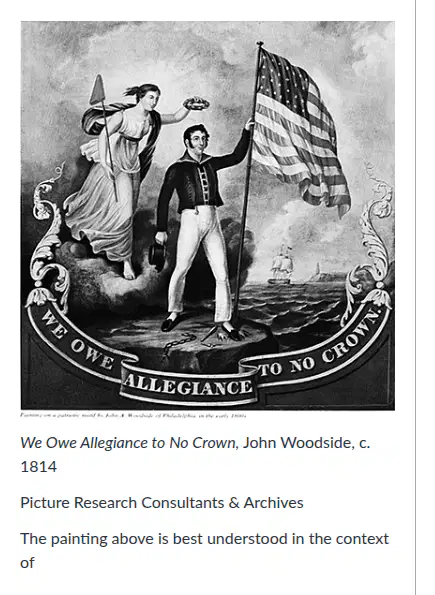
increased migration from Europe to the United States.
the emergence of a new national culture.
federal efforts to assert authority over the states
U.S. dominance over the North American continent.
We Owe Allegiance to No Crown, John Woodside, c. 1814
Picture Research Consultants & Archives
The sentiments expressed in the painting above best reflect which of the following antebellum-era historical developments?
The acquisition of new western territories
The impact of liberal social ideas from abroad
The U.S. interest in increasing foreign trade
The struggle to create an independent global presence
James Monroe, The Monroe Doctrine, 1823
Who of the following provided the strongest influence of President Monroe in the writing of the Monroe Doctrine?
George Washington
John Quincy Adams
John Adams
Thomas Jefferson
James Monroe, The Monroe Doctrine, 1823
Monroe counted on which of the following European nations to be an ally if any nation challenged the Monroe Doctrine?
Spain
France
Britain
Russia
James Monroe, The Monroe Doctrine, 1823
Which best explains why the American people were so supportive of the Monroe Doctrine?
Sectionalism
States’Rights
Dislike of Britain
Nationalism
Tecumseh, Letter to Governor William Henry Harrison, August 1810
Tecumseh believed that which of the following would be the best way for the American Indians to respond to the desire of white settlers for land?
Forming a confederacy among all American Indians
Moving westward to lands unoccupied by American Indians
Joining the British in order to stop westward expansion
Signing a treaty with the United States
Tecumseh, Letter to Governor William Henry Harrison, August 1810
Tecumseh objected to the treaty selling Indian land because he thought
American Indians were always encroaching on settlements
the white settlers would divide the land among them
no individual or single tribe had the right to sell the land
the price offered by the United States was too low
Senator Obadian German of New York, Speech in the Senate, June 1812
Based on the tone of the excerpt, which of the statements below best expresses Germanś position on declaring war in June of 1812
He opposed going to war because he did not believe the country was prepared for one
He opposed the war because he thought people did not have the right attitude about fighting
He supported the war to prevent British troops from Canada invading New York and other northern states
He supported going to war immediately against both Great Britain and France
Senator Obadian German of New York, Speech in the Senate, June 1812
Who of the following would be most likely to agree with German’s position on the war?
Henry Clay and other politicians from the West
Merchants from New England
John Calhoun and other politicians from the South
James Madison and other politicians from the executive branch
Senator Obadian German of New York, Speech in the Senate, June 1812
Which of the following is the best support for Germanś claim that the United States has abundant cause for war?
the impressment of US sailors
the findings of the Lewis and Clark Expedition
the controversy over the Louisiana Purchase
the actions by the Barbary Pirates
-Thomas Jefferson, First Inaugural Address, 1801
According to Jefferson’s address, which of the following should be relied on to protect equal rights for all people?
elections
laws
religion
the majority
-Thomas Jefferson, First Inaugural Address, 1801
Which person would most strongly disagree with Jefferson’s statement, “We are all Republicans, we are all Federalists?”
Hamilton
Calhoun
Monroe
Madison
-Thomas Jefferson, First Inaugural Address, 1801
Jefferson’s call to avoid entangling alliances is similar to the advice of
Washington
Marshall
Adams
Burr
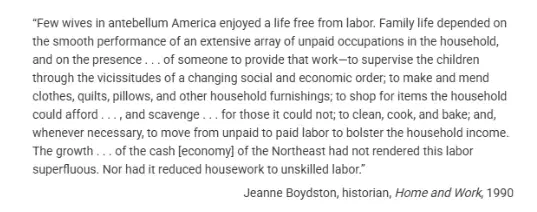
The market revolution
The emergence of mass political parties
Increased immigration
The abolitionist movement
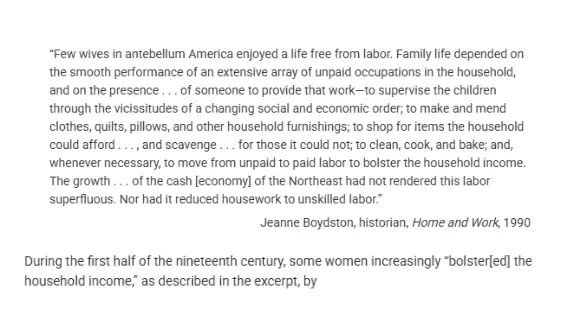
participating in secular and religious reform associations
obtaining positions in textile mills
signing contracts for indentured servitude
performing clerical and secretarial labor for large corporations
The South had become increasingly reliant on producing and exporting cotton in the early nineteenth century.
The public visibility of women as leaders of national social and political reform movements had increased.
The rise in manufacturing had led to many people relocating to towns and cities as demand for labor increased.
The debates over the federal government’s proper role had intensified during the early nineteenth century.
Allowing territories to determine whether slavery should be legal within their borders
Using federal power to forcibly relocate American Indian groups
Encouraging individuals to settle west of the Mississippi River
Rejecting the Supreme Court’s power to determine constitutionality of laws
The expansion of United States territory through war
The expansion of suffrage rights to most White men
The maintenance of low tariffs that allowed the export of goods to Europe
The use of federal government funding for internal improvements
U.S. Roads and Canals, 1837
Nancy A. Hewitt and Steven F. Lawson, Exploring American Histories, Bedford/St. Martin's, p. 266. Reprinted by permission.
The expansion of the U.S. transportation network by 1837, as shown in the map above, benefited MOST from which of the following technological advances?
The telegraph
The steam engine
The textile factory
Interchangeable parts
U.S. Roads and Canals, 1837
Nancy A. Hewitt and Steven F. Lawson, Exploring American Histories, Bedford/St. Martin's, p. 266. Reprinted by permission.
As shown in the map above, the national system of roads and canals most closely linked which regions’ economies together?
The Midwest and South
The North, Midwest and South equally
The North and South
The East and Midwest
U.S. Roads and Canals, 1837
Nancy A. Hewitt and Steven F. Lawson, Exploring American Histories, Bedford/St. Martin's, p. 266. Reprinted by permission.
The opening of canals and new roads in the United States, as depicted in the map above, had the LEAST impact on which of the following?
Westward migration of American citizens
The market revolution
Regional economic specialization
European immigration to the United States
“King Andrew the First,” Library of Congress, 1832.
Which of the following is the best interpretation of the meaning of the above political cartoon?
Jackson wanted to have the same prestige that European monarchs had
Political opponents depicted him as a weakling and a coward
The throne and scepter symbolized a republics equality with the royalty of Europe
His imperious nature included trampling the Constitution and use of the veto to create one-man rule
“King Andrew the First,” Library of Congress, 1832.
Which of the following actions by President Andrew Jackson best supports the interpretation of his presidency in the cartoon shown above?
Refusal to support the admission of Texas to the union as a slave state
Adoption of the Independent Treasury plan
Veto of the re-charter bill of the 2nd Bank of the United States
Expulsion of the Cherokee nation from Georgia and Tennessee
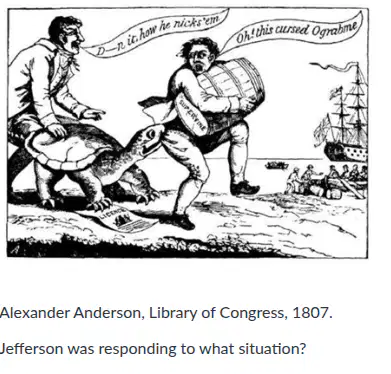
Electoral losses to domestic opponents
British support of Indians in the West
British interference with American shipping and trade
Aggressive actions by the French Emperor Napoleon
“Not far from this time Nat Turner’s insurrection [a slave rebellion] broke out; and the news threw our town
into great commotion. . . .
“It was always the custom to have a muster every year. On that occasion every White man shouldered his
musket. The citizens and the so-called country gentlemen wore military uniforms. . . .
“I knew the houses were to be searched; and I expected it would be done by country bullies and the poor
Whites. . . .
“It was a grand opportunity for the low Whites, who had no Negroes of their own to scourge. They exulted
in such a chance to exercise a little brief authority, and show their subserviency to the slaveholders; not
reflecting that the power which trampled on the colored people also kept themselves in poverty,
ignorance, and moral degradation. . . . Colored people and slaves who lived in remote parts of the town
suffered in an especial manner. In some cases the searchers scattered [gun]powder and shot among
their clothes, and then sent other parties to find them, and bring them forward as proof that they were
plotting insurrection.”
-Harriet Ann Jacobs, Incidents in the Life of a Slave Girl, published in 1861, describing events earlier in the
nineteenth century
Which of the following statements would an abolitionist claim supported the ideas expressed in the excerpt?
Southern interests depended on the labor of enslaved people, while the contributions of poor White citizens were minimal.
The immorality of slavery had a widespread corrupting effect on Southern culture.
The Constitution held that enslaved people were legally considered property.
Southern states had the authority to restrict free African Americans from owning firearms.
-Harriet Ann Jacobs, Incidents in the Life of a Slave Girl, published in 1861, describing events earlier in the
nineteenth century
Which of the following claims best aligns with the evidence in the excerpt about the relationship between enslaved African Americans and White Southern citizens?
A majority of poor White citizens benefited economically from having enslaved African Americans do the manual labor that White citizens did not want to do.
A majority of White citizens held slaves; therefore, they felt obligated to ensure the preservation of Slavery.
The slave system gave poor White citizens the feeling of social superiority over free and enslaved African Americans in a culture where African Americans held little power.
The attitudes of White citizens regarding the motives of slave rebellions differed by region within the South.
-Harriet Ann Jacobs, Incidents in the Life of a Slave Girl, published in 1861, describing events earlier in the
nineteenth century
Which of the following pieces of evidence best supports the excerpt’s depiction of reactions to slave rebellions?
Northerners agreed that slavery was a positive institution for society.
Southern states banned the importation of slaves from Africa.
The majority of slaveholders moved toward using alternative forms of labor
Additional restrictions were placed on enslaved and free African Americans.
-Harriet Ann Jacobs, Incidents in the Life of a Slave Girl, published in 1861, describing events earlier in the
nineteenth century
The excerpt best reflects which of the following developments?
The emergence of an abolitionist movement during the Second Great Awakening
The increase of prosperity caused by the production of manufactured goods
The development of regional cultures increasingly defined by the presence of enslaved people
The establishment of tariffs on textiles to protect domestic cotton production
-Noah Webster, “Preface,” An American Dictionary of the English Language, 1828
The national identity described in the excerpt most strongly reflects the influence of which of the following?
The English feudal system in which lords and landowners dominated vassals and farmers
Antislavery activism in the United States and Europe
European precedents along with an American national culture
Independence movements and revolutions in Europe and Latin America
-Noah Webster, “Preface,” An American Dictionary of the English Language, 1828
The historical concept of the American identity, as characterized in the excerpt, was most clearly distinguished from the identities of other nations by the
movement toward establishing a capitalist economy
importance of liberal ideas about natural rights and liberties
role women played in civic and public life
enthusiasm for copying English practices and institutions
-Noah Webster, “Preface,” An American Dictionary of the English Language, 1828
The excerpt best reflects which of the following historical situations in the early 1800s?
The innovations in the market revolution creating new wealth for Americans
The importance of reading literacy among Americans
The emergence of a new and distinctive American culture
The transition of the United States to a more participatory democracy
-South Carolina senator John C. Calhoun, speech in the United States Senate, 1837.
Which of the following resulted from arguments made by Southern politicians, such as the one in the excerpt, in the years prior to the Civil War?
Slaveholders became more insistent that maintaining the slave system was essential to protecting the South and its way of life.
Abolitionists scheduled numerous speaking tours throughout the South to counter proslavery attitudes like that expressed by Calhoun.
Congress passed legislation guaranteeing slavery in the South to show that the slave system was not threatened.
Many people in the South who depended on the labor of enslaved people nevertheless became more willing to admit that slavery was a sin.
-South Carolina senator John C. Calhoun, speech in the United States Senate, 1837.
The ideas expressed by John C. Calhoun and others who shared his views on slavery had which of the following effects on emerging abolitionist movements in the years leading up to the Civil War?
Arguments describing slavery as a “positive good” weakened the impact of abolitionist efforts to encourage White northerners to support emancipation.
Many abolitionist groups in the North began to question the accounts of harsh treatment described by escaped slaves who made it to freedom.
As many people came to see slavery as part of the Southern way of life, attitudes on both sides of the slavery argument hardened so that political compromise became difficult.
Very few members of Congress accepted Calhoun’s “positive good” argument, and they became more open to passing laws limiting slaveholding and the internal slave trade.
-South Carolina senator John C. Calhoun, speech in the United States Senate, 1837.
Which of the following most contributed to slaveholders such as Calhoun arguing in the 1830s and 1840s that slavery should be viewed as part of the Southern way of life?
Abolitionists made up a majority of members of Congress in the 1840s, and Southerners feared that they would pass emancipation legislation.
Most Southern states had begun to allow slaves to learn to read and write, and Southerners wanted people in other states to know that the slave system was changing.
Slave rebellions in Haiti, South Carolina, and Virginia had made many leaders in the South fear that enslaved African Americans could harm them.
“THEREFORE, And in pursuance of the said statute, you are hereby authorized and directed to subdue,
seize, and make prize, of all vessels, goods, and effects, belonging to the Bey of Tripoli, or to his
subjects, and to bring or send the same into port, to be proceeded against and distributed according to
Law. By command of the President of the United States of America.”
-Thomas Jefferson, 1802
The rhetorical purpose expressed in the excerpt would most likely have been interpreted as promoting which of the following?
Investing in technology to make ocean voyages faster
Using international commerce to expand United States influence
Challenging Great Britain’s control of Canada
Expanding suffrage rights to all White men
-Thomas Jefferson, 1802
The excerpt could best be used by historians studying which of the following?
The passage of the Missouri Compromise
The approval of the Louisiana Purchase
The abolition of the international slave trade
The creation of the Monroe Doctrine
-Thomas Jefferson, 1802
President Jefferson sought the protections described in the excerpt most likely for the purpose of
enlarging the size of the Navy
supporting alliances with European nations
creating United States colonies
establishing trade routes
“Louisiana as ceded by France is made part of the United States. Congress may make part of the United
States other adjacent territories which shall be justly acquired.
“Congress may sever from the United States territory not heretofore within the United States, with consent
of a majority of the free males above 21 years, inhabiting such territory.”
-James Madison, secretary of state, proposed constitutional amendment [not passed], 1803
Which of the following best describes the historical situation in which the amendment was proposed?
The federal government sought to acquire more western land in North America.
The Anti-Federalists sought to add a bill of rights to the Constitution.
The Constitutional Convention sought to establish the separation of powers between branches of government.
The United States sought to forcibly remove American Indians from their homelands
-James Madison, secretary of state, proposed constitutional amendment [not passed], 1803
Which of the following best describes a major purpose of the proposed amendment?
To give the president more control over negotiating treaties
To give Congress additional constitutional powers
To strengthen the United States alliance with France
-James Madison, secretary of state, proposed constitutional amendment [not passed], 1803
Which of the following groups would most likely have supported this proposed amendment?
Proponents of the supremacy of federal laws over state laws
Advocates of the power of the Supreme Court to review federal laws
Advocates of limiting federal powers to those specifically written into the Constitution
Proponents of the expansion of the executive branch powers under the Constitution
-Thomas Jefferson, first inaugural address, 1801
In highlighting “the safety with which error of opinion may be tolerated,” Jefferson was referring most directly to
the use of government force to put down popular uprisings like Shays’ Rebellion and the Whiskey Rebellion
passage of the Alien and Sedition Acts, which were designed to suppress criticism of the government
Great Britain’s efforts to deny colonists their political rights in the years before the American Revolution
restrictive anti–American Indian policies that conflicted with the nation’s professed political ideals
-Thomas Jefferson, first inaugural address, 1801
The excerpt best reflects which of the following?
Secessionist pressures coming from slaveholders in the South
Fear that the United States would be overtaken by a foreign power
Conflicts over how the Constitution should be implemented and interpreted
Disagreement over the consequences of the French Revolution for the United States
-Thomas Jefferson, first inaugural address, 1801
Which of the following issues of the period was Jefferson most likely concerned with in the excerpt?
The growth of slave labor
The growth of various Protestant religious groups
The expansion of the right to vote
The creation of political parties
-President Andrew Jackson, Veto Message Regarding the Bank of the United States, 1832
The excerpt best reflects which of the following developments during the first half of the nineteenth century?
The increase of immigration from Europe
The emergence of regional cultures
The establishment of abolitionist groups
The formation of new political parties
-Introduction to a book of reports from the American Temperance Society, 1835
Which of the following evidence was used by the American Temperance Society in the excerpt to explain why people would join the temperance movement?
The abstention from alcohol would extend American life expectancy.
The use of specific studies would convince people to believe the movement’s goals.
The development of treatments for alcoholism would change the habits of men.
The formation of a national movement would eliminate the consumption of alcohol.
-Introduction to a book of reports from the American Temperance Society, 1835
Which of the following evidence did the American Temperance Society in the excerpt use to support its argument about the need for the temperance movement?
Alcohol consumption damaged people’s physical and emotional well-being.
Men wasted too much money buying alcohol, and their families became poor.
Restrictions on alcohol could discourage European immigrants.
Federal government excise taxes on alcoholic beverages were too high.
-Introduction to a book of reports from the American Temperance Society, 1835
The American Temperance Society used which of the following evidence in the excerpt to explain why it believed the temperance movement would be successful?
Its supporters were willing to use violence to get people to stop drinking alcohol.
Its supporters were more likely to vote in upcoming elections.
Its supporters held the moral and religious high ground.
Its supporters used new transportation routes to spread their message.
-Introduction to a book of reports from the American Temperance Society, 1835
The sentiments described in the excerpt best reflect which of the following developments?
The use of public protest to effect social change in the antebellum period
The emergence of reform movements during the Second Great Awakening
The establishment of trade relationships with East Asia
-Sean Wilentz, historian, “Society, Politics, and the Market Revolution: 1815-1848,” 1997
Which of the following shifts resulted most directly from the trends described in the excerpt?
An increase on the importance placed on extended family relationships.
A decline in the income gap between the wealthiest classes and working classes.
The emergence of new ideas about the roles of husbands and wives.
A sharp decline in regional differences.
-Sean Wilentz, historian, “Society, Politics, and the Market Revolution: 1815-1848,” 1997
Which of the following pieces of historical evidence from the United States census could best be used to support the argument in the excerpt?
Data showing population growth in the West.
Data showing changes in the number of textile mills.
Data showing the growth of the slave population.
-Sean Wilentz, historian, “Society, Politics, and the Market Revolution: 1815-1848,” 1997
Which of the following historical developments contributed most directly to the market revolution?
The decline of slavery in the Northeast.
The emergence of southern opposition to tariffs.
The increased number of women in the paid workforce.
The emergence of new forms of transportation.

