
 Worksheets
Parliamentary Law Making: Structure
Total questions: 150
Worksheet time: 1hrs 15mins
Which statement best describes the UK Parliament’s structure?
Judicial legislature headed by Supreme Court
Unicameral legislature led by Prime Minister
Federal legislature with devolved chambers
Bicameral legislature with Monarch as part
In a constitutional monarchy like the UK, what is the Monarch’s role in law making?
Acts on government advice with formal powers
Exercises independent executive authority
Commands the armed forces to pass laws
Writes statutes without parliamentary consent
What is the primary law‑making chamber responsible for proposing and voting on Bills?
House of Commons as elected chamber
House of Lords as hereditary chamber
Monarch’s Privy Council chamber
Supreme Court as judicial chamber
Which feature explains the composition of the House of Lords today?
Elected members serving five years
Regional delegates from devolved nations
Mixture of life peers and bishops
Entirely hereditary peers with party whips
Why is the UK described as having a bicameral legislature?
Monarch and Commons share executive power
Local councils share law‑making duties
One chamber approves while courts review
Two chambers scrutinize and amend Bills
A government with a majority of MPs in the Commons typically can do what more easily?
Introduce and pass new Acts of Parliament
Overrule Lords using royal prerogatives
Suspend elections beyond five years
Appoint judges without scrutiny
Which function is most associated with the House of Lords in the law‑making process?
Choosing the Prime Minister
Setting national taxation rates
Scrutinizing and revising legislation
Initiating wars and treaties
Which statement best describes a Green Paper in the UK law-making process?
A private member’s plan for local law changes
A formal proposal with detailed draft legislation
A final statement of government policy before a vote
An early consultation document seeking public feedback
What is the primary purpose of a White Paper?
Announce government policy and outline planned legislation
Invite broad debate on possible reforms
Present court rulings that change existing statutes
Enable any MP to introduce a personal proposal
Which type of Bill generally affects the whole country or large sections of the public?
Public Bills
Private Bills
Hybrid Bills
Private Members’ Bills
A Private Member’s Bill is introduced by which of the following?
A civil servant from the Cabinet Office
A government minister from a department
An individual MP not acting for the government
Any judge in the Supreme Court
Which scenario best illustrates a Hybrid Bill?
An MP’s proposal to change school term dates nationwide
A government project affecting the public and named organizations
A national tax reform affecting all citizens equally
A company-specific charter with no public impact
During early stages of reform, which sequence is most typical before a Bill is introduced?
White Paper then Green Paper then Bill
Bill then White Paper then Green Paper
Bill then Green Paper then White Paper
Green Paper then White Paper then Bill
Why are Public Bills often introduced by government ministers rather than private MPs?
They concern broad national policy requiring government leadership
They only impact a single person or corporation
They must originate in the House of Lords
They are limited to procedural rules of Parliament
Which stage comes immediately after the second reading in the House of Commons when a Bill is progressing toward an Act?
Report stage with amendments considered
Committee stage for detailed examination
Royal Assent by the Monarch
Third reading for final debate
At which point does the House of Lords become involved in the passage of a Bill?
During the initial drafting of the Bill
Only after Royal Assent is given
After the third reading in Commons
Before the first reading in Commons
What is the final step required for a Bill to become an Act of Parliament?
Report stage in the Commons
Third reading in the Lords
Royal Assent by the Monarch
Committee stage in both Houses
Which sequence correctly orders these stages in the House of Commons?
Committee stage, third reading, first reading
Second reading, committee stage, third reading
Third reading, report stage, royal assent
First reading, report stage, second reading
Why are checks and balances included in the bill passage process?
To accelerate government policy changes
To prevent any abuses of power
To reduce participation by the Lords
To avoid public consultation entirely
Which factor is most likely to influence what new laws are proposed in Parliament?
Report stage deciding initial topics
Royal Assent preceding debates
Government policy shaping priorities
House of Lords drafting all bills
Which statement best defines parliamentary sovereignty in the UK?
EU institutions set UK domestic laws
Courts can overrule Acts that breach rights
Parliament may make or unmake any law
Ministers alone decide national legislation
What is a typical advantage of public opinion influencing Parliament?
Removes need for elections and parties
Prevents rapid policy changes entirely
Helps representatives reflect citizens’ priorities
Ensures minority views always prevail
Which disadvantage is most associated with lobbyists?
They guarantee transparent procurement
They always represent public sector unions
They can favor wealthy clients with access
They provide balanced research to all MPs
What was a key effect of the European Communities Act 1972 on UK law?
Introduced universal suffrage in elections
Created devolved parliaments in the UK
Allowed EU law to have domestic effect
Established the Supreme Court of the UK
Under the Human Rights Act 1998, how can courts respond to an Act that conflicts with rights?
Impose criminal penalties on ministers
Refer the Act directly to the EU Court
Issue a declaration of incompatibility
Strike down the Act and repeal it
Which scenario best illustrates a limitation on parliamentary supremacy?
A court declaring an Act incompatible with rights
An MP proposing a private member’s bill
A party winning a majority after an election
A committee publishing a consultation paper
How can public opinion directly shape parliamentary decisions?
Through royal prerogative instructions
Through civil service staffing changes
Through referendums influencing policy choices
Through binding court precedents
Which description best captures how lobbyists operate in politics?
They enforce compliance with Acts of Parliament
They adjudicate disputes between political parties
They present arguments to influence policymakers
They purchase votes inside Parliament
Which statement best defines delegated legislation in the UK?
Court-made law developed through judicial precedent
Unwritten customs enforced by government departments
Law made by bodies given power by Parliament
Law made by Parliament through primary Acts
What is the purpose of a Parent Act (enabling Act) in delegated legislation?
It grants powers to make detailed rules
It repeals outdated secondary laws
It sets court procedures for appeals
It allocates taxes to local authorities
Orders in Council are typically used when which condition applies?
Routine local traffic management needs
Parliament reviews long-term policy plans
Emergency situations requiring quick action
International trade negotiations take place
Statutory Instruments are usually made by whom?
Senior judges in the Supreme Court
Civil service agencies and ministers
Backbench MPs in select committees
Local councillors in parish councils
Which example best illustrates a by-law?
National minimum wage regulations
Airport authority rules on parking
Budget allocations for the NHS
Defense procurement orders in war
Why does Parliament rely on delegated legislation to handle detailed rules?
It prefers unwritten constitutional norms
It lacks time and specialized expertise
It seeks to avoid public participation
It wishes to reduce judicial oversight
Match each type of delegated legislation to its typical secondary body.
All of the above are correct
Orders in Council – Privy Council
By-laws – Local authorities
Statutory Instruments – Government ministers
Which statement best describes delegated legislation?
Law made by judges during court cases
Secondary rules created under authority of a parent Act
Unwritten customs followed by government agencies
International treaties approved by Parliament
What is the main purpose of an Affirmative Resolution Order (ARO)?
To allow courts to amend the wording of a parent Act
To let ministers bypass scrutiny in urgent situations
To automatically bring a rule into force after 40 days
To require explicit approval by Parliament before a rule takes effect
Under a Negative Resolution Order (NRO), how can Parliament control delegated legislation?
By sending the rule back to the drafting department
By annulling the rule within a set period unless objected
By replacing the rule with a new parent Act immediately
By debating and voting within 7 days to approve
What is the role of the Delegated Powers Scrutiny Committee in the House of Lords?
To draft detailed regulations for government departments
To prosecute ministers who misuse delegated powers
To examine Bills for inappropriate delegated powers
To approve all statutory instruments automatically
What does ultra vires mean in the context of delegated legislation?
A parent Act has been repealed by the courts
A minister must consult the judiciary before acting
A body has acted beyond the powers granted to it
A regulation is consistent with the enabling Act
Which scenario is procedural ultra vires?
A court reviews the reasonableness of a decision
A committee recommends more detailed guidance
A regulation contradicts the parent Act’s limits
A minister ignores mandatory consultation steps
Which scenario is substantive ultra vires?
A rule is laid before Parliament for more than 40 days
A committee fails to meet quorum requirements
A regulation imposes a tax not allowed in the parent Act
A department misses the publication deadline
What is the purpose of judicial review of delegated legislation?
To ensure every rule receives affirmative resolution
To determine if a rule is ultra vires and quash it
To rewrite statutory instruments for clarity
To evaluate whether Parliament’s debates were adequate
Which parliamentary control requires that a statutory instrument must be approved by Parliament before it can come into force?
Parent Act oversight
Joint scrutiny committee
Affirmative resolution procedure
Negative resolution procedure
What is the primary purpose of the Joint Scrutiny Committee in relation to delegated legislation?
To draft enabling clauses
To examine technical quality
To prosecute ultra vires acts
To conduct public consultations
Which judicial control can strike down delegated legislation that goes beyond powers granted in the enabling Act?
Affirmative resolution
Substantive ultra vires
Procedural ultra vires
Wednesbury unreasonableness
Under procedural ultra vires, why might a statutory instrument be invalidated?
It lacks parliamentary debate
It exceeds substantive powers granted
It fails to follow required steps
It is politically controversial
Which statement best describes Wednesbury unreasonableness as a judicial control?
Decision breaches consultation duty
Decision bypasses resolution process
Decision exceeds enabling powers
Decision is irrational in law
Which advantage of delegated legislation helps government respond to emergencies?
Detailed local customization
Rapid law-making speed
Enhanced democratic scrutiny
Reduced administrative costs
Which is a common disadvantage of delegated legislation?
Possible inadequate scrutiny
Greater public participation
Increased parliamentary time
Clearer statutory language
Why does Parliament use delegated legislation for technical matters?
To avoid legal challenges
To utilize expert knowledge
To reduce judicial oversight
To bypass elected officials
Which statement best explains why statutory interpretation is necessary in courts?
Lawyers disagree so judges must pick a winner
Parliament writes perfectly clear detailed statutes
Judges prefer creating new legal rules themselves
Acts use broad language needing judicial clarification
Which is an advantage of delegated legislation?
Eliminates the need for statutory interpretation
Prevents ministers from using any legal powers
Ensures all rules are debated by full Parliament
Allows fast law-making for technical matters
Which is a common disadvantage associated with delegated legislation?
Guarantees perfect drafting free of contradictions
Improves scrutiny through detailed parliamentary debates
Possible democratic deficit from unelected bodies
Always strengthens parliamentary sovereignty
Which situation most likely requires judges to interpret an Act due to technological advances?
A statute on telegraphs applied to internet messaging
A law on property taxes applied to local rates
An Act defining ministers’ powers applied to cabinets
A statute on jury service applied to court staff
What issue do ambiguous words in statutes create for courts?
Guaranteed interpretation using the literal rule only
Unclear meaning that must be resolved judicially
Automatic invalidation of the entire statute
Immediate referral back to Parliament for redraft
Which example best illustrates a drafting error that could trigger statutory interpretation?
A law that repeats definitions consistently
A cross-reference to the wrong section number
An Act with extensive explanatory notes attached
A statute using ordinary words with common meaning
Which statement best describes the literal rule in statutory interpretation?
Judges infer broad policy and intended purpose
Judges apply precedent from European courts
Judges follow ordinary meaning of statutory words
Judges balance rights under convention principles
What is the purposive approach primarily concerned with when interpreting legislation?
Exact dictionary definitions of terms
Original parliamentary debates transcript
Overall aim Parliament intended to achieve
Binding opinions of lower courts
Which influence led UK courts to adopt a purposive approach more frequently before 2020?
Expansion of jury trial rules
Increase in judicial review claims
Membership of the European Union
Creation of new criminal courts
Under the Human Rights Act 1998, how should courts read and give effect to legislation?
Only after consulting EU directives
Strictly according to literal meaning
In line with ministerial statements
Consistently with Convention rights
Which is an advantage commonly associated with the literal rule?
It preserves parliamentary sovereignty
It allows creative judicial lawmaking
It ensures flexible case outcomes
It prioritises evolving social values
Which is a disadvantage often linked to the literal rule?
Strong respect for separation of powers
Clear guidance on how courts will decide
Risk of unjust results in specific facts
Predictable application across similar cases
A statute prohibits vehicles in a park. Using the purposive approach, what would judges most likely consider?
Meaning of vehicle in technical dictionaries
Parliament’s aim to protect safety and tranquility
Historical usage of the word vehicle in poetry
Exact punctuation used in the statute text
After the UK left the EU, which interpretive trend is still likely for judges?
Continue applying purposive reasoning
Always revert to strict literalism
Follow binding European Court rulings
Ignore human rights compatibility
Which statement best defines judicial precedent in common law systems?
Customs alone determine legal outcomes
Each case is decided without reference to prior rulings
Past judicial decisions guide future cases
Parliamentary acts override judge-made rules
What does the Latin term stare decisis most closely mean in legal practice?
Stand by decided matters
Appeal to higher tribunals
Argue from first principles
Seek equitable outcomes
Which condition is necessary for binding precedent to operate effectively?
All courts are equal in authority
Only criminal cases are considered
A hierarchical court structure exists
Juries publish written opinions regularly
In a case where the legal point matches an earlier decision from a higher court, what should the current court do?
Request legislative amendment
Hold a public referendum
Follow the earlier ruling
Ignore the prior case
Which source can create persuasive precedent rather than binding precedent?
A lower court’s judgment
The same court’s later ruling
A statute passed by Parliament
A mandatory procedural rule
What is the role of obiter dicta within judicial reasoning?
Non-binding statements that can persuade
Binding rules that must be followed
Procedural orders issued to juries
Evidence summaries presented by counsel
Why is precedent considered an important source of law in common law systems?
It allows courts to disregard hierarchy
It promotes consistency and fairness
It eliminates judicial discretion entirely
It replaces all statutory legislation
What did the Constitutional Reform Act 2005 do regarding the Practice Statement when the Supreme Court replaced the House of Lords in 2009?
Transferred the House of Lords’ powers to the Supreme Court
Abolished the Practice Statement entirely
Limited the Practice Statement to criminal appeals only
Required all courts to follow Supreme Court decisions
In Austin v London Borough of Southwark (2010), what was confirmed about the Supreme Court’s authority?
It could use the Practice Statement after its transfer
It must always follow prior House of Lords decisions
It had no role in appellate jurisprudence
It could overrule lower courts without reasons
Which statement best explains the Supreme Court’s obligation when departing from its own previous decisions?
It must explain why it chooses not to follow them
It can depart without any justification
It must seek approval from Parliament first
It must publish every judgment in full detail
Practice Directions 3 and 4 describe the Practice Statement as having what status and effect?
Part of established appellate jurisprudence with equal effect in the Supreme Court
A temporary guideline with reduced effect in modern courts
A criminal procedure rule with limited appellate relevance
An advisory note with no binding impact on appeals
Which statement best defines ratio decidendi in a court judgment?
Procedural directions given to lower courts
A summary of facts written by court reporters
The binding legal reason forming the precedent
Persuasive comments offered for future guidance
What is the primary role of obiter dicta within judicial decisions?
Create binding rules all courts must follow
Replace the ratio decidendi in future cases
Offer persuasive guidance beyond the core ruling
Announce punishments and court orders
Why is accurate law reporting essential to the doctrine of precedent?
It increases courtroom seating capacity
It ensures judgments are recorded and accessible
It allows juries to draft legal rules
It permits judges to skip writing opinions
A lower court faces a past decision that clearly applies to the current case. What is the usual operation under precedent?
Overrule the earlier decision immediately
Remand both cases to a higher court
Follow the earlier decision as binding
Distinguish the earlier case and ignore it
When can a higher court overrule a precedent?
When it disagrees and has authority to replace the rule
When reporters misprint the headnote
When new facts make the old case irrelevant
When the trial judge requests clarification
What does it mean to distinguish a precedent?
Invalidate the entire body of case law
Explain factual or legal differences to avoid applying it
Replace the earlier rule with a new doctrine
Treat the earlier rule as universally binding
In which scenario would obiter dicta most likely influence a future case?
A judge’s hypothetical example clarifying a principle
A clerk’s typo in the case citation list
A bailiff’s announcement of courtroom rules
A jury’s note on witness credibility issues
Which statement best describes the main aim of the Law Commission established by the Law Commissions Act 1965?
To represent citizens in civil disputes nationwide
To enforce judicial decisions in lower courts
To prosecute serious crimes across all UK jurisdictions
To ensure that the law is fair, modern, simple, cost-effective
What is the first formal step in the Law Commission’s law reform process?
Codifying all related statutes into a single code
Drafting a Bill for immediate introduction to Parliament
An open consultation outlining the current law and issues
Publishing a final report with recommendations
During consultation, what does the Law Commission invite from interested parties?
Budget proposals for court infrastructure projects
Petitions for immediate implementation without debate
Responses to suggested reforms and questions
Applications for judicial appointments and training
Which option best defines codification in the context of the Law Commission’s work?
Reviewing all the law on one topic to create a complete code
Repealing outdated statutes without replacement
Transferring court powers from judges to ministers
Publishing guidance notes for legal practitioners
In 1985, the Law Commission published a draft criminal code. What was the outcome?
It was immediately enacted as a comprehensive statute
It abolished judicial discretion in sentencing entirely
It was never implemented but influenced later reform
It replaced all existing criminal case law nationwide
What is consolidation as used by the Law Commission?
Drawing existing provisions in an area of law together into one Act
Integrating regional police powers into national agencies
Combining civil and criminal courts under one authority
Merging legal professions into a single regulatory body
What recent example shows consolidation in sentencing law?
The Judiciary Act 2005 reforming court structures
The Sentencing Act 2020 following the 2017 consultation
The Constitutional Reform Act 2005 altering appointments
The Criminal Justice Act 1991 creating new offences
What does repeal of an Act of Parliament mean in the UK?
The Act ceases to be law entirely
The Act gains additional provisions
The Act applies only to local councils
The Act is transferred to the courts
Who can repeal an Act of Parliament, and who advises on which Acts should be repealed?
Parliament repeals; Law Commission advises
Courts repeal; Prime Minister advises
Law Commission repeals; Parliament advises
Local authorities repeal; Judiciary advises
Which example illustrates an Act identified as no longer needed for repeal?
Equality Act 2010
Statute of Marlborough 1267
Human Rights Act 1998
Companies Act 2006
Since 1965, approximately how many Acts have been repealed through 19 enacted Bills linked to the Law Commission’s work?
About 300 Acts
More than 3000 Acts
Fewer than 30 Acts
Exactly 1965 Acts
Which statement best describes an advantage of reform through the Law Commission?
Focus solely on criminal trials
Guaranteed enactment of recommendations
Rapid political approval every time
Independent, expert-led review process
Which treaty marked the formal beginning of the European Union’s integration project?
Maastricht Treaty, signed in 1992
Lisbon Treaty, signed in 2007
Treaty of Paris, signed in 1951
Treaty of Rome, signed in 1957
In 1973, how did the United Kingdom align its domestic law with European Community principles?
By issuing royal prerogative orders
By holding a nationwide referendum
By passing the European Communities Act 1972
By adopting the Lisbon Treaty directly
What is the best description of Brexit?
The UK’s withdrawal from the European Union
A new EU budget policy introduced in 2020
A reform of the European Parliament’s elections
The EU’s expansion to include new members
Which EU institution is the principal law‑making body operating with a double majority voting system?
Council of the European Union
European Commission
European Council
European Parliament
Who proposes new EU laws and oversees the proper administration of EU treaties and the budget?
Court of Justice
European Parliament
Council of the European Union
European Commission
Members of which institution are directly elected and form political groups to debate and amend legislation?
Council of the European Union
European Commission
European Parliament
European Council
Under the Council’s double majority rule, what must be achieved for a proposal to pass?
Support by Member States representing at least 65% of the EU population
Consent from the Commission President
Approval by a simple majority of MEPs
Unanimous support of all Member States
Which statement best explains how the three institutions interact when making EU law?
Commission adopts; Parliament and Council implement
Parliament proposes; Council enforces alone
Council drafts; Commission and Parliament ratify
Commission proposes; Council and Parliament adopt
Which role does the Court of Justice of the European Union primarily perform?
Decides if a Member State failed its EU obligations
Sets annual EU budget priorities
Reviews national criminal trials for fairness
Elects the European Parliament leadership
Why are preliminary rulings from the Court of Justice important for Member States?
They offer optional advice without consequences
They replace domestic laws automatically
They bind national courts, ensuring uniform EU law
They only apply to the country that asked
Where does the Court of Justice of the European Union sit?
Luxembourg, Luxembourg
Brussels, Belgium
Strasbourg, France
The Hague, Netherlands
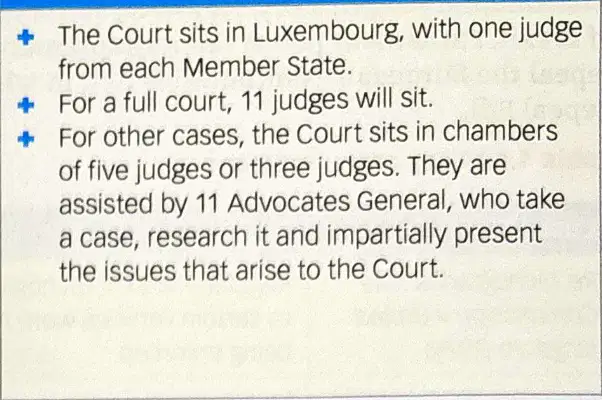
How is the Court of Justice typically composed when hearing cases?
A single judge appointed by the Commission
Chambers of five or three judges with Advocates General
Always the full court of twenty judges
Juries of twelve citizens from Member States
Which set lists the three primary sources of EU law?
Conventions, resolutions, case notes
Treaties, regulations, directives
Charters, ordinances, opinions
Acts, decrees, protocols
What is the function of the Advocates General at the Court of Justice?
Prosecute Member States for treaty breaches
Present impartial research and opinions on cases
Draft all EU regulations and directives
Negotiate political deals for the Council
Which set lists the three primary sources of European Union law?
Regulations, Statutes, Ordinances
Treaties, Case law, Conventions
Directives, By-laws, Codes
Treaties, Regulations, Directives
What is the usual legal effect of EU Treaties within Member States?
Automatically part of national law
Require national implementation acts
Apply only after Commission approval
Bind only EU institutions, not states
Which statement best describes Regulations in EU law?
Apply only to public authorities
Directly applicable in every Member State
Bind states but not individuals
Implemented through national enabling acts
What is the defining feature of EU Directives?
Cannot have direct effect under any conditions
Create rights only for EU institutions
Apply automatically without legislation
Require national laws within a time limit
Vertical direct effect allows who to rely on a directive in court?
An individual against the state
A company against another company
The Commission against the Parliament
A minister against private citizens
Horizontal direct effect, where available, concerns which relationship?
Between the EU and a state
Between courts and the Commission
Between Member States
Between private parties
Which UK statute established that EU law could override inconsistent national law?
Constitutional Reform Act 2005
Magna Carta 1215
Human Rights Act 1998
European Communities Act 1972
Which case showed UK courts disapplying national law conflicting with EU law in the shipping sector?
Factortame v Secretary of State for Transport
Van Gend en Loos v Netherlands
Francovich v Italian Republic
Marshall v Southampton Health Authority
Which statement best describes civil courts in the legal system?
They focus on constitutional issues and government powers
They resolve non-criminal disputes between individuals or organisations
They deal only with criminal offences and punishment
They hear appeals exclusively from higher courts of record
What are first instance courts?
Courts that only hear appeals from lower tribunals
Courts where a case is tried initially rather than on appeal
Courts reserved for criminal trials with juries
Courts that issue advisory opinions without judgments
Which reform goal is most closely linked to Lord Woolf’s report on civil justice?
Increase jury trials across all civil claims
Centralise all civil claims in one national court
Expand criminal jurisdiction into civil matters
Make procedures simpler, faster, and more affordable
In the three-track system, which claim type is usually allocated to the small claims track?
Employment disputes heard before specialist tribunals
Appeals from County Court to the High Court
Simple disputes under about £10,000 with limited costs
Complex claims over £250,000 with expert evidence
Which court commonly handles fast track claims under the three-track system?
Magistrates’ Court for summary civil offences
High Court for minor disagreements under £1,000
County Court for moderately complex claims around £10,000–£25,000
Supreme Court for high value constitutional cases
A business sues over a contract worth £60,000 requiring multiple expert reports. Which track is the claim most likely to follow?
Fast track with a single-day trial and limited experts
Small claims track with informal hearings and low costs
Summary track with immediate judgment by a magistrate
Multi-track with case management and tailored procedures
Which change increased judicial control over civil case progress after the 1990s reforms?
Elimination of alternative dispute resolution options
Mandatory appeals to higher courts for all decisions
Greater judicial case management to reduce delay
Automatic jury trials in all civil disputes
Which court usually hears civil appeals from the High Court and county courts in England and Wales?
Supreme Court (UK)
Magistrates’ Court (Civil)
Court of Appeal (Civil Division)
Crown Court (Criminal)
What is a ‘leapfrog appeal’ in the civil courts?
Appeal from High Court to Court of Appeal
Appeal from county court to tribunals
Appeal skipping evidence
Appeal straight to Supreme Court
Which statement best describes tribunals in the UK?
Specialist bodies for specific disputes
Criminal trial courts
Local mediation services
Private arbitration companies
Which ADR method involves a neutral facilitator helping parties reach a voluntary agreement without imposing a decision?
Mediation
Litigation
Negotiation
Arbitration
In negotiation, who typically decides the outcome of the dispute?
The parties decide outcome
An arbitrator decides outcome
A tribunal decides outcome
A judge decides outcome
Which path is most likely for a complex multi-track civil case after the initial judgment?
Appeal to Court of Appeal
Direct appeal to tribunals
Appeal to Crown Court
Appeal to Magistrates’ Court
Which dispute type is most appropriately handled by tribunals rather than ordinary civil courts?
Employment rights disputes
Minor personal injury claims
Property boundary disputes
Contract breach claims
Which ADR option is generally fastest and cheapest at early stages of a civil dispute?
Informal negotiation between parties
Formal arbitration hearing
Litigation in High Court
Facilitated mediation session
Which statement best defines negotiation in Alternative Dispute Resolution (ADR)?
A public hearing with legal representation
A formal court process led by a judge
A direct, private attempt to resolve a dispute
A binding decision imposed by an arbitrator
Which is an advantage of negotiation compared to litigation?
Usually quickest and cheapest, with no lawyers
Ensures no confrontation between parties
Provides a legally binding judgment
Guarantees the case will never go to court
Which is a disadvantage of negotiation compared to litigation?
Cannot address consumer issues at all
Always requires a judge to preside
Automatically results in binding outcomes
Requires confrontation with the other party
Which situation is a suitable example for using negotiation?
Shareholder class-action lawsuits
Noise caused by neighbours
Criminal sentencing decisions
International treaty disputes
What is the role of a mediator in mediation?
A neutral third party facilitating discussion
A lawyer advocating for one side
An arbitrator giving their opinion
A judge issuing a binding verdict
Which is an advantage of mediation compared to litigation?
Strict legal rules determine outcomes
Mediator decides who is at fault
Outcomes always legally binding
Parties control proceedings and decisions
Which is a disadvantage of mediation compared to litigation?
Works only if both parties agree and cooperate
Never involves a third party at all
Guarantees compliance through sanctions
Always more expensive than court
A business renegotiating a contract wants a relatively informal process where common sense guides outcomes and parties keep control. Which ADR method best fits this goal?
Negotiation led by a judge
Arbitration with binding awards
Litigation in civil court
Mediation with a neutral facilitator
Which two key criminal courts of first instance handle most cases in England and Wales?
Magistrates' Court and Crown Court
Tribunal Court and Appeals Court
High Court and Supreme Court
Family Court and County Court
What is the usual first step after a suspect is arrested on a criminal charge?
Appeal to the High Court
Immediate trial at Crown Court
Sentencing by magistrates
Being given a charge sheet
What does bail generally allow a suspect to do before their court hearing?
Remain in police custody without review
Live in the community under conditions
Avoid attending court permanently
Travel abroad without restrictions
Which statement best describes remand in the criminal process?
Dropping the charges against a suspect
Transferring the case to civil court
Releasing a suspect unconditionally
Keeping a suspect in custody until court
Who prosecutes criminal cases brought to the Magistrates' Court and Crown Court?
The Crown Prosecution Service
The Defence Solicitors' Office
The Civil Enforcement Agency
The Ministry of Justice
Under what circumstance can bail be refused before a hearing?
If the case is minor and non-violent
If the suspect requests it
If the court calendar is full
If there are insufficient grounds
A defendant is charged with a serious crime and poses a flight risk. Which option is most likely applied before their first hearing?
They are tried immediately
They are acquitted and released
They receive unconditional bail
They are remanded in custody
Which court generally tries the most serious indictable offences in England and Wales?
Magistrates’ Court handles indictable offences
Crown Court handles indictable offences
County Court handles indictable offences
Youth Court handles indictable offences
What is the usual composition for deciding guilt in a Crown Court trial?
Judge and jury decide guilt together
Magistrates decide guilt collectively
Single judge decides guilt alone
Jury decides guilt, judge oversees law
Who is responsible for prosecuting most criminal cases in England and Wales?
Home Office prosecutes most cases
Crown Prosecution Service prosecutes most cases
Ministry of Justice prosecutes most cases
Police prosecutors prosecute most cases

