
 Worksheets
8th Grade Semester Exam Review 25-26
Total questions: 118
Worksheet time: 59mins
Define culture in human geography.
The biological traits people inherit
The shared beliefs, practices, technologies, and social forms that shape a group’s way of life
Only the art and music produced by a society
Government laws that control a population
Which statement best describes a custom rather than a habit?
A single person’s routine of jogging every morning
A group’s widely adopted practice of wearing traditional dress on festivals
A spontaneous decision to try a new food
An individual’s preference for a particular brand
Which is an example of material culture?
Religious beliefs
A smartphone
Values about privacy
Language rules
Which is an example of non-material culture?
Monuments
Clothing styles
Shared values about honesty
Architecture
Which of the following is a cultural trait?
Average annual rainfall
The practice of eating dinner at 9 PM
Plate tectonics
Population size
In cultural geography, what is an artifact?
A behavior pattern within a society
A physical object made or used by people
A set of ideas and beliefs
A political boundary
What are sociofacts?
Tools and buildings
Shared ideas and knowledge
Structures and rules that organize social behavior, like families or schools
Natural landforms
What are institutions in the context of culture?
Individual habits
Established systems and organizations such as governments, religions, and education
Only economic activities
Random social gatherings
What are mentifacts?
Physical artifacts like pottery
Ideas, beliefs, and values such as religion or ethics
Natural resources used by a culture
Transportation networks
Which statement distinguishes cultural norms from taboos?
Norms are strictly illegal; taboos are encouraged
Norms are everyday rules for acceptable behavior; taboos are strong prohibitions against certain actions
Norms apply only to governments; taboos apply only to families
Norms are private opinions; taboos are scientific laws
Which example best illustrates ethnocentrism?
Judging another culture by your culture’s standards and assuming yours is superior
Trying to understand a practice within the other culture’s context
Learning another language to communicate respect
Comparing cuisines without judgment
Which statement best reflects cultural relativism?
Rejecting all cultural differences
Evaluating a cultural practice by the values and standards of its own culture
Assuming one culture is the benchmark for all others
Banning unfamiliar customs
What is a cultural hearth?
A barrier that stops diffusion
A region where a cultural trait originates and often spreads from
A remote area with no cultural activity
A place where cultures decline
Which statement distinguishes environmental determinism from possibilism?
Determinism says climate has no impact; possibilism says climate fully controls culture
Determinism claims the physical environment strongly shapes human culture; possibilism argues people adapt and make choices within environmental limits
Determinism is about language; possibilism is about religion
Determinism focuses on technology; possibilism rejects technology
In human geography, what is diffusion?
The movement of tectonic plates
The spread of cultural traits, ideas, or innovations from one place to another
Only migration of people
Government expansion of territory
What is cultural convergence?
Cultures becoming more alike through shared technologies, behaviors, or interactions
Cultures becoming more isolated
Elimination of all local customs
Only political unification
What is a diffusion hearth?
A barrier to diffusion
The origin point of an idea or innovation
A place that resists change
A remote destination
Which is an example of a barrier to diffusion?
Shared language
Strict government censorship
Open trade networks
High internet access
Which statement describes relocation diffusion?
Ideas spread widely without people moving
People move to a new location and carry their cultural traits with them
Only governments spread policies
Diffusion happens only through media
Which statement describes expansion diffusion?
Traits spread while staying strongest at the origin and moving outward to new adopters
Ideas spread only by migration
Only hierarchical authority spreads ideas
Traits disappear at the origin
Which statement describes contagious diffusion?
Spread through person-to-person contact rapidly and broadly
Spread only through high-ranking nodes
Spread by innovators altering a trait to fit new contexts
Spread only by migration of people
Which statement describes hierarchical diffusion?
Spread through everyday contact
Spread from important or influential nodes (like cities or leaders) to others
Spread only by moving people
Never involves technology
Which statement describes stimulus diffusion?
An idea spreads unchanged
An underlying idea spreads but is modified to fit local culture
Only physical objects spread
No change occurs in any place
Which option best distinguishes acculturation from assimilation?
Acculturation keeps significant original cultural traits while adopting some new ones; assimilation involves losing original traits and fully adopting the new culture
Acculturation means isolation; assimilation means migration
Acculturation is forced; assimilation is always voluntary
Acculturation applies only to language; assimilation applies only to religion
Which historical method helped diffuse culture across long distances?
Silk Road trade networks
Closed borders
Censorship of travel accounts
Outlawing merchants
Which modern example best illustrates contagious diffusion?
A law passed by a national legislature
A viral social media trend spreading peer-to-peer
Colonists carrying crops to a new region
A company moving its headquarters
What is an ethnic enclave?
A region without any cultural traits
A neighborhood where a particular cultural group is concentrated
An area controlled by the military
A natural landscape feature
How can architecture, statues, and monuments reveal cultural traits?
They only show materials used
They reflect values, beliefs, power structures, and historical events of a society
They prevent cultural change
They indicate climate but not culture
What is sequent occupancy?
A single group inhabiting a place forever
Layers of cultural imprints left by different groups over time in the same place
Only economic change in a city
Migration that never alters landscapes
Which statement best contrasts popular culture and folk culture?
Popular culture is localized and resists change; folk culture spreads globally by mass media
Popular culture spreads quickly through mass media and urban networks; folk culture is traditionally practiced by small, homogeneous groups and changes slowly
Popular culture is only rural; folk culture is only urban
Neither changes over time
Which rationale supports actively preserving folk culture?
It restricts diversity
It maintains cultural diversity and heritage that might otherwise be lost
It eliminates local identities
It stops innovation
Which terms refer to prejudice or hostility toward out-groups?
Ethnophobia
Xenophobia
Genocide
Cultural relativism
Which option best defines genocide?
Fear of strangers
The deliberate and systematic destruction of a national, ethnic, racial, or religious group
A peaceful cultural exchange
A census survey
Why is U.S. census data on ethnic makeup valuable for human geography?
It catalogs landforms
It informs policy and resource allocation, reveals demographic patterns, and helps analyze social needs
It only measures climate
It replaces all local surveys
Which example best illustrates syncretism?
Complete replacement of one culture by another
The blending of elements from different religions or cultures into a new practice
Isolation from outside influences
Uniform adoption of a single official language
Which statement distinguishes multiculturalism from assimilation?
Multiculturalism promotes maintaining multiple cultural identities within a society; assimilation seeks the dominant culture’s traits to replace others
Both require abandoning heritage
Multiculturalism bans immigration
Assimilation guarantees equal power to all groups
Which statement defines centripetal forces in a society?
Factors that unite people and strengthen state stability
Factors that push people apart and weaken cohesion
Only physical geography features
Only economic recessions
Which statement defines centrifugal forces in a society?
Factors that unite people
Factors that divide populations or reduce stability
Always religious beliefs
Only caused by climate
Who are linguists?
Scientists who study landforms
Researchers who study language and its structure, history, and use
Officials who write laws
Artists who invent alphabets only
Which is a language family?
Indo-European
Romance
Spanish
Dialect
What is an official language?
A language used by government for laws, administration, and public documents
A language spoken only at home
A language created for fiction
A language with no written form
What is a lingua franca?
A local dialect used by a few villages
A language used for trade and communication between speakers of different native languages
A ceremonial language used only in rituals
A language with no grammar
What is a creole language?
A simplified contact language with no native speakers
A stable language that develops from mixing a colonizer’s language with indigenous languages and has native speakers
A secret code used by governments
A dialect of a single village
What is a dialect?
A language family name
A regional or social variety of a language with distinct vocabulary, pronunciation, or grammar
A writing system
A ceremonial chant
What is a standard language?
A language used only informally
The accepted form of a language promoted for public use in education, media, and government
A language with no grammar rules
A dying language
Which description correctly matches a major world religion with a characteristic?
Hinduism centers on the Five Pillars
Buddhism emphasizes the Eightfold Path and seeking enlightenment
Christianity is strictly polytheistic
Islam rejects monotheism
What is GIS? Choose the option that correctly expands the acronym and best describes how it is used to help businesses, cities, or people.
Geographic Information System; stores, analyzes, and maps spatial data to support decision-making
Global Information Service; provides internet access for rural areas
Geologic Investigation Survey; measures rock layers for mining companies
General Infrastructure System; tracks road maintenance schedules
What is remote sensing, and when would it be used?
Collecting information about Earth’s surface from satellites or aircraft; used to monitor land use, weather, or environmental change
Measuring distances on the ground using tape measures; used for construction
Recording spoken language patterns with microphones; used for sociolinguistic studies
Transmitting directions to drivers; used for navigation
What is GPS? Choose the option that correctly expands the acronym and best describes how it is used to help businesses, cities, or people.
Global Positioning System; provides location and navigation by using satellites
Geospatial Planning Service; offers city zoning recommendations
Global Projection Software; changes map projections for cartographers
General Parcel Shipping; tracks mail delivery routes only
What are the two types of reference maps?
Political and physical
Choropleth and dot-density
Topographic and cartogram
Weather and climate
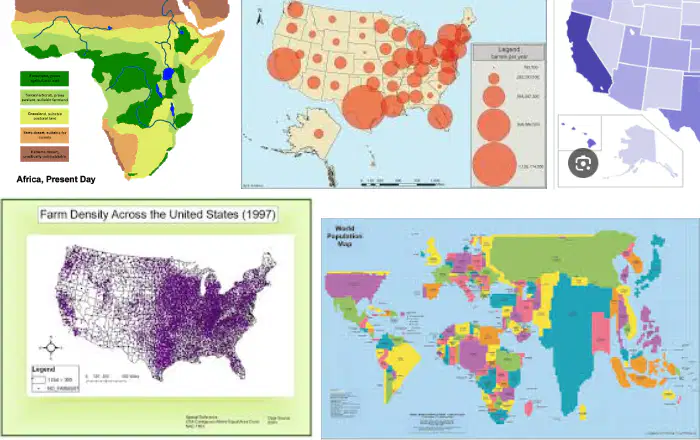
Which thematic map type best matches the image showing U.S. states shaded in different intensities of purple to represent a numeric variable by state?
Choropleth map
Proportional symbol map
Dot-density map
Cartogram
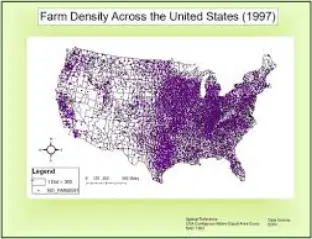
Which thematic map type best matches the image labeled Farm Density Across the United States (1997) that displays many small dots clustered in certain regions?
Dot-density map
Choropleth map
Isoline map
Proportional symbol map
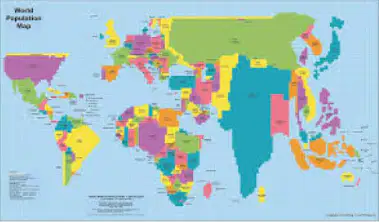
Which thematic map type best matches the world map with countries resized or distorted to reflect a variable rather than their actual land area?
Cartogram
Isoline map
Choropleth map
Proportional symbol map
Location can be described in two ways: relative and absolute. Which statement is an example of absolute location?
The school is at 40.7128° N, 74.0060° W
The library is two blocks south of the park
The cafe is across the street from the museum
The market is near the river downtown
Location can be described in two ways: relative and absolute. Which statement is an example of relative location?
The stadium is west of the train station
The stadium is at 34.0522° N, 118.2437° W
The stadium’s elevation is 300 meters
The stadium covers 20 acres
What is a unique toponym?
A distinctive place name that identifies a location
A measurement of distance between two cities
A type of climate characterized by seasonal rainfall
A method for drawing map projections
What is the difference between site and situation? Choose the option that correctly defines both and gives appropriate examples.
Site is a place’s physical characteristics (e.g., soil, climate, elevation); situation is a place’s location relative to other places (e.g., near a river and major highways)
Site is cultural traits (e.g., language, religion); situation is weather patterns (e.g., prevailing winds)
Site is political boundaries (e.g., county lines); situation is land ownership (e.g., public vs. private)
Site is transportation networks (e.g., bus routes); situation is vegetation types (e.g., forests)
What is a region? Select the best definition.
An area distinguished by one or more shared characteristics
A single point defined by latitude and longitude
A boundary created only by government law
A zone with no identifiable features
Formal region—Which option gives the best example or description of a formal region?
A state with uniform laws and official boundaries
A city served by one newspaper’s circulation area
An area people informally call “the Midwest”
A bus route centered on a downtown hub
Functional region—Which option gives the best example or description of a functional region?
A metropolitan area centered on a commuting network and economic hub
A country defined by a single official language across its territory
A climatic zone identified by average temperature
An area named locally without formal boundaries
Vernacular or perceptual region—Which option gives the best example or description of a vernacular (perceptual) region?
An area commonly referred to as “the South” based on shared cultural perceptions
A province with legally defined borders
A watershed mapped by river drainage divides
A transit zone with scheduled service radiating from a center
Which option is an example of qualitative data in geography?
Interview descriptions of neighborhood safety
The number of households in a census tract
Average annual precipitation in inches
Population density per square mile
Which option is an example of quantitative data in geography?
Average commute time in minutes
Stories people tell about local landmarks
Photographs of historic buildings
Descriptions of sense of place
How often does the Census take place in the United States?
Every 10 years
Every year
Every 5 years
Every 20 years
Which type of data collected by the Census would be useful to the government?
Population counts by age and household size
Daily weather forecasts for each city
Names of local sports teams
Soil pH measurements for farms
What do demographers study?
Human populations, including size, structure, and changes
Weather patterns and climate systems
Physical landforms and tectonic activity
Languages and their historical evolution
What is carrying capacity?
The maximum population an environment can sustainably support
The average number of children born per woman
The number of people per unit area of land
The percentage of infants who survive to age one
Which statement best describes crude birth rate and crude death rate and why they matter to demographers?
They are the total number of births and deaths per 1,000 people per year, indicating population growth or decline
They measure the number of children born to women aged 15–49, showing family size
They represent the percentage of infants who die before age one, showing health care access
They show the share of people aged 65+, revealing aging trends
What is infant mortality rate?
The number of deaths of infants under age one per 1,000 live births in a year
The average number of years a newborn is expected to live
The share of the population under age 15
The number of births per woman over her lifetime
What is life expectancy?
The average number of years a newborn is expected to live given current mortality patterns
The number of deaths per 1,000 people in a year
The percentage of people over age 65 in a population
The typical age at which people retire from the workforce
What is total fertility rate (TFR)?
The average number of children a woman is expected to have over her lifetime
The number of births per 1,000 people in a year
The proportion of infants surviving to age one
The percentage of women aged 15–49 currently pregnant
What is the dependency ratio, including the age range it uses?
The ratio of dependents (ages 0–14 and 65+) to the working-age population (ages 15–64)
The ratio of infants to total births in a year
The ratio of people living in urban areas to rural areas
The ratio of male to female residents in a population
How is a population pyramid graph laid out?
Horizontal bars show age cohorts with males on the left and females on the right; the x-axis is population size and the y-axis is age
Vertical lines show time with births at the top and deaths at the bottom
Dots represent individuals by location; color indicates age group
Stacked columns show occupations; width indicates income level
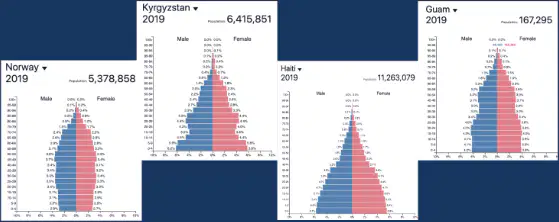
What would a growing population pyramid look like?
A wide base that narrows quickly toward the top, indicating many young people
A roughly rectangular shape with similar width across age groups
A narrow base and wider middle and upper ages
A shape with alternating bulges and indentations across ages
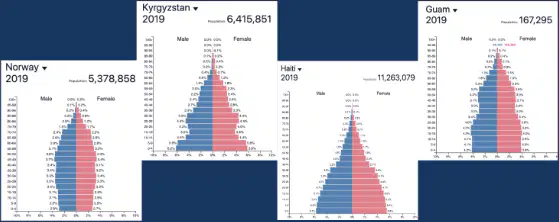
What are the consequences of a growing population shape in a population pyramid?
Greater demand for schools, childcare, and entry-level jobs in the near future
Immediate labor shortages due to many retirees
Rapid population decline within a decade
Lower need for housing due to shrinking families

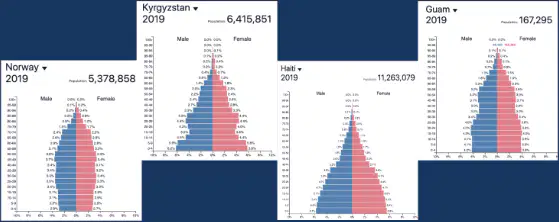
What would a stable population pyramid look like?
A shape that is fairly rectangular with similar widths across many age groups
A very wide base and sharply narrowing upper ages
A narrow base with a bulge in older ages
A pyramid dominated by a single bulge in one cohort

What are the consequences of a stable population shape in a population pyramid?
Balanced planning needs across age groups with steady demand for services
Immediate strain from a very large elderly population
Rapid, unsustainable growth in school-age population
Likely near-term population collapse
What would a declining population pyramid look like?
A narrow base with fewer young people and relatively larger older cohorts
A wide base with many children and few older adults
A perfectly symmetric rectangle across all age groups
A shape with repeated bulges at regular intervals
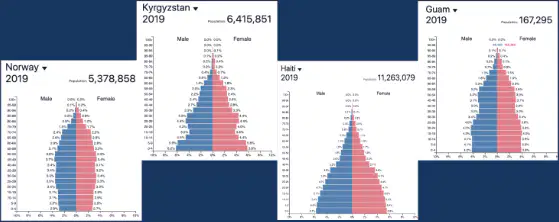
What are the consequences of a declining population shape in a population pyramid?
Aging population, potential labor shortages, and increased pressure on pensions and healthcare
Explosive growth in school enrollments and youth-oriented services
No changes to economic planning or service provision
Immediate increase in birth rates without policy intervention
What is an echo in a population pyramid?
A secondary bulge in younger ages caused by the children of a large cohort (e.g., a baby boom)
A sudden drop in the number of infants due to disease
A gap in the pyramid caused by migration of young adults
A perfectly symmetric pyramid with no irregularities
What would cause an irregularity in a population pyramid? Select all that apply.
Large-scale migration affecting certain age groups
War or conflict causing losses in specific cohorts
A change in retirement age across the entire population
Epidemics that disproportionately affect particular ages
Which is an example of a pronatalist policy and why a government might encourage it?
Tax credits or cash bonuses for larger families to increase birth rates
Limits on family size to slow population growth
Mandatory retirement at age 60 to open jobs for younger workers
A ban on immigration to reduce population density
Which is an example of an anti-natalist policy and why a government might encourage it?
Family-size limits or incentives to have fewer children to slow population growth
Tax credits for third and fourth children to raise fertility
Subsidized childcare to boost births
Paid parental leave to increase family formation
Which statement best distinguishes population density from population distribution?
Density is the number of people per unit area, while distribution describes how people are spread across space
Density describes how people are spread across space, while distribution is the number of people per unit area
Both density and distribution are the number of births per 1,000 people
Density is the total population, while distribution is the total land area
Define and give an example of internal migration. Choose the option that best states the definition and a correct example.
Movement within a single country; a family moves from rural Kansas to urban Kansas City
Movement between countries; a student moves from Canada to the United States
Seasonal movement of livestock; herders move cattle to mountain pastures
Forced movement due to war; civilians flee across an international border
Define and give an example of transnational migration. Choose the option that best states the definition and a correct example.
Movement within the same state; a worker moves from Dallas to Houston
Movement across national borders; a nurse relocates from the Philippines to the United Kingdom for work
Temporary travel for tourism; a family visits a beach for a week
Circular movement of livestock; pastoralists rotate grazing lands within one province
Define and give an example of forced migration. Choose the option that best states the definition and a correct example.
A voluntary decision to move for college; a teen attends a university in another city
Movement compelled by conflict or disaster; residents flee a war-torn region to seek safety
Seasonal movement for agriculture; workers follow harvest cycles within a region
Economic relocation for higher wages; a programmer moves to a tech hub
Voluntary migration — what is the main reason for voluntary migration? Select the best explanation.
Primarily driven by government decree
Primarily driven by economic opportunity such as jobs and higher wages
Primarily driven by sudden natural hazards only
Primarily driven by compulsory military service
How are refugees and asylum seekers connected? Explain each by selecting the statement that best defines both terms and their relationship.
Refugees are tourists and asylum seekers are students; both travel for leisure
Refugees are people forced to flee their country due to persecution; asylum seekers are those who request legal protection in another country, often after fleeing similar threats
Refugees are internal migrants and asylum seekers are guest workers; both move for jobs
Refugees are seasonal movers and asylum seekers are transhumant herders; both follow climate patterns
Define step migration. Choose the option that best describes the process.
Moving directly from a rural village to a foreign megacity in one step
Moving in a series of stages, such as rural to small town to city
Moving livestock between mountain and valley pastures
Returning to a former home country after retirement
Define chain migration. Choose the option that best describes the process.
Individuals relocate randomly without social ties influencing destination
Migration guided by government quotas rather than family or community networks
Migration where people follow relatives or members of the same community to a place already settled by them
Short-distance moves within the same neighborhood only
Define guest worker. Choose the option that best describes the term.
A permanent resident with full citizenship rights
A temporary labor migrant authorized to work for a limited time in a host country
A tourist who spends money in local businesses
An undocumented immigrant employed without authorization
Define transhumance. Choose the option that best describes the practice.
Permanent relocation to an urban center for factory work
Seasonal movement of people and livestock between pastures, often mountain and lowland areas
Emigration to another country to escape political persecution
Short-term business travel between regional offices
Give an example of a push and a pull for the economic category. Choose the pair that correctly shows one economic push factor and one economic pull factor.
Push: abundant jobs; Pull: factory closure
Push: high unemployment; Pull: higher wages and job availability
Push: stable government; Pull: political persecution
Push: pleasant climate; Pull: natural disaster recovery
Give an example of a push and a pull for the social category. Choose the pair that correctly shows one social push factor and one social pull factor.
Push: strong community support; Pull: family reunification barriers
Push: discrimination or lack of social services; Pull: access to education and family reunification
Push: high wages; Pull: job openings
Push: drought; Pull: fertile land
Give an example of a push and a pull for the political category. Choose the pair that correctly shows one political push factor and one political pull factor.
Push: persecution or conflict; Pull: political stability and protection of rights
Push: temperate climate; Pull: heavy snowfall
Push: lack of malls; Pull: new shopping centers
Push: busy traffic; Pull: bike lanes only
Give an example of a push and a pull for the environmental category. Choose the pair that correctly shows one environmental push factor and one environmental pull factor.
Push: frequent natural hazards or drought; Pull: safer environment and reliable resources
Push: high wages; Pull: lower taxes
Push: political freedom; Pull: civil unrest
Push: language barrier; Pull: bilingual schools
Define intervening obstacle. Choose the option that best describes the term in migration.
A factor that encourages people to move to a destination
A barrier that hinders or prevents migration, such as mountains, costs, or legal restrictions
A temporary residence established during step migration
A cultural attraction that draws migrants to a city
Define intervening opportunity. Choose the option that best describes the term in migration.
An unexpected alternative destination offering benefits that cause migrants to settle before reaching their original goal
A legal barrier blocking entry at a border
A natural hazard that forces detours
A government program that restricts visas
What are the qualifications and steps to becoming a naturalized citizen? Select the option that best summarizes common requirements.
Short tourist visit followed by immediate citizenship
Residence for a required period, good moral character, knowledge of civics and language, application and oath of allegiance
Military service only with no tests or residency
Owning property and paying a fee without interviews
What is an unauthorized immigrant? Choose the best definition.
A citizen traveling without a passport
A person residing in a country without legal permission or valid documentation
A guest worker with a temporary visa
A refugee granted asylum
What are a few historic policies regarding immigration? Select all that are accurate examples.
Quotas limiting immigration from specific regions in the early 20th century
Open-border policies with no screening during all periods of U.S. history
Deferred Action programs providing temporary protection for certain groups
Bans targeting all international students regardless of security checks
What are the challenges present at the southern border regarding immigration? Select the most accurate set of challenges.
Excess airline delays only
Complex asylum processing, border security and humanitarian concerns, and limited resources for screening and housing
Lack of weather forecasts
Shortage of tourist attractions
What are the positive impacts of immigration on a nation? Negative? Choose the option that best captures both sides.
Positive: labor shortages; Negative: innovation and entrepreneurship
Positive: economic growth, cultural diversity, and workforce contributions; Negative: strains on services, wage competition in some sectors, and social integration challenges
Positive: reduced tax revenue; Negative: improved productivity
Positive: fewer businesses; Negative: more investment
Explain remittances. Choose the option that best defines the term.
Payments migrants send home to support family or communities
Government fines collected at borders
Company reimbursements for business travel
Taxes paid by tourists during vacations
Brain drain — choose the option that best defines the term.
A sudden loss of population due to a storm
The emigration of highly educated or skilled workers from a country, reducing its human capital
Seasonal movement of farm laborers within a region
A temporary decline in school enrollment during holidays

Identify the shapes of states and a description of how they might be helpful or frustrating to control given their shape. Based on the diagram showing four example shapes, what is the political geography term for the solid circle shape? Choose the best answer.
Compact state
Elongated state
Fragmented state
Perforated state

Identify the shapes of states and a description of how they might be helpful or frustrating to control given their shape. Based on the diagram showing four example shapes, what is the political geography term for the L‑shaped territory with a clear projection? Choose the best answer.
Compact state
Prorupted state
Elongated state
Perforated state

Identify the shapes of states and a description of how they might be helpful or frustrating to control given their shape. Based on the diagram showing four example shapes, what is the political geography term for the solid circle that contains a smaller circle inside it? Choose the best answer.
Elongated state
Compact state
Perforated state
Prorupted state
Give an example of the following types of boundaries — Geometric. Which option is the best example of a geometric boundary?
A straight line drawn along latitude or longitude
A border created by mountain ranges
A frontier established by rivers shifting course
A boundary formed by historic tribal claims
Give an example of the following types of boundaries — Superimposed. Which option is the best example of a superimposed boundary?
A border agreed upon by neighboring communities after negotiations
A boundary imposed by an external power that ignores existing cultural patterns
A border following a natural desert edge
A boundary established by long‑standing language divisions
Give an example of the following types of boundaries — Relic. Which option is the best example of a relic boundary?
A current administrative line between two provinces
An old boundary that no longer functions but is still evident in the cultural landscape
A border drawn to separate two climate zones
A newly negotiated trade corridor
Define supranational organizations. Which description best matches a supranational organization?
A local council that governs a single city
An alliance of multiple states that delegates some sovereignty to cooperate on common goals
A private company operating across borders
A military command within one country
How do the following organizations help member nations? United Nations. Which statement best describes a primary way the United Nations helps its members?
By setting a single currency for all members
By providing a forum for diplomacy, peacekeeping, and international cooperation
By requiring members to merge their militaries
By controlling all national elections
How do the following organizations help member nations? European Union. Which statement best describes a primary way the European Union helps its members?
By eliminating trade among members
By promoting economic integration through a common market and policies
By forbidding freedom of movement within Europe
By replacing all national governments with one federal state
How do the following organizations help member nations? NATO. Which statement best describes a primary way NATO helps its members?
By coordinating collective defense and security among member states
By running a shared education curriculum
By managing agricultural prices in Europe
By administering global health programs
What is Gerrymandering? Choose the best definition.
Drawing electoral district boundaries to favor a particular party or group
Banning political parties from campaigning
Appointing judges to oversee elections
Registering voters through a national census
How is it used in American politics? Select the statement that best explains its use.
Districts are shaped to maximize fair representation for minorities only.
District boundaries are manipulated to concentrate or dilute voters so one party gains electoral advantage.
Districts are assigned randomly by computer to avoid bias.
Districts are redrawn solely to match county lines.

