
 Worksheets
Government Fall Final
Total questions: 75
Worksheet time: 38mins
Name
Class
Date
1.
Includes the right to a defense attorney and speedy trial
a)
Second Amendment
b)
Fifth Amendment
c)
Sixth Amendment
d)
Eighth Amendment
2.
Protects against cruel and unusual punishment
a)
Second Amendment
b)
Fifth Amendment
c)
Sixth Amendment
d)
Eighth Amendment
3.
Protects the right to bear arms
a)
Second Amendment
b)
Fifth Amendment
c)
Sixth Amendment
d)
Eighth Amendment
4.
Indirect democracy
a)
a. represents the type of government exhibited by the Greeks
b)
b. allows every person the ability to vote on every issue
c)
c. would never work in the United States
d)
d. operates when the people elect representatives to serve as their voice
5.
All of the following were weaknesses of the Articles of Confederation EXCEPT
a)
a. The national government couldn’t levy taxes
b)
b. Congress did not have the power to draft an army
c)
c. The Supreme Court was too powerful
d)
d. It was difficult to pass laws or amend the Articles
6.
The concept that the federal and state governments share power is best defined as
a)
checks and balances
b)
federalism
c)
sovereignty
d)
supremacy
7.
The Great (Connecticut) Compromise
a)
a. mostly favored the smaller states.
b)
b. formed our bicameral legislature.
c)
c. decided the issue of slavery.
d)
d. established the Electoral College
8.
Which of the following is an argument Federalists used in defense of the Constitution?
a)
a. all term lengths would be shorter than they were under the Articles of Confederation.
b)
b. slavery would be abolished.
c)
c. the new Constitution would limit the power of the government using separation of powers.
d)
d. the new Constitution would establish a direct democracy.
9.
The three fifths compromise
a)
a. required a 3/5ths vote on every measure at the Constitutional Convention.
b)
b. impacted the population count in both taxation and representation.
c)
c. counted women as 3/5ths of a person.
d)
d. stated 3/5ths of all states were required to ratify the Constitution.
10.
The power to declare war and the power to regulate interstate commerce are examples of which type of power?
a)
a. reserved powers
b)
b. expressed powers
c)
c. implied powers
d)
d. concurrent powers
11.
The decision of many states to legalize marijuana while it is illegal according to federal law, is problematic, because it violates the rules of the
a)
a. Supremacy Clause
b)
b. Commerce Clause
c)
c. 5th Article of the Constitution
d)
d. Colorado State Constitution
12.
The concept that states the government receives their power from the people is descriptive of which Constitutional principle?
a)
a. checks and balances
b)
b. limited government
c)
c. popular sovereignty
d)
d. federalism
13.
The Bill of Rights guarantees all of the following EXCEPT
a)
a. protection against unreasonable search and seizure
b)
b. the right of women to vote
c)
c. freedom of assembly
d)
d. the right to an attorney
14.
Which of the following best describes the government system under the Articles of Confederation?
a)
a. a federal system
b)
b. a “firm league of friendship” between states and a central government
c)
c. a unitary system
d)
d. anarchy
15.
The text above is a part of which constitutional amendment?
a)
a. The 17th amendment
b)
b. The 20th amendment
c)
c. The 22nd amendment
d)
d. The 25th amendment
16.
President Johnson was sworn in as the President of the United States on November 22, 1963, after President Kennedy was assassinated. He then proceeded to win the Election of 1964. According to the guidelines in the amendment above, could President Johnson have run for an additional term?
a)
a. Yes, because he technically only campaigned once.
b)
b. Yes, because he served less than two years of Kennedy’s presidency, which means he had the option to serve two additional terms of his own.
c)
c. No, because the rest of Kennedy’s term already counted as his first full term in office.
d)
d. No, he was too unpopular to run again.
17.
Which of the following statements is supported by the information in the table?
a)
a. Since 1969, the U.S. government has experienced more periods of unified government than divided government.
b)
b. Since 1969, the U.S. government has experienced more periods of divided government than unified government.
c)
c. Since 1969, Democrats have dominated the presidency.
d)
d. Since 1969, Republicans have dominated the House of Representatives.
18.
All of the following were accomplished as a result of the Senate’s investigation into the executive branch EXCEPT
a)
a. Proposed regulations regarding campaign finance
b)
b. Renewed public confidence in congressional investigations
c)
c. Accountability for the executive branch
d)
d. Increased trust in the federal government as a whole
19.
Which of the following statements best summarizes the message of the passage above?
a)
a. The Senate Watergate Committee opened the floodgate for mass congressional investigations of the executive branch since the 1970s.
b)
b. The Senate Watergate Committee highlighted party polarization, which contributed to the lengthy investigative process.
c)
c. The Senate Watergate Committee is an example of appropriate congressional oversight that resulted in meaningful reform.
d)
d. The Senate Watergate Committee is an example of a successful working relationship between the legislative and executive branches
20.
In addition to forming investigative committees, what is another example of congressional oversight over the executive branch?
a)
a. Using the “power of the purse” to cut an agency’s funding.
b)
b. Filing a lawsuit with the Supreme Court to fire the president.
c)
c. Passing a law to cut the president’s term short.
d)
d. Using a legislative veto to nullify an action taken by the executive branch.
21.
All of the following are considered normal tasks of the federal bureaucracy EXCEPT
a)
a. Enforcing federal regulations
b)
b. Appropriating money to agencies and departments.
c)
c. Testifying at congressional hearings
d)
d. Issuing fines to those who break the rules and laws set by the government.
22.
Which of the following makes a correct pairing of an executive branch power with a legitimate legislative branch check?
a)
Exec- The president issues an executive order. Leg- Congress can override the executive order with a 2/3rds vote.
b)
Exec- The president signs an executive agreement. Leg- The Senate must ratify the executive agreement.
c)
Exec- The president appoints an ambassador. Leg- The Senate must confirm the appointment.
d)
Exec- The president grants a pardon. Leg- The House must ratify the pardon.
23.
Which of the following makes a correct pairing of a formal and informal power of the president?
a)
Formal - The power to pardon. Infromal - The power to issue the State of the Union
b)
Formal- The power to issue the State of the Union Address. Informal- The power to issue signing statements.
c)
Formal - The power to issue signing statements. Informal- The power to appoint Cabinet members.
d)
Formal- The power to appoint Cabinet members. Informal- The power to veto laws.
24.
Which of the following is typical of an officeholder’s lame duck status?
a)
a. Decrease in influence
b)
b. Increase in influence
c)
c. Increase in approval ratings
d)
d. Greater caution regarding policy decisions
25.
Which of the following makes a correct comparison of a treaty and an executive agreement?
a)
T- Considered an informal power. EA- Considered a formal power.
b)
T- Requires Senate ratification. EA- Does not require Senate ratification.
c)
T- An agreement with a foreign head of state. EA-An agreement with a congressional leader.
d)
T- Only lasts for the duration of the signing president’s term. EA- An agreement that stands after the signing president leaves office.
26.
A pocket veto is only an option
a)
a. with the vice president’s approval.
b)
b. after the president has had 10 days to consider it.
c)
c. on budget bills.
d)
d. at the end of a legislative session.
27.
The president’s closest day-to-day advisors, such as the chief of staff, are organized in the
a)
a. White House Office
b)
b. Independent Executive Agencies
c)
c. Cabinet
d)
d. Office of Personnel Management
28.
Senator Phillips is a 32-year old Asian American female. She served one term in the House of Representatives before being elected as a U.S. Senator. Her parents immigrated to the U.S. two years before she was born in California. She grew up in the United States and decided she wanted to serve in the U.S. government. She is now looking to run for president in next year’s election. Is this a possibility for her?
a)
a. Yes, she meets the qualifications to run for president.
b)
b. No, her parents are immigrants, which disqualifies her from running.
c)
c. No, she does not have enough experience to run for president.
d)
d. No, she is not old enough to run for president.
29.
Which of the following scenarios best illustrates a legitimate check on the power of the federal bureaucracy?
a)
a. Congress decides to remove the Secretary of Homeland Security for questionable decision-making.
b)
b. The Supreme Court decides to impeach the Postmaster General.
c)
c. Congress holds a hearing with the Federal Reserve Board to question their policy decisions regarding inflation rates.
d)
d. The media publishes an article revealing a secret personal relationship between two Cabinet members.
30.
Which of the following officeholders would be considered a lame-duck?
a)
a. A member of Congress who identifies as an independent rather than as a Republican or Democrat.
b)
b. A majority leader who will soon become the minority leader due to party defeat.
c)
c. A president who is serving out the last remaining months of his second term until the new president is inaugurated.
d)
d. A bureaucrat who is ineffective at their job, but may not be fired.
31.
Which regulatory agency has been tasked with enforcing the rules of the stock market?
a)
a. The Federal Stock Commission
b)
b. The Securities and Exchange Commission
c)
c. The Federal Communications Commission
d)
d. The Federal Reserve
32.
Which of the following limits a president’s ability to implement policy how he wishes?
a)
a. The Supreme Court can dictate specific rules regarding policy implementation.
b)
b. The president is limited in his ability to remove civil service bureaucrats who disagree with his policy views.
c)
c. The president cannot publicize his intentions for policy implementation, as that is viewed as coercive.
d)
d. Congress has the power to veto bureaucratic rules.
33.
The President and Vice President have both been shot and killed after a press conference. Who will be sworn in as President of the United States?
a)
a. The Secretary of State
b)
b. The President Pro Tempore
c)
c. The Speaker of the House
d)
d. The Secretary of Defense
34.
Which law has played the greatest role in promoting neutrality and fairness in the hiring of civil service bureaucrats?
a)
a. The Pendleton Act
b)
b. The Hatch Act
c)
c. The Freedom of Information Act
d)
d. The Administrative Procedure Act
35.
If the president was anxious to act on a domestic issue, but Congress kept stalling, what action might he take?
a)
a. issue an executive agreement
b)
b. issue an executive order
c)
c. pass a law
d)
d. hold the Speaker of the House in contempt for lack of action
36.
The president wants to pass comprehensive immigration reform, but Congress continues to fight and refuses to pass anything significant. Which presidential power is he most likely to use to get Congress to act?
a)
a. The power to issue an executive agreement
b)
b. The power to appoint a new Speaker of the House
c)
c. The power to grant amnesty
d)
d. The power of the bully pulpit
37.
The Executive Branch falls into which one of the articles of the Constitution?
a)
1st Article
b)
2nd
c)
3rd
d)
7th
38.
Which of the following best illustrates the concept of iron triangles?
a)
a. The House, Senate, and Supreme Court all ban together to impeach the president.
b)
b. The Federal Reserve, Treasury Department, and Council of Economic Advisors meet to determine how to best deal with the current recession.
c)
c. Three lobbying firms join forces to push for new gun legislation.
d)
d. An agency, interest group, and congressional committee work to address specific policy concerns.
39.
For information regarding the federal budget, the president would consult the _________________. However, for an update on monetary policy, such as interest rates and the money supply, he would refer to the ______________________.
a)
a. Council of Economic Advisers, Office of Management and Budget
b)
b. Federal Reserve Board, Council of Economic Advisors
c)
c. Office of Management and Budget, Federal Reserve Board
d)
d. Securities and Exchange Commission, Federal Reserve Board
40.
The difference between a regulatory agency and an independent agency is
a)
a. regulatory agencies are smaller than independent agencies.
b)
b. regulatory agency heads are easier to remove than independent agency heads.
c)
c. regulatory agencies are meant to be more protected from partisan pressures in order to serve more impartially.
d)
d. there are more regulatory agencies than there are independent agencies.
41.
Which of the following would be an unconstitutional use of presidential power?
a)
a. Appointing a Supreme Court Justice that tends to share his party’s ideological views.
b)
b. Pardoning a convicted felon.
c)
c. Vetoing a congressional bill after considering it for only one day.
d)
d. Impounding funds appropriated by Congress.
42.
Which of the following is a correct example of the rule-making authority given to bureaucratic agencies?
a)
a. The Environmental Protection Agency decides to further define a congressional water pollution law by listing specific chemicals that corporations may no longer dispose of in rivers.
b)
b. The Department of the Treasury decides to pass a flat income tax rate of 20% regardless of income level.
c)
c. The FBI decides to create a new law specifying that ex-convicts may no longer fly cross-country.
d)
d. The Center for Disease Control decides that there should be a national standard for vaccinations, so they declare new vaccination requirements for all public schools across the country that supersede current state laws.
43.
The United States Postal service is a government owned entity that sells goods and services. It is therefore best classified as a(n)
a)
a. executive department
b)
b. regulatory commission
c)
c. government corporation
d)
d. entrepreneurial agency
44.
Modern communication technology has influenced the president’s relationship with the public in all of the following ways EXCEPT
a)
a. The president is able to televise public addresses, such as the State of the Union.
b)
b. The president is able to respond to political events and crises much more quickly than in the past.
c)
c. The president is better able to filter the information that reaches the public.
d)
d. The president is able to use communication technology as tools in agenda setting.
45.
Which of the following is an example of a president making a bureaucratic appointment based on political patronage?
a)
a. Choosing a bureaucrat based on a civil service exam.
b)
b. Appointing a Hispanic female as Secretary of Energy.
c)
c. Appointing a loyal party supporter and donor as an ambassador to Germany.
d)
d. Selecting a Federal Reserve Board member based on his past experience.
46.
Discretionary authority refers to
a)
a. the ability of the bureaucracy to add specific guidelines to policies that were not defined by congressional law.
b)
b. the ability of the executive branch to enforce judicial decisions how they please.
c)
c. the ability of the president to choose his/her running mate.
d)
d. the ability of the president to veto or sign a bill.
47.
The president has suffered a stroke, but believes he is still able to fulfill his duties. The vice president disagrees and believes the current president is unfit to continue as President of the United States. Which amendment sets the succession order and allows temporary presidency while th
a)
27th Amendement
b)
17th Amendemnt
c)
25th Amendment
d)
22nd Amendement
48.

Which of the following statements is supported by the information in the graph above?
a)
a. Congress rarely attempts to override a presidential veto.
b)
b. Democratic presidents are more likely to veto bills than Republican presidents.
c)
c. When compared to the number of presidential vetoes, successful veto overrides are rare.
d)
d. Congress often uses their power to veto
49.
How can Congress reduce the probability of a presidential veto?
a)
a. Pass the bill with a 55% majority.
b)
b. Negotiate with the president and make concessions.
c)
c. Pass the bill when the president is out of town.
d)
d. Pass the bill when presidential ratings are at their highest.
50.
What is required to overturn a presidential veto?
a)
a. A majority vote of all congressional leadership.
b)
b. A 2/3rds majority vote of both houses of Congress.
c)
c. A 3/5ths majority vote of both houses of Congress.
d)
d. A 51% majority vote of both houses of Congress with the approval of the Vice President.
51.
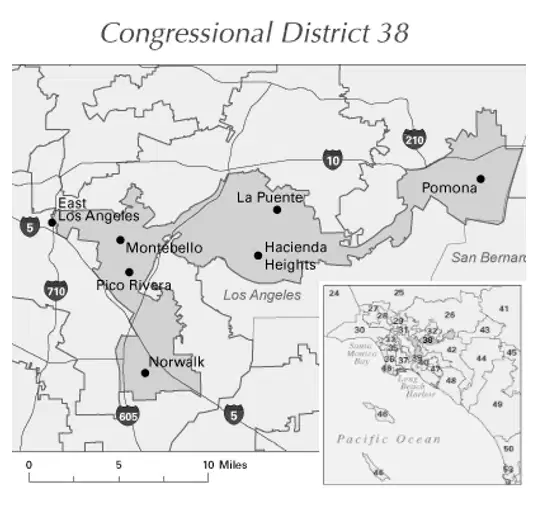
Why would a congressional district be drawn in the odd shape illustrated in the image above?
a)
a. To ensure racial diversity within each congressional district.
b)
b. To manipulate financial resources provided to each congressional district.
c)
c. To manipulate congressional election results by concentrating or separating certain groups of people.
d)
d. To ensure all political ideologies are equally represented within a congressional district.
52.
The practice of drawing district lines in the manner depicted above is referred to as
a)
a. gerrymandering
b)
b. malapportionment
c)
c. financial malfeasance
d)
d. reapportionment
53.
How often does redistricting typically occur?
a)
a. Whenever the voters decide
b)
b. Every two years, with each congressional election cycle
c)
c. Every ten years after the U.S. census is taken
d)
d. Every four years, with each presidential election cycle
54.

Which of the following statements is best illustrated by the information in the graph below?
a)
a. Presidents have a difficult time getting nominations confirmed by the Senate.
b)
b. Democratic presidents have a harder time gaining confirmation than Republican presidents.
c)
c. The Senate is more likely to confirm Supreme Court nominations than reject them.
d)
d. Republican presidents historically have had more opportunities to make Supreme Court appointments than Democratic presidents.
55.
What is one action senators in the minority party may take to block the confirmation of a Supreme Court nominee they disapprove of?
a)
a. Refuse to vote
b)
b. Filibuster
c)
c. Pass a discharge petition
d)
d. Pass a unanimous consent agreement
56.
Who does Congress share responsibility with in passing the budget?
a)
a. The Supreme Court
b)
b. The President
c)
c. The Secretary of the Treasury
d)
d. The Federal Reserve
57.
Which of the following powers are shared by both the House of Representatives and the Senate?
a)
a. Holding trials of impeachment
b)
b. Proposing constitutional amendments
c)
c. Approving treaties
d)
d. Holding confirmation hearings
58.
The Senate majority leader wants to ensure a successful vote on an upcoming health care bill. Who would he or she turn to in order to ensure that happens?
a)
a. Minority Leader
b)
b. Speaker of the House
c)
c. Majority Whip
d)
d. Minority Whip
59.
What is the primary role of the President of the Senate?
a)
a. Preside over daily matters in the Senate
b)
b. Determine committee assignments
c)
c. Break ties in the Senate
d)
d. Assign bills to committees
60.
Which of the following enumerated powers would permit Congress to issue an economic sanction against another country as a consequence for their actions towards the United States?
a)
a. The power to set weights and measures
b)
b. The power to maintain an army and navy
c)
c. The power to regulate interstate and foreign commerce
d)
d. The power to set immigration policies
61.
The House and Senate have passed two different versions of a budget bill and are at a temporary standstill. Which type of committee will they most likely form to move forward with the bill?
a)
a. Standing Committee
b)
b. Select Committee
c)
c. Rules Committee
d)
d. Conference Committee
62.
A majority of the House has just voted to force a bill out of committee and onto the floor for consideration. What device have they just utilized?
a)
a. Simple resolution
b)
b. Unanimous consent agreement
c)
c. Discharge petition
d)
d. Pork barrel legislation
63.
Congress’ power to declare war is considered a(n)
a)
a. enumerated power
b)
b. reserved power
c)
c. implied power
d)
d. concurrent power
64.
Some public concerns have been raised about the Food and Drug Administration, so Congress decides to form a committee to investigate the matter. Which of the following types of committees would be most appropriate for this course of action?
a)
a. Standing Committee
b)
b. Select Committee
c)
c. Rules Committee
d)
d. Conference Committee
65.
Which of the following makes a correct comparison between representatives in the House of Representatives and senators in the U.S. Senate?
a)
Reps- Members must be at least 30 years old. Senate- Members must be at least 35 years old.
b)
Reps- may serve for an unlimited number of terms. Senator- may only serve for four terms.
c)
Reps - The constituency of a representative is their legislative district. Senator- The constituency of a Senator is their state.
d)
Reps- serve for 6-year terms. Senator- serve for 2-year terms.
66.
Which of the following makes a correct pairing of an executive branch power with a legitimate legislative branch check?
a)
Exec- The president passes a bill. Leg- Congress can veto the bill.
b)
Exec- The president signs a treaty. Leg- The Senate must ratify the treaty.
c)
Exec- The president appoints a Supreme Court Justice. Leg-The House must confirm the appointment.
d)
Exec- The president passes an amendment. Leg- Congress must ratify the amendment.
67.
Which of the following makes a correct comparison between the legislative process in the House versus the Senate?
a)
House- Debate is more formal. Senate- Debate is less formal.
b)
House- Bills reach the floor more quickly. Senate-Bills must pass through the Rules Committee.
c)
House- Members have the ability to filibuster. Senate- Members have the ability to invoke cloture.
d)
House- Tax bills must originate in the House. Senate- Defense bills must originate in the Senate.
68.
Which of the following makes a correct comparison between a power of the House and a power of the Senate?
a)
House- Power to ratify amendments. Senate- Power to impeach the president.
b)
House- Power to confirm presidential appointments. Senate- Power to ratify treaties.
c)
House- Power to file charges of impeachment. Senate- Power to try impeachment cases and decide conviction.
d)
House- Power to introduce tax bills. Senate- Power to file charges of impeachment.
69.
The process in which a bill becomes a law can best be described as
a)
a. Quick and easy
b)
b. Slow and cautious
c)
c. Unorganized and chaotic
d)
d. Smooth and efficient
70.
The majority party in the House of Representatives holds all of the following advantages EXCEPT
a)
a. choosing the Speaker of the House
b)
b. controlling the legislative agenda
c)
c. holding committee chair positions
d)
d. the ability to stall or block presidential nominations
71.
Out of the following, who is most likely to be appointed as the committee chair for the Armed Services Committee?
a)
a. A new member of the majority party, who has an extensive military background.
b)
b. A member of the majority party, who has served in Congress for 30 years and on the Armed Services Committee for the past 6 years.
c)
c. A member of the minority party, who has served in Congress for 24 years and has served on the Armed Services Committee for the entirety of those 24 years.
d)
d. A member of the majority party who has served in Congress for 18 years and has served on the Armed Services Committee for the entirety of those 18 years.
72.
Which of the following is an example of an unconstitutional use of legislative power?
a)
a. Congress decides to investigate the Vice President’s office on suspicion of fraud.
b)
b. Congress decides to pass a tax on cars entering the United States from foreign nations.
c)
c. Congress withholds their approval on the federal budget until the president makes some concessions.
d)
d. Congress passes a law requiring all states to ban guns in all entertainment venues.
73.
Where is a bill most likely to die in the legislative process?
a)
a. Standing committee
b)
b. On the floor
c)
c. Conference committee
d)
d. On the president’s desk
74.
All of the following are powers of the Speaker of the House EXCEPT
a)
a. determining the committee assignment of bills.
b)
b. recognizing members to speak on the floor.
c)
c. appointing all majority whips and floor leaders.
d)
d. putting motions to a vote.
75.
Rico is a 33 year old, college graduate, who immigrated from Mexico and became a citizen 15 years ago. Rico would like to run for U.S. Congress to help support other immigrant children like himself. Is Rico eligible to run for Congress?
a)
No, he would have to be a natural born citizen
b)
Yes, he meets all the requirements of the House of Representatives
c)
No, we do not know how long Rico has been residing in his district
d)
Yes, his college degree makes him an ideal cadidate
100 %

