
NEW
Font size
 Worksheets
Chapter 13: Drug Interactions Introduction
Total questions: 30
Worksheet time: 15mins
Which phrase best captures the chapter’s central topic shown on the cover slide?
Advanced surgical techniques overview
Principles of drug interactions overview
Cellular microbiology pathogens overview
Veterinary anatomy systems overview
What academic year is indicated on the title slide?
2024/2025
2025/2026
2023/2024
2022/2023
The banner identifies the division responsible for this chapter. Which division is it?
Public Health and Epidemiology division
Biochemistry and Genetics division
Pharmacology and Toxicology division
Medical Physiology division
The institution named on the slides is located in which city?
Yogyakarta, Indonesia
Bogor, Indonesia
Jakarta, Indonesia
Bandung, Indonesia
Which school within IPB University is credited on the slides?
School of Veterinary Medicine and Biomedics
School of Agricultural Technology and Food
School of Marine Science and Aquaculture
School of Engineering and Applied Physics
Which visualization style is used for the biomolecule on the recall slide?
Flat 2D schematic
Electron micrograph image
Wireframe skeletal model
Space-filling 3D rendering
Which playful image on the objectives slide metaphorically illustrates interaction effects?
Two cartoon cars colliding
A rocket launching
A tree growing leaves
A microscope focusing
In the context of pharmacology, which term most closely matches the chapter theme?
Environmental toxic spills
Drug–drug interactions
Nutritional epidemiology
Genetic inheritance patterns
Which audience is implied by the school credited on the slides?
Veterinary and biomedical students
Elementary school students
Mechanical engineering trainees
Political science majors
Which domain is emphasized by the division name shown?
Classical literature studies
Astrophysics and cosmology
Pharmacology and toxicology
Civil engineering mechanics
Which slide uses a question to prompt prior knowledge activation?
Title slide with chapter name
Slide with “What did you learn last week?”
Objectives slide with car image
Credits slide at the end
Which depiction best symbolizes a potential adverse interaction outcome?
Handshake between two people
Book closing gently
Car crash cartoon metaphor
Lightbulb turning on
Which format is used to communicate the learning outcome?
Bulleted statistical table
Long technical derivation
Narrative case study paragraph
Short declarative sentence
What learning strategy is hinted by asking students what they learned last week?
Activating prior knowledge
Grading athletic performance
Measuring lung capacity
Calibrating lab equipment
Which element indicates the slides are part of a university-level course?
Travel agency watermark
Sports league emblem
Comic book publisher logo
IPB University branding
Vitamin C is stored with alkaline antacids. Which process explains its loss of activity?
Hydrolysis causing ester bond cleavage
Isomerization to inactive stereoisomer
Oxidation accelerated by alkaline environment
Polymerization reducing solubility
Co-storage of tetracycline with mineral supplements containing Fe, Zn, Ca, or Mg most directly leads to:
Chelation that lowers antibiotic potency
Enhanced absorption via salt formation
Oxidation increasing antimicrobial activity
Neutralization improving gastric tolerance
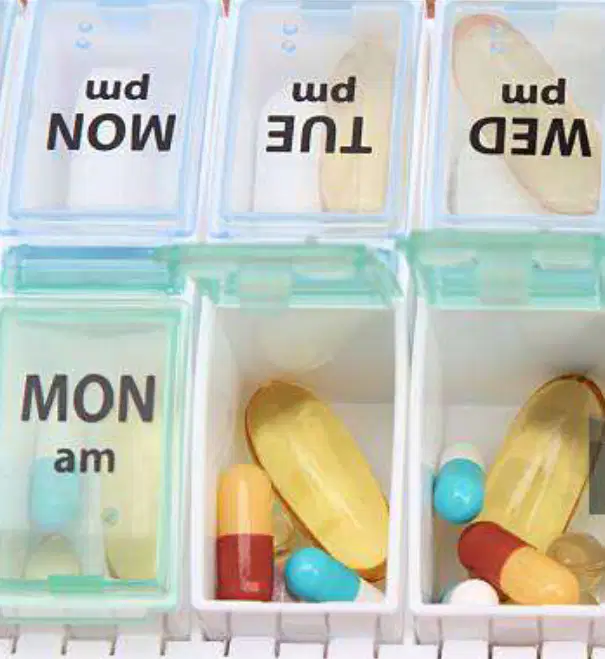
You must pre-fill a weekly pillbox for a patient taking omeprazole (enteric-coated), amoxicillin powder for suspension, and calcium tablets. Which storage plan minimizes interaction risks?
Mix all medications in one compartment daily
Place calcium next to powder to absorb moisture
Separate compartments; keep powder sealed separately
Store omeprazole with calcium to stabilize coating
What is the primary goal of multi-medication when managing disease?
To comprehensively treat causative and supportive needs
To quickly reduce symptoms without finding cause
To limit drug exposure by stopping supportive care
To avoid any interaction by using fewer medicines
Which pair correctly contrasts drug interaction types in multi-medication?
Synergistic reduces effect; antagonistic increases effect
Synergistic increases effect; antagonistic reduces effect
Both synergistic and antagonistic reduce overall effect
Both synergistic and antagonistic increase overall effect
Which patient group is at higher risk when multiple medications are used?
Short-term travelers
Postoperative athletes
Healthy young adults
Developing fetus and infants
Combining penicillin with an aminoglycoside (e.g., gentamicin) in a syringe is risky primarily because it can cause:
Immediate precipitation increasing efficacy
Buffering that stabilizes both drugs
Synergistic antibacterial enhancement
Spontaneous drug inactivation on contact
Which pairing is most prone to immiscibility during mixing?
Ivermectin oil-based with water-based antibiotic
Vitamin B complex with vitamin C or calcium
Penicillin with buffered saline diluent
Tetracycline with antihistamine tablets
Tetracycline taken with calcium-rich milk most likely leads to which outcome?
Chelate formation reducing absorption
Enhanced antibiotic uptake
Neutral gastric pH increasing absorption
Delayed gastric emptying increasing exposure
Phenylbutazone given with sulfonamide increases adverse effects mainly because of what kinetic interaction?
Displacement from albumin raising free drug
Accelerated renal excretion lowering levels
Chelate formation reducing bioavailability
Sucralfate-like mucosal coating limiting contact
Which pairing exemplifies CYP450 enzyme induction that reduces another drug’s effectiveness during metabolism?
Ketoconazole with cyclosporine therapy
Phenobarbital with doxycycline or prednisone
Furosemide with aminoglycoside therapy
Probenecid with Penicillin G dosing
Probenecid is co-administered with Penicillin G. What practical implication should be anticipated for dosing intervals?
Alternating intervals to avoid peak-trough overlap
Unchanged intervals because clearance is unaffected
Shorter intervals to counter faster elimination
Longer intervals due to prolonged penicillin half-life
Which combination raises the risk of both nephrotoxicity and ototoxicity through additive renal workload and ear hair cell effects?
Probenecid with Penicillin G course
Phenobarbital with doxycycline regimen
Furosemide with aminoglycosides therapy
Ketoconazole with cyclosporine treatment
Which statement best defines an additive drug interaction in terms of combined effect magnitude?
Two drugs cancel each other out
One drug boosts an inactive partner
Two drugs exceed the sum of effects
Two drugs equal the sum of effects
A clinician pairs ketamine with xylazine for anesthesia. Which rationale most accurately describes the expected interaction outcome?
Antagonism reducing overall anesthetic depth
Potentiation of xylazine by ketamine alone
Synergistic anesthesia with muscle relaxation
Additive sedation without muscle relaxation

