
 Worksheets
World History Final - Fall 25
Total questions: 85
Worksheet time: 43mins
Name
Class
Date
1.
philosophy based on Hanfeizi’s teachings
a)
Mahayana
b)
Legalism
c)
Shi Huangdi
d)
Daoism
e)
Confucius
2.
first emperor who united China
a)
Mahayana
b)
Legalism
c)
Shi Huangdi
d)
Daoism
e)
Confucius
3.
philosopher whose ideas helped shape Chinese civilization for 2,500 years
a)
Mahayana
b)
Legalism
c)
Shi Huangdi
d)
Daoism
e)
Confucius
4.
a form of Buddhism that developed in India that promised salvation to all
a)
Mahayana
b)
Legalism
c)
Shi Huangdi
d)
Daoism
e)
Confucius
5.
philosophy that taught living in harmony with nature
a)
Mahayana
b)
Legalism
c)
Shi Huangdi
d)
Daoism
e)
Confucius
6.
respect for one’s parents
a)
Ashoka
b)
Stupas
c)
Chandra Gupta
d)
Chandragupta
e)
filial piety
7.
established the Gupta Empire
a)
Ashoka
b)
Stupas
c)
Chandra Gupta
d)
Chandragupta
e)
filial piety
8.
Maurya emperor who converted to Buddhism
a)
Ashoka
b)
Stupas
c)
Chandra Gupta
d)
Chandragupta
e)
filial piety
9.
mounded stone buildings built over holy relics - Buddhists meditated while walking around these
a)
Ashoka
b)
Stupas
c)
Chandra Gupta
d)
Chandragupta
e)
filial piety
10.
established the Mauryan Empire
a)
Ashoka
b)
Stupas
c)
Chandra Gupta
d)
Chandragupta
e)
filial piety
11.
The Golden Age of India took place during the rule of the
a)
a. Mauryas.
b)
b. Romans
c)
c. Qin
d)
d. Guptas
12.
In an Indian household, the head of the family was the
a)
a. youngest son.
b)
b. oldest female.
c)
c. oldest male.
d)
d. oldest daughter.
13.
Confucius believed the best ruler was
a)
a virtuous man who led by example.
b)
b. a man with little education.
c)
c. someone who would pass strict laws.
d)
d. a great military hero.
14.
How did Han emperors select officials to run the government?
a)
a. They set up a system of civil service exams that were open to anyone.
b)
b. They chose the best-educated priests and scribes.
c)
c. They allowed villages to appoint their own officials.
d)
d. They appointed people from noble families.
15.
Hindus believed that caste could be changed by
a)
a. the emperor.
b)
b. marriage.
c)
c. the law of karma.
d)
d. moving.
16.
Confucian social relationships
a)
a. stressed the welfare and interests of the state
b)
b. were based upon universal love and forgiveness
c)
c. used rewards for correct behavior and punishments for transgressions
d)
d. established a hierarchy and insisted upon reciprocal duties of the people
17.
Which statement does not describe an achievement of the Han dynasty?
a)
a. Physicians used acupuncture to relieve pain and treat illness.
b)
b. Liu Bang invented a simple printing press.
c)
c. Inventors developed practical tools like wheel barrows and plows.
d)
d. Cai Lun invented a method for making durable paper out of wood.
18.
Daoists believed that the best government
a)
a. was one that forced people to work on government projects.
b)
b. was one that governed the least.
c)
c. was one that took control of people’s lives.
d)
d. was one that brought order to human affairs.
19.
Which of the following was part of the Confucian social order?
a)
a. filial obedience to one’s father
b)
b. respect for the elderly
c)
c. loyalty to the ruler
d)
d. all of these
20.
Han rulers based their policies on the teachings of
a)
a. Confucius.
b)
b. Laozi.
c)
c. Hanfeizi.
d)
d. the Buddha.
21.
What was a major influence of Indian culture on Chinese culture?
a)
a. the Indian language of Sanskrit became China’s second language
b)
b. Indian emperors ruled over China for hundreds of years
c)
c. the Indian religion of Buddhism made a profound impact on Chinese society
d)
d. Indian food became a common part of the diet among wealthy Chinese
22.
Who established the Han dynasty?
a)
a. Hanfeizi
b)
b. Wudi
c)
c. Liu Bang
d)
d. Shi Huangdi
23.
According to Legalism, the way to achieve order was
a)
a. to provide a ruler who set a good moral example.
b)
b. to pass strict laws and enforce them with harsh punishments.
c)
c. to live by the natural balance of yin and yang.
d)
d. to appeal to man’s natural goodness.
24.
Which language flourished as a literary vehicle during the Gupta Golden Age?
a)
a. Sanskrit
b)
b. Hindi
c)
c. Mandarin
d)
d. all of these
25.
For whom was the Terracotta Army built?
a)
a. Shi Huangdi
b)
b. Wudi
c)
c. Liu Bang
d)
d. Ashoka
26.
What statement defines the dynastic cycle?
a)
a. Chinese governments ruled based on the power of a single family.
b)
b. powerful militaries were replaced by Confucian scholars, leading to the fall by foreign invasion
c)
c. Chinese government depended upon economic growth but when the economy declined, so did the dynasties
d)
d. government had prosperity and economic growth, but corruption, internal disasters, and invasions ended rule
27.
What did the family of an Indian bride need to provide for the wedding?
a)
a. dowry - payment for wedding expenses
b)
b. a religious symbol of the couple’s love
c)
c. permanent employment for the groom
d)
d. none of these
28.
Who was considered ancient India's greatest poet and playwright?
a)
a. Shakuntala
b)
b. Chandragupta Maurya
c)
c. Kalidasa
d)
d. Ashoka
29.
All of the following were effects of Indian trade EXCEPT
a)
a. rise in banking in India
b)
b. Indian merchants lived abroad spreading Indian culture
c)
c. Hinduism and Buddhism spread
d)
d. trade boosted the economies of Mesoamerican civilizations
30.
The trade route that linked China with the West became known as the
a)
a. Great Wall.
b)
b. civil service system.
c)
c. Silk Road
d)
d. military districts
31.
Indian scientist Aryabhata calculated the solar year and pie during the Golden Age of
a)
a. the Gupta Empire
b)
b. the Mauryan Empire
c)
c. the Qin dynasty
d)
d. none of these
32.
Because of the exposure to other cultures and the popularity of Buddhism, Hinduism changed. What was the result of the changes in Hinduism?
a)
a. changes in Hinduism resulted in the religion being replaced by Buddhism and Confucianism
b)
b. changes in Hinduism boosted its popularity
c)
c. changes in Hinduism grew support from the upper classes
d)
d. none of these
33.
All were a result of the Gupta’s Golden Age EXCEPT
a)
a. astronomers proved earth was round 1,000 yrs before Columbus
b)
b. inventors developed the rudder to steer boats, suspension bridges, and the seismograph
c)
c. mathematicians invented numerals, the zero and decimal system
d)
d. physicians performed surgery, even plastic surgery
34.
Which dynasty succeeded Shi Huangdi and ruled for the next four centuries?
a)
a. Han dynasty
b)
b. Qin dynasty
c)
c. Shang dynasty
d)
d. all of these
35.
Who established the Qin dynasty?
a)
a. Hanfeizi
b)
b. Wudi
c)
c. Liu Bang
d)
d. Shi Huangdi
36.
People who move from place to place following game animals and ripening fruits
a)
polytheism
b)
Neolithic Age
c)
nomads
d)
domesticate
37.
taming of animals, in order to meet human wants or needs
a)
polytheism
b)
Neolithic Age
c)
nomads
d)
domesticate
38.
Worship of many gods
a)
polytheism
b)
Neolithic Age
c)
nomads
d)
domesticate
39.
New Stone Age
a)
polytheism
b)
Neolithic Age
c)
nomads
d)
domesticate
40.
Which of the following caused ancient civilizations to change?
a)
a. lack of traditions
b)
b. contact with other people through trade, warfare, and migration
c)
c. poor leaders
d)
d. nomadic herders
41.
Why was the Neolithic Revolution important to history?
a)
a. It contributed to the establishment of civilization.
b)
b. It brought about the outbreak of many wars
c)
c. It helped to establish nomadic tribes across the world.
d)
d. It caused the outbreak of epidemic diseases.
42.
Bronze became a favored material for tools and weapons because
a)
a. it could be given a tough sharp cutting edge an was easy to mold.
b)
b. was much less expensive than copper or tin.
c)
c. flint supplies diminished during the Bronze Age.
d)
d. artisans found it difficult to shape liquid metals.
43.
First human like creatures, walked upright, traced back to 4.4 million years ago
a)
a. Cro-Magnon
b)
b. neanderthals
c)
c. ninjas
d)
d. hominids
44.
People who specialized in jobs and became skilled craftworkers were known as
a)
a. artisans.
b)
b. priests.
c)
c. nobles.
d)
d. peasant farmers.
45.
Complex societies with advanced knowledge of farming, trade, government and art are
a)
a. cultures.
b)
b. cooperatives.
c)
c. civilizations
d)
d. agricultural villages
46.
A term that describes the rise and fall of dynasties
a)
theocracy
b)
dynastic cycle
c)
city-state
d)
mandate of heaven
e)
delta
47.
Government headed by religious leaders or a leader regarded as god
a)
theocracy
b)
dynastic cycle
c)
city-state
d)
mandate of heaven
e)
delta
48.
Triangular area of marshland formed by deposits of silt at the mouth of some rivers
a)
theocracy
b)
dynastic cycle
c)
city-state
d)
mandate of heaven
e)
delta
49.
A political unit consisting of a city and its surrounding land
a)
theocracy
b)
dynastic cycle
c)
city-state
d)
mandate of heaven
e)
delta
50.
Where did the first cities emerge?
a)
a. along trade routes
b)
b. in river valleys
c)
c. along the Mediterranean coast
d)
d. in the Americas
51.
The Egyptians believed in which of the following?
a)
a. life after death
b)
b. that God would lead them to the promised land
c)
c. one god
d)
d. Ahriman and Ahura Mazda
52.
How did the Sumerians differ from the Egyptians in the way they viewed an afterlife?
a)
a. They saw life after death to be pleasant.
b)
b. They believed they themselves would be gods.
c)
c. They saw life after death as horrible.
d)
d. They believed they would be with their gods
53.
The Code of Hammurabi was a major achievement for which of the following reasons?
a)
a. It was the first major collection of laws.
b)
b. It treated men and women as equals.
c)
c. It ended capital punishment
d)
d. It rejected the principle of an “eye for an eye, and tooth for a tooth.”
54.
During what Kingdom was the Ancient Pyramids of Giza built?
a)
a. Medium Kingdom
b)
b. New Kingdom
c)
c. Middle Kingdom
d)
d. Old Kingdom
55.
Which of the following geographic features had the greatest influence on ancient Egypt?
a)
a. Mediterranean Sea
b)
b. the Nile River
c)
c. the Nubian Desert
d)
d. the Red Sea
56.
Composed two famous Greek epics, the Iliad and the Odyssey
a)
oligarchy
b)
aristocracy
c)
democracy
d)
Minoan
e)
Homer
57.
a form of government in which power is held by the nobility or wealthy class
a)
oligarchy
b)
aristocracy
c)
democracy
d)
Minoan
e)
Homer
58.
System of government where power lies in the hands of all citizens
a)
oligarchy
b)
aristocracy
c)
democracy
d)
Minoan
e)
Homer
59.
System of government where a few people hold power over the larger group of people
a)
oligarchy
b)
aristocracy
c)
democracy
d)
Minoan
e)
Homer
60.
one of the first cultures of Greece
a)
oligarchy
b)
aristocracy
c)
democracy
d)
Minoan
e)
Homer
61.
A Greek play that mocked people or social customs is called a
a)
a. comedy.
b)
b. mystery
c)
c. tragedy.
d)
d. love story.
62.
From childhood, Spartan boys were trained to be
a)
a. philosophers.
b)
b. politicians
c)
c. soldiers
d)
d. artists.
63.
All of the following were true of the ancient Olympics EXCEPT
a)
a. women were not permitted to watch.
b)
b. non-Athenians were not allowed to compete.
c)
c. they were held in honor of Zeus.
d)
d. they did not include team events.
64.
Why was the Delian League formed?
a)
a. to guard against future attacks from Persia
b)
b. to create a trading alliance
c)
c. to give all the city-states equal power in Greece
d)
d. to unite the city-states into one empire
65.
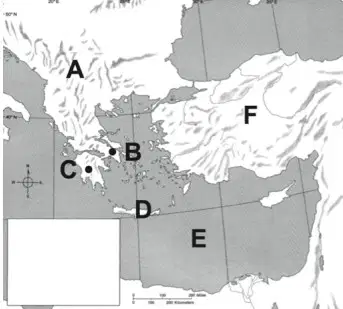
Which letter marks the location of Athens? Must Capitalize or it will be marked WRONG
(a)
66.
Julius Caesar’s enemies assassinated him because
a)
a. they were angry with him for his military failures in Gaul.
b)
b. they feared he planned to make himself king of Rome.
c)
c. they were opposed to his expansion into other lands.
d)
d. they were fearful when he refused to disband his army
67.
The Peace of Augustus - Pax Romana lasted for
a)
a. 6 years.
b)
b. 25 years.
c)
c. 200 years
d)
d. 2,000 years.
68.
The legendary twins who founded Rome, Romulus and Remus, were nurtured by a
a)
a. She-wolf.
b)
b. She-male.
c)
c. She-pig.
d)
d. Sheeba, Queen of the Jungle
69.
In the early Roman republic, members of the landholding upper class were called
a)
a. tribunes.
b)
b. plebeians.
c)
c. consuls.
d)
d. patricians.
70.
The first emperor of Rome took the title
a)
a. Julius Caesar
b)
b. Proconsul
c)
c. Claudius
d)
d. Augustus
71.
Bad Emperor was accused of burning much of Rome
a)
Theodosius
b)
Nero
c)
Augustus
d)
Hannibal
72.
The emperor who divided Rome in two – East & West, believing it would be easier to run was
a)
a. Constantine
b)
b. Theodosius
c)
c. Hadrian
d)
d. Diocletian
73.
On August 24, 79 A.D., the volcano Vesuvius erupted and covered
a)
a. Rome.
b)
b. Crete.
c)
c. Pompeii.
d)
d. Carthage.
74.
What important change did the Roman emperor Constantine make in A.D. 313?
a)
a. He divided the empire into two parts, eastern and western.
b)
b. He brought back the republic to help end political violence.
c)
c. He granted religious toleration to Christians.
d)
d. He moved the capital of the empire to Vienna
75.
Christians divided themselves into two groups, the Roman Catholic Church in the West, and in the East, they were called the
a)
a. Eastern Lutheran.
b)
b. Church of Block.
c)
c. Eastern Orthodox.
d)
d. Greek Mythological.
76.
Prophet of Islam
a)
Pope
b)
Mohammad
c)
Siddhartha Gautama
d)
Brahma
e)
Moses
77.
Hindu god known as the Creator
a)
Pope
b)
Mohammad
c)
Siddhartha Gautama
d)
Brahma
e)
Moses
78.
Founder of Buddhism
a)
Pope
b)
Mohammad
c)
Siddhartha Gautama
d)
Brahma
e)
Moses
79.
Bishop of Rome, who claimed authority over all - leader of the Catholic Church
a)
Pope
b)
Mohammad
c)
Siddhartha Gautama
d)
Brahma
e)
Moses
80.
led the Hebrews out of Egypt and gave them the Ten Commandments
a)
Pope
b)
Mohammad
c)
Siddhartha Gautama
d)
Brahma
e)
Moses
81.
Which of the following beliefs are held by Muslims, Christians and Jews?
a)
a. belief in reincarnation
b)
b. belief in Jesus as the Messiah
c)
c. belief in one God
d)
d. belief in Mohammad
82.
The oldest monotheistic religion in the world is
a)
a. Judaism
b)
b. Christianity
c)
c. Islam
d)
d. Hinduism
83.
The split between Sunni and Shiite Muslims began with a disagreement over
a)
a. the choice of a caliph or leader
b)
b. belief in one God
c)
c. acceptance of the Quran
d)
d. the required pilgrimage to Mecca
84.
All three major monotheistic religions developed in this region
a)
a. Asia
b)
b. Europe
c)
c. Middle East
d)
d. Italy
85.
Buddha believed in a force caused by a person's good and bad acts that affects future lives. What is the name of that force?
a)
a. Karma
b)
b. Reincarnation
c)
c. Dharma
d)
d. Vedas
100 %

