
 Worksheets
Fire Fighting
Total questions: 63
Worksheet time: 32mins
What is the principle to minimize the risk of fire according to the STCW 2010 learning outcomes?
Introduction & Safety Principle
Firefighting Equipment Maintenance
Evacuation Procedures
Emergency Communication Protocol
Which section covers the conditions for fires and properties of flammable materials?
3 - 5
1 - 2
6 - 8
9 - 10
Which section discusses fire prevention?
5 - 7
1 - 2
8 - 10
3 - 4
Which section covers fire hazard and fire spread?
7 - 11
12 - 16
1 - 6
17 - 21
What is the main objective of maintaining a state of readiness according to the STCW 2010 learning outcomes?
To respond to emergency situations involving fires
To ensure regular maintenance of ship equipment
To improve crew comfort during voyages
To facilitate routine administrative tasks
Which section discusses types of detection system?
13 - 14
1 - 2
5 - 6
9 - 10
Which section covers classification of fires/extinguishing medium?
15 - 17
10 - 12
18 - 20
21 - 23
Which section covers portable fire extinguishers?
23 - 26
10 - 12
30 - 33
15 - 18
Which section covers search procedure?
28 - 31
15 - 18
22 - 25
35 - 38
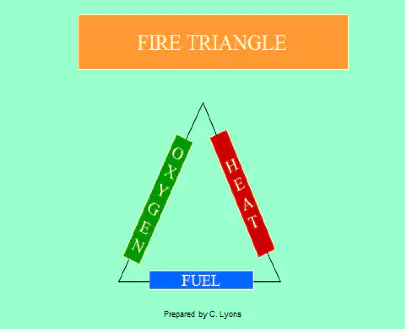
Which three elements are present in the flame stage?
Fuel, Heat, Oxygen
Fuel, Heat, Chemical Chain Reaction
Fuel, Oxygen, Reducing Agent
Fuel, Temperature, Oxidizing Agent
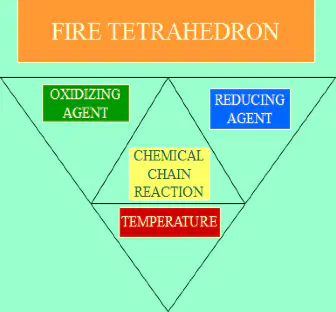
Refer to the diagram of the Fire Tetrahedron. Which four elements are present in the combustion stage?
Fuel, Heat, Oxygen, Chemical Chain Reaction
Fuel, Heat, Oxygen, Reducing Agent
Fuel, Temperature, Oxidizing Agent, Reducing Agent
Fuel, Heat, Oxygen, Temperature
Fire extinction consists of the limitation, or removal, of one or more of the factors (fuel, heat, oxygen) or by ________ the chemical chain reaction.
interrupting
accelerating
igniting
prolonging
What is the process called that involves the limitation or lowering of the temperature of the material involved below its ignition temperature, for example, the application of water to a carbonaceous material (wood) which is on fire?
Cooling
Combustion
Ignition
Insulation
What is the method of fire suppression that involves separating oxygen from the fuel by the use of an asbestos blanket, foam blanket, inert gas blanket, or dry chemical bather?
Smothering
Cooling
Starvation
Dilution
Which type of gas is very effective for fire suppression by employing the smothering technique and is safe for use on all electrical fires?
Inert gas (CO2, nitrogen, and others)
Oxygen
Hydrogen
Methane
What is the process called that involves shutting off fuel and oil tank emergency shut-off valves, draining of burning oil tanks, pumping out from burning bilges and tank tops, subdivision of burning material, and emulsification of burning liquids?
Starvation
Ventilation
Conduction
Radiation
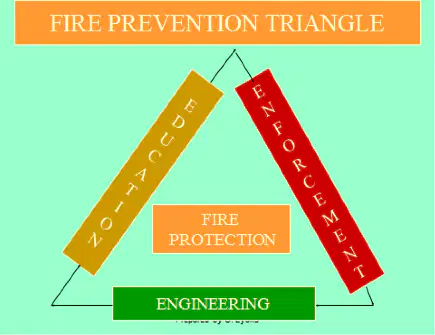
What are the three main components of fire prevention according to the triangle?
Engineering, Enforcement, Fire Protection
Detection, Response, Recovery
Education, Equipment, Evacuation
Inspection, Investigation, Intervention
Which committee reports to the Safety Committee for fire prevention?
Main Fire Committee
Sub-Fire Safety Committee
Emergency Response Team
Health Committee
One of the roles of the sub-fire safety committee is to ______ hazards and ensure that the hazards were addressed.
Identify
Ignore
Create
Hide
Which of the following is NOT a role of the sub-fire safety committee?
Monitor specific potentially hazardous processes
Plan and execute prevention activities
Develop and maintain a system for extracting fire related suggestions from crew members
Ignore fire safety suggestions
Enforcement is the essential third side of the prevention triangle.
True
False
List the four products of combustion mentioned under fire hazards.
Flame, heat, smoke, and fire gases
Water, ash, steam, and dust
Light, oxygen, carbon dioxide, and nitrogen
Heat, electricity, sound, and vapor
Only three methods of fire spread are possible. These are classified as: a. Convection b. Conduction c. _______
Radiation
Evaporation
Diffusion
Absorption
Convection is the transfer of heat from one point to another by means of a circulating gas or liquid.
True
False
Which method of fire spread relies on the movement of heated air, which is less dense than cool air and rises?
Conduction
Convection
Radiation
Conduction is the method of fire spread that relies on the flow of heat from a body at a higher temperature to a body of a lower temperature.
True
False
Which materials are generally good conductors of heat and electricity?
Silver, copper, aluminium
Wood, plastic, rubber
Water, air, glass
Radiation involves the transfer of heat by rays travelling through space without necessarily heating anything during their transmission until the rays are absorbed by something they strike.
True
False
In the incipient phase of fire, the oxygen level in the air is relatively ______ and the fire is developing mostly water vapour (H2O) and carbon dioxide (CO2).
unchanged
high
low
absent
During the incipient phase, the flame temperature may be above _______°F (537°C) but this may not be evident from the compartment or room temperature.
1,000
500
750
1,500
What is the recommended procedure during the incipient phase of fire?
Direct application of water at base of fire, ventilation not a must
Wait for fire to peak before acting
Increase ventilation immediately
What is the free burning phase in the context of fire behavior?
The free burning phase is the second phase of fire, where the fire is burning freely with oxygen-rich air readily available, and heated gases spread throughout the compartment, igniting combustible materials.
The free burning phase is the initial stage of fire, where only smoke is produced and no flames are visible.
The free burning phase is the final stage of fire, where the fire is extinguished and only ashes remain.
The free burning phase is the stage where fire is controlled by fire suppression systems and does not spread.
During the free burning phase, what is the typical temperature range at the top of the area?
Above 1,3000°F (700°C)
Below 500°F (260°C)
Between 800°F and 1,000°F (427°C and 538°C)
Around 400°F (204°C)
Flashover is most common during which phase of a fire?
Flashover is most common during the free burning phase of a fire.
Flashover is most common during the incipient phase of a fire.
Flashover is most common during the decay phase of a fire.
Flashover is most common during the smoldering phase of a fire.
What happens during the smouldering phase of a fire?
During the smouldering phase, the compartment is confined, flames may be smothered by gases, and there may only be glowing embers. The area is filled with smoke and gases, and the temperature is over 1,000°F (537°C).
During the smouldering phase, the fire burns rapidly with large flames and little smoke, and the temperature remains below 500°F (260°C).
During the smouldering phase, the fire is completely extinguished and there is no heat, smoke, or gases present.
During the smouldering phase, the compartment is filled with water and the temperature drops below freezing.
Ventilation is defined as 'The planned, systematic removal of hot smoke and toxic gases by natural or mechanical means from a contained structure, followed by their replacement with cooler air.'
True
False
What is one method of achieving ventilation (positive or negative)?
Natural means (wind)
Chemical means
Electrical means
Magnetic means
What is one method of achieving ventilation (positive or negative)?
Mechanical means (fans)
Solar means
Manual means
Hydraulic means
What is one method of achieving ventilation (positive or negative)?
Venturi effect (use of hoses etc.)
Gravity effect
Pressure effect
Friction effect
What is the first step to firefighting that must be considered each time the fire fighter arrives at the scene of a fire?
Size-up
Rescue operations
Extinguishing the fire
Salvage operations
What is the second step to firefighting that must be considered each time the fire fighter arrives at the scene of a fire?
Rescue
Extinguish
Alarm
Overhaul
What is the third step to firefighting that must be considered each time the fire fighter arrives at the scene of a fire?
Exposure (Boundary Cooling)
Rescue Operations
Fire Prevention
Ventilation Procedures
What is the fourth step to firefighting that must be considered each time the fire fighter arrives at the scene of a fire?
Confinement
Rescue
Extinguishment
Overhaul
What is the fifth step to firefighting that must be considered each time the fire fighter arrives at the scene of a fire?
Extinguishment
Rescue
Ventilation
Overhaul
What is the sixth step to firefighting that must be considered each time the fire fighter arrives at the scene of a fire?
Overhaul
Rescue
Ventilation
Exposure protection
Once size-up has been completed, what is one factor that ventilation decisions take into account?
When to ventilate
How to extinguish
Who is in command
What equipment to use
Once size-up has been completed, what is one factor that ventilation decisions take into account?
Where to ventilate
How to rescue
What time it is
Who is present
Once size-up has been completed, what is one factor that ventilation decisions take into account?
What type of ventilation method will be employed
What type of fire extinguisher to use
What type of hose to use
What type of alarm to sound
What is the general emergency signal on a ship?
One long blast followed by seven short blasts
Seven or more short blasts followed by one long blast on the ship's whistle or siren
Three short blasts followed by two long blasts
Continuous ringing of the bell
A series of short blasts on the ship's bell indicates ________.
Fire
Man overboard
Abandon ship
Collision
What must the muster list contain according to emergency plan requirements?
Details of the general emergency alarm and other emergency signals
Actions to be taken by the crew and passengers
Both A and B
Only the names of the crew members
The location for assembling on hearing the general emergency alarm is called the ________.
Muster station
Bridge
Engine room
Galley
How often must emergency drills be conducted on passenger ships?
Once daily
Once weekly
Once monthly
Once yearly
Which two items are required to be maintained at the gangway as part of ship fire plans?
A copy of the general arrangement of the vessel (fire plan) A current crew list (including passengers)
A copy of the ship's menu A list of engine spare parts
A weather report A list of ship's stores
A copy of the ship's logbook A list of maintenance schedules
What is the main purpose of head protection?
To protect against falling objects, crushing, sideways blows, and chemical splash.
To improve visibility in the workplace.
To provide comfort during long working hours.
To enhance communication among workers.
What does face and eye protection guard against?
Splashes, flying objects, heat, harmful lights, particles, and foreign bodies.
Only loud noises and vibrations.
Extreme cold and electrical shocks.
Slippery surfaces and falling from heights.
What do hand and foot protection protect against?
Heat, puncture, falling objects, splashes, or crushing blows.
Noise, radiation, and electrical shock.
Dust, fumes, and poor lighting.
Extreme cold, high altitudes, and dehydration.
What is the purpose of body protection?
To protect from hazards such as splashes or heat.
To improve body posture during work.
To increase physical strength.
To enhance comfort in the workplace.
What does respiratory protection protect against?
Irritating or dangerous dust, fumes, or gases.
Loud noises in the workplace.
Slippery floors and surfaces.
Extreme temperatures.
Which class of bulkhead will resist fire for 60 minutes and is from deck to deck head?
Class A60
Class A30
Class B-60
Class C
Class B-60 refers to a bulkhead which will resist fire for how long?
60 minutes
30 minutes
90 minutes
120 minutes
How long will a Class A30 bulkhead resist fire?
30 minutes
15 minutes
60 minutes
90 minutes
How long will a Class A15 bulkhead resist fire?
15 minutes
30 minutes
45 minutes
60 minutes

