
NEW
Font size
 Worksheets
Unit 4 Test: Waves
Total questions: 33
Worksheet time: 17mins
What is the distance between two adjacent points on a wave called?
Frequency
Period
Amplitude
Wavelength
Which of the following diagrams have the highest frequency?

A.
A.

B.
B.

C.
C.
A wave that causes the particles of the medium to vibrate parallel to the direction the wave travels.
Transverse wave
Longitudinal wave
Light wave
Heat wave
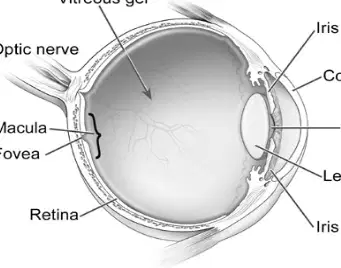
Refer to the diagram of the eye. The clear part of the eye covering the pupil and iris that lets light into the eye is called the
Lens
Pupil
Iris
Cornea
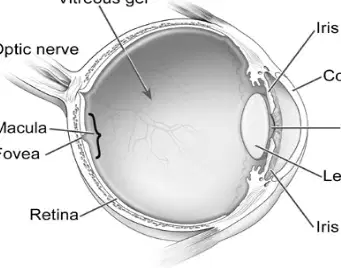
Order how light travels through the eye?
Cornea, retina, lens, pupil
Lens, retina, pupil, cornea
Cornea, pupil, lens, retina
Iris, vitreous humor, cornea, sclera
Which situation would cause your pupils to change from small to large?
The light got dimmer
The light got brighter
The person looked at a distant object
The person looked at a closer object
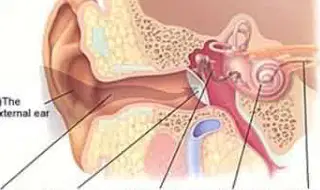
Which part of the ear contains tiny hairs that help translate sound vibrations into electrical signals sent to the brain?
Eardrum
Cochlea
Hammer
Anvil
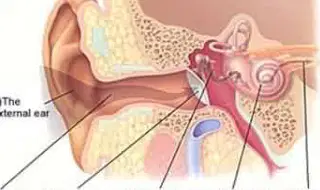
Which of the parts of the ear picks up vibrations and turns them into sound we can hear?
Pinna
Eustachian tube
Ear canal
Ear drum
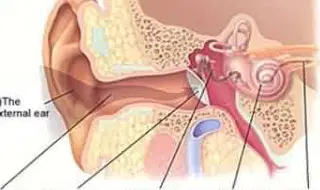
All of the following are part of the middle ear EXCEPT for the:
Hammer
Stirrup
Cochlea
Anvil
A person produces two sound waves with a flute, one immediately after the other. Both sound waves have the same pitch, but the second one is louder. Which of the following properties is greater for the second sound wave?
Frequency
Amplitude
Wavelength
Speed in air
What do playing a guitar, banging a drum, and dropping a pebble in the water have in common?
They all produce light.
They all cause vibrations.
They all convert heat to energy.
They all need gravity to move.
The human ear receives sound waves as ____________ and converts them to signals that are processed by the brain.
B. Vibrations
A. Light rays
C. Electrical currents
D. Chemical signals
Sound waves are _________________
B. Longitudinal
A. Transverse
C. Electromagnetic
D. Stationary
Which part of the ear acts as a funnel to collect sound waves and direct them into the ear canal?
Outer ear
Inner ear
Middle ear
Eardrum
White light is dispersed into color when it enters a prism because _______
The colors in white light are refracted to different degrees.
The colors in the white light are refracted at different angles
Some colors in white light are refracted at different degrees.
The colors in white light sped up by different amounts when they move from air to gas.
A person becomes deaf due to a part of the ear that sends signals to the brain becoming damaged. What part of the ear would this be?
Drum
Cochlea
Ossicles
Ear Canal
Vocal cords are small bands of muscle found in the larynx. How do vocal cords create “voice”?
Light energy
Frequency
Vibrations
Amplitude
What color does a blue object reflect?
Blue
Red
Green
Yellow
A prism is a transparent object that does what to white light?
Splits it into its component colors
Reflects it back as white light
Absorbs all the light
Turns it into heat energy
You can get sunburned through a closed glass window. Explain your answer.
Yes, because some UV rays can pass through glass.
No, because glass blocks all UV rays.
Yes, because glass amplifies sunlight.
No, because sunlight cannot pass through glass.
What is amplitude?
The highest part of a transverse wave.
The lowest part of a transverse wave.
The distance between one crest and the next in a transverse wave.
The height from the resting position to the crest of the transverse wave.
What is reflection in simple terms
Soaks up light
Passes through
Light bounces off
You can see the light in a mirror
Wax paper or a foggy window is an example of what type of material?
transparent
translucent
opaque
Waxy
What does refract mean?
To shrink
To bend
To widen
To enlarge
What can you see in a room that has no visible light?
Only bright colored objects
Only dark colored objects
Only white objects
Nothing at all
Caleb is sitting near the window on a sunny day. When he closes the curtain, the room becomes darker. What property of the curtain allows it to make the room darker?
The curtain absorbs light.
The curtain is brightly colored.
The curtain folds easily.
The curtain is rectangular shape.
Which section of the spectrum is the ONLY one we can see?
X-rays
Visible Light
Gamma Rays
Ultraviolet Rays

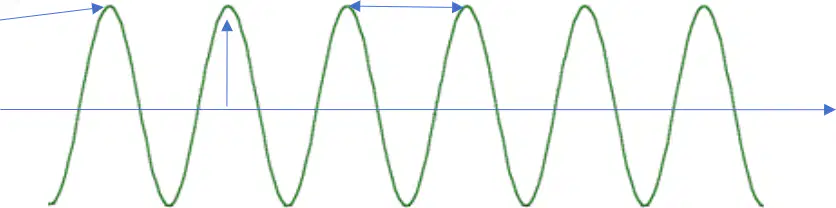
What is the name of the maximum height of the wave shown in the diagram?
Crest
Trough
Amplitude
Wavelength
What is the name of the lowest point of the wave shown in the diagram?
Trough
Crest
Node
Antinode

What is the term for the distance between two consecutive crests or troughs in the wave shown in the diagram?
Wavelength
Amplitude
Frequency
Period
What is the term for the maximum displacement from the rest position in the wave shown in the diagram?
Amplitude
Frequency
Wavelength
Velocity
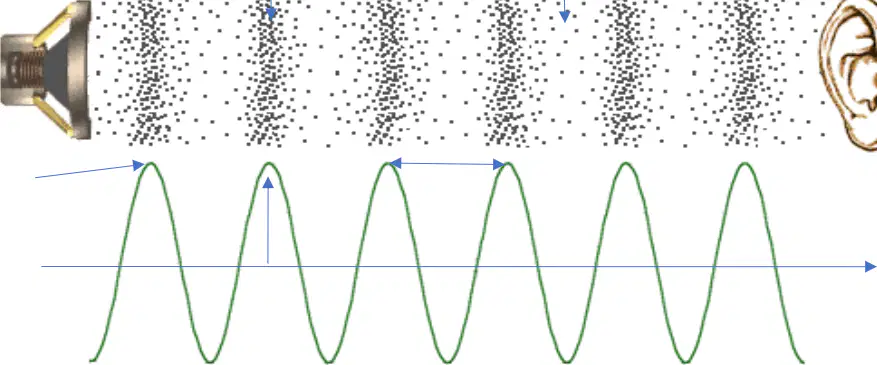
What is the region where particles are closest together in the wave shown in the diagram?
Compression
Rarefaction
Node
Antinode
What is the region where particles are farthest apart in the wave shown in the diagram?
Rarefaction
Compression
Node
Antinode

