
NEW
Font size
 Worksheets
United States Judicial Branch Quiz
Total questions: 73
Worksheet time: 37mins
What is the main focus of the United States Judicial Branch?
Making laws
Enforcing laws
Interpreting laws
Creating treaties
Which court is mentioned as part of the United States Judicial Branch?
The District Court
The Supreme Court
The Appeals Court
The Tax Court
Which of the following is NOT typically associated with the Judicial Branch?
Federal & State Courts
The Supreme Court
Constitutional Rights
Passing new laws
Why are constitutional rights important in the context of the Judicial Branch?
They allow the government to make laws
They protect individual freedoms and are interpreted by courts
They help enforce laws
They create new government agencies
What is the main topic introduced in Part I of the learning material?
Federal & State Courts
International Law
Civil Rights
Criminal Justice
What are laws?
The rules and standards by which a society governs itself
The buildings where trials are held
The people who enforce rules
The punishments given for breaking rules
Which legal system was the most important reference for the American legal system?
Roman law
English common law
French civil law
Germanic tribal law
What was the main purpose of the American court system when it was established?
To punish criminals harshly
To help people resolve conflict without resorting to violence
To collect taxes
To create new laws
Why might English common law have been chosen as a reference for the American legal system?
Because it was the only legal system known at the time
Because it provided a well-established set of rules and precedents
Because it was written in Latin
Because it was used by all countries
What is the main purpose of the courts according to the rule of law?
To prove that no one is above the law
To create new laws
To enforce only criminal laws
To elect government officials
What does judicial review allow courts to do?
Rule that laws are unconstitutional
Write new laws
Appoint judges
Enforce laws directly
Which branches have checks on the Supreme Court?
Legislative and executive branches
Judicial and military branches
State and local branches
Economic and social branches
Why is it important for courts to determine what laws mean?
To ensure laws are applied fairly and consistently
To create new laws
To collect taxes
To run elections
Which type of court hears cases about crimes such as burglary, murder, or driving under the influence?
Criminal court
Civil court
Family court
Traffic court
In civil court, who can bring a case against someone?
Only the state
Only the government
Any individual or group that believes they have been harmed
Only the police
What is the burden of proof required in a criminal court?
Preponderance of evidence
Guilt beyond a reasonable doubt
A lower probability of guilt
Clear and convincing evidence
Which of the following is a possible punishment in a criminal court but not in a civil court?
Legal action
Fines
Prison sentences
Community service
Compare the punishments in criminal and civil courts. Why is there never a prison sentence in civil court?
Civil court only deals with minor offenses
Civil court focuses on resolving disputes and compensation, not punishment
Civil court does not have the authority to punish
Civil court cases are always settled out of court
A person believes they have been harmed by another and wants compensation. Which court should they approach and why?
Criminal court, because only the state can bring cases
Civil court, because individuals can bring cases for harm
Traffic court, because it handles all disputes
Family court, because it deals with personal matters
What is the definition of jurisdiction?
A court’s authority to hear a case
The process of selecting a jury
The rules followed during a trial
The evidence presented in court
Who presides over trials and makes sure rules are followed?
Juries
Witnesses
Judges
Lawyers
What is the main role of juries in a trial?
Present evidence
Decide the case
Make sure rules are followed
Listen to testimony
In theory, why should court be the place where the truth comes out?
Because courts are always correct
Because courts listen to testimony, consider evidence, and decide the facts
Because courts only handle criminal cases
Because courts are run by juries
Criminal cases may be heard by which of the following?
Only a jury
Only a judge
Either a jury or a judge
Only the defendant
What is the role of public defenders?
Attorneys who work for the state and defend people who cannot afford a private attorney
Attorneys who only represent private clients
Judges who oversee court cases
Prosecutors who charge individuals with crimes
What is a plea bargain?
When an agreement is reached between the prosecutor and the defendant
When a judge makes a final decision in a case
When a defendant chooses to represent themselves in court
When a jury decides the verdict of a case
What is one reason an individual who loses a case in trial may wish to appeal the decision?
They want a different judge
They believe there was an error of law
They want a faster trial
They want to change the law
What does "error of law" generally mean in the context of an appeal?
The trial court did not have enough evidence
The trial court did not apply the law correctly or the trial was not fair
The jury was not present
The defendant was not present

Which type of court has original jurisdiction and hears evidence to determine guilt?
Trial courts
Appeals courts
Supreme courts
District courts
What is the main function of appeals courts in the court system?
Hear evidence and determine guilt
Review claims an error
Make laws
Conduct jury trials
Which type of jurisdiction do appeals courts have?
Original jurisdiction
Appellate jurisdiction
Federal jurisdiction
Local jurisdiction

If a case is being heard for the first time and evidence is being presented, which court is it most likely in?
Appeals court
Trial court
Supreme court
Circuit court
What type of jurisdiction does the Supreme Court primarily have?
Appellate jurisdiction
Criminal jurisdiction
Legislative jurisdiction
Administrative jurisdiction
In rare cases, what type of jurisdiction can the Supreme Court have?
Original jurisdiction
Federal jurisdiction
State jurisdiction
Military jurisdiction
Who served as Chief Justice of the United States from 1801 to 1835 and established the principle of judicial review?
John Marshall
John Adams
James Madison
Thomas Jefferson
What is one of the main roles of the Supreme Court regarding lower court decisions?
Review claims that a lower court did not interpret the law correctly
Create new laws for lower courts
Appoint judges to lower courts
Enforce laws passed by Congress
In an appeals court, what does the party that lost in the lower court typically do to start the appeal process?
Presents a written brief asking the court to review the decision
Requests a jury trial
Files a criminal complaint
Calls witnesses to testify
Who usually decides on the appeal in an appeals court?
A single judge
A panel of judges
The jury
The president
What happens if a case does not go on to the Supreme Court after an appeal?
The decision of the appeal court is final
The case is retried in the lower court
The jury makes the final decision
The president reviews the case
What are precedents in the context of appellate court decisions?
Legal principles created by an appellate court decision
Laws passed by Congress
Rules set by the Supreme Court only
Guidelines for police procedures
Explain the importance of precedents in the legal system and how they affect future court decisions.
Precedents provide a basis for future decisions, ensuring consistency and predictability in the law.
Precedents allow judges to ignore previous rulings.
Precedents are only used in criminal cases.
Precedents are not important in the legal system.

Which of the following is NOT typically under the jurisdiction of state courts?
Crimes under state laws
State constitutional issues
International treaties
Property disputes
State courts generally handle cases involving which of the following?
Motor vehicle registration
Space exploration
International trade agreements
Federal tax evasion
Which type of law is most likely to be addressed by state courts?
Federal immigration law
State constitutional issues
Maritime law
International law
A dispute over inheritance is most likely to be resolved in which type of court?
State court
International court
Military court
Federal court
If someone is involved in a contract dispute, which court would most likely have jurisdiction?
State court
Supreme Court
International Criminal Court
Bankruptcy court
Explain why traffic violations are typically handled by state courts rather than federal courts.
Because traffic laws are created and enforced by state governments.
Because federal courts do not have judges.
Because traffic violations are international crimes.
Because only federal courts can issue fines.

Which of the following is NOT typically under the jurisdiction of federal courts?
Federal crimes
Disputes between states
Local traffic violations
Maritime laws

Federal courts have jurisdiction over issues that involve which important document?
The Declaration of Independence
The US Constitution
The Bill of Rights
The Magna Carta

Which of the following is an example of a case that would fall under federal court jurisdiction due to international relations?
Disputes between local businesses
Treaties with foreign governments
State tax regulations
City zoning laws

Explain why disputes between states are handled by federal courts rather than state courts.
Because state courts do not have the authority to resolve conflicts between states
Because federal courts are located in every state
Because state courts are only for criminal cases
Because federal courts have more judges

A company is accused of violating antitrust laws. Which court system would handle this case?
State courts
Federal courts
Municipal courts
Family courts

Which of the following is an example of a case that falls under concurrent jurisdiction?
Crimes punishable only under state law
Issues that involve the US Constitution
Traffic violations
Local zoning disputes

Concurrent jurisdiction allows both federal and state courts to hear cases involving which of the following?
Environmental regulation
School policies
Local business licenses
City ordinances

Which type of claim is specifically mentioned as falling under concurrent jurisdiction?
Property disputes
Civil rights claims
Divorce proceedings
Patent applications

Explain why crimes punishable under both federal and state law might be heard in either federal or state court.
Because both courts have authority over such cases
Because only federal courts have authority
Because only state courts have authority
Because these crimes are not serious

A company is accused of violating environmental regulations that are enforced by both federal and state agencies. What type of jurisdiction would apply to this case, and why?
Exclusive federal jurisdiction, because only federal agencies regulate the environment
Exclusive state jurisdiction, because only state agencies regulate the environment
Concurrent jurisdiction, because both federal and state agencies have authority
No jurisdiction, because environmental regulation is not a legal issue
What is the main topic introduced in Part II of the learning material?
The Supreme Court
The Executive Branch
The Legislative Process
The Bill of Rights
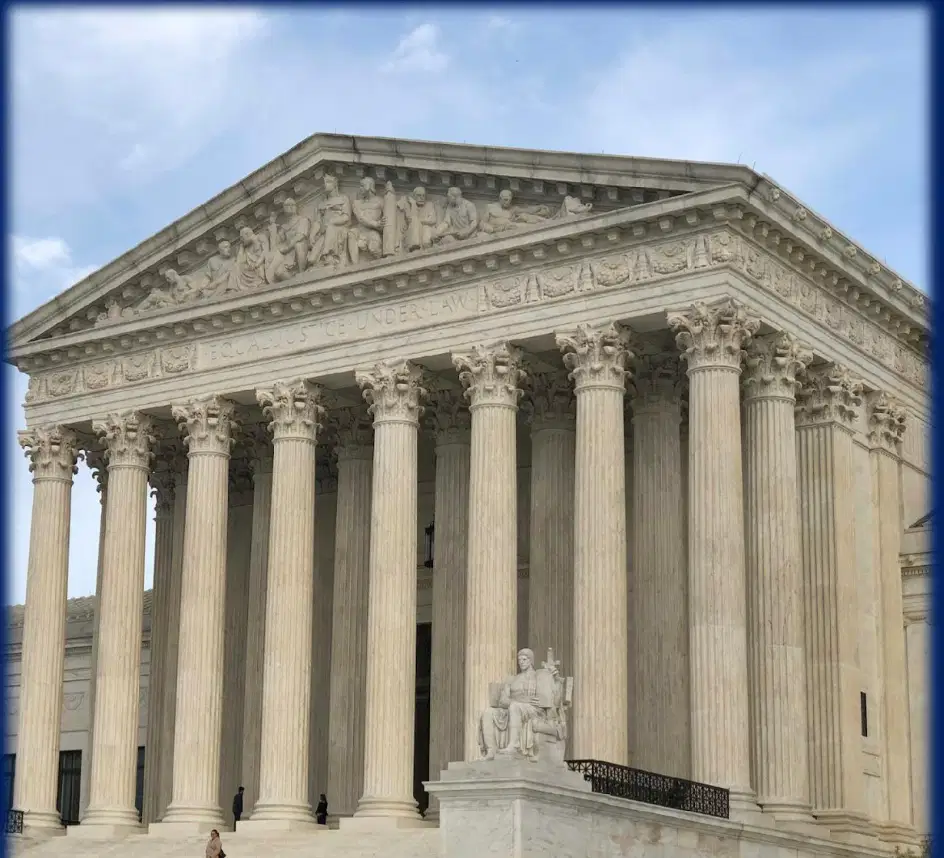
What is the highest court in the United States?
The Supreme Court
The District Court
The Court of Appeals
The State Court
What is the primary function of the Supreme Court?
Resolving disputes over the US Constitution and federal laws
Creating new laws
Enforcing state laws
Managing local governments
What is judicial review?
The ability to declare laws unconstitutional
The process of making new laws
The power to enforce laws
The ability to appoint judges
How many cases are appealed to the Supreme Court each year?
Between 7,000 and 9,000
Between 1,000 and 2,000
Between 10,000 and 12,000
Between 500 and 1,000
Why is judicial review considered an important power of the Supreme Court?
It allows the Supreme Court to declare laws unconstitutional, ensuring that laws comply with the US Constitution.
It allows the Supreme Court to create new laws.
It allows the Supreme Court to enforce state laws.
It allows the Supreme Court to manage local governments.
Which of the following statements is true about the Supreme Court's authority?
The Supreme Court must hear every case presented to it.
The Supreme Court gets to decide which cases it hears.
The Supreme Court only hears cases from state courts.
The Supreme Court only hears cases about criminal law.

Why might the Supreme Court justices choose to hear a particular case?
Because the case is about a local issue only
Because lower courts have ruled the same way
Because the case raises major questions about the law with national impact
Because the case involves only one person
What is one reason the Supreme Court may choose to hear a case from a lower court?
The lower courts have ruled in different ways on the issue
The case is about a traffic violation
The case is less than a year old
The case involves only state law
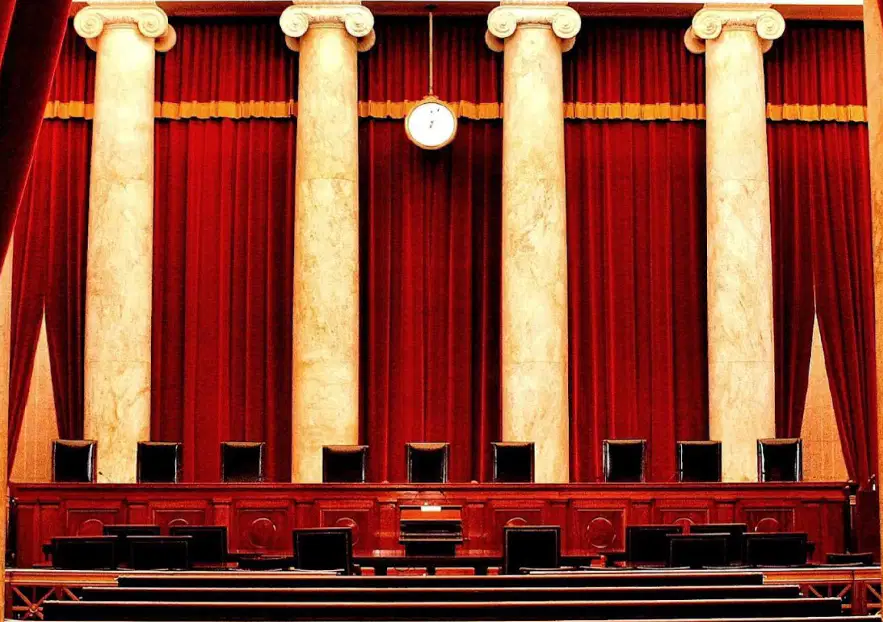
Which color is most prominent in the interior design of the United States Supreme Court as shown in the image?
Blue
Green
Red
Yellow
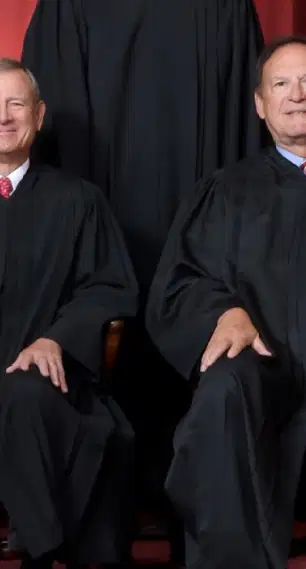
Which individual is identified as the Chief Justice in the front row of the image?
John G. Roberts, Jr.
Sonia Sotomayor
Samuel A. Alito, Jr.
Elena Kagan
Based on the arrangement described, what is the total number of Justices shown in the image?
Nine
Seven
Ten
Eight
Which types of jurisdiction does the Supreme Court have?
Only original jurisdiction
Only appellate jurisdiction
Both original and appellate jurisdiction
Neither original nor appellate jurisdiction
Which of the following is NOT a way a case can reach the Supreme Court?
Original Jurisdiction
Appeals Through State Courts
Appeals Through the Federal Courts
Appeals Through Local Government Offices
Who presided as Chief Justice during the era that ended racial segregation in public schools?
Earl Warren
John Marshall
William Rehnquist
Thurgood Marshall
What was the significance of the Supreme Court's decision in Brown v. Board of Education?
It established judicial review
It ended racial segregation in public schools
It created the federal court system
It allowed appeals through state courts

