
 Worksheets
Cardio Review
Total questions: 36
Worksheet time: 58mins
What is the primary role of a cardiologist?
To perform surgeries on the heart
To diagnose and treat heart diseases
To operate EKG machines
To conduct ultrasound imaging
Which of the following is a common heart function test?
MRI
X-ray
Stress Test
CT Scan
Explain why the left ventricle has a thicker wall compared to the right ventricle.
It pumps blood to the lungs
It pumps blood to the entire body
It receives blood from the body
It receives blood from the lungs
What is the purpose of an EKG technician during a stress test?
To interpret the results
To monitor the patient's heart rate and rhythm
To diagnose heart conditions
To perform heart surgery
Which part of the heart is responsible for pumping deoxygenated blood to the lungs?
Right Atrium
Left Atrium
Right Ventricle
Left Ventricle
What is the main function of heart valves?
To pump blood
To prevent backflow of blood
To oxygenate blood
To filter blood
Why might a cardiologist order an echocardiogram for a patient?
To measure blood sugar levels
To assess the structure and function of the heart
To check for lung infections
To evaluate kidney function


The largest artery in the body is the:
Aorta
Pulmonary Artery
Carotid Artery
Brachiocephalic Artery
Match the layer of the heart to the best description
Myocardium
The middle muscular layer of the heart
Epicardium
The external layer of the heart
Endocardium
The inner lining of the heart

The p-wave correlates with which event?
atrial depolarization
ventricle depolarization
ventricle repolarization
atrial repolarization
What does depolarization result in?
relaxation
contraction
repulsion
attraction


Interpret this EKG strip
Sinus Rhythm, Hr.70
Sinus Rhythm, Hr.90
Sinus Bradycardia, Hr.50
Sinus Tachycardia, Hr. 110

Interpret this Rhythm:
Normal sinus rhythm
Ventricular fibrillation
Sinus Brady with PAC's
Sinus Bradycardia

Which best describes this rhythm?
Atrial Fibrillation
Atrial Flutter
Asystole
PEA

Which best describes this rhythm?
Asystole
PEA
Pulseless Ventricular Tachycardia
Ventricular Fibrillation

Which best describes this rhythm?
Asystole
PEA
Ventricular Tachycardia
Ventricular fibrillation

Which best describes this rhythm?
Asystole
PEA
Ventricular Tachycardia
Ventricular fibrillation

Identify the cardiac rhythm strip pictured above
Ventricular Tachycardia
Normal Sinus Rhythm
Atrial Fibrillation
Sinus Tachycardia
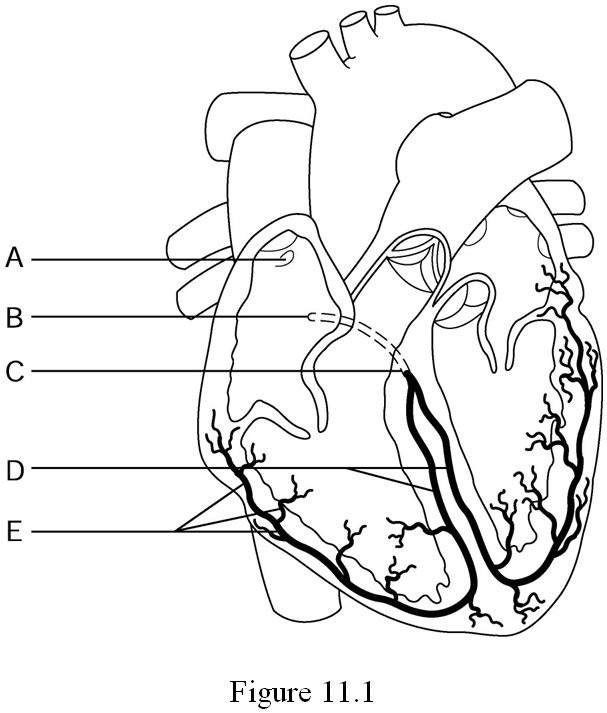
Label the heart
right atrium
left atrium
left ventricle
right ventricle
The paper on an ECG normally moves at:
50mm/sec
75mm/sec
25cm/sec
25mm/sec
The width of each small box represents:
0.04 seconds
0.02 seconds
0.40 seconds
0.20 seconds
The small boxes on ECG paper measure:
1 cm by 0.20 seconds
1mm by 0.20 seconds
1cm by 0.04 seconds
1mm by 0.04 seconds
Following best practices, how frequently
should an EKG technician disinfect lead wires
and clips?
At the end of every shift
After each use
Once every hour
Once every hour
An EKG technician is preparing to apply leads
to a patient who is scheduled for five-lead
Holter monitoring. In which of the following
locations should the technician apply the
ground electrode?
Right lower abdomen
Over the manubrium
Over the fourth intercostal space
Left lower abdomen

