
 Worksheets
APES Semester 1 Test Reviews
Total questions: 81
Worksheet time: 41mins
The underlying subsoil of this biome is permafrost, which prevents both water draining through and deep-rooted plants from growing. Additionally, there is very little precipitation per year.
Temperate Grassland
Taiga
Tropical rainforest
Tundra
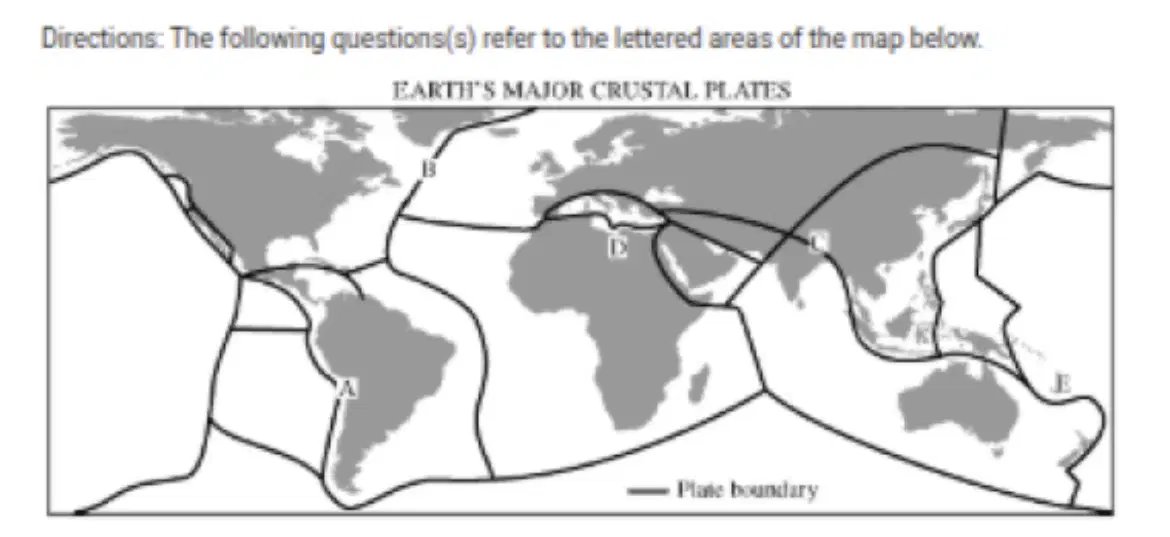
Area where new crust is being created at a divergent plate boundary.
A
B
C
D
E
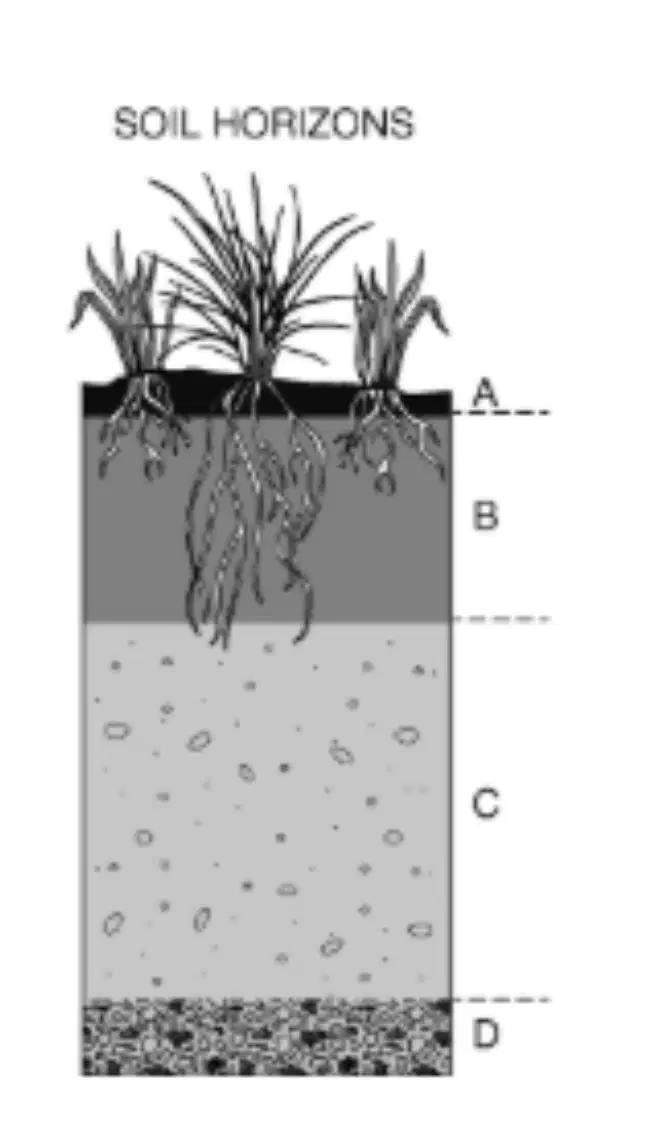
What soil horizon is the least weathered horizon and contains rock that is starting to break down into soil?
A
B
C
D
A 163 square-kilometer (km²) small island is found 2,000 km from the mainland. A second, larger, 230,000 km² island is found 1,000 km from the mainland. Based on the theory of island biogeography, which of the following statements is most likely true about the small island when compared with the large island?
The rate of immigration is lower for the small island than for the large island.
The small island has niches that are more like the mainland than the large island.
The small island has more available resources than the large island.
The rate of species extinction is lower on the small island than on the large island.
Which of the following best describes soil in many tropical rain forests?
They lack soil horizons.
They are quickly depleted nutrients when the forest is removed.
They are similar to soils in grasslands.
They are well suited for growing a wide variety of crops.
They are deep and well drained.
Which of the following biomes is best characterized as an area that forms the narrow band along the coast that experiences a range of environmental conditions (including daily changes in sunlight, temperature, and water)?
Open ocean
Lakes
Coral reefs
Intertidal zones
Which of the following is true of carbon as it cycles in nature?
Carbon dioxide is released during photosynthesis.
Carbon compounds rarely exist in the gaseous state.
Carbon sinks include forests and oceans.
The carbon dioxide concentration in the atmosphere is reduced by cutting trees.
Carbon is concentrated in igneous rocks.
In 1900, an invasive fly was introduced to the Galapagos islands. To understand the relationship between the invasive fly and the tree finches that live on the island, researchers examined the mating success of two species of finches. Some finches had nests with flies and some did not. The data from the study are in the table. Based on the table, which of the following claims about the relationship between the tree finch and the invasive fly is best supported?
The flies and finches have a commensal relationship; finches provide a home for the fly, but finches are not affected by the presence of the fly.
The flies and finches have a mutualistic relationship; the finch provides a home for the fly, and the fly helps the breeding success of the finch.
The flies and finches have a parasitic relationship; the finches provide a home for the fly, and the fly decreases the breeding success of the finches.
The flies and finches have a competitive relationship; the two species feed on the same food, and the finches are more successful at feeding than the flies are.
The major reservoirs of nitrogen and sulfur in the biosphere are correctly identified by which of the following?
Nitrogen- Rocks, Sulfur - rocks
Nitrogen - Rocks, Sulfur - Vegetation
Nitrogen - Rocks, Sulfur - Atmosphere
Nitrogen - Atmosphere, Sulfur - Rocks
Nitrogen - Atmosphere, Sulfur - Atmosphere
Which of the following statements is true of aquatic biomes?
Freshwater and marine biomes are evenly distributed on earth.
Freshwater biomes are a vital source of drinking water.
Freshwater biomes supply a greater portion of Earth's oxygen than marine biomes.
Marine biomes include streams, rivers, ponds, and lakes.
The data table below shows plant biodiversity of different ecosystems in Glacier National Park. In parts of the park, the glacier is receding leading to succession. Based on the data in the table, which ecosystem is in the earliest stages of succession?
Ecosystem A
Ecosystem B
Ecosystem C
Ecosystem D
Which of the following is true of carbon as it cycles in nature?
Carbon dioxide is released during photosynthesis.
Carbon compounds rarely exist in the gaseous state.
Carbon sinks include forests and oceans.
The carbon dioxide concentration in the atmosphere is reduced by cutting trees.
Carbon is concentrated in igneous rocks.
The greatest amount of fresh water is found in which of the following?
The atmosphere
Estuaries
Lakes
Rivers and streams
Polar ice caps and glaciers
At which of the following sites is an earthquake most likely to occur as two plates slide sideways past each other?
A
B
C
D
A team of ecologists are studying four different ecosystems with varying levels of biodiversity. The ecologists categorize the different levels of biodiversity for the four ecosystems as shown in the table below. Based on the information above, which ecosystem most likely experienced a recent population bottleneck?
Ecosystem A, because its low genetic diversity could have resulted from an event that reduced the variation in the gene pool.
Ecosystem B, because its high species diversity could have resulted from increased competition among its members.
Ecosystem C, because its low habitat diversity indicates an increase in available niches.
Ecosystem D, because its low species diversity indicates that it also has low species evenness.
A developer wants to develop a large tract of land near a watershed, which will require the removal of several large trees. Which of the following statements best describes the impact that the development would have on the watershed?
Removing large trees would decrease the amount of runoff in the watershed.
Removing large trees would cause an increase in temperature and keep the surrounding water and soil warmer.
Removing large trees would decrease the rate of erosion in a watershed.
Removing large trees would increase the retention of water within the watershed.
A team of ecologists are studying four different ecosystems with varying levels of biodiversity. The ecologists categorize the different levels of biodiversity for the four ecosystems as shown in the table below. Based on the information above, which ecosystem would most likely recover the fastest from a natural disruption?
Ecosystem A
Ecosystem B
Ecosystem C
Ecosystem D
Which of the following best identifies and describes the process that is illustrated in the diagram above?
Primary succession, because the result is a mature force with a variety of shade-intolerant shrubs, and grasses.
Primary succession, because the process in the diagram begins with bare rock.
Secondary succession because intermediate plant species like grasses and weeds are present.
Secondary succession because the result is immature force with a variety of shade-tolerant trees.
Which of the following best describes the movement of energy in an ecosystem?
Energy is constantly recycled by decomposers for use by producers.
Energy is harnessed by producers, and available energy decreases with each trophic level transfer.
Energy is absorbed by plants through water and soil and then moves up the food chain through consumers.
Energy is magnified as it moves up the trophic levels, and tertiary consumers store the most energy in a food web.
Most oxygen is found in which layer of Earth's atmosphere?
Thermosphere
Exosphere
Troposphere
Mesosphere
Stratosphere
Which of the following biogeochemical cycles is correctly paired with its largest reservoir?
The hydrologic cycle and living things
The nitrogen cycle and the atmosphere
The phosphorus cycle and bacteria
The carbon cycle and glaciers
Which of the following best describes why secondary succession generally occurs more quickly than primary succession?
A) Secondary succession is not hindered by the presence of any existing vegetation, but primary succession is.
B) Secondary succession takes place in areas that already have soil and nutrients in place, whereas primary succession occurs in areas that lack soil.
C) Secondary succession includes the return of plants and animal species, whereas primary succession includes only the return of plants.
D) Secondary succession requires pioneer species, including lichens and mosses, in the earliest stages, but primary succession does not.
Which of the following changes in eastern Pacific Ocean food webs is typically associated with La Niña events?
Decreased populations of squid
Decreased populations of anchovies
Increased phytoplankton concentrations
Increased famine among sea lions and seals
During an El Niño event, farmers in the southwestern United States often benefit from which of the following climatic changes?
Longer and cooler summers that increase crop yield
Wetter and warmer weather that increases soil moisture
Cooler and drier conditions that help cold-weather crops
Warmer and drier weather that reduces soil erosion and flooding.
Which tree species grows best with full sunlight?
White oak
Hickory
Dogwood
Sweet gum
Beech
If the population of a country grows at a rate of approximately 5 percent per year, the number of years required for the population to double is closest to
5 years
10 years
15 years
25 years
35 years
Based on the data in the table, which of the following pairs of organisms has two ecological relationships: both competition and predation?
Spiders and shrews
Hawks and snakes
Spiders and snakes
Spiders and grasshoppers
Scientists are monitoring a caribou population whose maximum population size is 500,000 and current population size is 198,000. Which method should be used to determine the percent change between the maximum population and the current population?
(500,000 caribou – 198,000 caribou) ÷ 198,000 caribou × 100
(198,000 caribou – 500,000 caribou) ÷ 500,000 caribou × 100
198,000 caribou + 500,000 caribou × 1,000
(500,000 caribou – 198,000 caribou) ÷ 100
Based on the map, which of the following best explains the area of the Andes Mountains that would have the greatest number of rivers?
Equal numbers of rivers would be found on both the east and west sides of the Andes Mountains because water flows downhill.
More rivers would be located on the west side of the Andes Mountains because it is the leeward side.
More rivers would be located on the east side of the Andes Mountains because the trade winds are coming from the east.
More rivers would be located on the south side of the Andes Mountains because it is protected from the drying sunlight.
The ultimate source of energy for terrestrial ecosystems is
Nutrients in soil
Nutrients in vegetation
Primary consumers
Producers
The Sun
Human population growth in 2018 was 1.07%. If this rate of growth remains constant, in what year will the human population double?
2083
2088
2092
2104
In a given ecosystem, producers convert solar energy into 15,000 kcal of chemical energy stored in organic compounds. Which of the following is the most likely amount of energy available to secondary consumers?
1.5 kcal
150 kcal
1,500 kcal
13,500 kcal
A country with an age distribution like that shown in the figure above is most likely a country that
Is experiencing rapid growth
Is experiencing slow or no population growth
Is experiencing a high death rate
Has 40% of the population under age 15
The current global human population is about 6.1 billion and is growing at an annual rate of 1.35 percent. If world population were to grow at this rate for the next year, approximately how many people would be added?
8×10⁵
8×10⁶
8×10⁷
8×10⁸
8×10⁹
The beneficial ozone layer is found in this region of Earth’s atmosphere?
Thermosphere
Exosphere
Troposphere
Mesosphere
Stratosphere
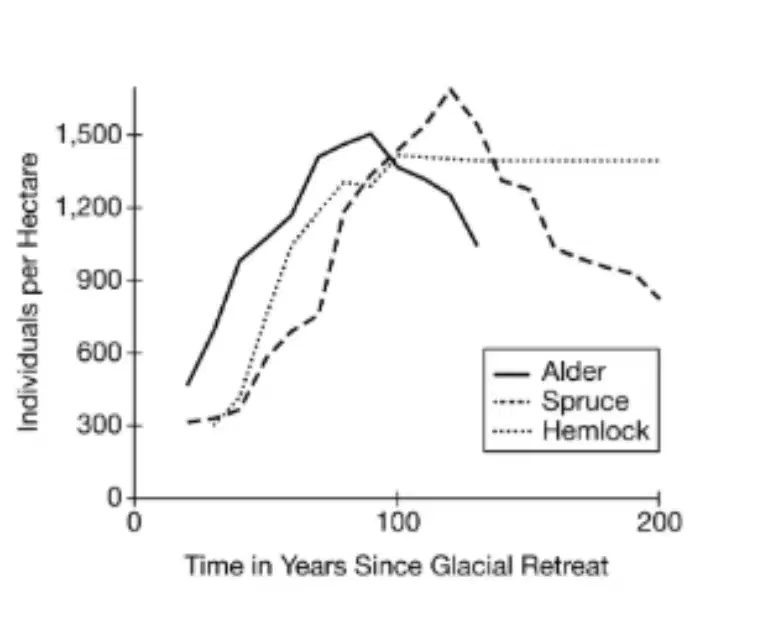
The graph below shows data about three tree species after a glacial retreat. Based on the data shown in the graph, which of the following events occurred after the glacial retreat?
A. Primary succession
B. Flooding
C. Sea level rise
D. Global climate change
Which of the following biomes is best characterized as an area that forms a narrow band along the coast and experiences a wide range of environmental conditions, including daily changes in sunlight, temperature, and water availability?
Open ocean
Lakes
Coral reefs
Intertidal zones
Which of the following processes indirectly removes carbon from Earth's atmosphere?
Formation of carbonate deposits
Outgassing by volcanoes
Respiration by mammals
Respiration by anaerobic bacteria
Photodissociation by ultraviolet light
Elements that cycle in the environment and also have a gaseous phase at some point in their cycle include which of the following?
III. Sulfur
II. Phosphorus
I. Carbon
A. I only
B. II only
Based on the map, which region of South America would have a more moderate climate, and why?
The west coast would have a more moderate climate because of the Peru Current.
The west coast would have a more moderate climate because of the Andes Mountains.
The east coast would have a more moderate climate because of its proximity to the equator.
The east coast would have a more moderate climate because of the Brazil Current.
Which of the following correctly describes the disruption of an ecosystem service by an anthropogenic activity?
Provisioning services are disrupted by increased combustion of fossil fuels, which leads to an increase in air pollution.
Regulating services are disrupted by flash flooding from a hurricane, which decreases available food resources.
Supporting services are disrupted by an earthquake that causes habitat destruction, which displaces plants and animals.
Cultural services are disrupted by a tornado that causes the loss of acres of forest, which reduces the amount of harvestable timber.
Which of the following ecosystem services are categorized as regulating?
Wood fuel, medicine, and potable water
Pollination, decomposition, and water purification
Recreation, education, and aesthetics
Photosynthesis, nutrient cycling, and soil formation
Which graph best illustrates a population growing at its biotic potential?
Graph A
Graph B
Graph C
Graph D
Which soil composition would be the best choice for lining a landfill?
Point T
Point U
Point V
Point W
Point X
Which area receives the most intense solar radiation at the time of year shown in the diagram, and why?
The Antarctic Circle, because it is closest to the Sun.
The Tropic of Capricorn, because incoming solar radiation is most direct at this latitude.
The equator, because it is the hottest region and therefore receives the most intense solar radiation.
The Tropic of Cancer, because solar radiation spreads out over a wider area at this latitude.
Based on the map, which of the following best explains why the Atacama Desert has a consistently arid climate?
It is on the windward side of the Andes Mountains.
It is in the rain shadow of the Andes Mountains.
The cold Peru Current brings dry air to the west coast.
Compared to the east coast, it has less water available.
Which area on the map exhibits a growing nonvolcanic mountain chain due to uplift?
Area A
Area B
Area C
Area D
Area E
Based on the marine food web diagram, which of the following best describes the most likely direct effect of a decline of the small fish population?
The jellyfish population will experience local extinction because of a lack of food resources.
The jellyfish population will increase because of decreased predation.
The jellyfish population will migrate to an area with more available habitat for eggs.
The jellyfish population will decrease from an increase in the sea turtle and tuna populations.
Which letter correctly identifies a process of the hydrologic cycle in which the phase of water is changed from a liquid to a gas?
A
B
C
D
Which of the following best shows the process of evolution?
A lizard’s color becomes brown as it sits on a log.
A bear goes into hibernation.
A plant loses its leaves in a drought.
A population of mosquitoes develops resistance to a pesticide.
A population of foxes increases as more prey becomes available.
Which graph best illustrates a population that was growing and has reached its carrying capacity?
Graph A
Graph B
Graph C
Graph D
Graph E
Which soil horizon has very little organic matter and accumulates soluble metals and nutrients transported from other soil layers?
Horizon A
Horizon B
Horizon C
Horizon D
Which of the following best identifies the author’s claim in the bull trout article?
Bull trout experienced high mortality rates as a result of estuary formation and sediments released during dam deconstruction.
Bull trout are adaptable to a variety of habitats and were able to survive in the river during dam deconstruction.
Bull trout remained in the estuary system after dam deconstruction because the disruption irreversibly altered the river habitat.
Bull trout are unable to live in highly sedimented waters and migrated to avoid the conditions introduced during dam deconstruction.
Which of the following correctly describes the season and length of day at the Tropic of Cancer at the time of year shown in the diagram?
It is winter at the Tropic of Cancer, and daylight is less than twelve hours per day.
It is winter at the Tropic of Cancer, and daylight is approximately twelve hours per day.
It is summer at the Tropic of Cancer, and daylight is greater than twelve hours per day.
It is summer at the Tropic of Cancer, and daylight is approximately twelve hours per day.
The diagram below is an illustration of global atmospheric circulation. Which of the following causes air to rise high into the atmosphere in the areas labeled A, B, and C on the global circulation diagram?
El Niño circulation patterns
The rotation of Earth shifting air upward
Warm, moist air that is less dense than the surrounding air
Rain shadows over mountain ridges
Brown pelicans are fish-eating birds. As a result of an El Niño event, the population of brown pelicans in southern California declines. Which of the following best explains this relationship?
Warmer ocean temperatures can cause fish to move to colder water farther from pelican nest sites.
Lower sea surface heights isolate nest sites too far from the ocean food supply.
Lower water temperatures disrupt bird reproduction.
Male pelicans become disoriented due to reduced moisture.
Predatory seal populations increase due to decreased rainfall.
Which of the following best identifies the author’s claim in the aardvark article?
Aardvarks are shifting the location of their territories as a response to global climate change.
Aardvarks are a keystone species and their decline could have a trophic cascade effect on the ecosystem.
The loss of aardvarks described in the study was an isolated incident because most aardvark populations are increasing globally.
Providing aardvarks with more burrows will help them maintain body temperature and increase survival rates.
The phenomenon causing global warming occurs primarily in this region of the atmosphere.
Thermosphere
Exosphere
Troposphere
Mesosphere
Stratosphere
Which of the following best describes soil in many tropical rain forests?
They lack soil horizons.
They are quickly depleted of nutrients when the forest is removed.
They are similar to soils in grasslands.
They are well suited for growing a wide variety of crops.
They are deep and well drained.
Which of the following best describes the change in Antarctic temperature from about 440,000 years ago to about 340,000 years ago?
The temperature increases by about 10°C.
The temperature decreases by about 8°C.
The temperature increases by about 12°C and then decreases by about 12°C.
The temperature decreases by about 10°C and then increases by about 12°C.
What are the proportions of sand, silt, and clay for the soil at point T on the soil composition diagram?
75% sand, 20% silt, 5% clay
70% sand, 20% silt, 10% clay
65% sand, 25% silt, 10% clay
60% sand, 30% silt, 10% clay
55% sand, 30% silt, 15% clay
During a La Niña event, what environmental changes would the tropical Pacific Ocean and its surrounding landmasses most likely experience?
Increased rainfall in the eastern Pacific Ocean leading to flooding and landslides off the coast of South America
An area of high pressure forming over landmasses and increasing the chance of typhoons
Cooler ocean water in the western Pacific Ocean leading to an increased chance of wildfires
Increased upwelling off the coast of South America resulting in increased productivity of fisheries
Which of the following best describes why understanding a watershed and its boundaries is important in designing housing developments along a river?
Water in a watershed is more likely to become polluted if soil has high permeability.
Watersheds provide habitats for hundreds of marine species.
Watersheds provide space for cultivating land to produce food.
Surface water and stormwater runoff will drain downstream within watershed boundaries, making it important to understand water flow.
Algae in an aquatic food chain convert solar energy into 93,000 kilocalories of plant tissue. Which of the following values best represents the amount of energy available for primary consumers in the aquatic food chain?
930 kilocalories
9,300 kilocalories
93,000 kilocalories
930,000 kilocalories
Which of the following best describes the net primary productivity of an ecosystem?
The amount of energy captured by producers through photosynthesis over time
The amount of energy lost by producers through respiration over time
The amount of energy lost through respiration by producers subtracted from the gross primary productivity
The amount of energy lost through respiration by producers added to the gross primary productivity
Researchers monitored the number of reindeer over time on an island off the coast of Alaska. The reindeer were introduced in year 1, and the population size was counted every 5 years. The data are shown in the table above. Which of the following claims about trends in the population size over time is best supported by the data?
The population did not have enough males to help the herd survive.
The population exceeded the carrying capacity of the island, leading to a population decline after resource depletion.
The population experienced significant reindeer immigration after year 20.
The reindeer formed mutualistic relationships and thrived between year 10 and year 20.
Which of the following is a measure of the biodiversity of an ecosystem?
The total number of individuals of a single animal species
The density of individuals in a hectare
The total number of different plant species
The soil depth at which burrowing insects are located
Based on predator–prey dynamics, which hypothesis is most likely to be supported by the study of Canadian lynx and snowshoe hare populations?
A) A decrease in the lynx population size will lead to a decrease in the hare population size
B) A decrease in the hare population size will lead to an increase in the lynx population size
C) An increase in the lynx population size will lead to a decrease in the hare population size
D) An increase in the hare population size will lead to a decrease in the lynx population size
If a country has a crude birth rate of 24 per 1,000 and a crude death rate of 8 per 1,000, what is the natural annual percent increase of its population?
0.6%
1.6%
3%
16%
32%
Which of the following best describes a symbiotic relationship?
Striped bass and bluefish eat the same variety of mackerel
Intestinal bacteria inhabit the gut of humans
Mountain lions feed on white-tailed deer
Marsupial animals carry their young in a pouch
Area that exhibits island arches
A
B
C
D
E
Researchers in the Galápagos Islands measured the average beak size in a population of finches from 1976 to 1984, as shown in the graph below. Birds with smaller beaks are better suited for grasses and soft seeds, while birds with larger beaks are better suited for seeds and nuts. In years with less rainfall, there are fewer grasses to feed on and the finches rely more on seeds for food. In 1977, 1980, and 1982, there were droughts, and the area experienced significantly less rainfall than average. Which statement is best supported by the data on average beak size in Galápagos finches during drought years?
Finches were better able to find mates in 1977 because of abundant grasses
Finches with larger beaks were more likely to survive drought years because they could feed on seeds and nuts
The average beak size increased due to unlimited resources
The finch population declined due to habitat loss
Based on the biomass pyramid shown, which group of organisms would be considered herbivores?
Snakes
Mice
Grasshoppers
Grasses
Which soil horizon is best developed in areas with dense vegetation, such as forests and grasslands, because it consists of decomposing leaves and other plant material?
A horizon
B horizon
C horizon
D horizon
Which conclusion is best supported by the data on mating success of Galápagos finches with and without invasive flies present in the nest?
Invasive flies increase mating success in both finch species
The presence of invasive flies reduces mating success in both small and medium finches
Medium finches are unaffected by invasive flies
Small finches have higher mating success when flies are present
During an El Niño–Southern Oscillation event, which conditions best describe the eastern tropical Pacific Ocean near Peru and Ecuador?
Sea surface temperature: Low; Rainfall: Low
Sea surface temperature: Low; Rainfall: High
Sea surface temperature: High; Rainfall: Low
Sea surface temperature: High; Rainfall: High
Sea surface temperature: High; Rainfall: Normal
Refer to the population data table provided. Which of the following countries has achieved replacement-level fertility based on the population data provided?
Country A
Country B
Country C
Country D
Which of the following is a positive effect likely to result from an El Niño event?
Increased droughts in Central and South America
Reduced chance of winter flooding in California and the Pacific Northwest
Fewer hurricanes forming in the central Atlantic basin
Fewer heat waves in Australia
Which of the following best describes a difference between generalist and specialist species?
Generalists use a large range of resources, while specialists have a limited range of resources they use to survive
Generalists thrive in a narrow range of environmental conditions, while specialists thrive in a wide range
Generalists are often herbivores, while specialists are omnivores
Generalists are more prone to extinction than specialists
Based on the theory of island biogeography, which statement best predicts the effect of invasive species on Easter Island compared to Madagascar?
Native species on Easter Island are more likely to survive because the island is farther from the mainland
Native species on Easter Island are more likely to survive because the island is small
Native species on Madagascar are more likely to survive because the island is larger and has greater habitat diversity
Native species on Madagascar are more likely to survive because of warmer ocean temperatures
Which energy source drives the global atmospheric circulation pattern labeled in the diagram?
The Coriolis effect
Solar radiation
Earth’s magnetic field
The spinning core of Earth

