
 Worksheets
Information Theory and Coding Worksheet
Total questions: 57
Worksheet time: 29mins
A codeword of the Hamming code consists of _______ and _______ bits.
none of the given
with errors; without errors
allowable; not allowable
data; parity
ASCII code is a
Fixed length code
Error-correction code
Variable length code
None of the given
By the Bayes' rule for conditional entropy H(Y|X) = ...
H(X∣Y)−H(X)
P(B)P(A)
H(X∣Y)+H(Y)
H(X∣Y)−H(X)+H(Y)
By the Bayes' theorem ...
P(A∣B)=[P(B∣A)][P(A)]×P(B)
P(B∣A)=P(A)P(AandB)
P(B∣A)=P(AandB)×P(A)
P(A∣B)=P(B)[P(B∣A)][P(A)]
By the Chain rule H(X,Y) = H(Y|X) + ...
H(X)
H(Y∣X)
H(Y)
H(X∣Y)
By the Hartley's formula the entropy H = ...
H=−∑(logpipi)
H=−∑(pilogpi)
H=−∑(logpi)
H=logm
By the property of joint entropy H(X,Y) <= ...
H(X)+H(Y)
H(Y)
None of the given
H(X)
By the property of joint entropy H(X,Y) ...
H(X,Y)≥H(X) and H(X,Y)≥H(Y)
H(X,Y)≤H(X) and H(X,Y)≥H(Y)
H(X,Y)≥H(X) and H(X,Y)≤H(Y)
H(X,Y)≥H(X)+H(Y)
By the Shannon's formula the amount of information I = ...
H=−n⋅∑(pilogpi)
H=−n⋅∑(logpi)
H=−n⋅∑pi
H=−n⋅∑(logpipi)
By the Shannon's formula the entropy H = ...
H=−∑pi
H=−∑(logpi)
H=−∑(logpipi)
H=−∑(pilogpi)
Conditional entropy H(Y|X) lies between
0 and H(Y)
- H(Y) and H(Y)
- H(Y) and 0
0 and 1
Convert the message into a signal suitable for transmission over the channel of communication, referred to as ...
Redundancy
Decoding
Encoding
Entropy
Hamming distance can easily be found with ...
XOR operation
OR operation
XNOR operation
AND operation
Noise affects ...
Transmitter
Receiver
information source
channel
Shannon-Fano and Huffman codes are an encoding algorithms used for
error correction
lossless data compression
lossy data compression
error detection
Specify the formula to find the amount of information if events have different probabilities.
Fano's formula
Hartley's formula
Bayes' formula
Shannon's formula
Specify the formula to find the amount of information if events have the same probabilities.
Fano's formula
Shannon's formula
Bayes' formula
Hartley's formula
Suppose the letters a, b, c, d, e, f have probabilities 1/2 , 1/4 , 1/8 , 1/16 , 1/32 , 1/32 respectively. Which of the following is the Huffman code for the letter a, b, c, d, e, f?
110, 100, 010, 000, 001, 111
11, 10, 01, 001, 0000
0, 10, 110, 1110, 11110, 11111
11, 10, 011, 010, 001, 000
The basic idea behind Shannon-Fano coding is to
compress data by using fewer bits to encode more frequently occuring characters
compress data by using fewer bits to encode fewer frequently occuring characters
compress data by using more bits to encode more frequently occuring characters
expand data by using fewer bits to encode more frequently occuring characters
The Hamming code is a method of ______.
Optimal coding
Error control coding
None of the above
All of the above
The Hamming distance between "make" and "made" is
4
1
3
impossible to detect
The Hamming distance between "push" and "pull" is
0
4
2
impossible to detect
What is the first step of Shannon-Fano algorithm?
Letters divided to the two subsets so that the overall probability of these subsets were about equal.
Characters of the original alphabet are setted in descending order of probability.
What is the sample space of one dice roll?
{1,3,5}
{2,4,6}
{1,2,3,4,5,6}
{1,2,3,4,5,6,7,8,9,10,11,12}
The study of encryption and decryption techniques
Cryptanalysis
Cryptography
Cryptology
Information theory
According to Kerckhoff's Principle, which part of a cryptographic system must remain secret to ensure security?
The key
The coding scheme
The communication protocol
The encryption algorithm
What is another name for Kerckhoff's Principle
The Interaction Routine
Information Asymmetry
Advanced Persistent Threat
Shannon's Maxim
Which of the following is typically known by an attacker under Kerckhoff's Principle?
The plaintext message before encryption
The key length and how the key is used
The specific value of the secret key
The password to Bob's private computer
In contrast to Kerckhoffs' principle, what does the 'Security by Obscurity' approach primarily rely on?
Publicly available descriptions of proprietary protocols.
The strength and length of a secret key.
The attacker's lack of knowledge regarding the algorithm or system execution.
The use of advanced persistent threats to protect the system.
What is the primary focus of steganography compared to general security by obscurity?
Making the ciphertext look like gibberish to the attacker.
Concealing the very presence of a message.
Increasing the mathematical complexity of the encryption.
Sharing the concealment method with the public.
Which of the following is an example of ancient steganography?
Using the Caesar Cipher to shift letters.
Sending a message through an encrypted proprietary protocol.
Hiding messages on a messenger's head beneath regrown hair.
Applying Kerckhoffs' principle to open systems.
In the digital context, how can messages be hidden within image files using steganography?
By using the least significant bits of the image or source files.
By deleting the source files entirely.
By increasing the resolution of the image.
By making the description of the protocol publicly available.
In Cryptography terminology, the original text is known as ...
Encrypt
Plaintext
Key
Cipher
Ciphertext
In Cryptography terminology, the coded message is known as ...
Ciphertext
Encrypt
Key
Plaintext
If a vertex in a graph has no incident edges and is not connected to anything, what is it formally called?
A zero-vertex
A singular vertex
An isolated vertex
A leaf vertex
What is the degree of every vertex in a standard 'cycle' graph?
1
2
3
4
It depends on the number of vertices in the cycle.
If every single vertex in a graph has a degree of exactly 'k', what is the graph called?
A k-incident graph
A k-regular graph
A k-complement graph
A complete graph
How is the 'Complement' of a graph G (denoted as Ĝ) defined?
It is a graph with the same vertices that contains only the isolated vertices of G.
It is a graph where every vertex has a degree of zero.
It is a graph with different vertices but the same number of edges as G.
It is a graph where an edge exists between two vertices if and only if that edge DOES NOT exist in G.
In the context of directed graphs, what is the primary difference between using curly brackets {u, v} and round brackets (u, v) to denote an edge?
Curly brackets denote that the vertices must be connected to themselves, while round brackets do not.
Round brackets are used for social networks, while curly brackets are used for physical maps.
There is no difference; both notations can be used interchangeably in directed graphs.
Curly brackets denote a set where order doesn't matter, while round brackets indicate a specific direction from u to v.
If a directed edge is drawn from vertex u to vertex v, how are the roles of u and v formally described?
u and v are both considered heads of the edge.
u is the head and v is the tail.
u is the tail and v is the head.
u is the origin and v is the incident.
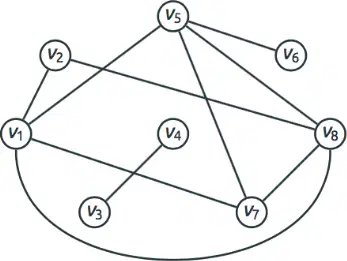
Refer to the diagram showing an undirected graph with vertices v1 through v8 connected by multiple edges. Is this graph connected?
Yes
No
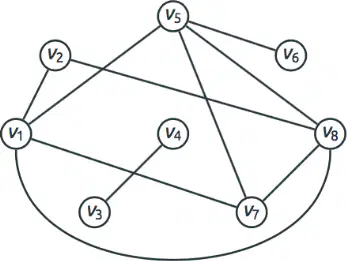
Refer to the diagram showing an undirected graph with vertices v1 through v8. How many connected components does this graph have?
2
8
4
1
3
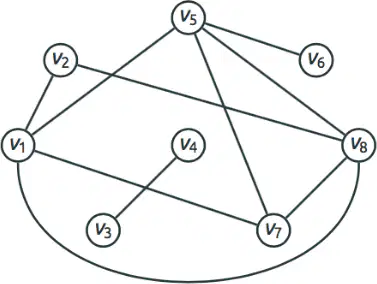
Refer to the diagram showing an undirected graph with vertices v1 through v8. Is there a path from v1 to v6?
Yes
No
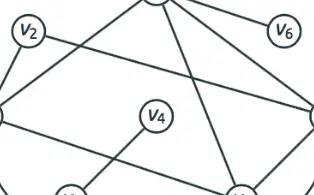
Refer to the two diagrams, each showing an undirected graph with six labeled vertices v1–v6. Are these graphs complement?
Yes
No
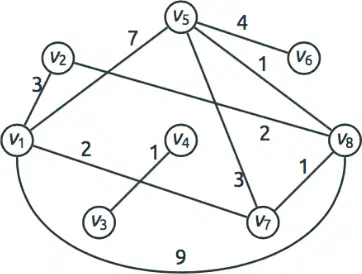
Refer to the weighted graph with vertices v1 through v8 shown. What is the distance (the weight of the shortest path) from v1 to v6?
13
6
11
9
8
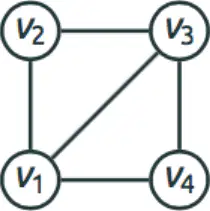
Refer to the graph with vertices v1, v2, v3, v4 arranged in a square with edges v2–v3, v2–v1, v1–v4, v3–v4, and a diagonal edge v1–v3. Is it complete graph?
No
Yes
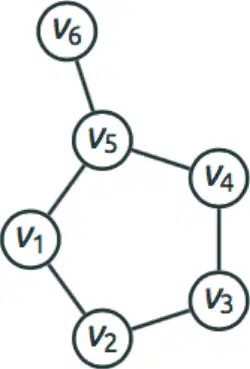
Refer to the graph with vertices v1–v6 where v1–v2–v3–v4–v5–v1 forms a cycle and v6 is a leaf attached to v5. Is this a tree?
No
Yes
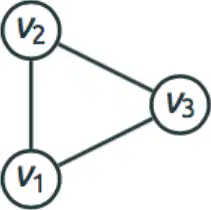
Refer to the three-vertex graph with vertices v1, v2, v3 where each pair of vertices is connected by an edge. This graph is –
a tree
complete
bipartite
a cycle
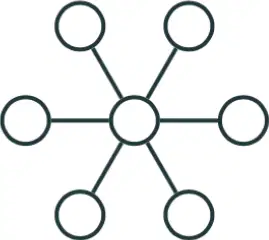
Refer to the star graph with one central vertex connected to six outer vertices and no edges among the outer vertices. This graph is
a tree
complete
bipartite
a cycle
a path
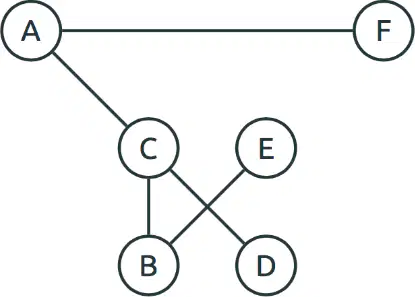
Refer to the labeled graph with vertices A, B, C, D, E, F and edges A–F, A–C, C–B, C–D, and D–E, with no other edges. This graph is
a tree
it’s not a graph
a cycle
a vertix
Which of the following is NOT allowed when using AI tools, regardless of the use level?
Summarizing course notes
Brainstorming project ideas
Formatting citations
Entering another person’s personal details
What is defined as a group of objects
Union
Complement
Set
Subset
Partition
Set A and Set B are given. The term which includes objects in the set A, objects in the set B and objects in both sets A and B.
Intersection
Union
Negation
Group
A shorthand way of saying A and B.
A/B
A∪B
Ab
A∩B
A∗B
A shorthand way of saying when set A does not occur
Complement
A-
-A
Union
Intersection
There are three closed doors. A car has been placed behind one of the doors at random; there are goats behind the other two doors (assume that you prefer the car to the goat). You pick a door; say, for the purpose of this example, you pick Door 1. Host, who knows where the car is, then opens up Door 2 to reveal a goat (importantly, Host will always open a door with a goat, and if you pick the door with the car so that the other two doors have goats behind them, he will select one of the goat doors to open with equal probabilities). He then offers you the option to stay with Door 1 or switch to Door 3. Should you switch doors? What does this problem refer to?
Bayes’ theorem
The Birthday Problem
Gambler’s Ruin
Conditional Probability
Monty Hall problem
Measure of information
Byte
Second
Kilobyte
Bit
Meter

