
 Worksheets
Halal Policy, IHC and IHA Quiz
Total questions: 20
Worksheet time: 15mins
What is the primary purpose of a halal policy in an organization?
To define the organization's direction and commitment to produce halal, quality, and safe products or services.
To increase the cost of products.
To reduce the number of employees.
To promote non-halal products.
Which system is mentioned as part of the ongoing maintenance in a halal policy?
Halal Assurance Management System (HAS)
Food Safety Management System (FSMS)
Environmental Management System (EMS)
Quality Control System (QCS)
Which of the following should a halal policy mention regarding company compliance?
Compliance with the Malaysian Standard for halal products/services
Compliance with international food safety standards
Compliance with local labor laws
Compliance with environmental regulations
Why is it important for stakeholders or related parties to be aware of their responsibility towards halal requirements?
To ensure proper adherence to halal standards
To increase company profits
To reduce marketing expenses
To improve packaging design
Which statement best describes the company’s duty in relation to halal requirements according to the halal policy?
The company must abide by halal requirements and exercise halal best practices at all times
The company must focus only on profit maximization
The company must prioritize environmental sustainability
The company must follow international trade regulations
How should the halal policy contribute to the halal control system?
By driving its establishment and encouraging continual improvement
By reducing the number of employees involved
By limiting the scope of halal certification
By focusing only on product marketing
If a company wants to continually improve its halal control system, what should its halal policy emphasize?
The aim of the halal control system and continual improvement
The reduction of production costs
The expansion into new markets
The use of advanced technology
Which of the following best describes a halal objective in a company's halal policy?
Ensuring all products are organic
Supporting the policy with measurable halal objectives
Using only local ingredients
Reducing production costs
What does the processing/facilities area refer to in the context of halal certification?
The area where products are advertised
The area involved in producing your products/services
The area where products are sold
The area where products are stored after sale
How does the IHC ensure the effectiveness of the Halal Assurance System (HAS)?
By monitoring and verifying its implementation
By advertising Halal products
By hiring more staff
By reducing the number of products
Which of the following roles is NOT typically included in the Internal Halal Committee (IHC)?
Chairman
Halal Executive
Purchaser
Marketing Manager
According to the guidelines, which eligibility is required for members of the Internal Halal Committee?
Experienced
Creative
Friendly
Innovative
Why is it important for members of the Internal Halal Committee to be competent and trained?
To ensure the committee can effectively manage halal compliance and uphold standards
To increase the number of committee members
To improve marketing strategies
To reduce production costs
Which roles/department are included in the Internal Halal Committee structure besides Chairperson and Halal Executive?
Purchasing or Procurement, Production/Operation, Other
Marketing, Sales, Finance
Legal Advisor, Auditor, Consultant
Human Resources, IT, Security
Which of the following is also checked during a halal internal audit besides the ingredients?
The steps and procedures to ensure they meet Halal certification standards
The marketing strategy of the product
The packaging design of the product
The nutritional value of the product
Which statement best describes the audit process for different types of audits?
The process is similar for any type of audit.
Each audit type has a completely different process.
Only financial audits follow a standard process.
The process is unique for every organization.
How often must a Halal Internal Audit be conducted at minimum?
Once every five years
At least 1 time audit a year
Every month
Only when requested by management
Who must confirm the findings and non-conformities (NC) in a Halal Internal Audit?
The supplier
The external auditors
IHC (Internal Halal Committee)
The government
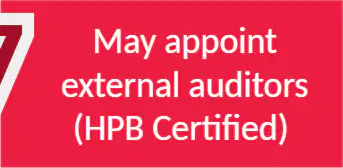
Why might an organization appoint external auditors for Halal Internal Audit?
To avoid internal responsibility
To ensure HPB certification
To reduce costs
To eliminate the need for records
Strategically, how does focusing on compliance and halal control points benefit the Halal Internal Audit process?
It ensures audits are only done for financial reasons
It helps maintain halal integrity and regulatory compliance
It reduces the need for written procedures
It allows for random audits without planning

