
 Worksheets
Learning Outcomes
Total questions: 73
Worksheet time: 37mins
Which option best defines an information system?
A manual procedure for recording transactions in notebooks
A single software application for file storage only
A set of interrelated components handling data and feedback
A collection of unrelated programs and devices
Which of the following are components of an information system?
Budgets and facilities
People and procedures
Software and telecommunication
Data and hardware
Which item is NOT listed as a component of an information system?
Procedures
Facilities
Hardware
Data

Arrange the four stages of processing in a typical information system workflow.
Input → Data processing → Output → Storage
Input → Output → Data processing → Storage
Data processing → Input → Output → Storage
Storage → Input → Data processing → Output
In the context of processing stages, what is a transaction?
A software upgrade applied during processing
A backup routine stored on optical media
A business event usually entered as input
A report produced as final output
During which stage are calculations performed on the input data?
Input
Data processing
Output
Storage
Which statement accurately describes the output stage?
It archives data onto optical disks
It performs calculations on collected inputs
It is what is produced by the system
It gathers and introduces data to the system
What storage detail is emphasized in the material?
Output files replace the need for any backups
Only temporary data are kept in main memory
Vast amounts of data stored on optical discs
Storage primarily uses magnetic tapes for all data
Which statement best distinguishes data from information?
Data are personal opinions; information is objective facts
Data are context-rich visuals; information is raw records
Data are summarized charts; information is unorganized
Data are stored representations; information is processed meaning
Which is a correct pairing of data category and example?
Unstructured—primary keys and indexes
Unstructured—tables with fixed fields
Structured—images, videos, documents
Structured—numbers, text, dates
A class roster listing names, IDs, majors, and GPAs illustrates which concept?
Data presented in context
Unstructured data examples
Summarized information chart
Metadata describing length
Which scenario turns data into information most clearly?
Labeling files with owner names
Storing images of scanned forms
Collecting raw student ID numbers
Creating a pie chart of enrollment by major
Which best describes information in relation to knowledge?
Formats that define data field sizes
Data processed to increase user knowledge
Unprocessed facts about objects and events
File names that label stored datasets
Which set contains only structured data examples?
Scans, photos, recordings
Free-form notes, videos
Images, audio, PDFs
Dates, integers, short text
Which statement about unstructured data is most accurate?
Never requires additional processing
Often includes images, video, documents
Always fits predefined tables neatly
Primarily consists of numbers and dates
Metadata is best defined as:
Data that describes properties and context of data
Summarized charts derived from raw datasets
Unstructured content like images and videos
User conclusions drawn from processed data
Which item is typically a metadata property to describe?
Allowable values for a field
Trends over several years
Count of records by category
Visualization color palette
Which item is typically part of metadata context?
Bars, lines, and pie slices
Primary, foreign, and composite
Average, median, and mode
Source, ownership, and usage
Which combination correctly matches category to items?
Metadata properties—data names, length
Structured data—images, documents
Metadata context—source, ownership
Unstructured data—numbers, dates
Information—data processed for meaning
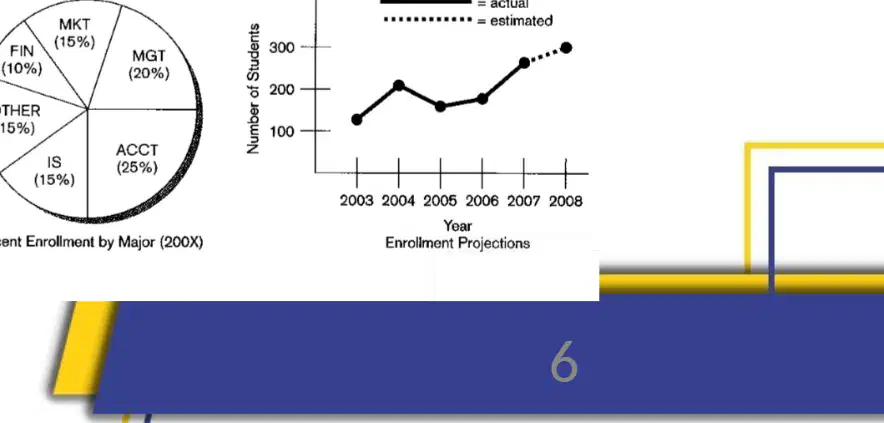
A line chart showing enrollment projections over years best exemplifies:
Metadata fields like data length
Raw unprocessed student identifiers
Structured data stored as dates
Information created by summarizing data
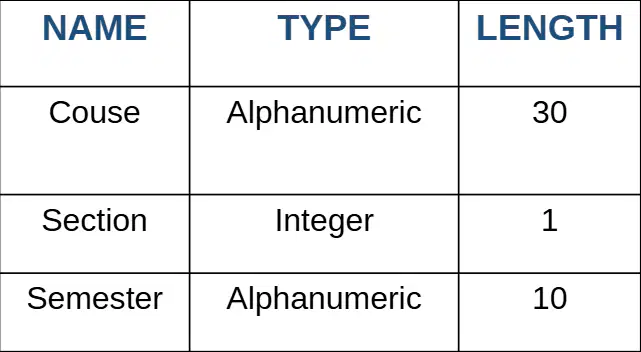
In the metadata table, which attribute is explicitly constrained with a minimum of 1 and a maximum of 9?
Course alphanumeric length thirty characters
Section integer with bounds one to nine
Semester alphanumeric length ten characters
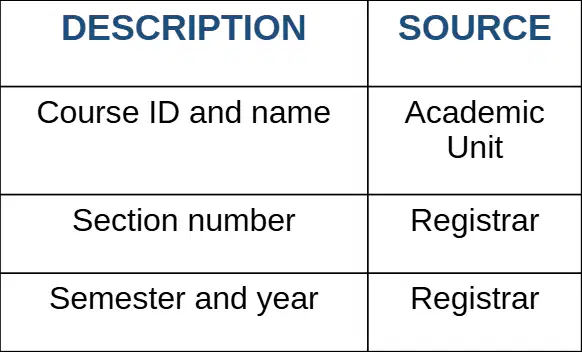
Which metadata row describes the field sourced from the Registrar and representing the semester and year?
Course with type alphanumeric thirty length
Section with type integer range one to nine
Semester with type alphanumeric ten length
Which statement best distinguishes metadata from data using the table example?
Metadata lists field properties like type and length
Metadata stores individual student or course values
Metadata records grades for each enrolled student

Which combination correctly matches the 'Name' field with its type and likely purpose in the table?
Integer, to store section identifiers
Alphanumeric, to store student names
Select all components that are listed as major parts of a database system environment.
Procedures
People
Software
Hardware
Data
Which statement best describes a data model in database design?
A catalog of installed database software versions
A collection of concepts describing database structure
A visual of screens and forms for users
A set of server hardware configuration rules

In the abstraction process shown as Real World → Data Model → Database, what is the role of the data model?
It represents reality in a structured form for databases
It converts raw data directly into reports
It replaces the real world entirely with code
It validates transactions after deployment
Which option correctly matches the basic building block with its definition?
Attribute: a characteristic of an entity
Entity: a person, place, thing, or event
Entity: a characteristic of an entity
Relationship: an association among entities
Select all statements that are true about an entity in data modeling.
It is something about which data will be collected
It is used to describe an association among entities
It can be a person, place, thing, or event
It is synonymous with an attribute's value
Which is the best example of an attribute for the entity Student?
Advises
Address
Taught By
Enrolled In
Which statement about relationships is most accurate?
They define physical storage structures
They describe how entities are associated
They are replaced by tables in all models
They store the values of attributes directly
Which pair illustrates a relationship between entities?
Course and Credits
Student and Email
Instructor and Teaches
Book and Title
When moving from a real-world domain to a database, why is a data model necessary?
It replaces entities with unstructured files
It ensures queries run automatically
It provides concepts to achieve abstraction
It eliminates the need for schema design
Which scenario best fits a one-to-many relationship in a data model?
One passport with one citizen
Many students with many courses
Many orders with many products
One department with many employees
In a many-to-many relationship, which statement is accurate?
Each side can be associated with many occurrences of the other
No entity instances are associated with any others
One entity instance links to many, but not vice versa
Each entity occurrence links to exactly one other occurrence
Which description matches a one-to-one relationship?
One entity instance associated with many related instances
Many occurrences on both sides of the relationship
One entity instance associated with only one related instance
One entity instance associated with zero related instances
During conceptual design, the primary activity is to:
Create ERDs and a data dictionary
Normalize tables and define indexes
Tune storage and partition strategies
Implement triggers and stored procedures
Logical design most directly involves which task?
Transforming ERD into tables and constraints
Modeling reality using entities and attributes
Allocating files and configuring hardware
Migrating data between production systems
Physical design focuses on:
Deriving candidate keys from attributes
Transforming entities into relational schemas
Creating DBMS-specific storage structures
Formalizing business rules in an ERD
Which set correctly orders the data model design stages from abstract to implementation?
Physical, Logical, Conceptual
Conceptual, Physical, Logical
Conceptual, Logical, Physical
Logical, Conceptual, Physical
Which pair is correctly matched to its design phase?
Conceptual: ERD and data dictionary
Logical: tables and key constraints
Physical: DBMS-specific structures
Conceptual: file groups and partitions
Which statement best defines a business rule in an organization?
A prediction about future customer demand trends
A metric that measures quarterly financial performance
A guideline that only describes employee preferences
A statement that defines or constrains business aspects
Which elements are commonly defined by properly written business rules?
Entities within a domain
Network hardware topology
Attributes of data items
Relationships among entities
Which description aligns with the role of business rules?
A budget outline for fiscal year planning
A policy, procedure, or principle description
A workflow for coding application interfaces
A marketing slogan for brand awareness
Which outcome reflects the importance of business rules for data understanding?
Maximizes profits in all market conditions
Standardizes the company’s view of data
Automates every manual business task
Eliminates the need for documentation
How do business rules support collaboration between people who build and use systems?
They act as a communication tool between users and designers
They replace managers with automated decision engines
They hide constraints to reduce conflict across teams
They force all teams to use the same programming language
Which pair best describes how business rules assist designers?
Expose business processes to the designer
Clarify the nature, role, and scope of data
Guarantee zero defects in source code
Remove the need for user interviews
What is an Entity Relationship Diagram (ERD)?
A security framework for encrypting transactions
A storage format for compressing database tables
A programming paradigm for real-time systems
A data modeling technique creating a graphical view
Which aspects does an ERD represent within an information system?
Graphical layout of server racks
Relationships between those entities
Entities involved in the domain
Attributes and connections conceptually
Which statement best defines an entity in an ER model?
A rule that constrains attribute values
A person, object, place, or event we collect data about
A link that connects multiple data sets
A specific data type collected about items
In ER modeling, what are attributes?
The entities that store unique keys
The data we collect about entities
The constraints that enforce cardinality
The relationships linking two tables
What role do relationships play in an ER model?
They store attribute domains for entities
They provide the link or structure between entities
They remove redundancy from attributes
They describe entity identifiers only
Which example best illustrates a physical existence entity?
A particular employee working in finance
The concept of revenue recognition
A set of business rules for payroll
A constraint on salary increases
Which statement correctly contrasts strong and weak entities?
Strong entities are existence-dependent, weak entities are independent
Strong entities cannot exist without relationships, weak entities can
Strong entities have unique primary keys, weak entities lack independent keys
Strong entities only hold attributes, weak entities only hold links
Select all that are true about a weak entity.
It often relies on an owner entity like EMPLOYEE
It requires a relationship to be identifiable
It can exist on its own with a unique key
It is existence-dependent on another entity
Which scenario best demonstrates existence dependence?
COURSE records stored without instructors
DEPENDENT records tied to a specific EMPLOYEE
STUDENT records managed by the registrar
EMPLOYEE records synchronized across sites
Which pair is most appropriate as strong entities in an academic database?
INVOICE ITEM and ORDER LINE as independent entities
ADDRESS and PHONE as independent entities
DEPENDENT and BENEFIT as independent entities
STUDENT and COURSE as independent entities
In an entity-relationship model, what is an attribute?
A particular property that describes an entity
A set of entities in a system
A relationship between entities
A constraint that limits data values
Which statement best describes a key attribute?
It groups several related entities together
It is the unique, distinguishing characteristic of an entity
It enforces referential integrity across tables
It can be split into meaningful subparts
Which of the following is characteristic of a composite attribute?
It can be divided into smaller subparts
It uniquely identifies each entity instance
It represents a many-to-many relation
It is always a single atomic value
Choose all statements that are true for composite attributes.
They contain subparts with independent meanings
They can be broken into more basic attributes
They are used to uniquely distinguish entities
They cannot be decomposed without losing meaning
Which scenario illustrates a key attribute for a Student entity?
Date of birth and birthplace combined
Full name consisting of first and last
University-assigned student ID number
Home address with street and city
Which scenario best illustrates a composite attribute for a Customer entity?
International phone number in E.164
Mailing address split into street, city, and zip
Email address as a single string
Auto-incrementing customer identifier
Why is a key attribute essential in an ER model?
It documents optional relationships only
It allows attributes to be grouped logically
It reduces the number of entity types
It ensures an entity can be uniquely identified
Select the most accurate comparison between key and composite attributes.
Both primarily enforce relationship cardinalities
Key attributes decompose; composite attributes identify
Key attributes identify; composite attributes decompose
Both are always indivisible values
Which statement best defines a required attribute in an entity-relationship model?
It may be empty and filled later if needed
It can store multiple values per entity
It must have a value and cannot be empty
It is computed from other stored attributes
In a student database, which field is most appropriately modeled as an optional attribute?
Date of birth of the student
Student identification number
Primary email address on record
Middle name of the student
A single-valued attribute is best described as one that
holds exactly one value for each entity
may hold several values of the same type
is derived from other related attributes
can be left empty without constraints
Which pair correctly matches the attribute type to a realistic example?
Single-valued attribute – list of hobbies
Derived attribute – raw birthdate field
Optional attribute – mandatory serial number
Required attribute – employee ID
Select all attribute types that can legally be empty for an entity instance.
Single-valued attribute
Optional attribute
Multi-valued attribute
Derived attribute
Required attribute
Which scenario illustrates a multi-valued attribute?
A customer with exactly one birthdate
A book with a single ISBN code
An author with several pen names
An invoice with one total amount
Which attribute is most likely derived rather than stored directly?
Vehicle VIN printed by manufacturer
Customer age calculated from birthdate
Passport number issued by authority
Student ID assigned by registrar
Identify the true statements about attribute types.
Required attributes cannot be null
Derived attributes are computed values
Optional attributes may be null
Multi-valued attributes require exactly one
Single-valued attributes allow one value

