
Font size
 Worksheets
Exam Objective Matrix
Total questions: 107
Worksheet time: 54mins
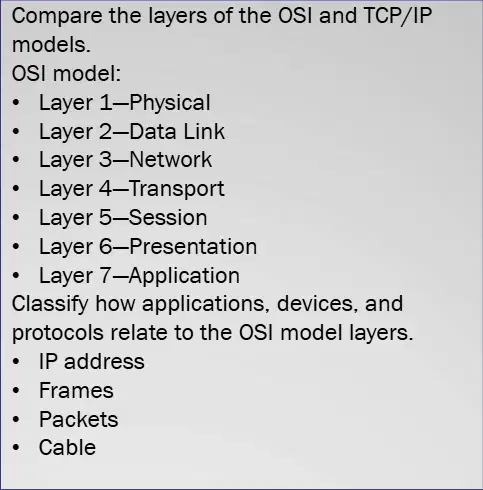
Which OSI layer is responsible for end-to-end delivery and flow control?
Network layer handles logical addressing
Transport layer manages reliable delivery
Data Link layer formats frames
Session layer ensures dialog management
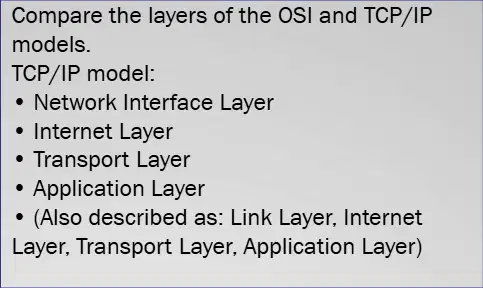
In the TCP/IP model, which layer corresponds most closely to the OSI Internet Layer?
Network Interface layer manages cabling
Application layer handles user protocols
Transport layer provides segment control
Internet layer performs routing functions
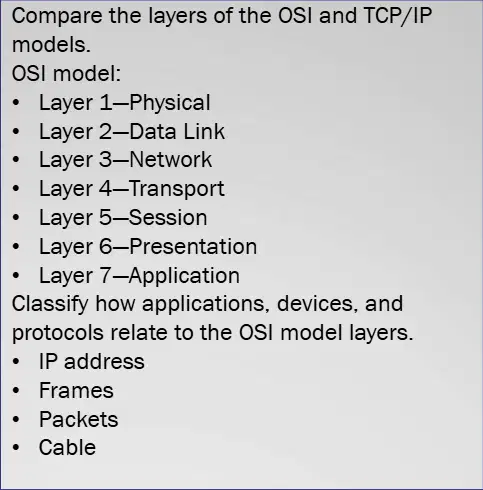
Where should IP addressing primarily be classified within the OSI model?
Physical layer handles signaling
Data Link layer uses MAC addressing
Network layer assigns logical addresses
Session layer controls connections
What does the acronym OSI stand for in networking?
Operational System Interface
Organizational Systems Interlink
Open Systems Interconnection
Open Standards Integration
Which organization created the OSI model as a reference framework?
International Standards Organization
Institute of Electrical Engineers
Internet Engineering Task Force
International Telecommunications Union
Which statement best describes the purpose of the OSI model?
A security model for encrypting application data
A hardware specification for network adapters
A mandated protocol suite every vendor must follow
A framework explaining how networking technologies interact
Which statement about the OSI model is accurate?
It replaces all protocol stacks used today
It defines only physical wiring requirements
It enforces mandatory compliance for all vendors
It is not a standard that protocols must follow
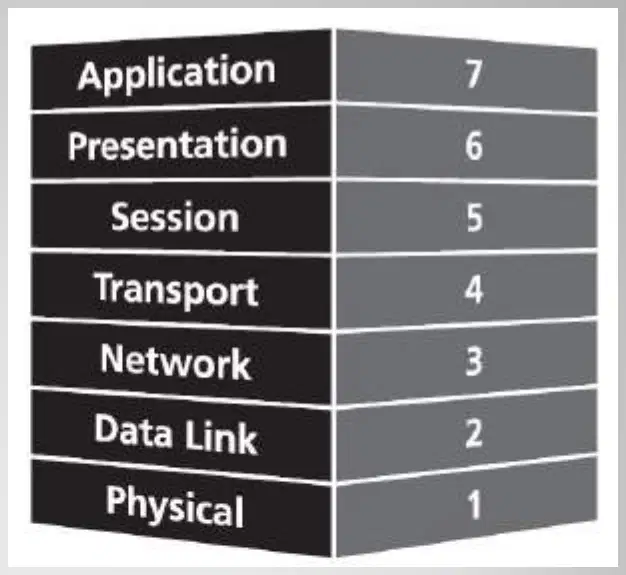
How do the seven layers of the OSI model operate together?
They work in order to move data across networks
They function independently without interaction
They execute randomly based on traffic load
They only operate when encryption is enabled
Which is the correct top-to-bottom layer order using the mnemonic provided?
Network, Transport, Session, Presentation, Application, Data Link, Physical
Physical, Data Link, Network, Transport, Session, Presentation, Application
Application, Session, Presentation, Transport, Network, Physical, Data Link
Application, Presentation, Session, Transport, Network, Data Link, Physical
Which mnemonic helps remember layers from bottom to top?
Please Do Not Throw Sausage Pizza Away
Every Nice Device Talks Secure Protocols
Physical Devices Need Transport Network Access
All People Seem To Need Data Processing
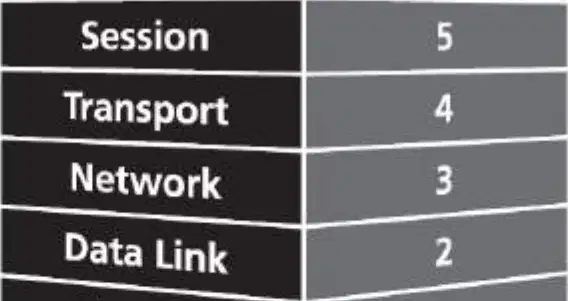
Which layer number corresponds to the Transport layer in the OSI stack diagram?
Layer 4
Layer 3
Layer 5
Layer 2
If a protocol operates at layer 3, which OSI layer is it associated with?
Session layer
Data Link layer
Transport layer
Network layer
Using the top-to-bottom mnemonic, which layer comes immediately after Session?
Application layer
Network layer
Presentation layer
Transport layer
Which description aligns with the OSI model’s role for technologies?
A compulsory standards document
A proprietary implementation guide
A reference model explaining interaction
A physical cabling requirement list
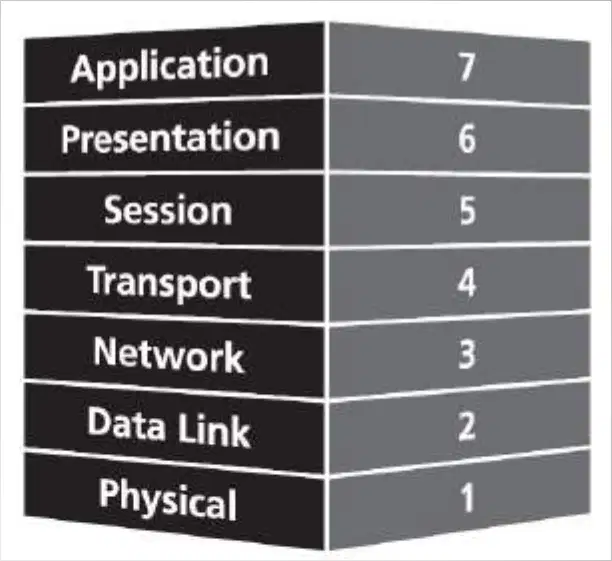
What is the primary idea conveyed by the OSI layer stack image?
Only upper layers handle data movement
All layers are merged into one module
Lower layers manage applications directly
Each layer has specific responsibilities
During encapsulation, what is the correct order as data moves down the OSI layers?
Data to bits to frame to packet to segment
Data to frame to packet to segment to bits
Data to packet to frame to segment to bits
Data to segment to packet to frame to bits
Which OSI layer refers to the unit as a packet?
Transport layer
Network layer
Data Link layer
Physical layer
At the Transport layer, how is the data unit named?
Segment
Packet
Frame
Bits
Which option correctly represents de-encapsulation as data moves up the OSI layers?
Bits to frame to segment to packet to data
Bits to packet to frame to segment to data
Bits to frame to packet to segment to data
Bits to segment to packet to frame to data
A network interface card passes information to the wire. What is the data unit at this stage?
Bits
Frame
Packet
Segment
Which pairing of OSI layer and data unit is correct?
Physical layer — Frame
Data Link layer — Frame
Network layer — Segment
Transport layer — Packet
An application sends a message to a remote host. Before reaching the network layer, what is the immediate naming transition at the transport layer?
Data becomes a segment
Data becomes a packet
Data becomes bits
Data becomes a frame
Which sequence correctly maps OSI layers to their data-unit names from top to bottom?
Application/Presentation/Session—Data; Transport—Packet; Network—Segment; Data Link—Frame; Physical—Bits
Application/Presentation/Session—Data; Transport—Segment; Network—Packet; Data Link—Frame; Physical—Bits
Application/Presentation/Session—Data; Transport—Segment; Network—Frame; Data Link—Packet; Physical—Bits
Application/Presentation/Session—Packet; Transport—Frame; Network—Segment; Data Link—Bits; Physical—Data
Which OSI layer converts upper-layer data into 1s and 0s for transmission?
Data Link layer converts bits for transmission
Physical layer converts bits for transmission
Network layer converts bits for transmission
Transport layer converts bits for transmission
What does the Physical layer primarily define for data transmission?
Routing paths between distant networks
Application protocols and services
How data is encoded onto the media
Session establishment and teardown
Which standard category is defined at the Physical layer?
File system access control lists
IP addressing and subnetting rules
Cable and wireless media standards
Encryption standards for TLS sessions
Which device is an example operating at the Physical layer?
Firewall inspecting application traffic
Hub repeating electrical signals
Managed switch filtering frames
Layer-3 router forwarding packets
Which of the following is considered Physical layer media?
Copper wiring and radio frequencies
User interface widgets and icons
ARP tables and routing metrics
Process IDs and thread priorities
The Data Link layer is responsible for moving which unit of data?
Segments between end-host processes
Packets across internetwork routers
Frames between adjacent nodes
Files across distributed storage
What limitation applies to Data Link layer forwarding?
Cannot encapsulate data into frames
Cannot send data on copper cabling
Cannot move frames across routers
Cannot traverse wireless access points
At the Data Link layer, encapsulation results in what?
A packet with IP header fields
A stream with application markers
A frame with link-layer headers
A segment with TCP flags set
Which address type is required for Data Link layer operation?
Email-style user identifier
DNS hostname and domain suffix
MAC or physical hardware address
IPv4 dotted-decimal address
Which protocol is defined at the Data Link layer?
HTTP and REST protocols
OSPF dynamic routing protocol
Ethernet and PPP protocols
DNS name resolution protocol
A frame must travel from one adjacent computer to another. Which layer ensures this delivery?
Data Link layer manages adjacent delivery
Network layer manages adjacent delivery
Application layer manages adjacent delivery
Transport layer manages adjacent delivery
Which statement best contrasts Physical and Data Link layers?
Physical routes packets across routers
Data Link encodes bits onto media
Physical defines media and encoding
Data Link manages user sessions
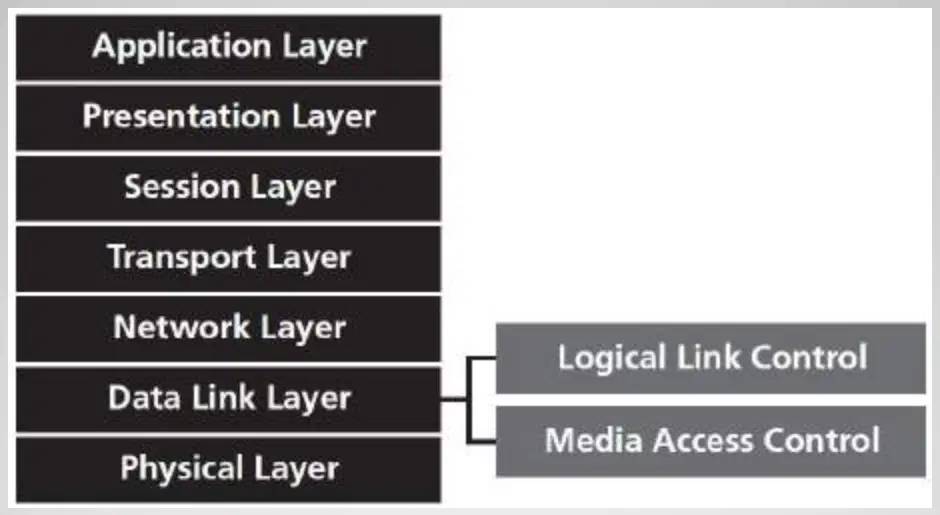
Which OSI layer is divided into the Logical Link Control and Media Access Control sublayers?
Physical layer with signaling control
Network layer with routing control
Transport layer with flow management
Data Link layer with LLC and MAC

Which device primarily operates at the Data Link layer in typical LANs?
Router for inter-network routing
Switch for frame forwarding
Firewall for packet filtering
Hub for IP addressing
What is a core function of the LLC sublayer?
Allocates IP addresses dynamically
Selects best path across networks
Synchronizes frames on shared media
Provides data link addressing and flow control
Which statement best describes MAC sublayer responsibility?
Determines which node can use the medium
Reassembles packets into application streams
Handles logical addressing with IP headers
Encrypts application data for sessions
In ethernet, frame synchronization refers to the ability to:
Translate data for presentation layer
Assign logical IP addresses to hosts
Mark where one frame ends and next begins
Choose the fastest router path
Which OSI layer is responsible for end-to-end movement of packets across networks?
Data Link layer framing bits
Transport layer ensuring reliability
Network layer handling routing
Session layer managing dialogs
What type of address does the Network layer rely on to deliver packets?
MAC addresses burned into NICs
Hostnames resolved by DNS
Logical addresses such as IP
Port numbers assigned by TCP
Which device is the classic example of operating at the Network layer?
Bridge isolating collision domains
Repeater regenerating electrical signals
Router moving packets between networks
Switch forwarding frames locally
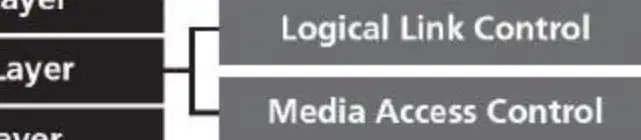
A switch uses MAC tables to forward frames. This action most closely involves which sublayer?
LLC managing logical addresses
MAC controlling media access rules
Transport sequencing and acknowledgments
Network routing with IP headers
You must ensure only one host transmits at a time on a shared medium. Which sublayer policy addresses this?
Transport congestion control mechanism
Network path selection mechanism
MAC access determination mechanism
LLC flow control mechanism
To move a packet from source LAN to a distant LAN, which combination is required?
LLC services plus application gateways
Session tokens plus bridges
Logical IP addressing plus routers
MAC addressing plus repeaters only
Error correction at the Data Link layer is primarily associated with:
MAC sublayer functions
Physical layer encoding
LLC sublayer functions
Network layer routing
Which OSI layer breaks application data into segments for transmission?
Network layer handles segmentation tasks
Transport layer performs data segmentation
Data link layer segments application frames
Session layer divides data into chunks
What is the purpose of sequencing at the Transport layer?
Assigns IP addresses to each segment
Compresses segments to reduce size
Labels segments to reassemble in order
Encrypts segments for confidentiality
Which protocol is connection-oriented and ensures receipt of segments?
ARP confirms segment reception
ICMP manages reliable transport
UDP guarantees ordered delivery
TCP provides reliable delivery
Which protocol sends segments without assurance of delivery?
TCP with handshake reliability
UDP connectionless transport
SCTP reliable stream control
TLS reliable encrypted sessions
Port addressing at the Transport layer primarily identifies what?
Data link frames and MACs
Routing paths across networks
Specific applications or services
Physical devices on the LAN
Which statement best describes the Transport layer’s reassembly function?
Combines frames into bits for media
Reorders segments back into data
Merges packets into IP addresses
Converts signals to electrical pulses
A video stream needs continuous delivery but can tolerate some loss. Which protocol is most appropriate?
UDP lower overhead streaming
TCP reliable segment transfer
FTP connection-oriented file
SMTP reliable email transport
Which capability is provided by the Session layer?
Signal modulation and encoding
Frame checks and MAC addressing
Dialog management between devices
IP addressing and routing
What communication modes can the Session layer support?
Unicast and anycast only
Synchronous and asynchronous
Duplex, half-duplex, simplex
Broadcast and multicast only
Which action occurs during Session layer checkpointing?
Establish save points in a dialog
Assign port numbers to sockets
Fragment packets at the router
Encrypt payloads end-to-end
During a file transfer, maintaining orderly segment delivery is failing. Which Transport feature addresses this?
Sequencing numbers on segments
Port mapping for applications
Physical layer signal tuning
Session adjournment procedures
Which statement best contrasts TCP and UDP at the Transport layer?
TCP uses ports, UDP does not
TCP connection-oriented, UDP connectionless
TCP unordered delivery, UDP ordered
TCP for signaling, UDP for routing
Which OSI layer handles how data is presented to the network?
Session layer manages presentation concerns
Presentation layer manages presentation concerns
Transport layer manages presentation concerns
Application layer manages presentation concerns
Which task is NOT one of the Presentation layer's primary responsibilities?
Data encryption for protection
Data compression to reduce size
Data translation between formats
Routing packets across subnets
What does data translation at the Presentation layer accomplish?
Changes data so another type of computer can understand it
Splits data into segments for reliable delivery
Maps IP addresses to physical hardware addresses
Prioritizes traffic to guarantee quality of service
Why is compression performed at the Presentation layer?
To authenticate users before establishing sessions
To make data smaller to send more data in same time
To detect errors using checksums and retransmissions
To maintain session state across multiple connections
What is the primary purpose of encryption at the Presentation layer?
Allocates bandwidth among competing applications
Encodes data to protect from interception or eavesdropping
Selects optimal paths for packet forwarding
Converts analog signals into digital bitstreams
Which statement best describes the Application layer in the OSI model?
Provides physical signaling and media connections
Contains services and protocols used by application software
Handles end-to-end transport and flow control
Manages sessions and dialog synchronization
Which protocol would a web browser commonly use at the Application layer?
HTTP for transferring web content
SMTP for browsing web pages
POP3 for loading websites
FTP for rendering HTML documents
An email client downloads messages using which Application layer protocol?
HTTP retrieves inbox messages
SMTP retrieves inbox messages
POP3 retrieves inbox messages
DNS retrieves inbox messages
Which protocol does an email client typically use to send outgoing messages?
HTTP sends outbound messages
SMTP sends outbound messages
POP3 sends outbound messages
IMAP sends outbound messages
A company needs to prevent eavesdropping on sensitive files in transit. Which Presentation layer function addresses this need?
Encryption to encode the information
Translation to match character encodings
Compression to reduce payload sizes
Session control to track conversations
If two systems use different data formats, which Presentation layer capability enables successful communication?
Routing shifts traffic to compatible paths
Translation converts between representations
Encryption standardizes encoding schemes
Compression makes formats compatible
To improve throughput over a limited bandwidth link, which Presentation layer task is most directly helpful?
Application protocols rewire network cabling
Translation enhances signal strength
Compression reduces bits transmitted
Encryption increases available bandwidth
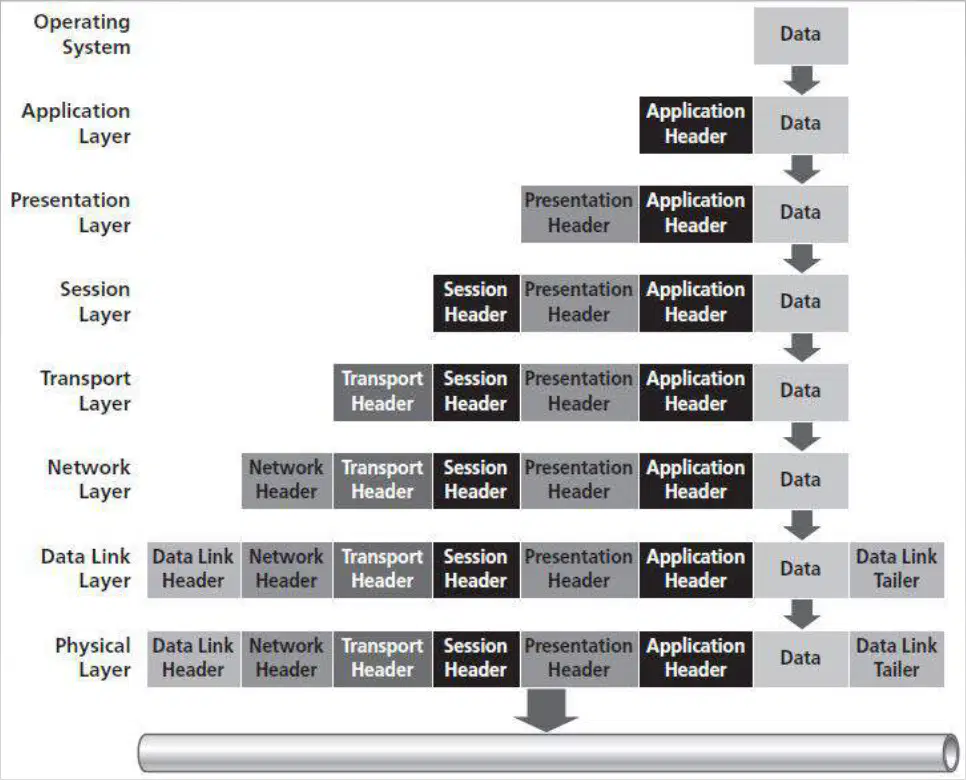
In the diagram, which layer first adds a header directly to the original data from the operating system?
Application layer adds its header
Presentation layer adds its header
Transport layer adds its header
Session layer adds its header
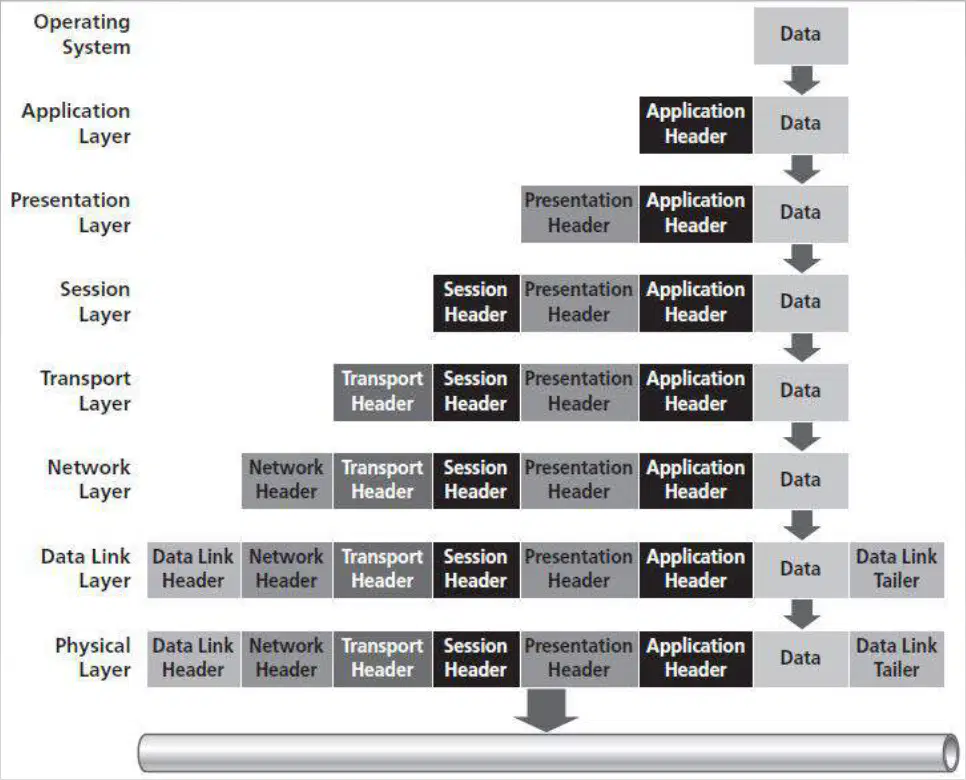
According to the diagram, what cumulative structure is formed as data moves downward through the layers?
A chain of alternating tails
A stack of layer-specific headers
A mesh of interleaved payloads
A ring of distributed metadata
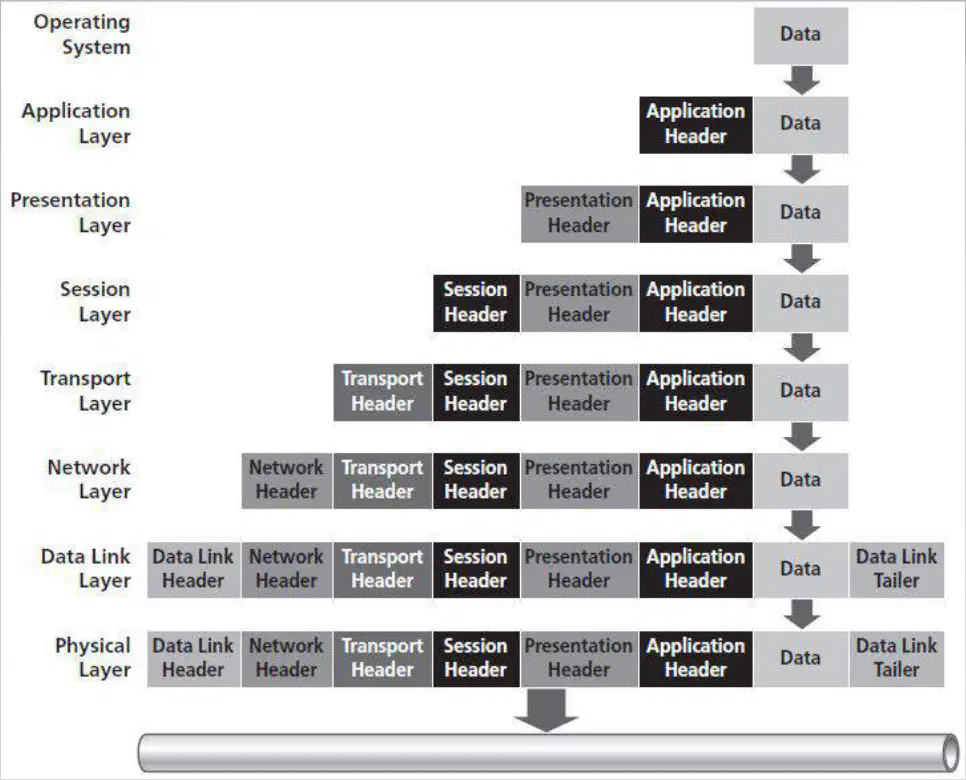
Which layer in the visual sequence is responsible for adding the first tailer to the encapsulated data?
Transport layer adds the tailer
Physical layer adds the tailer
Network layer adds the tailer
Data Link layer adds the tailer
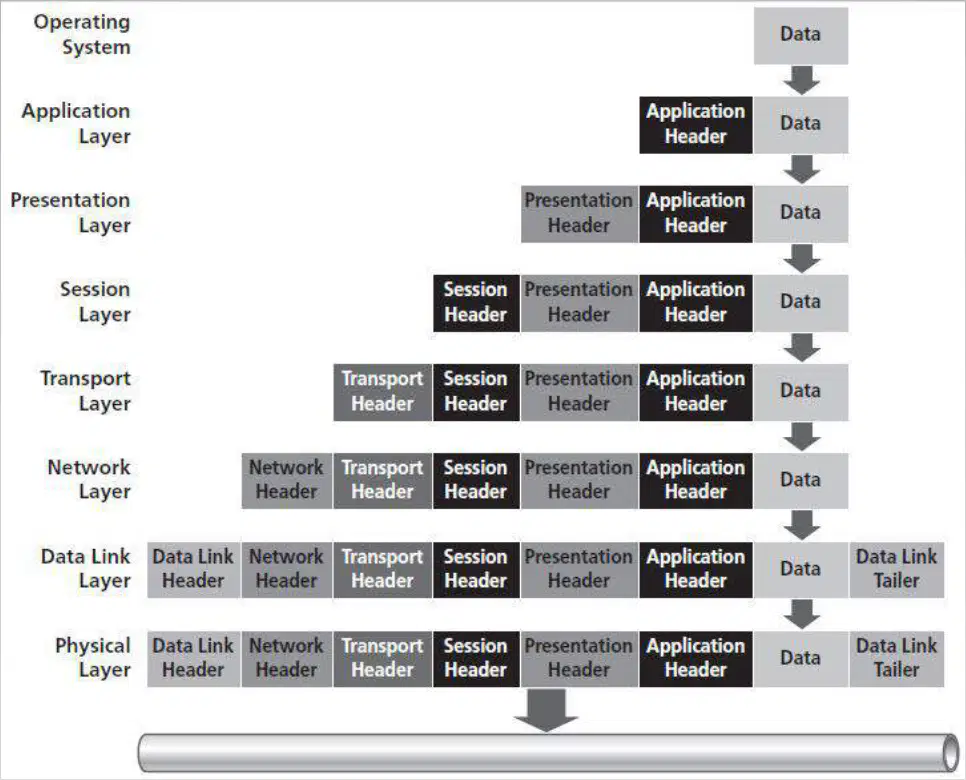
From the diagram, what does the Physical layer transmit?
Fully encapsulated bits with headers and tailer
Transport segments without data
Raw application data without headers
Only the network header as a frame
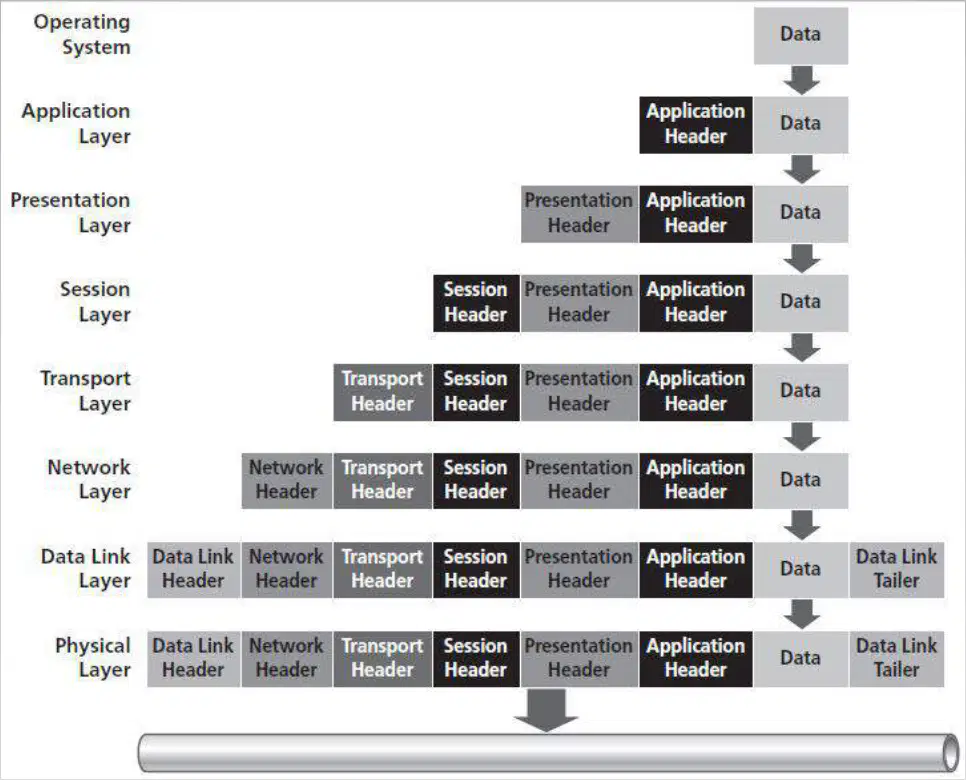
Which TWO consecutive headers appear immediately before the Application header in the downward flow?
Transport then Presentation headers
Data Link then Network headers
Network then Transport headers
Presentation then Session headers
In the second slide, what is the placement rule for each new header relative to the previous one?
Overwrites the previous header entirely
Alternates before and after headers
Inserted behind the previous header
Added in front of the previous header
What is the primary purpose of each layer’s header as described?
Describe actions for that layer
Store user-visible text
Compress payload for efficiency
Encrypt physical signals only
Which statement best captures the role of the Data Link tailer mentioned?
Contains information for error correction
Defines routing across autonomous systems
Specifies application encoding options
Negotiates session establishment details
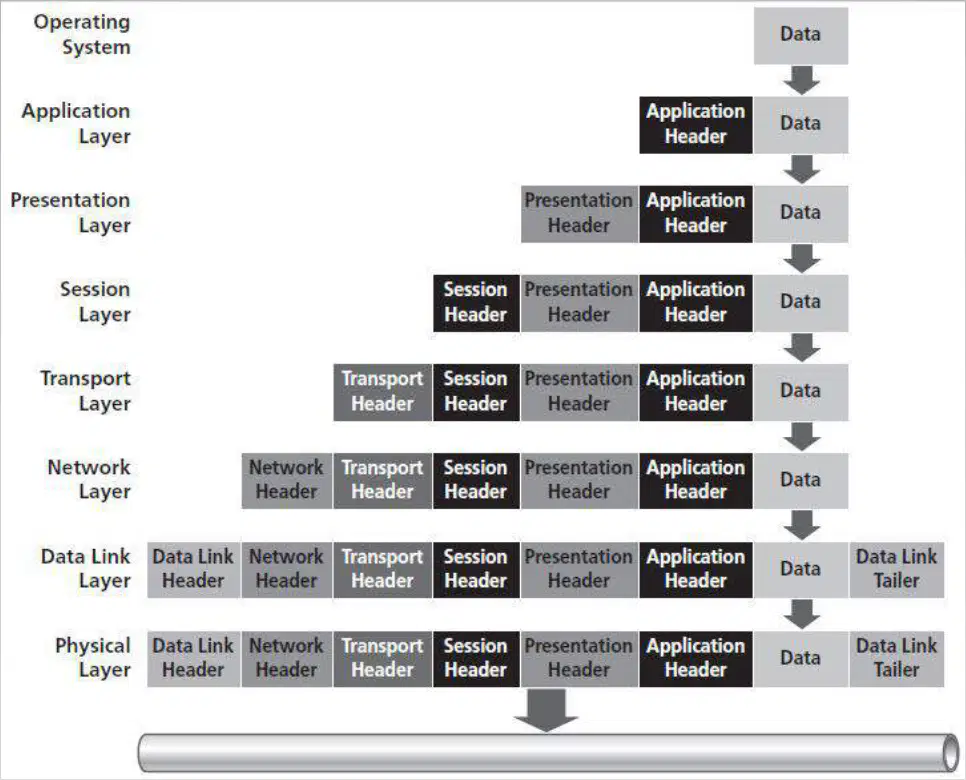
Reason through de-encapsulation at the receiver: which header will be interpreted first when data ascends the stack?
Presentation header is processed first
Transport header is processed first
Application header is processed first
Data Link header is processed first
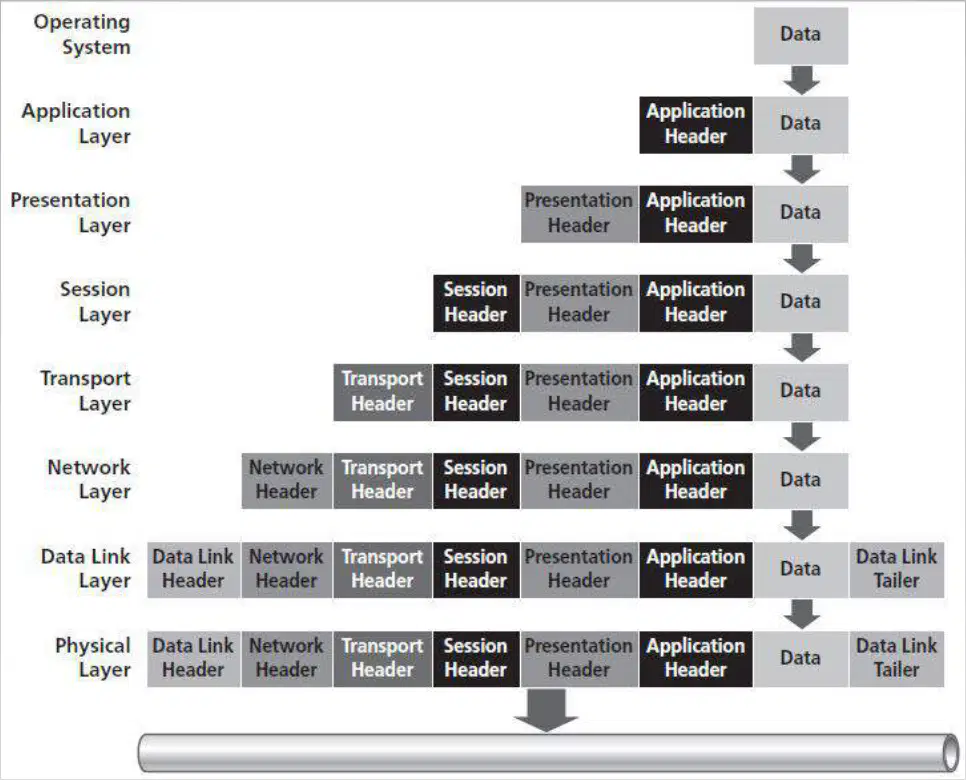
Plan the path of a payload: which sequence correctly lists the headers added from top to bottom before transmission?
Session, Presentation, Application, Transport, Network, Physical
Application, Presentation, Session, Transport, Network, Data Link
Data Link, Network, Transport, Session, Presentation, Application
Application, Network, Data Link, Transport, Session, Physical
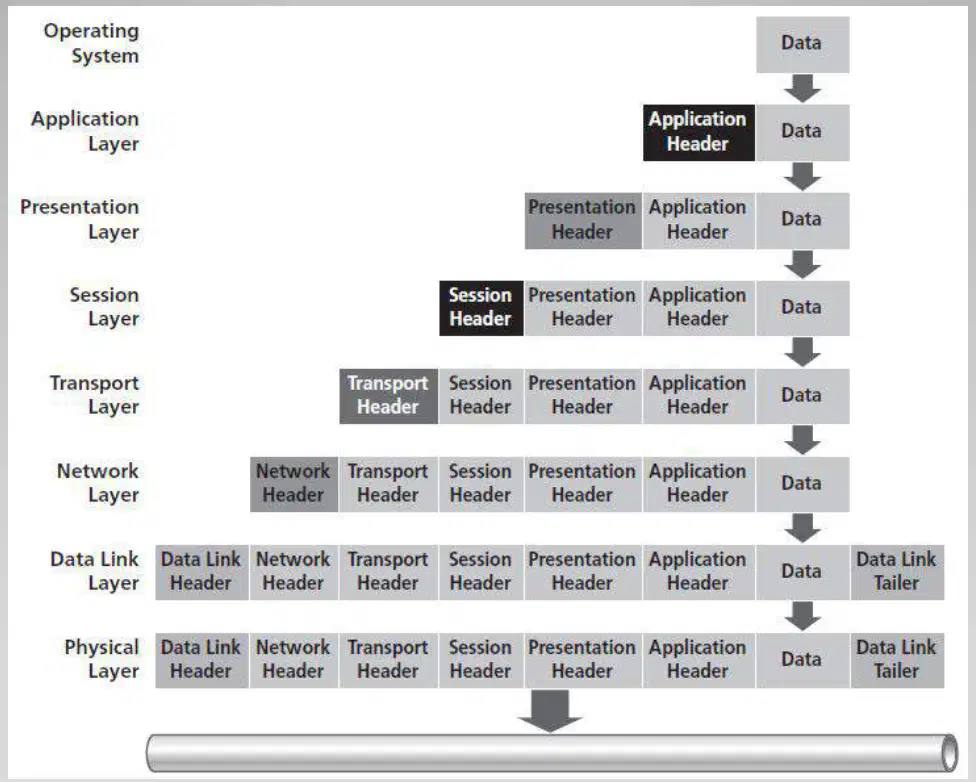
In the first diagram, which OSI layer is shown as the first to add a header to the raw application data when moving downward?
Transport layer adds first header
Network layer adds first header
Session layer adds first header
Application layer adds first header
According to the diagrams, which pair of fields is unique to the Data Link layer encapsulation at the bottom of the stack?
Data Link header and trailer
Transport header and checksum
Session header and trailer
Network header and trailer
When data is sent from one computer to another, how do the headers behave on the receiving side as the data ascends the OSI stack?
Headers are added at each layer
Headers remain unchanged at all layers
Headers are stripped off layer by layer
Headers are converted into trailers
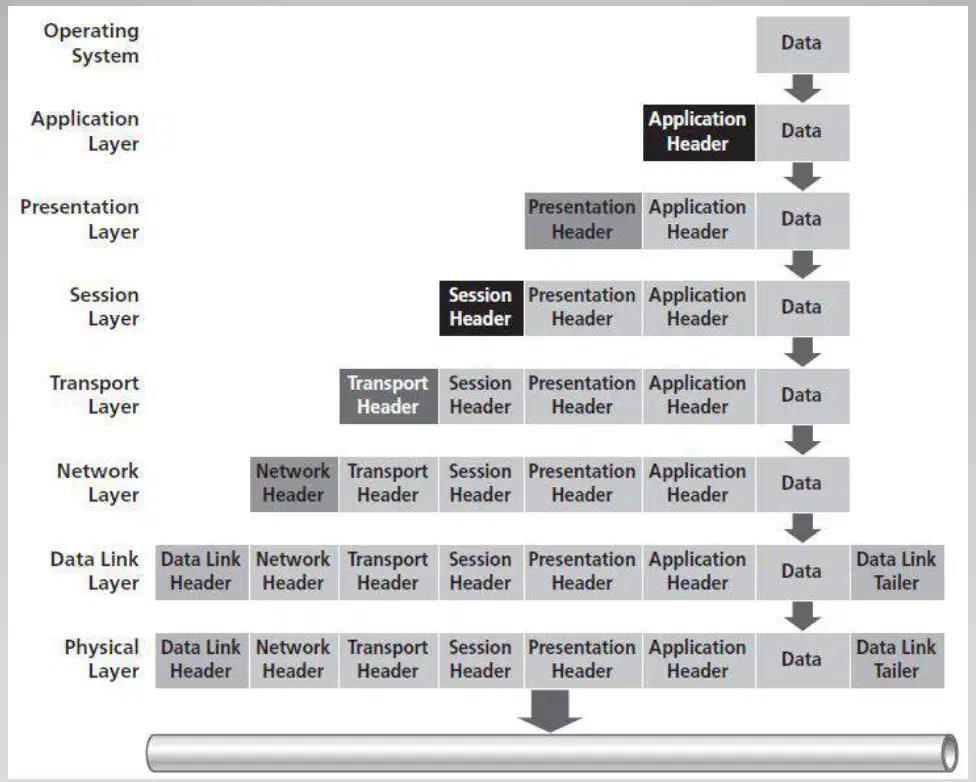
Which sequence correctly represents the order of encapsulation headers added when moving from the Session layer down to the Physical layer in the first diagram?
Session, Presentation, Application, Transport, Network, Data Link
Transport, Network, Data Link, Physical, Presentation, Application
Application, Presentation, Session, Transport, Network, Physical
Session, Presentation, Application, Transport, Network, Data Link
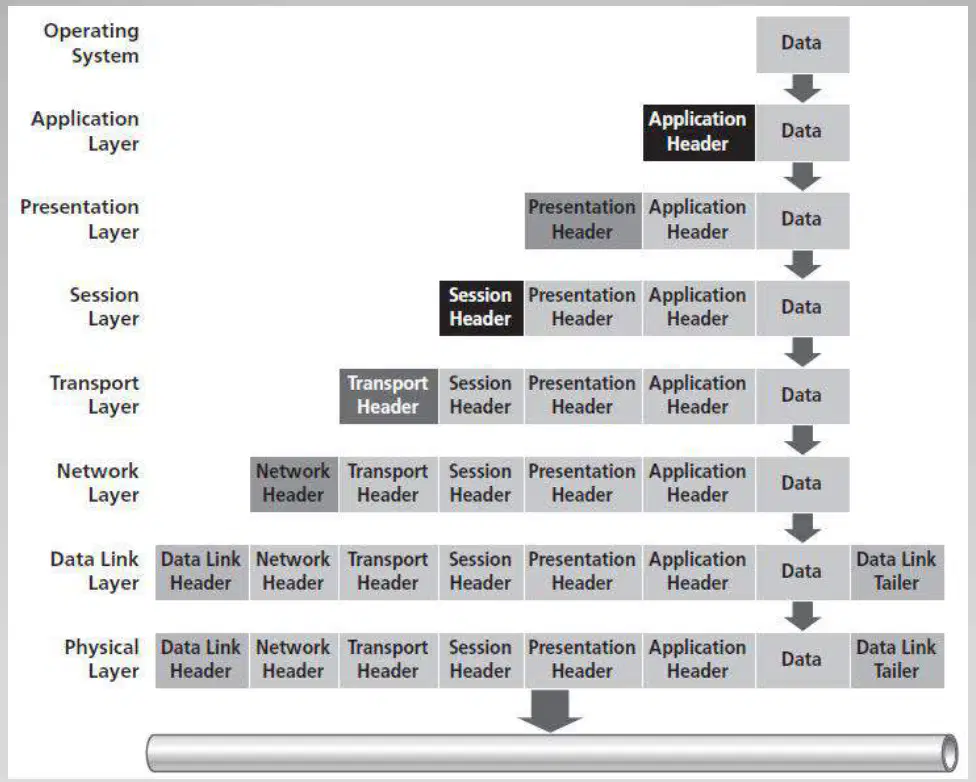
If a corruption is detected at the Data Link layer on the sending side, which component in the diagram most likely contains the integrity information used for detection?
Network header includes parity fields
Transport header provides integrity bits
Session header holds checksum metadata
Data Link trailer carries Frame Check Sequence
In the second diagram, what structural difference distinguishes the sending side from the receiving side with respect to header accumulation?
Both sides accumulate headers upward through the stack
Sending side accumulates headers downward; receiving side removes headers upward
Both sides remove headers downward through the stack
Receiving side adds trailers first, then headers
Which statement best defines a protocol suite in networking?
A hardware specification for network cards
A layered diagram without real protocols
A single protocol for one vendor only
A large set of related protocols working together
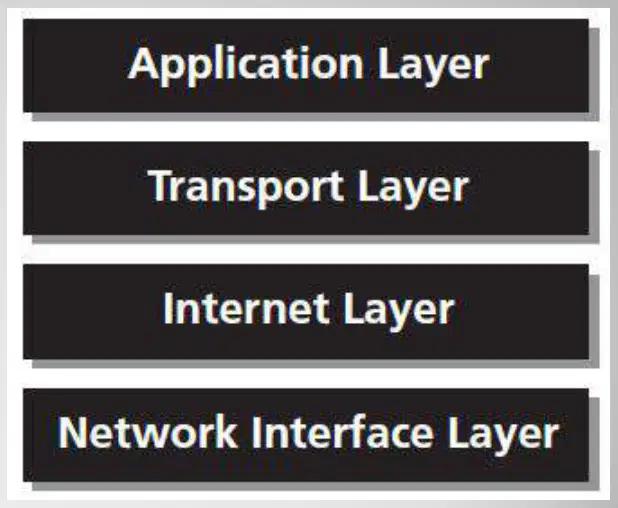
Which four layers are commonly shown in the TCP/IP model?
Application, Session, Network, Physical
Network, Data Link, Transport, Presentation
Application, Transport, Internet, Network Interface
Presentation, Session, Data Link, Physical
At which TCP/IP layer do IP addressing and routing primarily occur?
Application layer for user services
Network Interface layer for cabling
Transport layer for flow control
Internet layer for logical addressing
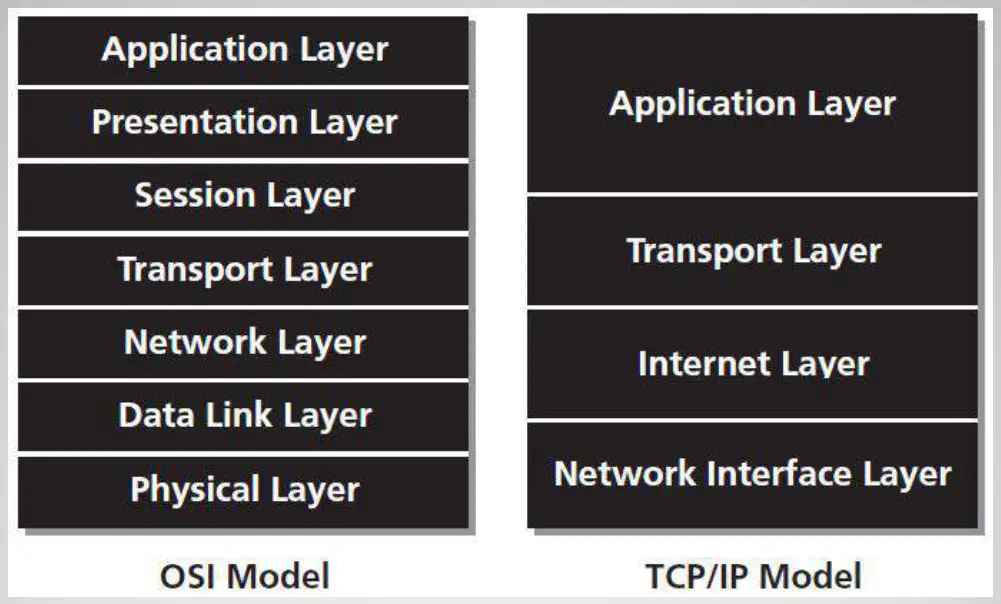
Which TCP/IP layer most closely corresponds to the OSI Data Link and Physical layers combined?
Network Interface layer mapping to OSI lower two
Application layer mapping to OSI Application
Internet layer mapping to OSI Network
Transport layer mapping to OSI Transport
Select the best reason why OSI and TCP/IP layers with the same names may not function exactly the same.
They only define hardware specifications for cables
They omit addressing and encapsulation concepts
They use identical protocols across all layers
They were designed by different committees and eras
Which pairing correctly matches an OSI layer with its closest TCP/IP counterpart?
OSI Transport to TCP/IP Internet
OSI Physical to TCP/IP Internet
OSI Network to TCP/IP Transport
OSI Application to TCP/IP Application
You are troubleshooting unreliable data delivery. Which TCP/IP layer’s services should you analyze first?
Network Interface layer for user authentication
Transport layer for segmentation and reliability
Application layer for formatting and content
Internet layer for cabling and signals
A new protocol is proposed to manage how frames are placed on Ethernet. Which TCP/IP layer should it belong to?
Application layer for end-user programs
Transport layer for port multiplexing
Internet layer for path selection
Network Interface layer for media access
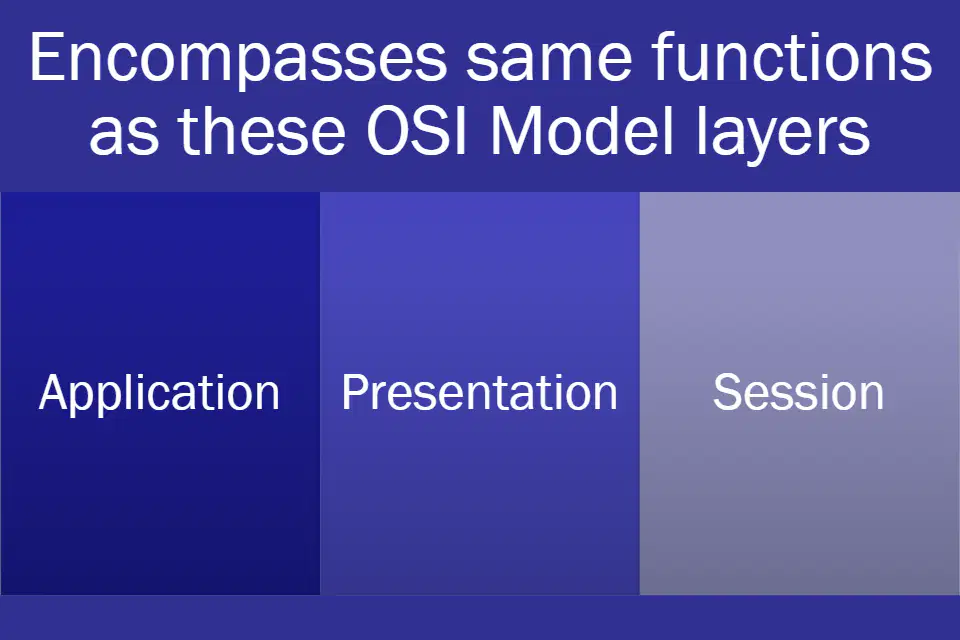
Which TCP/IP layer combines the roles of the OSI Application, Presentation, and Session layers?
Internet layer in TCP/IP
Application layer in TCP/IP
Link layer in TCP/IP
Transport layer in TCP/IP
In the TCP/IP model, which layer provides end-to-end communication and takes on some session setup responsibilities?
Application layer
Network Interface layer
Internet layer
Transport layer
Which protocol is identified as the primary protocol of the TCP/IP Internet layer?
Transmission Control Protocol
Address Resolution Protocol
Internet Protocol
User Datagram Protocol
What function does ARP perform relative to OSI layers, as described for the TCP/IP Internet layer?
Replicates physical layer signaling
Performs much of LLC sublayer addressing
Implements network layer routing decisions
Handles end-to-end flow control
Which TCP/IP layer is responsible for logical addressing and routing, while overlapping some Data Link functions?
Internet layer
Network Interface layer
Transport layer
Application layer
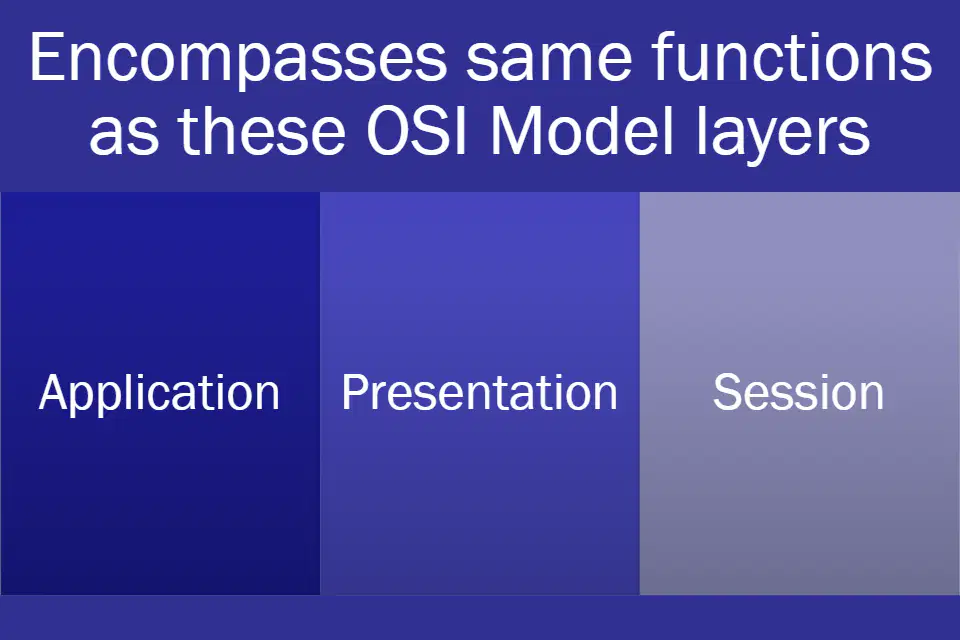
The TCP/IP Application layer encompasses which OSI model functionalities?
Segmentation and reliable delivery
Data formatting and session control
Signal encoding and media access
Routing and logical addressing
According to the material, what additional role can TCP take beyond transport duties?
Partial session establishment
Media access arbitration
Application data compression
Physical addressing resolution
Which TCP/IP layer corresponds to OSI Network layer functions?
Link
Application
Internet
Transport
Which statement best describes the Transport layer’s synchronization activity mentioned?
Synchronizes applications for data formatting
Synchronizes routers for path selection
Synchronizes source and destination computers
Synchronizes NICs for media access
Which pair correctly matches protocol to its TCP/IP layer from the slides?
ARP — Application layer
IP — Internet layer
UDP — Link layer
TCP — Internet layer
Which TCP/IP layer is also referred to as the Link or Network Interface layer?
Internet
Link
Application
Transport
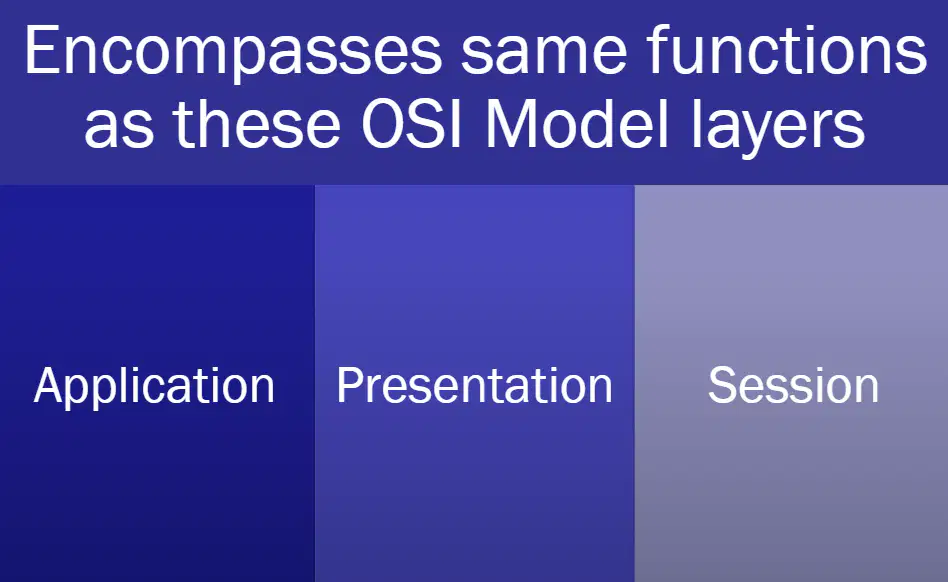
Why does the TCP/IP Application layer not separate presentation and session functions?
Because ARP replaces them at lower layers
Because those functions are combined within applications
Because transport protocols always manage them completely
Because routing handles them implicitly

