
 Worksheets
Temperature and Heat Transfer Quiz
Total questions: 85
Worksheet time: 43mins
What is temperature a measure of?
The amount of light a body emits
The 'hotness' of a body
The color of a body
The size of a body
Why is the temperature sense by touch considered unreliable for scientific purposes?
It is always accurate
It has a limited range and is subjective
It can measure very high temperatures
It is the only way to measure temperature
What is the form of energy transferred between two or more systems or a system and its surroundings by virtue of temperature difference?
Light
Sound
Heat
Electricity
Which SI unit is used to express the amount of heat energy transferred?
Watt (W)
Joule (J)
Kelvin (K)
Celsius (°C)
What are the two commonly used temperature scales mentioned in the text?
Kelvin and Rankine
Fahrenheit and Celsius
Celsius and Newton
Fahrenheit and Kelvin
What are the freezing and boiling points of water on the Fahrenheit scale?
0°F and 100°F
32°F and 212°F
0°F and 212°F
32°F and 100°F
How many equal intervals are there between reference points on the Celsius scale?
180
100
212
32
What is the equation for converting Celsius temperature (t_C) to Fahrenheit temperature (t_F)?
t_F = t_C + 32
t_F = (t_C × 180/100) + 32
t_F = (t_C × 9/5) + 32
t_F = (t_C × 5/9) + 32
Which law states that at constant temperature, the pressure and volume of a quantity of gas are related as PV = constant?
Charles's law
Boyle's law
Newton's law
Avogadro's law
Who discovered the law that relates pressure and volume of a gas at constant temperature?
Jacques Charles
Isaac Newton
Robert Boyle
Albert Einstein
What is the relationship known as Charles's law?
PV = constant
V/T = constant
P/T = constant
P/V = constant
What is the value of absolute zero in Celsius?
0°C
-273.15°C
100°C
-100°C
Which equation represents the ideal-gas law?
PV = μRT
PV = RT
PV = T/μR
PV = μR/T
What is the value of the universal gas constant R?
8.31 J mol⁻¹ K⁻¹
273.15 J mol⁻¹ K⁻¹
100 J mol⁻¹ K⁻¹
1.00 J mol⁻¹ K⁻¹
Which scientist is the Kelvin temperature scale named after?
Isaac Newton
Lord Kelvin
Albert Einstein
James Joule
What does the straight line in a pressure versus temperature graph for a low-density gas at constant volume indicate?
Pressure is independent of temperature
Pressure is directly proportional to temperature
Pressure decreases with temperature
Pressure remains constant
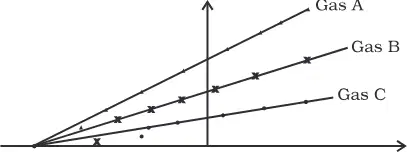
What does the extrapolation of the pressure versus temperature lines for low-density gases indicate?
The same boiling point
The same absolute zero temperature
The same melting point
The same critical temperature
How are temperatures on the Kelvin and Celsius scales related?
T = tc + 100
T = tc + 273.15
T = tc - 273.15
T = tc × 273.15
Why is absolute zero considered the foundation of the Kelvin temperature scale?
It is the boiling point of water
It is the freezing point of water
It is the lowest possible temperature
It is the average temperature of gases
If a constant-volume gas thermometer is used, what does the temperature reading depend on?
Volume of the gas
Pressure of the gas
Mass of the gas
Color of the gas
A student wants to convert 25°C to Kelvin. What is the correct temperature in Kelvin?
273.15 K
298.15 K
25 K
248.15 K
Which term describes the expansion in length of a substance when its temperature increases?
Linear expansion
Area expansion
Volume expansion
Thermal contraction
According to Table 10.1, which material has the highest coefficient of linear expansion (αₗ) among the listed materials?
Aluminium
Brass
Copper
Glass (pyrex)
If the fractional change in length of a rod is given by Δl/l = αₗΔT, what does αₗ represent?
Coefficient of linear expansion
Coefficient of area expansion
Coefficient of volume expansion
Coefficient of thermal conductivity
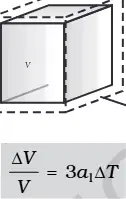
Which equation correctly represents the fractional change in volume due to temperature change?
ΔV/V = 3αₗΔT
ΔV/V = αₗΔT
ΔV/V = 2αₗΔT
ΔV/V = α_vΔT
Why does a fully inflated balloon shrink when immersed in cold water?
Due to contraction of the air inside
Due to expansion of the air inside
Due to increase in pressure
Due to loss of air
Based on the graph in Fig. 10.6, what happens to the coefficient of volume expansion (α_v) of copper at high temperatures?
It becomes constant
It decreases rapidly
It increases rapidly
It fluctuates randomly
Copper expands about five times more than glass for the same rise in temperature. What does this indicate about their coefficients of linear expansion?
Copper has a much higher coefficient than glass
Glass has a much higher coefficient than copper
Both have equal coefficients
Both have very low coefficients
Which of the following statements is true regarding the thermal expansion of metals compared to glass?
Metals generally have higher coefficients of linear expansion than glass
Glass expands more than metals for the same temperature rise
Metals and glass have equal coefficients of expansion
Metals do not expand with temperature
What is the formula for the coefficient of volume expansion (α_v) as given in the text?
α_v = (ΔV/V) × (1/ΔT)
α_v = (ΔV/V) × ΔT
α_v = (ΔT/V) × ΔV
α_v = (ΔV/ΔT) × V
Which material has the highest coefficient of volume expansion according to Table 10.2?
Water
Aluminium
Alcohol (ethanol)
Mercury
What is the value of the coefficient of volume expansion (α_v) for glass (ordinary)?
2.5 × 10⁻⁵ K⁻¹
1 × 10⁻⁵ K⁻¹
7 × 10⁻⁵ K⁻¹
18.2 × 10⁻⁵ K⁻¹
Why does water have its maximum density at 4°C?
Because its volume is minimum at 4°C
Because its temperature is maximum at 4°C
Because its coefficient of volume expansion is zero at 4°C
Because it freezes at 4°C
What environmental effect does the maximum density of water at 4°C have?
It causes lakes to freeze from the top first
It causes lakes to freeze from the bottom first
It increases the temperature of lakes
It decreases the density of lakes
For an ideal gas, how can the coefficient of volume expansion at constant pressure be found?
Using the equation α_v = ΔV/V
Using the equation α_v = 1/T
Using the equation α_v = μRT
Using the equation α_v = P/V
At 0°C, what is the value of the coefficient of volume expansion (α_v) for an ideal gas?
3.7 × 10⁻³ K⁻¹
3300 × 10⁻⁶ K⁻¹
7 × 10⁻⁵ K⁻¹
2 × 10⁻⁶ K⁻¹
What does the graph of volume of one kg of water versus temperature indicate about water at 4°C?
Water has its minimum volume at 4°C
Water has its maximum volume at 4°C
Water freezes at 4°C
Water boils at 4°C
According to the density versus temperature graph, at what temperature does water reach its maximum density?
0°C
4°C
10°C
100°C
What is the simple relation between the coefficient of volume expansion (α_v) and the coefficient of linear expansion (α_l) for a cube that expands equally in all directions?
α_v = α_l / 3
α_v = 2α_l
α_v = 3α_l
αv=αl2
If the temperature of a rod increases by ΔT and its length increases by Δl, what is the formula for the change in volume (ΔV) of the rod?
ΔV = lΔl
ΔV = 3Vα_lΔT
ΔV = VΔT
ΔV = α_lΔl
What is the coefficient of area expansion (α_r) of a rectangular sheet of solid in terms of its linear expansivity (α_l)?
α_r = α_l / 2
α_r = 2α_l
αr=αl2
α_r = 3α_l

When the temperature of a rectangular sheet increases by ΔT, how does the increase in area (ΔA) relate to the changes in length and breadth?
ΔA = aΔb + bΔa
ΔA = aΔa + bΔb
ΔA = abΔT
ΔA = ΔaΔb
A steel rail of length 5 m and cross-section 40 cm² is prevented from expanding while the temperature rises by 10°C. If the coefficient of linear expansion of steel is 1.2 × 10⁻⁵ K⁻¹, what is the strain developed in the rail?
1.2 × 10⁻⁴
1.2 × 10⁻⁵
1.2 × 10⁻³
1.2 × 10⁻²
What is the formula for the thermal stress developed in a steel rail when its expansion is prevented?
ΔF = Y_steel × (Δl / l)
ΔF = Y_steel × (ΔT / l)
ΔF = Y_steel × (Δl × l)
ΔF = Y_steel × ΔT
A blacksmith fixes an iron ring on the rim of a wooden wheel. The diameter of the rim and the iron ring are 5.243 m and 5.231 m, respectively, at 27°C. To what temperature should the ring be heated so as to fit the rim of the wheel? (Given α_l = 1.20 × 10⁻⁵ K⁻¹)
100°C
218°C
27°C
300°C
What is the SI unit of specific heat capacity?
J kg⁻¹ K⁻¹
J mol⁻¹ K⁻¹
kg J⁻¹ K⁻¹
K J⁻¹ kg⁻¹
If the amount of substance is specified in terms of moles (μ) instead of mass (m), what is the specific heat capacity called?
Molar specific heat capacity
Latent heat
Thermal conductivity
Heat of fusion
Which formula correctly represents the heat capacity (S) of a substance?
S = ΔQ / ΔT
S = m × ΔT / ΔQ
S = ΔT / ΔQ
S = ΔQ × ΔT
When the gas is held under constant pressure during heat transfer, what is the molar specific heat capacity called?
Cₚ
Cᵥ
S
Q
Suppose you double the amount of water and heat it using the same heating arrangement. What happens to the time required to raise the temperature by the same amount?
It remains the same.
It doubles.
It halves.
It becomes four times.
Which of the following is NOT a factor that affects the quantity of heat required to raise the temperature of a substance?
Mass of the substance
Change in temperature
Nature of the substance
Color of the substance
If the volume of a gas is maintained during heat transfer, what is the molar specific heat capacity called?
Molar specific heat capacity at constant volume (Cᵥ)
Molar specific heat capacity at constant pressure (Cₚ)
Latent heat
Heat of vaporization
Given the formula s = (1/m) × (ΔQ/ΔT), what does 's' represent?
Specific heat capacity
Molar mass
Temperature change
Heat supplied
Which substance has the highest specific heat capacity at room temperature and atmospheric pressure?
Water
Aluminium
Carbon
Lead
What is the specific heat capacity of copper at room temperature and atmospheric pressure?
386.4 J kg⁻¹K⁻¹
506.5 J kg⁻¹K⁻¹
127.7 J kg⁻¹K⁻¹
236.1 J kg⁻¹K⁻¹
Which of the following gases has the highest molar specific heat capacity at constant pressure (Cp)?
CO₂
O₂
N₂
He
What is the main function of a calorimeter?
To measure heat transfer between bodies
To measure temperature only
To measure pressure changes
To measure volume changes
In the example provided, why is the heat given by the aluminium sphere equal to the heat absorbed by the water and calorimeter at steady state?
Because the system is isolated and no heat escapes to the surroundings
Because aluminium has a low specific heat capacity
Because water is a good conductor of heat
Because the temperature of the sphere is always higher than the water
A sphere of 0.047 kg aluminium is placed in boiling water and then transferred to a calorimeter. If the initial temperature of the sphere is 100°C and the final temperature is 23°C, what is the change in temperature?
77°C
123°C
47°C
100°C
What is the purpose of the outer jacket in a calorimeter?
To reduce heat loss from the inner vessel
To increase the temperature of the system
To measure the pressure inside the calorimeter
To stir the contents of the vessel
What is the specific heat capacity of water as given in the document?
4.18 × 10³ J kg⁻¹ K⁻¹
0.386 × 10³ J kg⁻¹ K⁻¹
1.00 × 10³ J kg⁻¹ K⁻¹
2.00 × 10³ J kg⁻¹ K⁻¹
Which process describes the change of state from solid to liquid?
Melting or fusion
Freezing
Condensation
Sublimation
What is the phenomenon called when a wire passes through an ice slab and the ice refreezes above the wire?
Regeneration
Regeling
Regeneration
Regelation
What does the flat portion of the temperature vs. time graph represent when heating ice?
The temperature is increasing rapidly.
The ice is melting and temperature remains constant.
The ice is freezing and temperature drops.
The water is boiling.
What is the process called when a substance changes from liquid to vapour and the temperature remains constant until the entire liquid is converted?
Fusion
Sublimation
Vaporisation
Condensation
At what temperature and pressure is the triple point of water represented?
100 K and 1 atm
273.16 K and 6.11×10⁻³ Pa
0 K and 0 Pa
374 K and 218 atm
Which curve on a phase diagram represents the states in which solid and vapour phases coexist?
Fusion curve
Vaporisation curve
Sublimation curve
Boiling curve
Which phase region is NOT separated by the fusion curve in a pressure-temperature phase diagram?
Solid region
Liquid region
Vapour region
Plasma region
What happens to the boiling point of water when the pressure on the water surface inside a flask is decreased?
The boiling point increases
The boiling point remains the same
The boiling point decreases
The boiling point fluctuates randomly
What is the term used for the boiling point of a substance at standard atmospheric pressure?
Sublimation point
Normal boiling point
Melting point
Freezing point
Which process describes the change of a substance from solid to vapour state without passing through the liquid state?
Condensation
Evaporation
Sublimation
Fusion
Why does cooking take longer at high altitudes?
Atmospheric pressure is higher, increasing boiling point
Atmospheric pressure is lower, decreasing boiling point
Temperature is higher, increasing boiling point
Water freezes faster at high altitudes
During the sublimation process, what states of a substance coexist in thermal equilibrium?
Solid and liquid
Liquid and gas
Solid and vapour
Liquid and plasma
If the steam outlet of a boiling flask is closed, what must be done to resume boiling?
Lower the temperature
Increase the pressure
Raise the temperature
Add more water
Explain why dry ice (solid CO₂) is used as an example of sublimation.
It melts into liquid before becoming gas
It changes directly from solid to vapour
It remains solid at room temperature
It dissolves in water easily
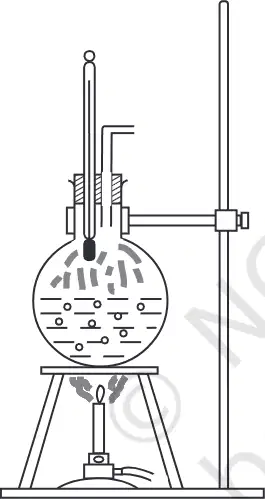
Boiling process: A flask with water, thermometer, and steam outlet, showing bubbles forming and rising as water boils.
The water is boiling and bubbles are forming and rising.
The water is freezing and ice is forming at the bottom.
The water is evaporating without any bubbles forming.
The water is condensing and droplets are forming on the outside.
Which substance has the highest latent heat of fusion (Lf) at 1 atm pressure according to Table 10.5?
Water
Gold
Lead
Oxygen
What is the boiling point of Mercury at 1 atm pressure?
357°C
1744°C
78°C
100°C
What is the SI unit of latent heat?
J kg⁻¹
W m⁻²
kg m⁻³
J s⁻¹
Which term refers to the latent heat required for a solid-liquid state change?
Latent heat of fusion
Latent heat of vaporisation
Specific heat
Boiling heat
If 0.15 kg of ice at 0°C is mixed with 0.30 kg of water at 50°C, and the final temperature is 6.7°C, what is the latent heat of fusion of ice calculated in Example 10.4?
3.34 × 10⁵ J kg⁻¹
2.1 × 10⁵ J kg⁻¹
8.5 × 10⁵ J kg⁻¹
1.0 × 10⁵ J kg⁻¹
Why are burns from steam usually more serious than those from boiling water?
Steam has a higher latent heat of vaporisation than boiling water.
Steam is colder than boiling water.
Steam contains less energy than boiling water.
Steam is less dense than boiling water.
What does the equation Q = mL represent in the context of change of state?
The quantity of heat required for a substance to change state
The pressure exerted by a substance
The temperature at which a substance boils
The density of a substance
What is the latent heat of vaporisation (Lv) of water at 1 atm pressure?
22.6 × 10⁵ J kg⁻¹
8.67 × 10⁵ J kg⁻¹
2.7 × 10⁵ J kg⁻¹
1.0 × 10⁵ J kg⁻¹
Which physical quantity is plotted on the y-axis in Fig. 10.12?
Temperature (°C)
Heat (J)
Pressure (atm)
Volume (L)

