
 Worksheets
FA2/CP1/FQ3: Respiratory & circulatory systems
Total questions: 27
Worksheet time: 30mins
Which equation best represents aerobic respiration at the cellular level?
Glucose + oxygen → carbon dioxide + water + ATP
Glucose → lactic acid + ATP + oxygen
Oxygen + water → glucose + carbon dioxide + ATP
Carbon dioxide + water → glucose + oxygen + ATP
Fill in the blank: The diaphragm contracts and moves downward during (a) , increasing thoracic volume and drawing air into the lungs.
Which sequence correctly traces airflow from entry to the site of gas exchange?
Nasal cavity → larynx → trachea → bronchi → bronchioles → alveoli
Mouth → pharynx → esophagus → bronchi → alveoli → capillaries
Pharynx → larynx → alveoli → bronchi → bronchioles → capillaries
Nasal cavity → trachea → esophagus → bronchioles → alveoli
Which statement best explains why oxygen diffuses from alveoli into blood?
Alveoli actively pump oxygen against its gradient into capillaries
Red blood cells release oxygen to increase alveolar concentration
Blood oxygen partial pressure is higher than alveolar oxygen partial pressure
Alveolar oxygen partial pressure is higher than blood oxygen partial pressure
During forced expiration after exercise, which muscular action most directly pushes air out of the lungs?
Relaxation of the diaphragm and contraction of internal intercostals
Contraction of the diaphragm and relaxation of external intercostals
Contraction of external intercostals and diaphragm together
Relaxation of internal intercostals and abdominal muscles
Which gas shows the greatest percentage decrease from atmospheric air to alveolar expired air?
Water decreases slightly from 0.04% to 0.02%
Oxygen decreases markedly from 21% to 14%
Nitrogen decreases slightly from 78% to 75%
Carbon dioxide decreases from 0.004% to 0.001%
Fill in the blank: At rest, adults typically breathe approximately (a) times per minute, drawing in about 12 L of air each minute.
Match each lung volume or capacity to its description.
Tidal volume (TV)
Air moved in a normal breath
Inspiratory reserve volume (IRV)
Extra air inhaled after a normal inhale
Expiratory reserve volume (ERV)
Extra air exhaled after a normal exhale
Residual volume (RV)
Air remaining after maximal exhale
Vital capacity (VC)
Maximal air exhaled after maximal inhale
During sustained aerobic training over months, which combination of respiratory adaptations is most likely?
Lower ventilation rate at any exercise intensity
Increased ventilation muscle strength and larger lung volume
Decreased capillary density and reduced gas exchange efficiency
Fewer alveoli with lower oxygen uptake potential
Explain how and why ventilation rate and depth change from rest to vigorous exercise, and estimate the total volume of air moved per minute at both intensities using provided values.
Fill in the blank: The straw-coloured liquid that makes up about 55% of blood volume and transports formed elements is (a) .
A patient has reduced platelet count but normal red and white blood cell counts. Predict the most immediate physiological consequence and justify your reasoning.
Match each heart valve to the chambers or vessel it connects.
Tricuspid valve
Right atrium to right ventricle
Mitral (bicuspid) valve
Left atrium to left ventricle
Aortic valve
Left ventricle to aorta
Pulmonary valve
Right ventricle to pulmonary artery
Explain how oxygenated and deoxygenated blood flow differs between the pulmonary artery and pulmonary vein, and identify their destinations.
A patient has a stenosis that limits opening of the mitral (bicuspid) valve. Which immediate hemodynamic consequence is most likely?
Backflow from aorta into left ventricle during systole
Impaired flow from left atrium to left ventricle during diastole
Reduced filling of the right ventricle during diastole
Reduced ejection from right ventricle into pulmonary artery during systole
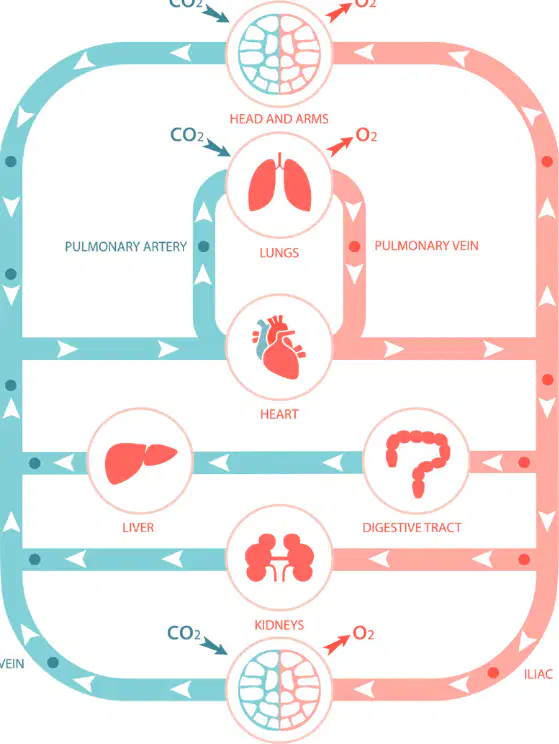
Which statement best distinguishes systemic circulation from pulmonary circulation?
Pulmonary carries oxygenated blood to body tissues; systemic carries deoxygenated blood to the lungs
Systemic carries oxygenated blood to body tissues; pulmonary carries deoxygenated blood to the lungs
Which feature most directly increases the rate of gaseous exchange in alveoli by providing more contact between air and blood?
Strong muscular walls in bronchi and trachea
Large surface area from many alveoli and capillaries
High blood viscosity for slower capillary transit
Equal pressures between air and capillary blood
Dry alveolar lining to prevent fluid buildup
Fill in the blank: In external respiration, oxygen diffuses from the alveoli into the blood because of a (a) between alveolar air and capillary blood.
An athlete from sea level experiences reduced aerobic capacity and faster fatigue during competition at 2,500 m. Explain the physiological reasons for these changes and how training at altitude over weeks could modify their performance upon returning to sea level.
Anaemia most directly lowers the blood’s (a) .
Describe how haemoglobin levels influence oxygen transport and fatigue during exercise.
Which option correctly orders the loop of blood flow starting with oxygenated blood in the left ventricle?
Right ventricle → lungs → left atrium → left ventricle → aorta
Lungs → left atrium → left ventricle → aorta → body
Aorta → body → venae cavae → right heart → lungs → left heart
Body → right atrium → right ventricle → lungs → left atrium
Match each blood vessel type to its primary feature.
Artery
Thick walls, carry blood from heart
Vein
Return blood with valves to heart
Capillary
Thin walls for exchange
Arteriole
Small vessel controlling flow
During inhalation at rest, which sequence best describes the mechanics of breathing?
Diaphragm contracts downward; thoracic volume increases
Diaphragm relaxes upward; thoracic volume increases
Intercostals relax; lung pressure decreases
Lung volume decreases; air is drawn in
Explain one way movement increases respiratory demand during exercise.
At high altitude, what initial change in the cardiorespiratory system helps maintain oxygen delivery?
Reduced red blood cell production
Immediate rise in haemoglobin concentration
Decreased heart rate at submax effort
Increased ventilation rate and depth
Label the heart

