
NEW
Font size
 Worksheets
Untitled Quiz
Total questions: 12
Worksheet time: 36mins
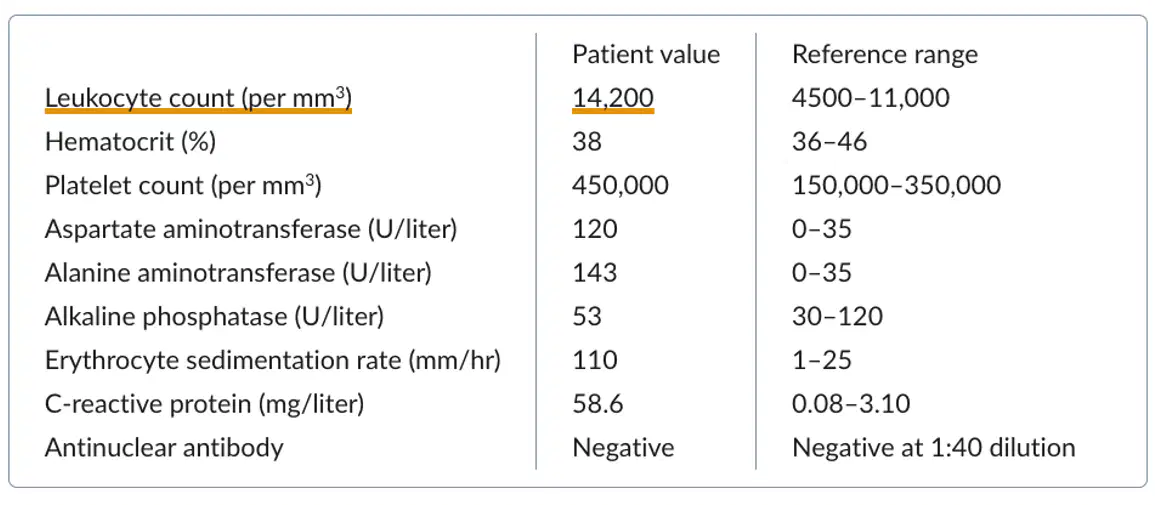
A 43-year-old woman who has a history of rheumatoid arthritis with erosive arthritis reports a one-week history of daily fever up to 38.9°C, pleuritic chest discomfort, myalgias, and a new erythematous rash on her face. She states that she does not have increased joint pain or morning stiffness. For the past year, she has taken methotrexate 20 mg orally and etanercept 50 mg subcutaneously, both once weekly, with good effect. Daily folic acid is her only other medication.
Physical examination is notable for a malar rash and decreased breath sounds at both lung bases. Joint examination shows no evidence of active synovitis. Her skin is otherwise clear, and she has no oral ulcerations. An antinuclear antibody assay is positive, at a titer of 1:640, as is a test for anti-double-stranded DNA antibodies. An anti-histone antibody test is negative.Which one of the following diagnoses is most likely in this patient?
A)Rheumatoid arthritis flare
B)Lymphoma
C)Systemic lupus erythematous
D)Drug-induced lupus
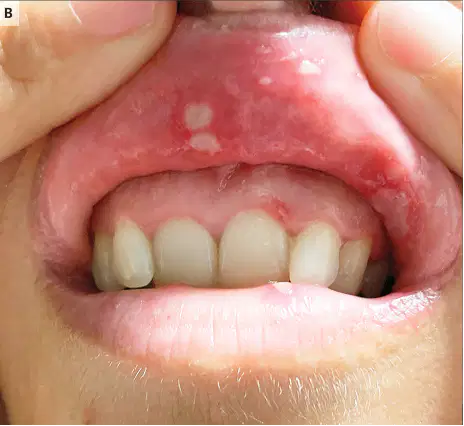
A 54-year-old woman with a history of deep-vein thrombosis and uveitis presents with pain and burning in the genital area that started 2 weeks ago. One week before the onset of those symptoms, she noticed multiple painful oral lesions on her tongue, buccal mucosa, and soft palate. She reports that she has had similar lesions 3 to 5 times per year for the past several years. Her intake of food and fluids has not been affected.
Physical examination reveals several aphthous ulcers on the tongue, buccal mucosa (figure), and labia majora. A swab for herpes simplex virus of the current buccal-mucosa lesion is negative. Laboratory work reveals an antinuclear antibody titer of 1:40 and negative findings for anti-double-stranded DNA, anti-Smith, and HIV antibodies.The patient is treated with oral prednisone 0.5 mg/kg. The lesions resolve, and she tapers off prednisone over the next 4 weeks.
Which one of the following treatments is most appropriate for preventing recurrence of this patient’s genital lesions?
A)Acyclovir
B)Prednisolone
C)Hydroxychloroquine
D)Colchicine
A 35-year-old woman who underwent a kidney transplant 5 years ago presents with a chief complaint of pain and swelling in the first metatarsophalangeal joint. She first experienced the pain yesterday upon waking; today, it has worsened to the point where she cannot walk. The patient has no history of trauma and no family history of arthritis or crystalline arthropathy. Her current daily medications are losartan 50 mg, cyclosporine 400 mg, azathioprine 100 mg, prednisone 5 mg, and vitamin D supplementation 250 μg (10,000 IU).
Physical examination reveals erythema, swelling, tenderness, and decreased range of motion of the first metatarsophalangeal joint. Fluid aspirated from that joint contains monosodium urate crystals; Gram stain and cultures are negative. Laboratory testing is notable for a uric acid level of 10.4 mg/dL (reference range, 1.5–6.0) and a creatinine level of 1.5 mg/dL (0.6–1.1). Which one of this patient’s medications is most likely contributing to her hyperuricemia?
A)Azathioprine
B)Cyclosporin
C)Prednisolone
D)Losartan
An 18-year-old woman reports a 3-week history of fevers. The fevers typically occur once daily, range between 38.9°C and 40°C, and resolve spontaneously. Two weeks ago, the patient noted the onset of joint pain. Initially, the pain migrated from the right wrist to the left elbow and then to the left knee, but during the past week, she has noted persistent pain in the left wrist, right knee, and right ankle. She reports no illicit drug use and has a monogamous relationship with her boyfriend.
On examination, her temperature is 39.6°C, her heart rate is 98 beats per minute, and her blood pressure is 110/76 mm Hg. Her skin examination is remarkable for a faint, pink rash on her chest. Her right knee and left wrist are warm and swollen.Arthrocentesis of the right knee reveals 25,500 leukocytes (80% polymorphonuclear leukocytes), no crystals, and no organisms. Cultures of blood, synovial fluid, and urine are negative.
Which one of the following laboratory findings is most likely in this patient?
A)Positive Anti-double stranded DNA antibody
B)Elevated serum cryoglobulin
C)Elevated serum ferritin
D)Positive rheumatoid factor
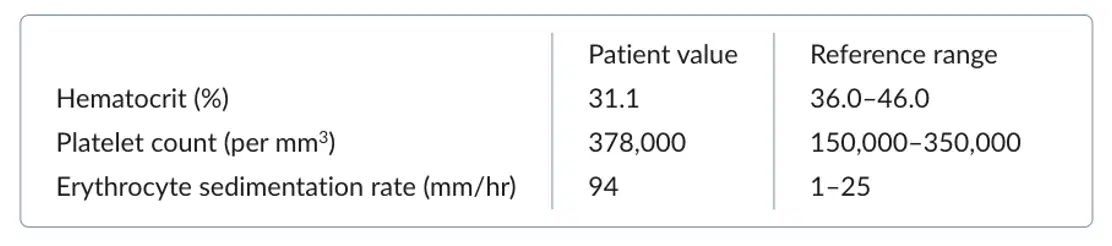
An 80-year-old woman presents to the emergency department after a single episode of transient loss of vision in the right eye that lasted one minute. She also reports fatigue for the past few months. Her vision is currently intact, and her scalp is not tender.
Laboratory testing reveals a normal leukocyte count, normal electrolyte and creatinine levels, and the following other results:
Which one of the following symptoms would most increase the likelihood that this patient has giant-cell arteritis?
A)Jaw claudication
B)Shoulder and hip stiffness
C)Temporal headache
D)Arthralgia
An 82-year-old woman is evaluated for severe left wrist pain of 3 days' duration. She reports no preceding trauma. She has hypertension treated with lisinopril and stage G3 chronic kidney disease.
Vital signs are normal. The left wrist is swollen and tender with decreased range of motion without erythema or warmth.
Left wrist synovial fluid analysis reveals a leukocyte count of 20,000/µL (20 × 109/L) (90% neutrophils) and rhomboid-shaped, weakly positively birefringent crystals within macrophages. Gram stain is negative. Which of the following is the most appropriate treatment?
A)Allopurinol
B)Prednisolone
C)Ibuprofen
D)Methotrexate
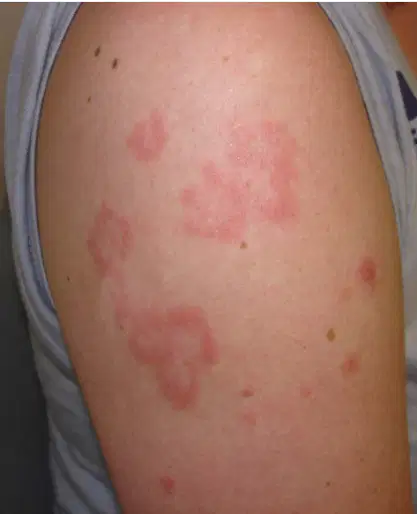
A 40-year-old woman is evaluated for a skin rash and arthralgia temporally related to intense sunlight exposure. She takes hydrochlorothiazide for hypertension.
Skin findings are shown.
Which of the following is the most likely diagnosis for these skin findings?
A)Acute cutaneous lupus erythematosus
B)Chronic discoid lupus erythematosus
C)Polymorphous light eruption
D)Subacute cutaneous lupus erythematosus
A 48-year-old man is evaluated for a 3-week history of cough, joint pain, and muscle weakness.
Skin findings are shown.
Which of the following is the most likely diagnosis?
A) Amyopathic dermatomyositis
B) Anti-synthetase syndrome
C) Immune-mediated necrotizing myopathy
D) Inclusion body myositis
A 51-year-old man is evaluated for worsening mid-back pain 1 day after he tripped at home and fell on his back. He has a 17-year history of ankylosing spondylitis. Medications are etanercept and naproxen.
On physical examination, vital signs are normal. Mild thoracic kyphosis is noted. Point tenderness is present over the 10th, 11th, and 12th thoracic vertebrae. Neurologic examination is normal.
Radiographs of the thoracic spine and lumbar spine show advanced syndesmophyteformation in the thoracolumbar spine and ossification of the spinal ligaments. Which of the following is the most appropriate next step in management?
A) CT of the spine
B) Dual-energy x-ray absorptiometry
C) Physical therapy
D) Switching etanercept to Ustekinumab
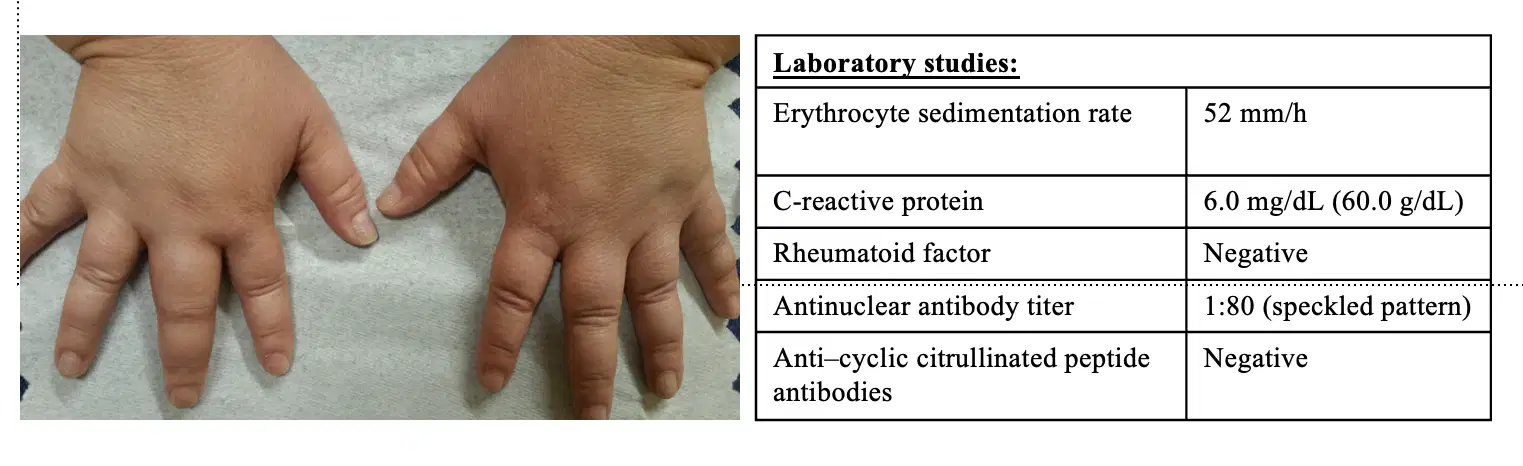
A 31-year-old woman is evaluated for 3 months of pain and swelling in her hands, particularly her right middle finger. Medical history is unremarkable, and she takes no medications. Family history is notable for psoriasis in her mother.
On physical examination, vital signs are normal. Circumferential swelling and tenderness of the right middle finger and small shallow depressions on multiple nails are appreciated. Hand findings are shown. The remainder of the examination is normal. Which of the following is the most likely diagnosis?
A) Erosive osteoarthritis
B) Psoriatic arthritis
C) Rheumatoid arthritis
D) Systemic lupus erythematosus

Which antibody is most commonly associated with these clinical finding, and what screening test should be performed in this patient?
A. Anti-RNP — Echocardiogram
B. Anti-Scl-70 — CT (ILD)
C. Anti-centromere — Echocardiogram
D. Anti-RNA polymerase III — Serum creatinine
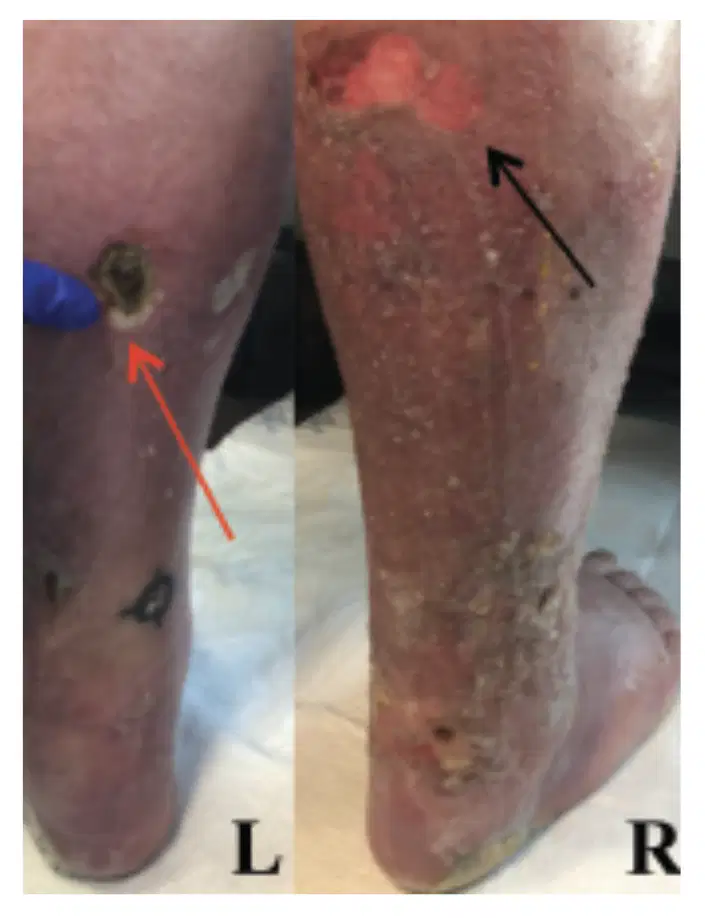
Which combination of investigations is most appropriate for confirming polyarteritis nodosa?
A. ANCA testing and chest CT
B. Renal biopsy and immunofluorescence
C. Skin or nerve biopsy OR angiography showing microaneurysms
D. ESR and CRP levels
E. Urinalysis and serum creatinine

