
 Worksheets
Логика высказываний и побитовые операции
Total questions: 146
Worksheet time: 1hrs 13mins
Let p be a statement. The assertion "it is not true that p " is denoted by
¬p
⊕p
p→¬p
p∧¬p
¬p∨p
Let p and q be statements. The statement that is true if and only if both p and q are true, and false otherwise, is denoted by
p∧q
p∨q
p→q
p↔q
p⊕q
Let p and q be statements. The statement that is false if and only if both p and q are false, and true otherwise, is denoted by
p∨q
p∧q
p→q
p↔q
p⊕q
Let p and q be statements. The statement that is true if and only if exactly one of p and q is true, and otherwise false, is denoted by
p⊕q
p∨q
p→q
p↔q
p∧q
Let p and q be statements. The statement that is false if and only if p is true and q is false, and true in all other cases, is denoted by
p→q
p∨q
p∧q
p↔q
Let p and q be statements. The statement that is true if and only if p and q have the same truth values, and false otherwise, is denoted by
p↔q
p∨q
p→q
p∧q
p⊕q
Which of the following statements is a proposition?
3+2=6
Can you help me?
Take this pencil.
x+2=6
Why should you study discrete mathematics?
Find the converse of the implication p→¬q .
¬q→p
q→¬p
q→p
¬q→¬p
p→q
Find the contraposition of the statement ¬p→q .
¬q→p
q→¬p
p→¬q
¬q→¬p
p→q
Find the bitwise OR for the bit strings 1011 0010 and 0110 0110.
1111 0110
0010 0011
0011 0011
1010 1001
0111 1100
Find the bitwise AND for the bit strings 1010 1010 and 1001 1001.
1000 1000
1011 1011
Find the bitwise XOR for the bit strings (0111 0101) and (1101 0101). Write the result as a binary string with a space after every four bits.
1010 0000
1111 0111
0101 0100
0110 1010
1101 0101
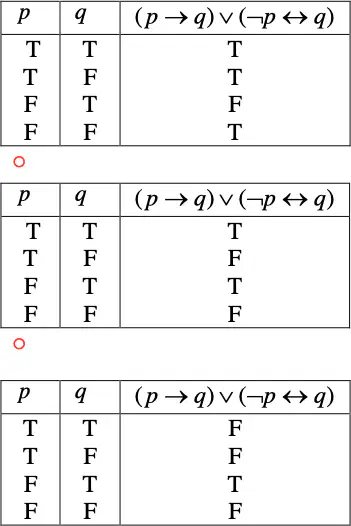
Select the correct truth table for the statement (p → q) ∨ (¬p ↔ q). Each of the five tables is shown in the image; indicate which one is correct.
First option of the table
Second option of the table
Third option of the table
Fourth option of the table
Fifth option of the table
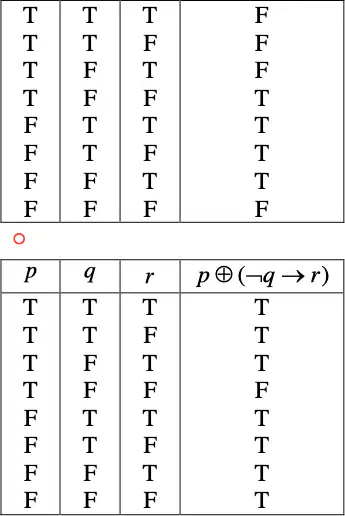
Select the correct truth table for the statement p ⊕ (¬q → r). Each of the five tables is shown in the image; indicate which one is correct.
First option of the table
Second option of the table
Third option of the table
Fourth option of the table
Fifth option of the table
Let p, q, and r be the statements "You get an A on the final exam", "You complete every exercise in this book", and "You get an A in this course" respectively. Write the statement "Getting an A on the final exam and completing every exercise in this book is sufficient to get an A in this course" using p, q, r, and logical connectives.
(p ∧ q) → r
r → (p ∧ q)
(p ∨ q) → r
(p ∧ q) ↔ r
¬r → (¬p ∧ ¬q)
Let p and q be the statements "You get an A on the final exam" and "You get an A in this course" respectively. Write the statement "To get an A in this course, it is necessary to get an A on the final exam" using p, q, and logical connectives.
p → q
q → p
q ↔ p
p ⊕ q
¬p → ¬q
Calculate the expression (101100⊕010101)∧110110 . Present the answer as a binary string with a space after every four bits.
11 0000
11 0100
00 0110
11 1111
01 0101
Find the implication that is false.
If 2+3=5 , then pigs can fly.
If 2+3=6 , then God exists.
If 2+3=4 , then 3+3=5 .
If pigs can fly, then 1+3=5 .
If 2+3=5 , then 1+3=4 .
Let p and q be the statements "The temperature is below zero" and "It is snowing" respectively. Express the statement (p∨q)∧(p→¬q) in English (in Russian translation).
Either below zero or it is snowing, but if it is below zero, then there is no snow.
Either below zero or it is snowing, and snow is falling only if it is below zero.
Either below zero or it is snowing, and if it is snowing, then it is not below zero.
It is below zero, but there is no snow.
If it is below zero, then there is no snow.
Let p and q be the statements "You are failing the final exam" and "You are passing the course" respectively. Express the statement ¬p↔q in English (in Russian translation).
If you are not failing the final exam, then you are passing the course, and vice versa.
If you are not failing the final exam, then you are passing the course, but not vice versa.
You are failing the final exam if and only if you are not passing the course.
You are passing the course only if you are failing the final exam.
If you are passing the course, then you are failing the final exam, and vice versa.
A compound statement is a tautology if
it is always true regardless of the truth values of the statements it contains.
it is always false regardless of the truth values of the statements it contains.
it is always true when each of the statements it contains is true.
it is false only when each of the statements it contains is false.
it is always true when all the statements it contains have the same truth values.
Find the statement that is a tautology: ¬(p∨q)↔(¬p∧¬q) .
¬(p∨q)↔(¬p∧¬q)
(p→q)↔(¬q∨p)
¬(p∨q)↔(p∨q)
(p→q)↔(¬q→p)
(¬p∨¬q)↔(q→p)
Which of the following logical equivalences is the law of distribution?
p∧(q∨r)⇔(p∧q)∨(p∧r)
p∨(q∨r)⇔(p∨q)∨r
p∨q⇔q∨p
p∧(q∧r)⇔p∧(q∧r)
p∧q⇔q∧p
Find the statement that is logically equivalent to ¬p∨¬q .
¬(p∧q)
¬(p∨q)
(p→q)∨(q→p)
¬(p⊕q)
¬p→q
Which implication is logically equivalent to the implication ¬r→s ?
¬s→r
¬s→¬r
r→¬s
s∧r
s→¬r
A statement is contingent if
it is neither a tautology nor a contradiction.
it is both a tautology and a contradiction.
it is not a contradiction.
it is not a tautology.
it is not logically equivalent to any tautology.
Find the compound statement with propositions p, q, and r that is true when p and q are false, and r is true, and false in all other cases.
¬p∧¬q∧r
p∨q∨r
(¬p∧¬q)∨r
(p∧q)∨¬r
(p↔q)∧r
Find the compound statement with propositions p, q, and r that is false when p is false, and q and r are true, and true in all other cases.
p∨¬q∨¬r
¬p∧q∧r
p∧¬q∧¬r
p→¬(q∧r)
¬p∨q∨r
Find the compound statement with propositions p, q, and r that is true when p and q are true, and r is false, and false in all other cases.
p∧q∧¬r
(p∨¬r)∧(q∨¬r)
(p∨q)∧¬r
r→¬(p∧q)
(p∧q)→r
Let P(x) be the statement "x spends less than three hours every weekday in class," and the domain of discourse for x is the set of students. Express the proposition ∃x¬P(x) in English.
There is a student who spends no less than three hours every weekday in class.
Every student doesn’t spend more than three hours every weekday in class.
There is a student who doesn’t spend more than three hours every weekday in class.
There is a student who spends less than two hours every weekday in class.
Every student spends no more than six hours every weekday in class.
Let P(x) be the statement "x can speak Kazakh", and Q(x) be the statement "x knows the Delphi programming language", with the domain of discourse being the set of all students at your university. Express the statement "There exists a student at your university who can speak Kazakh but does not know Delphi" using P(x), Q(x), quantifiers, and logical connectives.
∃x(P(x)∧¬Q(x))
∃x(P(x)∨¬Q(x))
∀x(P(x)→¬Q(x))
∃x(Q(x)→P(x))
∀x(¬P(x)∨Q(x))
Let S(x,y) be the statement "x + 3y = 3x - y", where the domain of discourse for both variables is the set of integers. Which of the following statements is true?
∀y∃xS(x,y)
∀x∀y¬S(x,y)
∀x∃yS(x,y)
∃x∀yS(x,y)
∃y∀xS(x,y)
Rewrite the statement ¬∃y∀xP(x,y) so that negations appear only within predicates (that is, nowhere outside the quantifier or the expression containing logical connectives).
∀y∃x¬P(x,y)
∀y∀xP(x,y)
∃y∀x¬P(x,y)
∃x∀y¬P(x,y)
∀x∃yP(x,y)
Rewrite the statement ¬∀y(P(y)∨∃x¬S(x,y)) so that negations appear only within predicates (that is, nowhere outside the quantifier or the expression containing logical connectives).
∃y(¬P(y)∧∀xS(x,y))
∃y(¬P(y)∨∃x¬S(x,y))
∀y(¬P(y)∧∀xS(x,y))
∀x(S(x,y)∧¬∃yP(y))
∃y(P(y)∧∀x¬S(x,y))
Rewrite the statement ¬∃y(∀xP(x,y)∧∃xR(x,y)) so that negations appear only within predicates (that is, nowhere outside the quantifier or expression containing logical connectives).
∀y(∃x¬P(x,y)∨∀x¬R(x,y))
∀y(∃x¬P(x,y)∧∀xR(x,y))
Rewrite the expression ¬∀y(∃x∀z¬P(x,y,z)∧∀x∃z¬S(x,y,z)) so that the negations appear only within the predicates (that is, no negation is found outside the quantifier or expression with logical connectives).
∃y(∀x∃zP(x,y,z)∨∃x∀zS(x,y,z))
∃y(∀x∃zP(x,y,z)∧∃x∀zS(x,y,z))
∀y(∀x∃zP(x,y,z)∧∃x∀zS(x,y,z))
∀x(∃y∃z¬P(x,y,z)∨∃y∀zS(x,y,z))
∃x∀z(∃y¬P(x,y,z)∨∃yS(x,y,z))
Which of the following statements are true if the domain of discourse for all variables is the set of all integers?
∀n∃m(n2+1<m−1)
∀n(n2≥1)
∃n(n2=8)
∃n∀m(n<m3)
∀n∀m(n>m∨n2≤m2)
Which of the following statements are true if the domain of discourse for each variable is the set of real numbers?
∃x(x2=8)
∀x∃y(x=y2)
∃x∀y(x⋅y=4)
∀x∃y(x+y=y+x)
∃y∀x(x3=y)
Find the set of all subsets of the set {1,2} .
{∅,{1},{2},{1,2}}
{∅,{1,2}}
{{0},{1},{1,2}}
{{0},{1}}
{∅,{2}}
List the elements of the set {x∣x — a negative integer greater than (−8)} .
{−7,−6,−5,−4,−3,−2,−1}
{−8,−7,−6,−5,−4,−3,−2,−1}
{−9,−10,−11,…}
{0,1,2,3,4,5,6,7}
{9,10,11,12,…}
List the elements of the set {x∣x — an integer for which x2=5} .
∅
{−5;5}
{25}
{−2,−1,0,1,2}
{−5;5}
Find the set of all subsets of the set {0,1} .
{∅,{0},{1},{0,1}}
{∅,{0,1}}
{{0},{1},{0,1}}
{{0},{1}}
{∅,{1}}
Let A={1,2,3,4,5} , B={2,4,6,8} and C={2,4} . Which of the following statements is true?
A∩B⊆C
A−C⊆B
A⊆B∪C
B−C⊆A
B⊆A∩C
Let A={a,b,c,d,e,f} , B={b,d,f,g,h,s} and C={m,n,o,p,r,d,f} . Find (A∩C)∪B .
{b,d,f,g,h,s}
{b,m,n,o,p,r,d,f}
{a,b,c,d,e,f}
{m,n,o,p,r,d,f}
{b,d,e,f,g,h,r}
Let A={0,1,2} , B={y,z} and C={b,c} . Find C×B×C .
{(b,y,b),(b,y,c),(b,z,b),(b,z,c),(c,y,b),(c,y,c),(c,z,b),(c,z,c)}
{(0,y,b),(1,y,b),(2,y,b),(0,z,b),(1,z,b),(2,z,c),(0,y,c),(1,y,c),(2,y,c)}
{(b,y),(b,z),(c,y),(c,z)}
Let U={0,1,2,3,4,5,6,7,8,9} , A={0,1,3,4,7,8} , B={0,2,4,6,7,8,9} . Find A∪B .
{5}
∅
{0,1,2,4,6,7,8,9}
{0,1,2,3,4,6,7,8,9}
{0,4,7,8}
Let U={0,1,2,3,4,5,6,7,8,9} , and A={0,1,3,4,7,8} , B={0,2,4,6,7,8,9} . Find B−A .
{0,1,3,4,5,7,8}
{2,6,9}
{1,3}
{5}
∅
Set A is a strict subset of set B if
every element of A is also an element of B and A=B
every element of A is also an element of B
there exists an element of B that is not an element of A
there exists an element of A that is also an element of B
B−A=∅ and A∩B=∅
Let A be a set. The set of all subsets of A (the power set) is
the set of all subsets of A
the set of all proper subsets of A
{∅,A}
the set of all finite subsets of A
the set of all proper subsets of A and the empty set
Let A and B be sets. The Cartesian product of A and B is
the set of all ordered pairs (a,b) , where a∈A and b∈B
the set of all ordered pairs (b,a) , where a∈A and b∈B
the set of all two-element sets {a,b} , where a∈A and b∈B
{(a,b)∣(a∈A∧b∈/B)∨(a∈/A∧b∈B)}
the set of all ordered n -tuples (a1,a2,…,an) , where ai∈A∪B for all i=1,2,…,n
Let U={1,2,3,4,5,6,7,8} be the universal set, and A={1,3,4,5,8} , B={2,4,5,7,8} . Find the complement of the set A .
{2,6,7}
{1,3,6}
{4,5,8}
{6}
{1,2,3,4,5,7,8}
Let U={1,2,3,4,5,6,7,8} be the universal set, and A={1,3,4,5,8} , B={2,4,5,7,8} . Find the complement of the set B .
{1,3,6}
{2,6,7}
{4,5,8}
{6}
{1,2,3,4,5,7,8}
Let Ai={3,4,5,…,i+2} for i=1,2,3,… . Find i=1⋃5Ai .
{3,4,5,6,7}
{3}
{5,6,7}
{1,2,3,4,5}
{3,4,5}
Let Ai={i+3,i+4,i+5,…} for i=1,2,3,… . Find i=1⋂4Ai .
{7,8,9,…}
{4,5,6,…}
{1,2,3,…}
{4,5,6,7}
{1,2,3,4}
Let f be a function from A to B . Then the codomain of f is
the set B
the set A
{b∈B∣∃a∈A:f(a)=b}
{a∈A∣∃b∈B:f(a)=b}
{b∈B∣∄a∈A:f(a)=b}
What is the Cartesian product A={a,b} and B={1,2} ?
{(a,1),(b,1),(a,2),(b,2)}
{(1,a),(1,b),(2,a),(b,b)}
{(1,1),(2,2),(a,a),(b,b)}
{(1,a),(a,a),(1,b),(b,b)}
{(1,1),(a,a),(2,a),(1,b)}
Let A={a,b,c,d,e,g,h} and B={0,1,3,4,5} , where f(a)=3 , f(b)=2 , f(c)=4 , f(d)=0 , f(e)=5 , f(g)=1 , f(h)=3 . Find the image of the set S={c,d,e,g} .
{0,1,4,5}
{4,0,3,1}
{0,1,2,3,4,5}
{4,0,5,1,3}
{1,2,3,4}
Which of the following is true for all sets S and T ?
(S−T)∩(T−S)=∅
∅∈S∪T
S−T=∅
S∪T=∅
S∩T=∅
Which of the following is true for all sets S and T ?
S∩T=S∪T
S∪T=S∪T
S∩T=S∩T
(S−T)∪(T−S)=S∪T
S∩T=S∩T
Let S={a,{a}} . Which of the following is not an element of P(S) (the set of all subsets of S )?
{∅,{a}}
∅
{a}
{a,{a}}
{{a}}
Let S={1} . Which of the following is an element of P(P(S)) (the set of all subsets of P(S) )?
{∅,{1}}
{∅,1}
{1}
{{∅},1}
{1,{1}}
What is the Cartesian product A={1,2} and B={a,b} ?
{(1,a),(1,b),(2,a),(2,b)}
{(1,a),(1,b),(2,a),(b,b)}
Let U={0,1,2,3,4,5,6,7,8,9} be the universal set, A={0,1,3,4,7,8} , and B={0,2,4,6,7,8,9} . Find A∩B with respect to U .
{1,2,3,5,6,9}
∅
{0,1,2,4,6,7,8,9}
{0,4,7,8}
{4,7,8}
Let U={0,1,2,3,4,5,6,7,8,9} be the universal set, A={0,1,3,4,7,8} , B={0,2,4,6,7,8,9} . Find A∩B .
{5}
∅
{0,1,2,4,6,7,8,9}
{0,4,7,8}
{1,2,3,5,6,9}
The function f:A→B is called injective (one-to-one) if …
if and only if f(x)=f(y) implies x=y for all x and y in the domain of f
if and only if for every element b∈B there exists an element a∈A such that f(a)=b
if f(x)<f(y) whenever x<y , and both x and y are in the domain of f
if f(x)>f(y) whenever x<y , and both x and y are in the domain of f
if and only if for every element a∈A there exists an element b∈B such that f(a)=b
A function f:A→B is called surjective if …
if and only if for every element b∈B there exists an element a∈A such that f(a)=b
if and only if for every element a∈A there exists an element b∈B such that f(a)=b
if f(x)<f(y) whenever x<y , and both x and y are in the domain of f
if f(x)>f(y) whenever x<y , and both x and y are in the domain of f
if and only if f(x)=f(y) implies x=y for all x and y in the domain of f
The function f is a one-to-one correspondence, or bijection, if …
it is both injective and surjective
it is either injective or surjective
it is injective but not surjective
it is surjective but not injective
the codomain and the image f coincide
Let f and g be functions from the set of integers to the set of integers, defined by f(x)=3x−4 and g(x)=4x−3 . Find the composition g∘f .
12x−19
12x−13
7x−7
7x−12
x+1
Find ⌈1,01⌉ .
2
1
1.01
0
1.02
Find ⌈−2,34⌉ .
− 2
− 3
−2.34
0
− 1
Find ⌈31⌉+⌊31⌋+31 .
2
1
1/3
2/3
0
Which of the following functions from {a,b,c,d} is one-to-one?
f(a) = d, f(b) = c, f(c) = b, f(d) = a
f(a) = c, f(b) = d, f(c) = b, f(d) = b
f(a) = a, f(b) = b, f(c) = d, f(d) = d
f(a) = a, f(b) = a, f(c) = a, f(d) = a
f(a) = d, f(b) = a, f(c) = a, f(d) = d
Which of the following functions from R to R is a bijection?
f(x)=−6x+5
f(x)=−4x2+9
f(x)=x4+1x2−1
f(x)=x6+11
f(x)=x+10x+5
Let S={−3,0,3,7} . Find f(S) , if f(x)=⌈3x2+2⌉ .
{1,4,17}
{32,32,17}
{0,3,17}
{−2,0,3,16}
{−3,0,3,7}
Find f∘g , if f(x)=x3+2 and g(x)=5x−3 are functions from R to R .
(5x−3)3+2
5x3+7
x3+5x−1
(x3+2)(5x−3)
5x−3x3+2
Find ⌈32−⌊34⌋⌉ .
0
− 2/3
2
1
3
Find ⌈23−⌊43⌋⌉ .
− 2/3
4
1
2
3
Let f:Z→R be defined by the rule f(n)=2n−3 . What is the value of the image f ?
the set of odd integers
the set of even integers
the set of real numbers
the set of natural numbers {0,1,2,3,…}
Let f and g be functions from R to R, defined by the rules f(x)=[2x] and g(x)=[35−2x] . Find (f∘g)(5) .
-1
1
0
2
5
Let f and g be functions from R to R, defined by the rules f(x)=[22x+3] and g(x)=[35−2x] . Find (f∘g)(5) .
0
1
-1
3
5
Let f:N→N be defined by the rule f(x)={n2,n<8 n+1,n≥5 . Which of the following statements is true?
f is not a function because f(6) is equal to both 36 and 7
f is a function
f is not a function because f(3)=9 and f(8)=9
none of these
f is not a function because there is no natural number n such that f(n)=2
Find the functions f:R→R and g:R→R such that f∘g has the rule (f∘g)(x)=[x2+8.2] .
g(x)=x2+8.2 , f(x)=[x]
g(x)=[x]+8.2 , f(x)=x2
g(x)=[x] , f(x)=x2+8
g(x)=x , f(x)=[x]+8.2
g(x)=x2 , f(x)=[x]+7.2
Let f:A→B , where B={0,1,4,9} , and f is defined by the rule f(x)=x2 . For which set A is the function correctly defined as a mapping from A to B and is one-to-one?
{1,2,3}
{−2,−1,0,2}
{−3,−1,0,2,3}
{0,1,4,9}
{−1,0,1,2}
Let the function f:A→{1,2,3} be defined by the rule f(n)=[32n−1] . On which domain is the function a bijection (1–1 and surjective)?
{3,4,6}
{2,3,4,5}
{3,5}
{2,3,4}
{2,3}
Let the function f:A→Z be defined by the rule f(n)=[32n−1] . On which domain A is the function an injection (1–1)?
{−1,1,3,4}
{−1,0,1,3}
{−2,−1,0,1}
{1,2,3,4}
{2,3,4}
Find [1.99] .
1
2
1.98
0
1.99
Find the functions f:R→R and g:R→R such that f∘g has the rule (f∘g)(x)=[x2+7.1] .
g(x)=x2+7.1 , f(x)=[x]
g(x)=[x]+7.1 , f(x)=x2
g(x)=[x] , f(x)=x2+7.1
g(x)=x , f(x)=[x]+7.1
g(x)=x2 , f(x)=[x]+7.1
Let f:R→R , where f(x)=[23x−1] . Find the set {x: f(x)=1} .
[1,35]
(0,2)
[32,3]
none of these
(0,1)
Let f:R→R , where f(x)=[23x−1] . Find the set {x: f(x)=2} .
[35,37]
(0,3)
[32,3]
none of these
[35,37]
Let f:A→R be defined by the rule f(x)=x3−x1 . Which of the following sets can be the domain of definition A?
R−{−1,0,1}
R−{0,1}
R−{−1,1}
none of these
R
Which statement is true about the function f(x)=2x , considered as a mapping from the set of integers Z to Z?
f is injective but not surjective
f is surjective but not injective
f is both injective and surjective
f is neither injective nor surjective
f is a one-to-one correspondence
Which statement is true about the function f(x)=[x]+1 from the set of real numbers R to the set of integers Z?
f is surjective but not injective
f is injective but not surjective
f is both injective and surjective
f is neither injective nor surjective
Function f: {0,1,2,3,...} → B, where f(n)=⌊2n−1⌋ , is surjective if the codomain B is which of the following sets?
{-1,0,1,2,3,...}
{0,1,2,3}
R (the set of all real numbers)
{1/2, 3/2, 5/2, 7/2, ...}
{0,1,2,3,...}
Suppose the function f: A → {0,1,2,3} is defined by the rule f(n)=⌊32n−1⌋ . For which domain A is the function surjective onto the codomain {0,1,2,3}?
{1,3,4,6}
{1,3,5}
{1,2,3,5}
{2,3,5,6}
{2,3,4,5,6}
Function f: A → R, where f(x)=(∣x∣)2 , is injective if the domain A is which of these sets?
{-π, π}
{x ∈ R: −2 < x < 2}
Z (the set of all integers {...,−3,−2,−1,0,1,2,3,...})
{1/2, 3/4, −2}
{−5,5}
In a college, there are 20 students majoring in mathematics and 40 students majoring in computer science. How many ways can one representative be chosen who is either a mathematician or a computer science specialist?
60
800
In a college, there are 20 students majoring in mathematics and 40 students majoring in computer science. In how many ways can we choose two representatives such that one is a mathematician and the other is a computer science specialist?
800
60
20
40
80
How many strings of five English letters exist that start with B, if the letters can be repeated?
264
25·24·23·22
26·25·24·23
265
26·25·24·23·22
If set A has 3 elements, how many elements are in the Cartesian product A × A × A?
27
3
9
12
6
Let A = {a, b, c, d, e, f}. How many 4-combinations of the set A exist?
15
360
60
30
120
Find C(8, 5).
56
70
35
5
840
Find the coefficient of x7y5 in (x+y)12 .
792
495
924
144
120
Find the coefficient of x4y2 in (3x−5y)6 .
35⋅53
15
3⋅53
34⋅52
−15
How many different strings can be formed from the letters of the word STATISTICS, using all the letters?
50400
100800
10!
C(10,3)
720
In the croissant shop, there are regular croissants, cherry croissants, chocolate croissants, almond croissants, apple croissants, and broccoli croissants. How many ways can you choose a dozen croissants?
6188
12376
924
210
3003
How many ways can you choose eight coins from a piggy bank containing 100 identical pennies and 80 identical nickels?
9
C(100,8)+C(80,8)
P(100,80)
36
80!⋅8!100!
Find P(8,5) .
6720
336
56
Find C(8,4) .
70
1680
35
140
840
In the dormitory, there are students — 12 second-year students, 8 third-year students, and 20 senior students. Which of the following is equal to the number of ways to form a committee of five students from the same course?
C(12,5)+C(8,5)+C(20,5)
3C(40,5)
P(12,5)+P(8,5)+P(20,5)
P(12,5)⋅P(8,5)⋅P(20,5)
C(12,5)⋅C(8,5)⋅C(20,5)
The class consists of 12 women and 10 men. How many ways can a committee of size six be formed if there are more women than men in the committee?
C(12,4)⋅C(10,2)+C(12,5)⋅C(10,1)+C(12,6)⋅C(10,0)
C(12,4)⋅(10,2)
C(12,4)⋅(10,2)⋅C(12,5)⋅(10,1)⋅C(12,6)⋅(10,0)
C(22,6)−[C(10,6)⋅(12,0)−C(10,5)⋅(12,1)−C(10,4)⋅(12,2)]
C(12,4)+(10,2)
How many different car license plates are available if the license plate pattern consists of three letters, which cannot be repeated, followed by three digits, which can be repeated? (Assume that all letters are uppercase and the digits are 0, 1, …, 9.)
26⋅25⋅24⋅103
C(26,3)⋅103
263⋅103
C(26,3)⋅C(10,3)
26⋅25⋅24⋅10⋅1⋅1
The class consists of 12 women and 10 men. How many ways can a committee of size six be formed if the committee has an equal number of women and men?
C(12,3)⋅C(10,3)
C(12,3)+(10,3)
C(22,6)−(12,6)−C(10,6)
C(22,6)
If you use the Caesar cipher with a shift of 3, how will the word "CIPHER" be encrypted?
FLSKHU
FMKSHU
EKRJGT
BLOGDQ
DJQIFS
The word "HELLO" is encrypted using the Caesar cipher as "KHOOR". What key was used?
3
2
1
4
5
What word, encrypted with Caesar cipher using a key of 3, gives "WRGDB"?
TODAY
MAKER
CODED
LESSON
TERMS
What is the plaintext corresponding to the ciphertext "PROTO" when using the Vigenère cipher with the keyword "HELLO"?
INDIA
WORLD
AMERICA
TABLE
ITEMS
What is the ciphertext for the string "INDIA" when using the Vigenère cipher with the keyword "HELLO"?
PROTO
PARTO
RAPYO
RAPTO
TOPRO
The quotient and remainder when dividing -1 by 3 are:
-1 and 2
1 and 2
-1 and -2
-1 and 1
2 and 1
Which positive integer less than 21 is coprime to 21?
19
18
21
24
22
Find the quotient q and the remainder r when dividing -11 by 3.
q=-4 and r=1
q=1 and r=4
q=11 and r=0
q=-3 and r=4
q=1 and r=-3
Find the quotient q and the remainder r when dividing 547 by 4.
q=136 and r=3
q=3 and r=136
q=136 and r=0
q=3 and r=130
q=136 and r=-3
Find the quotient q and the remainder r when dividing -111 by 11.
q=-11 and r=10
q=11 and r=10
q=111 and r=0
q=-10 and r=11
q=16 and r=-3
Consider the relation R = {(1, 1), (1, 2), (2, 1), (3, 2)} on the set {1, 2, 3} in the form of a matrix (the elements of the set are listed in ascending order).
( 1 1 0 )\n( 1 0 0 )\n( 0 1 0 )
( 1 1 0 )\n( 1 1 1 )\n( 0 0 1 )
( 0 1 1 )\n( 1 0 0 )\n( 1 1 0 )
( 1 0 1 )\n( 0 0 0 )\n( 1 0 1 )
( 1 1 1 )\n( 1 0 1 )\n( 0 0 0 )
List the ordered pairs in relation R from A = {0, 1, 2, 3, 4} to B = {0, 1, 2, 3}, where (a, b) ∈ R if and only if a + b = 3.
{(0, 3), (1, 2), (2, 1), (3, 0)}
{(0, 3), (1, 2), (2, 1), (3, 0), (4, -1)}
{(0, 0), (0, 1), (0, 2), (0, 3), (1, 1), (1, 2), (1, 3), (2, 1), (2, 2), (2, 3)}
{(0, 0), (1, 1), (2, 2), (3, 3)}
{(0, 1), (0, 2), (0, 3), (1, 2), (1, 3), (2, 3), (3, 4)}
Let R1 = {(1, 1), (1, 2), (2, 2), (2, 3), (3, 3), (3, 4)} and R2 = {(1, 2), (2, 1), (2, 4), (3, 1), (3, 2), (3, 4)} — relations from {1, 2, 3} to {1, 2, 3, 4}. Find R1 ∩ R2.
{(1, 2), (3, 4)}
{(1, 1), (1, 2), (2, 1), (2, 2), (2, 4), (3, 1), (3, 2), (3, 3), (3, 4)}
{(1, 1), (2, 2), (3, 3)}
{(1, 2), (1, 2), (2, 4), (3, 1), (3, 2)}
{(1, 1), (1, 2), (2, 2), (3, 3), (3, 4)}
Let R = {(a, b), (b, c), (c, a), (d, b)} and S = {(a, a), (b, b), (c, c), (d, a)} — relations on A = {a, b, c, d}. Find S ∘ R.
{(a, b), (b, c), (c, a), (d, b)}
{(a, a), (b, b), (c, c), (d, a)}
{(a, a), (b, a), (c, a), (c, b), (d, b), (d, c)}
{(a, a), (a, b), (b, b), (b, c), (c, a), (c, c), (d, a), (d, b)}
{(b, a), (c, b), (a, c), (b, d), (a, d)}
Consider the relation R = {(1, 1), (1, 2), (2, 1), (2, 3), (3, 2)} on the set {1, 2, 3} in the form of a matrix (the elements of the set are listed in ascending order).
( 1 1 0 )\n( 1 0 1 )\n( 0 1 0 )
( 1 1 0 )\n( 1 1 1 )\n( 0 0 1 )
List the ordered pairs in the relation on {1, 2, 3}, corresponding to the matrix\n( 1 0 1 )\n( 0 1 1 )\n( 1 1 0 )\n(where the rows and columns correspond to integers in ascending order).
{(1, 1), (1, 3), (2, 2), (2, 3), (3, 1), (3, 2)}
{(1, 2), (1, 3), (2, 1), (2, 3), (3, 2), (3, 3)}
{(1, 2), (2, 1), (3, 3)}
{(1, 1), (2, 2), (3, 1), (3, 2), (1, 2), (1, 3)}
{(1, 1), (1, 3), (3, 1), (3, 3)}
List the triples in relation {(a, b, c) | a, b, and c are positive integers, where 1 < a + b < c ≤ 4}.
{(1, 1, 3), (1, 1, 4), (1, 2, 4), (2, 1, 4)}
{(0, 2, 3), (0, 2, 4), (2, 0, 3), (2, 0, 4), (1, 1, 3), (1, 1, 4), (0, 3, 4), (3, 0, 4)}
{(1, 2, 4), (0, 1, 3), (0, 2, 4), (0, 3, 4)}
{(0, 1, 2), (0, 1, 3), (0, 1, 4), (0, 2, 3), (0, 2, 4), (1, 0, 2), (1, 0, 3), (1, 0, 4)}
{(1, 2, 1), (0, 1, 3), (1, 1, 2), (2, 1, 1), (1, 0, 3), (3, 0, 1)}
A relation S on a set B is called antisymmetric if
both (a, b) and (b, a) belong to S only if a = b for all a, b ∈ B
(b, c) ∈ S whenever c, b ∈ S for all b, c ∈ B
(b, b) ∈ S for every element b ∈ B
whenever (b, c) ∈ S and (c, a) ∈ S, then (b, a) ∈ S for all a, b, c ∈ B
it is not symmetric
Let R = {(1, 1), (2, 1), (2, 3), (3, 1), (4, 2), (4, 3)}. Find R2 .
{(1, 1), (2, 1), (3, 1), (4, 1), (4, 3)}
{(1, 1), (2, 1), (3, 1), (4, 1)}
{(2, 1), (4, 1), (3, 1), (2, 3)}
{(1, 1), (2, 1), (2, 3), (3, 1), (4, 2), (4, 3)}
Let R = {(a,b)∣a≤b} — a relation on the set of integers. The relation R
is reflexive, antisymmetric, and transitive
is reflexive, symmetric, and transitive
is antisymmetric and symmetric
is non-reflexive and non-transitive
is non-antisymmetric and non-symmetric
Let R = {(1,2),(2,3),(3,4),(4,1),(4,2)} . Find R3 .
{(1,4),(2,1),(2,2),(3,2),(3,3),(4,3),(4,4)}
{(1,3),(2,4),(3,1),(3,2),(4,2),(4,3)}
{(1,2),(2,3),(3,4),(4,1),(4,2)}
{(1,1),(2,2),(3,3),(4,4)}
{(1,4),(2,3),(3,3),(4,3)}
Let R1={(a,b)∣a=b+1} and R2={(a,b)∣a+b≤3} be relations on {0,1,2,3} . Find R1−R2 .
{(3,2)}
{(1,0),(2,1)}
{(0,0),(0,2),(1,2),(2,0),(3,0)}
{(1,1),(2,0)}
{(2,1)}
Consider the relation R={(0,1),(0,3),(1,2),(1,3),(2,0),(2,1),(2,3),(3,2),(3,3)} on {0,1,2,3} in the form of a matrix (the elements of the set are listed in ascending order).
(0 1 0 1; 0 0 1 1; 1 1 0 1; 0 0 1 1)
(0 0 1 0; 1 0 1 0; 0 1 0 1; 1 1 1 1)
(1 0 1 0; 0 1 1 0; 1 1 0 1; 0 1 1 0)
(0 0 0 0; 1 1 1 1; 0 0 0 0; 1 1 1 1)
List the ordered pairs of the relation on {1,2,3,4} , corresponding to the matrix (rows and columns correspond to the numbers in ascending order): (0 0 1 1; 1 1 0 0; 1 0 1 0; 1 0 0 0).
{(1,3),(1,4),(2,1),(2,2),(3,1),(3,3),(4,1)}
{(1,2),(1,3),(1,4),(2,2),(3,1),(3,3),(4,1)}
{(0,2),(0,3),(1,0),(1,2),(2,0),(2,2),(3,0)}
{(0,1),(0,2),(0,3),(1,1),(2,0),(2,2),(3,0)}
{(0,0),(1,1),(1,2),(2,1),(2,2),(2,4),(3,1),(3,2),(4,2)}
Which of the following relations on {0,1,2,3,4} are equivalence relations?
{(0,0),(0,3),(1,1),(2,2),(2,4),(3,0),(3,3),(4,2),(4,4)}
{(0,0),(0,1),(1,0),(2,2),(2,4),(3,3),(4,2)}
{(1,2),(2,3),(1,3),(3,4),(1,4),(4,4)}
{(0,0),(1,1),(1,3),(2,2),(3,2),(3,3),(4,4)}
{(0,0),(0,1),(1,2),(0,2),(2,1),(3,4),(4,1),(3,1)}
Which of the following are partially ordered sets (posets)?
(Z,≥)
(Z,=)
(Z,<)
(Z+,>)
(Z,>)
Find two incomparable elements in the set (P({0,1}),⊆) .
{0} and {1}
∅ and {0,1}
∅ and {1}
{0} and {0,1}
{1} and {0,1}
Let S={0,1,2,3} . With respect to the lexicographic order based on the usual "less than" relation, find all pairs from S×S that are less than (1,3) .
{(0,0),(0,1),(0,2),(0,3),(1,0),(1,1),(1,2)}
{(0,0),(1,1),(1,2),(2,0),(2,1),(0,1),(0,2),(0,3)}
{(2,0),(2,1),(2,2),(3,0),(1,0),(1,1),(1,2),(0,0),(0,3)}
Find the maximum elements of the partially ordered set ({1, 2, 3, 5, 6, 15, 30, 45}, |).
30, 45
45
15, 30, 45
1
2, 3, 5
Find the minimal elements of the partially ordered set ({2, 3, 5, 6, 9, 30, 45}, |).
2, 3, 5
30, 45
2, 3
5, 6
2
Find the lexicographic order of the following strings made up of lowercase English letters: computer, computing, comma, competent, computable.
comma, competent, computable, computer, computing
computer, computable, computing, comma, competent
comma, computable, computer, computing, competent
computer, competent, comma, computing, computable
computable, computer, computing, competent, comma
Which of the following sets is the equivalence class of the number 1 modulo 3?
{..., −5, −2, 1, 4, 7, ...}
{..., −6, −3, 0, 3, 6, ...}
{..., −4, −1, 2, 5, 8, ...}
{..., −7, −4, −1, 1, 4, 7, ...}
{..., −9, −5, 1, 5, 9, ...}
Let S = {1, 2, 3, 4, 5, 6, 7, 8}. Which of the following collections of sets forms a partition of the set S?
{1, 4, 8}, {3, 5, 7}, {2, 6}
{1, 2, 3, 4}, {5, 6, 7}, {7, 8}
{1, 2}, {3, 4, 5}, {4, 6, 7, 8}
{1, 2, 3}, {2, 4, 6}, {5, 7, 8}
{1, 2, 3, 7}, {3, 4, 5, 6, 8}
Find the largest element of the partially ordered set ({2, 4, 5, 6, 10, 24, 50}, |).
there is no largest element
50
24, 50
4,6,10
2

