
 Worksheets
Worksheet Questions Extraction
Total questions: 69
Worksheet time: 35mins
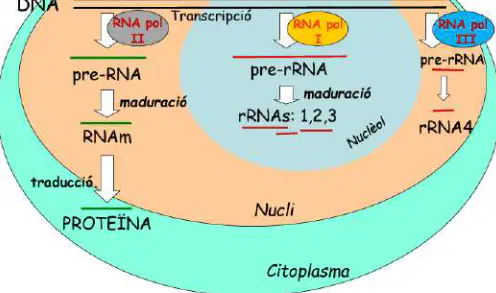
How does the cell synthesize so many rRNAs? Select all correct mechanisms described: many copies of each rRNA gene are present, and each gene can be transcribed multiple times consecutively by several RNA polymerase I molecules.
The cell has many copies of each rRNA gene, and each gene can be transcribed repeatedly by multiple RNA polymerase I molecules in succession.
rRNAs are translated in the cytoplasm to make more rRNA molecules.
RNA polymerase III exclusively transcribes rRNA 1, rRNA 2, and rRNA 3 in the nucleolus, increasing yield.
A single copy of the rRNA gene is sufficient because DNA replication amplifies RNA during transcription.
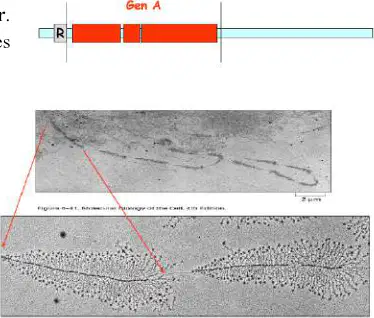
Where are the copies of Gene A located within each of the 10 chromosomes that contain it?
Clustered together at nucleolar organizer regions (NORs) in a chromosomal zone that contains only Gene A and no other genes, from which a nucleolus originates.
Scattered across multiple loci throughout each chromosome, interspersed with many other genes.
All concentrated on chromosome 1 alongside Gene B.
Evenly distributed across all 23 chromosomes without clustering.
According to the summary of ribosome genesis, which set best describes the elements found together in the nucleolar region where ribosome components are produced?
Multiple rRNAs, many ribosomal proteins, hundreds of enzymes/regulators, and many small RNAs
A single rRNA, a few ribosomal proteins, and no regulatory RNAs
Only DNA and histones with no RNAs or proteins involved in regulation
Exclusively mRNAs with cytosolic ribosomal subunits and no nucleolar RNAs
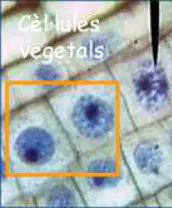
During mitosis, what happens to rRNA synthesis (transcription) and the nucleolus?
Transcription of rRNA stops and the nucleolus disappears
Transcription of rRNA accelerates and the nucleolus enlarges
Transcription of rRNA continues unchanged while the nucleolus remains
Transcription of mRNA stops but the nucleolus persists
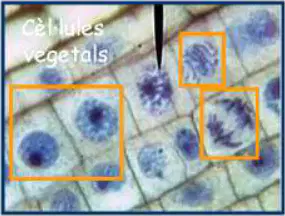
In metaphase, how are NORs (nucleolar organizer regions) and rRNA transcription described?
NORs are condensed and rRNA transcription is inhibited
NORs are decondensed and rRNA transcription is maximal
NORs are absent and mRNA transcription replaces rRNA transcription
NORs relocate to the cytoplasm to continue transcription
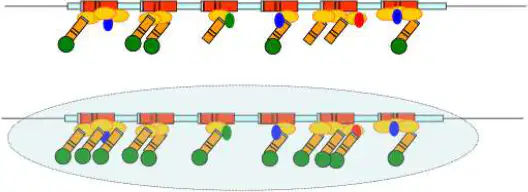
When and how does a new nucleolus begin to form after mitosis?
At telophase, chromatin decondenses, signaling leads to renewed rRNA transcription and maturation
At metaphase, chromatin condenses, halting transcription and assembling nucleoli
At prophase, NORs leave chromosomes and form cytosolic nucleoli
At S phase, DNA replication directly builds nucleoli without transcription
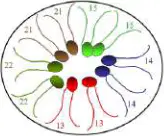
Where are nucleoli generated, and what is the stated maximum number that can be formed in a cell?
At NORs; up to 10 nucleoli
In the cytoplasm; unlimited nucleoli
At centrosomes; exactly 2 nucleoli
At telomeres; up to 2 nucleoli
Which statement summarizes what nucleoli are a consequence of, according to the synthesis summary?
Interactions between nucleolar proteins and RNAs, reflecting rRNA transcription and ribosome genesis
Passive DNA condensation independent of transcription
Exclusive action of membrane-bound organelles without RNAs
Only metabolic enzyme activity unrelated to RNAs or proteins
Which description best reflects nucleolus formation dynamics mentioned in the worksheet?
Nucleoli are highly dynamic; they may be absent at times, can be many and small, and later fuse
Nucleoli are static structures always present as a single large body
Nucleoli form only once during development and never change
Nucleoli depend solely on centrosome duplication for formation
Which feature characterizes the nucleolus as a dynamic structure, based on the listed points?
Nucleolar proteins move in and out; many proteins transit through the nucleolus to act elsewhere; some proteins are sequestered there
Proteins are immobile; all nucleolar proteins are permanently confined
Only lipids move through the nucleolus
Proteins move only outward and never inward
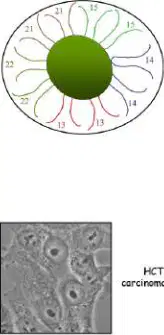
What relationship between nucleolus size and cancer cell activity is noted in the worksheet?
Cancer cells often have larger nucleoli because they proliferate actively and need many ribosomes
Cancer cells have smaller nucleoli due to reduced protein synthesis
Nucleolus size is unrelated to cancer proliferation
Cancer cells lack nucleoli entirely
Which condition is listed under diseases associated with the nucleolus?
Syndromes linked to mutations of nucleolar proteins
Deficiency of chloroplast DNA
Exclusive mitochondrial disorders without protein involvement
Autoimmune diseases only affecting cell membranes
Which additional condition is listed under diseases associated with the nucleolus?
Viral infections in which essential viral proteins localize to the nucleolus
Only bacterial infections confined to the cytoplasm
Fungal infections that avoid the nucleus
Parasitic infections that do not interact with RNAs
According to the text, Ran is compartmentalized and acts as a molecular switch that controls the binding and release of transport proteins, allowing compartmentalization to direct transport. Which statement correctly places RanGTP and RanGDP in the cell?
RanGTP in the cytoplasm and RanGDP in the nucleus
RanGTP in the nucleus and RanGDP in the cytoplasm
RanGTP and RanGDP both in the cytoplasm
RanGTP and RanGDP both in the nucleus
The text states that RanGTP is converted to RanGDP with energy release, and the reciprocal conversion occurs thanks to RanGEF. Where are GEF proteins and GAP proteins located, respectively?
GEF in the cytoplasm; GAP in the nucleus
GEF in the nucleus; GAP in the cytoplasm
GEF and GAP both in the cytoplasm
GEF and GAP both in the nucleus
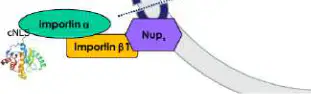
Import of proteins with cNLS starts with trimer formation: a protein bearing a nuclear signal binds importin α and β to form a trimer, though sometimes a single importin suffices. What is the next step described for cNLS import?
Export of importins to the cytoplasm
Translocation to the nucleus
Hydrolysis of RanGTP
Release of the cargo

During cNLS import, which step involves cargo release from the import machinery?
Trimer formation
Translocation to the nucleus
Release
Export of importins and RanGTP hydrolysis

In the cNLS import cycle, which step couples export of importins with RanGTP hydrolysis?
Trimer formation
Translocation to the nucleus
Release
Export of importins and hydrolysis of RanGTP
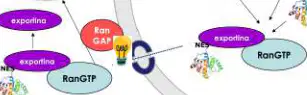
Export of proteins with NES begins with trimer formation and continues through export to the cytoplasm, RanGTP hydrolysis and release, and re-import of exportins to the nucleus. Which sequence best reflects these steps?
Hydrolysis and release → export to cytoplasm → trimer formation → import of exportins
Trimer formation → export to cytoplasm → hydrolysis of RanGTP and release → import of exportins to the nucleus
Export to cytoplasm → trimer formation → import of exportins → hydrolysis and release
Trimer formation → hydrolysis of RanGTP and release → export to cytoplasm → import of exportins
The text notes that nucleocytoplasmic transport is delicate and can cause severe diseases such as cancer or some neurodegenerative disorders. Which option best captures this implication?
The process is robust and rarely associated with disease
Defects in the process are linked to severe diseases including cancer and neurodegeneration
Only viral infections affect this process
Defects in the process lead exclusively to metabolic syndromes
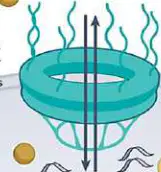
In the schematic of normal physiological conditions, proteins and mRNA are imported and exported through the nuclear pore complex (NPC). Which component label is shown as the pore scaffold proteins?
NCT
NPC Nups
RanGTP
Importin β
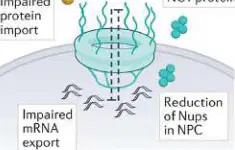
Neurodegenerative diseases feature failures in some part of nucleocytoplasmic transport, with pathological protein aggregates in the nucleus or cytoplasm. Which statement is consistent with this description?
All neurodegenerative diseases enhance nuclear import efficiency with no aggregates
Failure of import and export with age-dependent changes can contribute to neurodegeneration
Only cytoplasmic export is affected and nuclear import remains perfect
Aggregates are irrelevant to disease mechanisms
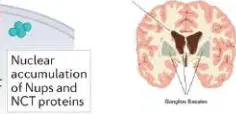
Which characteristic listed for Huntington’s disease (HD) is noted in the text?
Recessive mutation in the Tau gene
Autosomal dominant mutation in the Huntingtin gene
Dominant mutation in TDP-43
X-linked mutation affecting importins
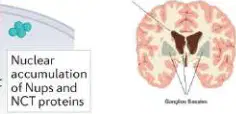
What tissue change is described for Huntington’s disease (HD)?
Muscle hypertrophy
Cerebral nervous tissue atrophy
Bone demineralization
Hepatic steatosis
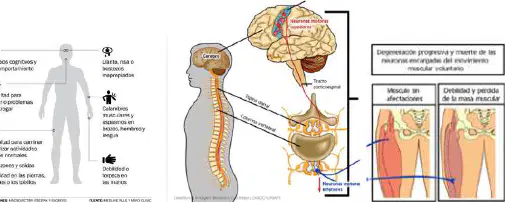
Which feature is highlighted for amyotrophic lateral sclerosis (ALS/ELA-ALS) in the text?
Degeneration of motor neurons causes muscle atrophy and uncontrolled protein import
Excessive mRNA export improves movement
Mutation exclusively in the Huntingtin gene
Selective improvement of nuclear import prevents symptoms
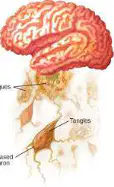
In Alzheimer’s disease (AD), which accumulation is described in the text?
Cytoplasmic TDP-43 inclusions only
Amyloid plaques in the brain and Tau protein tangles inside neurons
Exclusive nuclear import defects without aggregates
Prion plaques with no Tau involvement

Which consequence for neurons is noted in Alzheimer’s disease (AD)?
Neurons proliferate and cerebral tissue enlarges
Neurons die and cerebral tissue markedly reduces
Neurons temporarily swell and recover to normal size
Only glial cells die without brain tissue loss
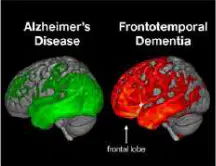
For frontotemporal dementia (FTD), which statement matches the text?
Neurons of the frontal and temporal lobes accumulate or have abnormal forms of Tau and TDP-43 proteins, and die
Only occipital neurons accumulate amyloid plaques
FTD is solely due to improved nuclear export
Frontal neurons accumulate insulin receptors and survive
For cyclin-dependent kinases (Cdks) to be effective, where must they be located inside the cell according to the regulation notes?
In the cytoplasm regardless of activation
At the nucleus to carry out their function
At the plasma membrane near receptors
Inside lysosomes during degradation
Which combination directly regulates Cdk activity as described in the steps of regulation?
Binding to cyclins and activation by phosphorylation
Ubiquitination and proteasomal degradation
Binding to phospholipids and calcium influx
Association with ribosomes and translation initiation
What are the proteins that act as inhibitors of Cdk activity called in the notes?
Topoisomerases
CKIs (cell cycle inhibitors)
Chaperonins
Histone acetyltransferases
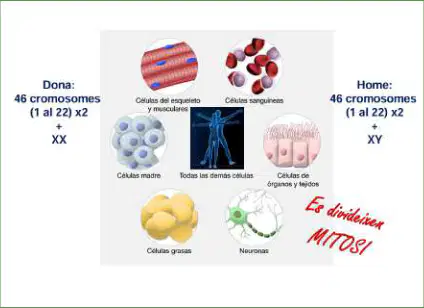
In the summary of cell types, which statement correctly describes somatic cells?
They are haploid and divide by meiosis
They have two copies of each chromosome (diploid) and divide by mitosis
They carry only sex chromosomes and divide by budding
They are polyploid and do not divide
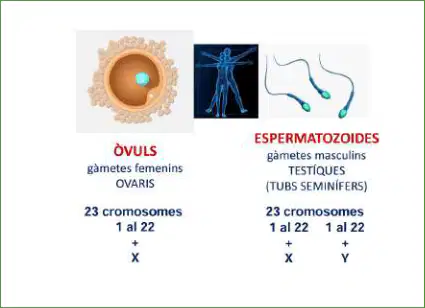
Which statement correctly describes germinal cells (gametes) as presented?
They contain two copies of each autosome and both sex chromosomes
They contain one copy of each chromosome and one sex chromosome; they divide by meiosis
They lack sex chromosomes and divide by mitosis
They are non-dividing support cells in the gonads
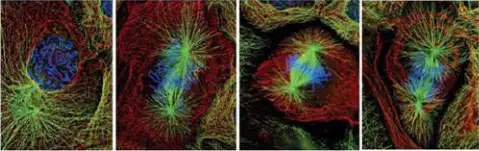
According to the mitosis overview, what happens to genetic material during mitosis?
It is randomly assorted to produce genetically different daughter cells
It is equally distributed so the two daughter cells are genetically identical to the progenitor
It is reduced by half to form haploid cells
It is replicated during cytokinesis
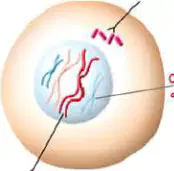
What is the starting cellular condition for entering mitosis from interphase as described?
Chromosomes have not duplicated and there is a single centrosome
Chromosomes have duplicated their DNA and centrosomes have duplicated
Mitochondria are degraded and ribosomes disassemble
Nuclear envelope is absent and kinetochore microtubules are attached
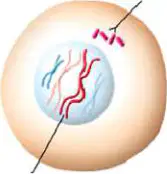
By the end of G2, how many centrosomes are present to organize the mitotic spindle?
Zero
One
Two
More than four

After DNA duplication, what is each chromosome composed of at mitotic entry?
A single chromatid with dispersed chromatin
Two sister chromatids joined together
Four chromatids paired as bivalents
A nucleolus-associated chromatin ring
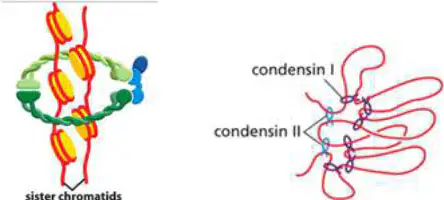
During prophase, which structural change is emphasized for chromosomes and chromatin?
Chromatin fully decondenses and transcription increases
Chromosomes and chromatin condense to form the mitotic chromosome
Nuclear envelope disintegrates immediately
Centromeres duplicate to form kinetoplasts
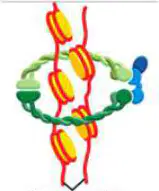
Which protein complexes are described as maintaining sister chromatids together during early mitosis?
Condensins alone
Cohesins (not fully replaced by condensins)
Dyneins
Topoisomerase IV
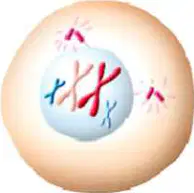
Which event is noted as still intact during prophase before later degradation?
Nucleolus is fully formed and enlarged
Nuclear envelope remains intact initially
Kinetochore–microtubule attachment is complete
Cleavage furrow forms at the cell equator
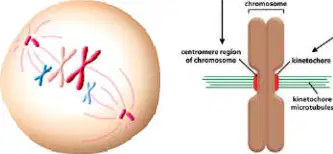
What key transition defines prometaphase in the description?
Nuclear envelope re-forms and cytokinesis starts
Nuclear envelope disassembles and chromosomes attach to spindle microtubules via kinetochores
Chromosomes replicate their DNA
Sister chromatids fuse
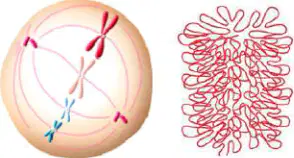
What hallmark configuration occurs during metaphase?
Chromosomes cluster at one pole
Chromosomes align at the metaphase plate with maximum compaction
Nuclear envelope reassembles
DNA replication peaks
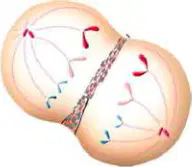
Which prerequisite enables anaphase to proceed according to the notes?
Activation of transcription at centromeres
Degradation of cohesins allowing sister chromatids to separate
Replication of DNA at the kinetochore
Fusion of centrosomes at the midzone
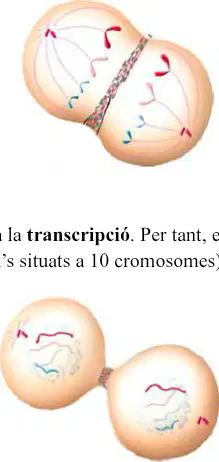
Which sequence best summarizes telophase events described?
Chromatin condenses, nuclear envelope breaks down, nucleolus disappears
Chromatin decondenses, nuclear envelope reforms, transcription resumes, nucleolus forms
DNA replicates, centrosomes duplicate, kinetochore attaches
Spindle forms, metaphase plate alignment, cohesins degrade
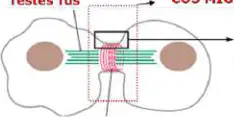
In cytokinesis, what structure is responsible for physically dividing the cell into two?
Kinetochore disk
Actin-based contractile ring at the cleavage furrow
Nuclear lamina scaffold
Centrosome-derived vesicle chain
Which substrate and outcome pairing reflects Cdk–cyclin regulation of mitosis noted in the text?
Chromosome proteins → chromosomes condense
Nuclear lamins → nuclear envelope breaks down
Mitotic spindle proteins → spindle organizes
Vesicle trafficking regulators → fragmentation of the endoplasmic reticulum and Golgi
According to the description of mitosis, the transition between metaphase and anaphase is identified as the inflection point of mitosis.
Inflection point of mitosis
G1 checkpoint
Start of cytokinesis
DNA replication in S phase
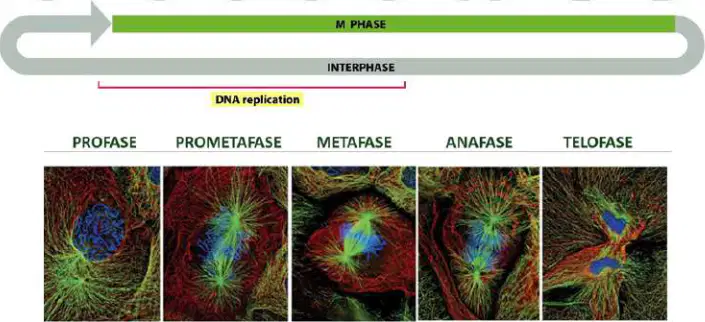
In anaphase, the anaphase-promoting complex (APC) performs a key function related to M-Cdk activity and the separation of chromatids.
It inactivates M-Cdk and promotes cohesin degradation to allow sister chromatid separation
It activates M-Cdk to initiate spindle formation
It replicates DNA before chromosome segregation
It strengthens cohesins to keep chromatids together

In the special cell division called meiosis, a diploid precursor cell produces haploid daughter cells. From a human cell with 46 chromosomes, what is produced by meiosis?
Four cells with 23 chromosomes each
Two cells with 46 chromosomes each
Four cells with 46 chromosomes each
Two cells with 23 chromosomes each
Compared with mitosis, meiosis generates daughter cells that are genetically different from each other and from the progenitor.
Daughter cells are genetically different from each other and from the progenitor
Daughter cells are genetically identical to each other and to the progenitor
Daughter cells remain diploid and unchanged
Genetic differences occur only after cytokinesis II
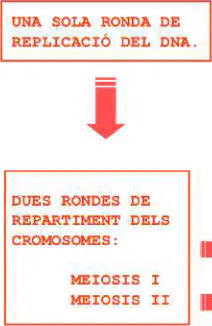
Meiosis consists of a single round of DNA replication followed by two rounds of chromosome distribution (Meiosis I and Meiosis II). Which statement best reflects this sequence?
One DNA replication, then two chromosome segregation rounds
Two DNA replications, then one chromosome segregation round
No DNA replication, only one segregation round
One DNA replication and one segregation round
During the first metaphase of meiosis, homologous chromosomes pair, and in the first anaphase entire chromosomes move to opposite poles of the cell. What separates at anaphase I?
Homologous chromosomes
Sister chromatids
Centromeres within single chromatids
Nuclear envelope layers
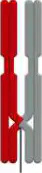
Genetic recombination (crossover) occurs when homologous chromosomes are aligned at the equatorial plate during the first metaphase of meiosis. Which process directly produces exchange of DNA between homologs?
Crossover involving DNA breakage and rejoining
Cytokinesis at the end of meiosis I
DNA replication in S phase
Spindle disassembly during telophase
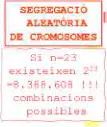
Chromosome segregation in meiosis occurs randomly. With 23 different chromosomes, how many possible combinations of separation exist?
223
232
2×23
246
The differentiation process is described as cells losing their stem-like generalization and specializing into a particular cell type.
Cells lose general stem traits and specialize into a determined cell type
Cells gain pluripotency and become more generalized
Cells replicate DNA without changing identity
Cells maintain totipotency throughout development
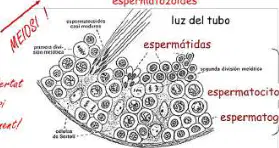
Regarding human gametogenesis timelines, which statement matches the description provided?
In women, meiosis continues at puberty with one ovary each month; in men, spermatogonia are continuously present
In women, new oogonia are produced throughout life; in men, meiosis begins only at birth
In women, meiosis proceeds continuously from fetal life; in men, spermatogonia disappear after puberty
In women and men, meiosis starts only during embryogenesis and stops permanently at birth
According to the text, cancer is a disease characterized by uncontrolled proliferation of cells that can disseminate to other parts of the body (metastasis). Which option best matches this definition?
A disorder of controlled cell division that remains localized
A disease of uncontrolled cell proliferation with potential dissemination (metastasis)
A transient inflammation that resolves without spreading
A genetic condition that never affects cell division
In the material, a tumor (neoplasia) is described as an abnormal mass of tissue that appears when cells multiply more than they should or do not die when they should. Which statement best defines a tumor (neoplasia)?
A normal enlargement of an organ with regulated cell turnover
An abnormal tissue mass due to excessive cell multiplication or failure of programmed cell death
A temporary swelling caused by fluid accumulation
A benign cyst formed by blocked ducts only
Melanoma is defined as a tumor that forms because melanocytes begin to proliferate mass. Which cell type proliferates to form a melanoma?
Melanocytes
Keratinocytes
Fibroblasts
Adipocytes
Where are the melanocytes that give rise to melanoma located in the skin, according to the text?
In the basal layer of the epithelial tissue (epidermis)
In the dermis among connective tissue
In the hypodermis near adipose tissue
On the surface stratum corneum
The text states that melanomas are highly metastatic and therefore malignant. Which option correctly characterizes melanomas based on this description?
They rarely spread and are typically benign
They frequently metastasize and are malignant
They are non-epithelial and therefore harmless
They only invade adjacent tissues but never disseminate via blood or lymph
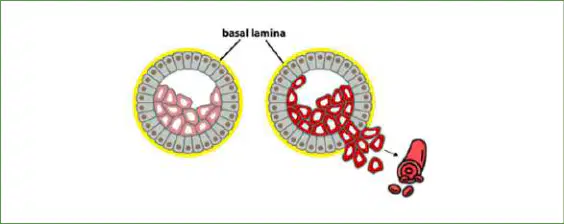
Using the example of an epithelial tissue surrounding a duct (such as the small intestine or colon), which feature distinguishes malignant tumors from benign tumors as described?
Benign tumors invade nearby tissues and disseminate through blood and lymph
Malignant tumors disseminate or invade nearby tissues and may spread to other parts of the body via blood and the lymphatic system
Benign tumors always metastasize to distant organs
Malignant tumors grow slowly and never invade adjacent tissues
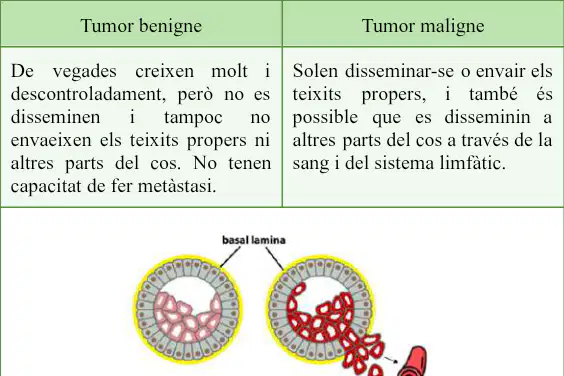
Which description matches a benign tumor in the duct example provided?
They often grow uncontrollably, disseminate widely, and invade nearby tissues
They may grow considerably but do not disseminate or invade nearby tissues and lack the capacity to metastasize
They always remain microscopic and asymptomatic
They spread via the lymphatic system but not the bloodstream
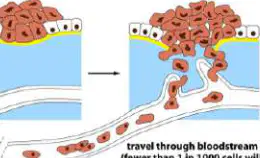
Metastasis is described as the process by which cancer cells disseminate to other parts of the body. A metastatic cancer is at which stage?
Stage I
Stage II
Stage III
Stage IV
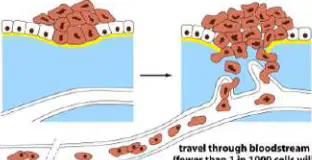
According to the sequence described, what is the term for the process in which cells from a primary tumor disseminate, migrate to another tissue, and can proliferate there?
Angiogenesis
Invasion
Apoptosis
Differentiation
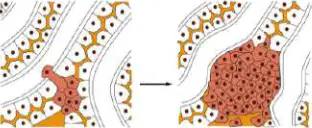
When disseminated tumor cells lack the capacity to proliferate in another tissue, the text refers to this as what?
Dormant metastasis
Benign transformation
Complete regression
Stable angiogenesis
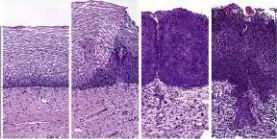
In the stages of epithelial cancer development outlined, what is the term used when a benign tumor forms in an epithelial tissue?
Carcinoma
Sarcoma
Adenoma
Melanoma
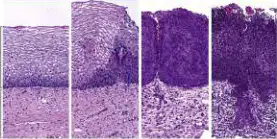
According to the outlined stages, when a tumor of epithelial tissue is already malignant, what is it called?
Adenoma
Carcinoma
Lymphoma
Leukemia
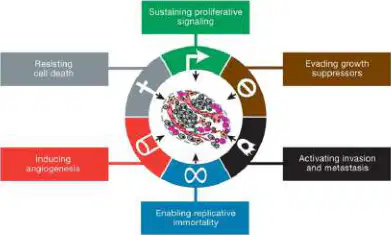
Based on the hallmarks diagram referenced, which are recognized common characteristics of cancers? Select all that apply.
Sustaining proliferative signaling
Resisting cell death
Evading growth suppressors
Increasing normal differentiation

