
 Worksheets
Transformer Fundamentals – Multiple Choice Extraction
Total questions: 70
Worksheet time: 35mins
In a transformer, which of the following describes additive polarities?
The phase relationships of the windings are such that their voltages add together.
The phase relationships of the windings are such that their voltages subtract.
The windings are connected in opposition so induced voltages cancel.
Polarity has no effect on the magnitude of the resultant voltage.
When performing a transformer polarity test, the H1 and X1 terminals are connected together. A voltage is applied to the H-windings (H1–H2), and the resulting voltage is measured across H2 and X2.
If the measured voltage is higher than the applied primary voltage, the transformer is said to have:
Additive polarity – because the induced voltage from H1→X1 is in phase and adds to the applied voltage
Subtractive polarity – because the induced voltage subtracts from the applied voltage
Additive polarity – because H1 is always opposite in phase to X2
Subtractive polarity – because H2 and X2 are always out of phase
During a transformer polarity test, terminals H1 and X1 are connected together. A voltage is applied across the primary winding (H1–H2), and the resulting voltage is measured across H2 and X2.
If the measured voltage is lower than the applied primary voltage, this indicates:
Additive polarity – because the induced voltage from H1→X1 is in phase and adds to the applied voltage
Subtractive polarity — because the induced voltage in the secondary opposes the applied primary voltage
Additive polarity – because H1 is always opposite in phase to X2
Subtractive polarity – because H2 and X2 are always out of phase
How are CTs typically connected in an electrical circuit?
In parallel with the load
In series with the voltage source
Around the conductor carrying the current
Across the secondary winding of a transformer
Which of the following describes the current characteristics of a wye/wye transformer connection?
Line current is equal to phase current.
Line current is √3 times phase current.
Phase current is √3 times line current.
Line current exists only as zero-sequence current.
In a three-phase transformer with taps, which statement correctly describes the impact of changing the tap position?
It adjusts the primary voltage only, leaving secondary voltage unchanged.
It adjusts the secondary voltage while maintaining primary voltage constant, influencing load distribution.
It alters system frequency without affecting voltage magnitude.
It increases core losses while keeping voltages unchanged.
A single-phase transformer has a primary voltage of 480 volts and a secondary voltage of 600 volts. If there are 2400 turns on the primary winding, calculate the number of turns on the secondary winding.
2400 turns
3000 turns
3600 turns
4800 turns
If the primary rating of a PT is 600 volts and the secondary rating is 120 volts, what is the PT ratio?
2:1
4:1
5:1
6:1
When connecting a delta-delta bank of transformers that are mismatched will result in:
Low impedance path, high circulating current.
Balanced load sharing with reduced circulating current.
Increased impedance path, reduced fault current.
Open-circuit secondary under all conditions.
Which of the following is NOT a necessary condition to be able to parallel two single-phase transformers?
The transformers must be the same kVA rating.
The transformers must have the same voltage ratio.
The transformers must have the same polarity and phase sequence.
The transformers should have closely matched percent impedance.
Transformers have two types of losses:
Core losses and copper losses
Eddy losses only
Mechanical and ventilation losses only
Dielectric and friction losses
A transformer has a no-load secondary voltage of 480 volts and a full-load secondary voltage of 472 volts. What is the percent voltage regulation of the transformer?
1.69%
3.33%
2.00%
1.25%
A transformer in which the primary and secondary circuits have a portion of the winding in common is called a/an:
Auto-transformer
Isolation transformer
Three-winding transformer
Current transformer
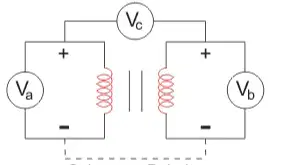
The diagram shown illustrates the ______ transformer.
Additive polarity
Subtractive polarity
Isolation transformer
Autotransformer
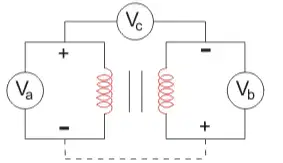
The diagram shown illustrates the ______ transformer.
Additive polarity
Subtractive polarity
Isolation transformer
Autotransformer
To properly size the rated breaker or fuse to safely interrupt current, you must perform a ______.
Overload test
Open-circuit test
Short-circuit test
Insulation resistance test
Four wire delta connections can supply ______ panels.
1Ø 3W (115/230V) and 3Ø 3W (230V)
Only 3Ø 3W (230V)
Only 1Ø 3W (115/230V)
Neither 1Ø 3W (115/230V) nor 3Ø 3W (230V)
Which three phase system can supply both three‑phase and single‑phase loads and is easier to balance loads?
Wye–Wye
Delta–Delta
Wye–Delta
Delta–Wye
An autotransformer transfers energy by:
mutual induction
self induction
conduction between windings
electrostatic coupling
A single-phase autotransformer rated at 6 kVA has a primary voltage of 200 V and a secondary voltage of 250 V in a step-up configuration.
primary =30 A, I
secondary =24 A, Icommon = 6 A
primary =20 A, I
secondary =30 A, Icommon = 10 A
primary =24 A, I
secondary =30 A, Icommon = 6 A
primary =30 A, I
secondary =20 A, Icommon = 10 A
If the volts per turn on the primary winding of a 10:1 step‑down transformer is 6 volts, then the volts per turn of the secondary winding would be ______ volts.
3.0
6.0
0.6
60.0
The series winding in a step‑down autotransformer has a volt‑per‑turn value of 2 volts. The common winding in the same transformer will have a volt‑per‑turn value of:
1 volt
2 volts
3 volts
4 volts
A disadvantage of a step‑down autotransformer is that:
isolation between primary and secondary is improved
a large voltage could be applied to the load under fault conditions
a reduced voltage could be applied to the load under fault conditions
copper savings are reduced compared with a two‑winding transformer
A disadvantage of the wye transformer connection is:
the primary neutral current is free of harmonics with a balanced load
the primary neutral current contains a third harmonic with a balanced load
the secondary line voltage equals the phase voltage in all cases
it cannot serve any single‑phase loads from the system
A single‑phase 120‑volt load is to be connected to a three‑phase four‑wire delta supply. This load must be connected between the neutral and:
line A only
line A or line B
line B or line C
line C only
A transformer with a voltage rating of 240/120 volts has 60 turns on the low‑voltage winding. This transformer will have ______ turns on the high‑voltage winding.
30
60
120
240
Which of the following statements best describes the voltage characteristics of a ungrounded delta/delta transformer connection?
The primary and secondary voltages are equal.
The secondary voltage is √3 times the primary voltage.
The secondary voltage is half of the primary voltage.
The primary and secondary voltages are unequal and phase-shifted by 30 degrees.
An ungrounded wye connected transformer is feeding a three-phase distribution panel. Which of the following loads cannot be connected to this panel.
Single phase lights
Three-phase motors
Balanced three-phase resistive loads
Line-to-line heating load
A single-phase transformer has a primary voltage rating of 240 V and a secondary voltage rating of 120 V. The transformer is rated for a power of 1500 VA. What is the turns ratio of the transformer?
2:1 (primary:secondary)
1:2 (primary:secondary)
4:1 (primary:secondary)
1:1
A single-phase transformer has a primary voltage rating of 240 V and a secondary voltage rating of 120 V. The transformer is rated for a power of 1500 VA. If the transformer is supplying a load of 1000 VA on the secondary side, what is the primary current?
4.17 A
8.33 A
2.08 A
6.25 A
A single-phase 120 V load cannot be connected to ______ of a distribution panel fed from a grounded delta connected transformer.
Phase A
Phase B
Phase C
Any phase
An autotransformer has a primary voltage of 240 V and a secondary voltage of 120 V. What is the voltage transformation ratio of the autotransformer?
2.0
1.5
0.5
1.2
Which of the following statements about the windings of an autotransformer is true?
The autotransformer has a single winding that serves as both the primary and secondary.
The autotransformer has separate, isolated primary and secondary windings.
The autotransformer uses two windings connected in opposition.
The autotransformer has three-phase windings only.
A transformer has a no-load secondary voltage of 240 V and a full-load secondary voltage of 220 V. What is the percent voltage regulation of the transformer?
11.25%
8.90%
4.20%
20.00%
In a wye-delta connection, the circulating currents in the secondary ________ the primary.
are the same as
are not the same as
lead by 30 degrees relative to
lag by 30 degrees relative to
What happens to the capacity of an open delta-open delta connection compared to the original three transformers?
Increases by 33%
Remains at 100%
Goes down to 57.7%
Doubles to 200%
On a transformer that has taps labelled, the letters "FCAN" stand for:
Full current at nominal
Full capacity above normal
Flux control automatic neutralization
Forced cooling air natural
A "short circuit" test is performed on a 4 kVA single-phase 480/120 volt transformer. The wattmeter reading taken during this test would determine the:
Core losses
Copper losses
Stray load losses
Leakage reactance only
A single-phase transformer has a primary voltage of 480 volts and a secondary voltage of 600 volts. If there are 2400 turns on the primary winding, calculate the number of turns on the secondary winding.
2000 turns
2500 turns
3000 turns
3600 turns
If the primary rating of a PT is 600 volts and the secondary rating is 120 volts, what is the PT ratio?
1:5
5:1
2:1
10:1
When connecting a delta-delta bank of transformers that are mismatched will result in:
High impedance path, low circulating current
Balanced load sharing with no circulating current
Low impedance path, high circulating current
Increased voltage regulation with reduced current
In a four-wire delta connection, the highest voltage to ground (power leg) is a result of:
the third phase being connected to the center‑tapped winding
the third phase not being connected to the center‑tapped winding, creating a high leg
all phases being equally referenced to ground
the neutral conductor being connected to all three phase windings
A single‑phase transformer has a primary voltage of 400 V and a secondary voltage of 200 V. What is the turns ratio of the transformer?
1:2
2:1
1:1
4:1
A single‑phase transformer has a primary voltage of 400 V and a secondary voltage of 200 V. The transformer is rated for 5000 VA. If the primary winding has a resistance of 2 Ω and a reactance of 3 Ω, and the transformer supplies a load of 4000 VA on the secondary side, what is the primary current, considering the impedance of the primary winding?
8.0 A
10.0 A
12.0 A
11.0 A
If two transformers have different voltage ratios, what is the consequence when attempting to parallel them?
they will operate at different frequencies
they will not share the load properly
they will automatically balance their voltages
they will increase the overall frequency of the supply
How does the capacity of an open‑delta connection compare to a closed‑delta connection?
it can handle up to 50% of the load
it can handle up to 86.6% of the load
it can handle 100% of the load
it can handle up to 33% of the load
An autotransformer has a primary voltage of 400 V and a secondary voltage of 200 V. If the transformer supplies a load of 8 kW, what is the primary current?
10 A
16 A
20 A
40 A
What is the primary purpose of conducting a short‑circuit test on a transformer?
to measure the winding resistance
to evaluate the transformer's equivalent circuit parameters
to determine the no‑load losses
to verify the turns ratio
What characteristic of a wye connection aids in providing a neutral point?
it isolates the neutral from ground
it connects to the ground
it eliminates the need for a neutral conductor
it uses delta‑connected phases
Which of the following best describes the voltage characteristics of a wye/wye transformer connection?
line voltage is equal to phase voltage
line voltage is the sum of the phase voltages
line voltage is lower than phase voltage by 50%
line voltage is 3 times the phase voltage
If the short‑circuit impedance of a transformer is found to be high, what does this indicate?
low resistance in windings
high core losses
high resistance in windings
low leakage reactance
A three‑phase connection has the following voltage characteristics: Phase A to N – 120 V; Phase B to N – 120 V; Phase C to N – 208 V. This connection is considered:
unbalanced wye
open delta
ungrounded delta
grounded delta
A single‑phase transformer has a primary voltage of 120 V and a secondary voltage of 60 V. What is the turns ratio of the transformer?
1:2
2:1
3:1
1:1
Which of the following is NOT an advantage of autotransformers?
smaller size for the same kVA
higher efficiency for small voltage changes
isolation between circuits
reduced copper usage
In a delta–four-wire delta transformer connection, which statement about the power leg is true?
The power leg refers to the line that carries the highest phase voltage.
The power leg is the conductor with the lowest line-to-line voltage.
The power leg is the neutral that balances phase currents.
The power leg is any phase that is physically closest to the transformer tank.
Which of the following best describes induction and mutual induction in a single-phase transformer?
Induction is the process by which a current is generated in one coil due to a changing magnetic field produced by another coil, while mutual induction refers to the transfer of electrical energy between two coils.
Induction occurs when two coils are connected in series, and mutual induction refers to the magnetic field produced by a single coil.
Induction is the transfer of mechanical energy between coils, and mutual induction is the flow of DC current in a single coil.
Induction only occurs in three-phase systems, while mutual induction occurs only in single-phase systems.
Which of the following characteristics is true for an open-delta transformer connection?
It can supply three-phase loads with two transformers.
It cannot operate unless all three transformers are installed.
It is used only for single-phase lighting loads.
It provides a neutral for grounding without any voltage imbalance.
What is the primary principle behind the operation of an autotransformer?
It uses electromagnetic induction between two separate windings to transfer energy.
It operates solely by resistive voltage division with no magnetic coupling.
It rectifies AC to DC using semiconductor devices.
It relies on mechanical rotation to induce voltage.
Three transformers connected in Y–Y have the primary side provided with a neutral for the purpose of:
Maintaining unbalanced voltages
Increasing the phase shift between primary and secondary
Eliminating harmonic currents in the secondary
Raising the line-to-line voltage on the primary
The series-winding current in a step-down autotransformer is the same as the:
primary current
secondary current
no-load current
magnetizing current
Three 2 kVA single-phase transformers are connected in a delta/wye configuration. If the primary line voltage is 480 volts, what is the voltage from C to N on the secondary?
120 volts
208 volts
240 volts
277 volts
The reason for single-phase transformers having laminated cores is:
To reduce the eddy current losses
To increase the core weight for better stability
To improve mechanical rigidity against vibration
To raise the operating frequency without loss
What is the primary purpose of instrument transformers in electrical systems?
To measure and control electrical parameters accurately
To increase power factor under all loading conditions
To convert DC power to AC power efficiently
To eliminate all voltage drop in long feeders
Two transformers must be connected in parallel for increases capacity, however only a 25KVA and a 37.5KVA transformers are available. Can they be paralleled?
yes
No
Not enough information
If a transformer has a no-load secondary voltage of 600 Volts and a full-load secondary voltage of 592 Volts, what is the significance of the percent voltage regulation?
It indicates the efficiency of the transformer.
It shows the voltage drop under load conditions.
It measures the power factor of the transformer.
It determines the frequency response of the transformer.
A transformer has a no-load secondary voltage of 600 Volts and a full-load secondary voltage of 592 Volts. What is the formula to calculate the percent voltage regulation of the transformer?
(No-load voltage + Full-load voltage) / Full-load voltage * 100
(No-load voltage - Full-load voltage) / Full-load voltage * 100
(Full-load voltage + No-load voltage) / No-load voltage * 100
(Full-load voltage - No-load voltage) / No-load voltage * 100
What would be the percent voltage regulation of a transformer if the no-load secondary voltage is 600 Volts and the full-load secondary voltage is 580 Volts?
3.33%
5.00%
6.67%
4.00%
If the primary winding of a transformer has 10 turns and the primary voltage is 12 volts, what is the voltage per turn on the primary winding?
12 Volts
1.2 Volts
0.12 Volts
10 Volts
In a 10:1 step-down transformer, if the secondary winding has 5 turns, what would be the primary voltage if the secondary voltage is 6 Volts?
6 Volts
12 Volts
60 Volts
30 Volts
What is the relationship between the turns ratio and the voltage ratio in a transformer?
They are directly proportional.
They are inversely proportional.
They are equal.
They have no relationship.

