
Font size
 Worksheets
CSCA Physics 1
Total questions: 95
Worksheet time: 1hrs 15mins

The graph below represents the relationship between energy and equivalent mass from which it can be converted.
c
c2
g
g2
Moving electrons are found to exhibit properties of
particles, only
waves, only
both particles and waves
neither particles nor waves
Which of the following changes occur?
Energy of electrons: increase.
Energy of electrons: no change.
Energy of electrons: increase.
Energy of electrons: no change.
The only way to increase the number of photoelectrons emitted is by increasing the _________ of the light
Intensity
Wavelength
Frequency
Energy
The special theory of relativity was developed by......
Galileo
Watson
Einstein
De broglie

1
2
3
4

1
2
3
4
What are the subatomic particles called that make up both protons & neutrons?
(a)
Which fundamental force is primarily responsible for the attraction between protons and electrons?
strong
gravitational
electromagnetic
weak
A pencil submerged in a clear glass of water may appear broken or bent when observed from the side of the glass. Which of the following characteristics describes this broken or bent appearance?
refraction
diffraction
reflection
amplitude


An electromagnetic wave travels through a vacuum. Which best describes the orientation of the E-Field and M-Field? (select two)
M-Field is parallel to the velocity of the wave
M-Field is perpendicular to the velocity of the wave
M-Field is parallel to the E-Field
M-Field is perpendicular to the E-Field

Monochromatic light (λ=550 nm) passes through a diffraction grating with 2,000 lines per centimeter. If a screen is 1m away from the grating, determine the distance between m=0 and m=1.
5.00 x 10⁻⁶ m
0.115 m
0.226 m
0.639 m
A green laser has a wavelength of 532 nm in a vacuum. What is the frequency of green light?
4.55 x 10¹⁴ Hz
5.64 x 10¹⁴ Hz
4.55 x 10¹¹ Hz
5.64 x 10¹¹ Hz
What optical phenomenon involves the separation of light into different colors?
total internal reflection
DIFFRACTION
BENDING
POLARIZATION

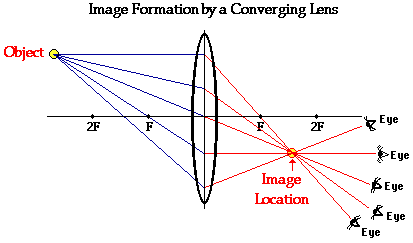
During an adiabatic process, a sample of gas does 400 J of work on the environment. What change occurs with the internal energy of the gas?
The internal energy increases by 400 J.
The internal energy doesn't change.
The internal energy decreases by 400 J.
There is not enough information if we don't know how much heat was added or removed.

Process B on the PV diagram is an ______________ process.
adiabatic
isobaric
isochoric
isothermal

During process A, from state 1 to state 2, the temperature of the ideal gas
stays the same
increases
decreases
is half as much

An ideal gas undergoes the process below. Calculate the total work is conducted in one cycle
32
48
52
64
80
The work done by an ideal gas through an isochoric process from pressure P1 to P2 is ....
0
P1(V2-V1)
P2V2
( P1 - P2 )V
In an enclosed area, an ideal monoatomic gas with a pressure of 2 x 10⁶ Pa and a volume of 25 liters experiences an isobaric process, reducing the volume become 10 Liters. the gas then goes through an isobaric phase, which changes the pressure to 5 x 10⁶ Pa, before going through an isothermic process, which restores the pressure and volume tot he original positions. The process is represented by the graph ....


When an ideal gas expands, the amount of work it does is proportional to the change in gas pressure.
Usaha yang dilakukan oleh gas ideal Ketika mengembang sebanding dengan perubahan tekanan gas
True
False
Transfer of heat from low temperature to high temperature is
None of these
Possible by doing some external work
Possible by keeping both the bodies in contact
Impossible
Process B on the PV diagram is an ______________ process.
adiabatic
isobaric
isochoric
isothermal

In this picture, a bar slides to the right. The flux is _______ and field is induced ________.
increasing, out of the page
increasing, into the page
decreasing, out of the page
decreasing, into the page

A moveable rod makes contact along two rails with a lightbulb attached. As the rod is moved to the right, the magnetic flux _________.
increases
decreases
stays the same

A field of constant B = 0.5 T is enclosed by a ring with radius 2m. Which of the following is true?
Flux is 2π Webers and has counterclockwise current
Flux is 2π Webers and has no current
Flux is 0 Webers and has clockwise current
Flux is 0 Webers and has no current

Which coil will have the largest flux?
A
B
C
D
Electric current would be produced in the magnet.
The magnet would do nothing to the coil of wire.
Electric current would be produced in the copper wire
It would make the copper wire produce a magnetic field.

____________law states that the direction of the induced current is such that it always _______ ___ the change producing it.
Lenz's Law, oppose
Faraday's Law, oppose
Lez's Law, follow
Faraday's Law, follow

When a conductor is moved to cut through the magnetic flux, an _______________ is produced.
induced current
electromotive force
electromagnetic induction
internal resistance
How can the Force on the current carrying conductor be reversed?
Decrease the current
Increase the distance between magnetic poles
Swap the North and South poles.
Place the conductor parallel to the magnetic field.

Are the magnetic field lines in the picture correct?
Yes, because they point from north to south.
No, because they point from north to south (they're supposed to go the other way).
Yes, because the North pole is on the left in all pictures.
No, because the North pole is on the left in all pictures (it's supposed to be on the right).
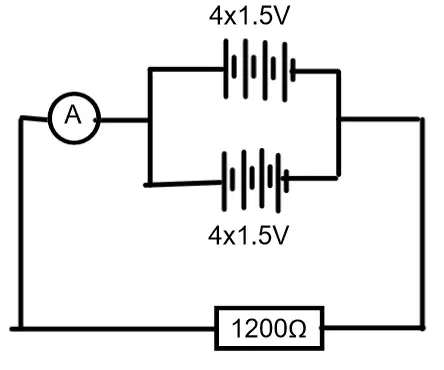
In the circuit diagram shown, each cell has an emf of 1.5V and negligible internal resistance and the resistor has a resistance of 1200 Ω. What will be the current shown on the ammeter?
12 mA
10 mA
2.5 mA
5 mA

What is the total resistance of the 4 x 100 Ω resistors connected as shown in the diagram?
50 Ω
400 Ω
200 Ω
100 Ω

A circuit is set up as shown in the diagram. The e.m.f. of the battery is 1.5 V and the resistance R is 2.0 Ω . Which statement below is not true about the circuit?
When switch S is opened, the voltmeter reads 1.5 V.
When switch S is closed, the voltmeter reads less than 1.5 V.
When switch S is closed, the ammeter reads 0.75 A.
When switch S is opened, the ammeter reads zero.


Calculate the internal resistance, r
0.1 ohm
0.2 ohm
0.3 ohm
0.4 ohm
2 charged objects both feel a force of 200 N. If q1 becomes 3 times bigger, what is the new force
203
600
66.7
1800
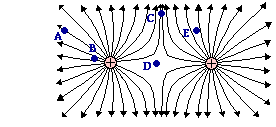
The amplitude and period in a SHM is 0.5 m and 0.4 s respectively. The equation of SHM will be:
x=0.5 sin 5πt
x=0.5 sin 4πt
x=0.5 sin 2.5πt
x=0.5 sin 0.8πt
The acceleration of a particle in SHM is:
always zero
always constant
maximum at amplitude
maximum at the equilibrium position
The maximum displacement from equilibrium of a particle is 1 m and its maximum acceleration is
1.57 m s-2. The period of the particle will be
1.25 s
0.63 s
0.20 s
5.03 s

How is the gravitational force between to objects related to their mass
They are directly proportional
They are inversely proportional
They do not affect each other
They are equal
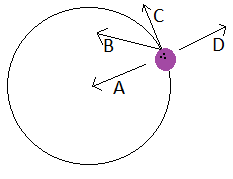
The clock on Big Ben has a minute hand of length 4.3 m and an hour hand of length 2.7 m. What is the ratio of the centripetal acceleration of a point on the tip of the minute hand to a point on the tip of the hour hand?
1.6
150
230
5700
The combined mass of a race car and its driver is 600 kg. Travelling at constant speed, the car completes one lap around a circular track of radius 160 m in a total time of 36 s. What is the magnitude of the centripetal acceleration of the car?
0.17 m s-2
4.9 m s-2
100 m s-2
2900 m s-2
A bungee rope has a spring constant of 5N/m. How much a person must weighs in Newton if we want it to extend (stretch) 10m?
20N
22cm
50N
50cm
21N


A 57.0-g tennis ball is traveling straight at a player at
21.0 m/s. The player volleys the ball straight back at
25.0 m/s. If the ball remains in contact with the racket
for 0.060 0 s, what average force acts on the ball?
22.6 N
32.5 N
43.7 N
72.1 N
102 N
A massive tractor is rolling down a country road. In
a perfectly inelastic collision, a small sports car runs
into the machine from behind. Which vehicle experiences a larger
change in kinetic energy?
The car does.
The
tractor does.
Their kinetic energy changes are the
same size.
It could be either vehicle.
A massive tractor is rolling down a country road. In
a perfectly inelastic collision, a small sports car runs
into the machine from behind. Which vehicle expe-
riences a change in momentum of larger magnitude?
The car does.
The tractor does
Their
momentum changes are the same size
It could be
either vehicle.
A 10.0-g bullet is fired into a 200-g block of wood at rest
on a horizontal surface. After impact, the block slides
8.00 m before coming to rest. If the coefficient of fric-
tion between the block and the surface is 0.400, what
is the speed of the bullet before impact?
106 m/s
166 m/s
226 m/s
286 m/s
none of those
answers is correct
The momentum of an object is increased by a factor
of 4 in magnitude. By what factor is its kinetic energy
changed?
16
8
4
2
1
According to Newton’s third law of motion, when a hammer strikes and exerts force on a nail, the nail
creates a friction with the hammer.
exerts an equal and opposite force on the hammer.
disappears into the wood.
moves at a constant speed.
According to Newton's Third Law of Motion, when a hammer strikes and exerts a force on a nail, the nail
disappears into the wood
exerts an equal and opposite force back on the hammer
moves at a constant speed
moves at a constant speed
A person not wearing a seat belt flies through a car window when someone slams on the breaks because the person’s body wants to remain in continuous motion even when the car stops.
Newton's 1st Law
Newton's 2nd Law
Newton's 3rd Law
If you slide a hockey puck on ice, eventually it will stop because of the friction of the ice. This is an example of which Law of Motion.
Newton's First Law
Newton's Third Law
Newton's Second Law
The first law of motion states that objects at rest will stay at rest unless acted upon by an unbalanced:
motion
force
inertia
acceleration
When you are standing in a subway train and the train suddenly stops but your body continues to move forward.
Newton's 1st Law
Newton's 2nd Law
Newton's 3rd Law
Which of Newton's Laws of motion best explains why motorists should buckle up?
1st law of motion
2nd law of motion
3rd law of motion
Uniform circular motion


What is the average velocity of the object between 0 and 10 seconds?
6.0 m/s
1.5 m/s
-4 m/s
0 m/s
for 8 s until it finally lifts off the ground.
Determine the velocity at take-off.

