
Font size
 Worksheets
Voltammetric Methods and Measurements
Total questions: 89
Worksheet time: 45mins
What is voltammetry? Fill in the blank: In voltammetry, we apply a ______-dependent potential to an electrochemical cell and measure the resulting current as a function of that potential.
time
temperature
pressure
concentration
What is the plot of current versus applied potential in voltammetry called?
Polarogram
Voltamogram
Spectrogram
Chromatogram
Who developed the earliest voltammetric technique, and what was it called? Fill in the blank: The earliest voltammetric technique is ______, developed by ______ in the early 1920s.
polarography, Jaroslav Heyrovsky
amperometry, Michael Faraday
cyclic voltammetry, Allen Bard
chronopotentiometry, John Bockris
In voltammetry, what is the function of the auxiliary electrode?
To complete the electrical circuit and allow current to flow
To measure the potential of the solution
To act as a reference for the working electrode
To detect the analyte concentration
In voltammetry, the reference electrode is usually a SCE or a Ag/AgCl electrode.
True
False
Read the passage and answer the following: Which of the following materials can be used as a working electrode in voltammetric techniques?
Mercury
Platinum
Gold
All of the above
In the hanging mercury drop electrode (HMDE), how is the mercury drop formed?
By gravity
By rotating a micrometer screw
By activating a solenoid
By heating the mercury
The dropping mercury electrode (DME) produces mercury drops at the end of the capillary tube as a result of ________.
gravity
pressure
temperature
electrolysis
Read the passage and answer the following: True or False: The static mercury drop electrode (SMDE) can be used as either a HMDE or a DME.
True
False
What is a mercury film electrode?
A solid electrode placed in Hg2+ solution, forming a thin mercury film on its surface.
A mercury electrode used only for measuring temperature.
An electrode made entirely of solid mercury.
A film electrode used exclusively in organic chemistry experiments.
What is one major advantage of using mercury as a working electrode?
Its high overpotential for the reduction of H3O+ to H2, allowing access to very negative potentials.
Its ability to catalyze the oxidation of most organic compounds.
Its strong absorption of visible light, making it useful in photochemical reactions.
Its high melting point, allowing it to be used at elevated temperatures.
Mercury electrodes can be used at potentials more positive than approximately -0.3 V to +0.4 V versus the SCE.
True
False
What is an amalgam, and how is it formed when using mercury as a working electrode?
An amalgam is a mixture of mercury with another metal, formed when metals dissolve in mercury at the electrode surface.
An amalgam is a compound formed by the reaction of mercury with non-metals at high temperature.
An amalgam is a solution of mercury in water, formed by electrolysis.
An amalgam is a type of alloy formed only when mercury reacts with organic compounds.
According to the passage, which materials can be used to construct solid electrodes?
Platinum, gold, silver, carbon
Mercury, platinum, copper
Gold, copper, zinc
Silver, mercury, carbon
Fill in the blank: The potential window for a Pt electrode extends from approximately +1.2 V to ____ V versus the SCE in acidic solutions.
-0.2
0.0
-1.0
+0.5
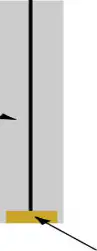
Which type of electrode is fashioned into a disk and sealed into the end of an inert support with an electrical lead, as shown in Figure 11.36?
Solid electrode
Reference electrode
Gas electrode
Liquid junction electrode
A solid electrode can replace a mercury electrode for many voltammetric analyses that require negative potentials.
True
False
What is the most important problem associated with solid electrodes as mentioned in the passage?
High cost
Ease of surface alteration by adsorption or oxide layer formation
Difficulty in construction
Limited potential range
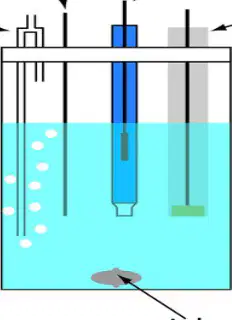
Refer to the diagram of the typical electrochemical cell for voltammetry. Which electrode is responsible for the oxidation or reduction of the analyte?
Auxiliary electrode
Reference electrode
Working electrode
Stir bar
In voltammetry, the current from redox reactions at the working electrode and the auxiliary electrode is called a ________ current.
faradaic
capacitive
ionic
diffusion
A faradaic current due to the analyte’s reduction is called a cathodic current.
True
False
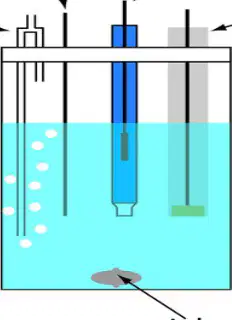
Which of the following is used to remove dissolved O₂ from the solution in an electrochemical cell?
Reference electrode
N₂ purge line
Stir bar
Auxiliary electrode
Electrochemical cells are available in a variety of sizes, allowing the analysis of solution volumes ranging from more than ____ mL to as small as ____ μL.
100 mL; 50 μL
10 mL; 5 μL
500 mL; 100 μL
1000 mL; 10 μL
What is the effect of an anodic current at the working electrode?
It is due to a reduction reaction and its sign is positive.
It is due to an oxidation reaction and its sign is negative.
It is due to an oxidation reaction and its sign is positive.
It is due to a reduction reaction and its sign is negative.
Fill in the blank: The relationship between the concentrations of Fe(CN)63− , Fe(CN)64− , and the potential is given by the Nernst equation:
E = +0.356V – 0.05916log[Fe(CN)4–6]x=0/[Fe(CN)3–6]x=0.
E = +0.356V + 0.05916log[Fe(CN)3–6]x=0/[Fe(CN)4–6]x=0.
E = +0.356V – 0.05916log[Fe(CN)3–6]x=0/[Fe(CN)4–6]x=0.
E = +0.356V + 0.05916log[Fe(CN)4–6]x=0/[Fe(CN)3–6]x=0.
What is the standard-state potential for the Fe(CN)63−/Fe(CN)64− redox couple?
+0.059 V
+0.356 V
+0.530 V
0 V
Explain why surface concentrations are used instead of bulk concentrations when determining the equilibrium position for the redox reaction Fe(CN)3–6(aq) + e– ⇆ Fe(CN)4–6(aq) at the electrode’s surface.
Because the reaction occurs at the electrode surface, where concentrations may differ from the bulk solution.
Because bulk concentrations are always equal to surface concentrations.
Because surface concentrations are easier to measure than bulk concentrations.
Because the equilibrium position is independent of concentration at the surface.
Fill in the blank: If the initial concentration of Fe(CN)6^3- is 1.0 mM and Fe(CN)6^4- is absent, switching the potential to +0.356 V will result in [Fe(CN)3–6]x=0 = [Fe(CN)4–6]x=0 = _______.
0.50 mM
1.0 mM
0.25 mM
0.75 mM
What is the standard electrode potential (E°) for the Fe(CN)63−/Fe(CN)64− redox half-reaction?
+0.530 V
+0.356 V
-0.530 V
-0.356 V
What creates the driving force that transports Fe(CN)64− away from the electrode and Fe(CN)63− to the electrode?
A concentration gradient between the solution at the electrode’s surface and the bulk solution.
The temperature difference between the electrode and the solution.
The pressure applied to the solution near the electrode.
The electrical conductivity of the solution.
The analyte’s concentration at the electrode is always the same as its concentration in bulk solution.
True
False
Explain why a faradaic current continues to flow during the Fe(CN)63−/Fe(CN)64− redox reaction at the electrode.
Because electron transfer occurs between the electrode and the redox species.
Because the electrode is non-conductive.
Because the solution is saturated with Fe(CN)63− .
Because no redox reaction takes place at the electrode.
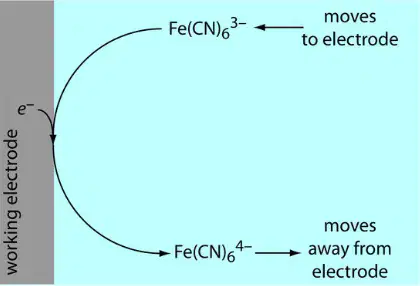
What process is illustrated in this figure?
The transport of ions during the reduction of Fe(CN)63−toFe(CN)64− at the electrode surface.
The oxidation of Fe(CN)6^4- to Fe(CN)6^3- at the electrode surface.
The diffusion of water molecules across a membrane.
The precipitation of Fe(CN)63− from solution.
What are the two factors that contribute to the rate of the electrochemical reaction according to the passage?
1. The rate at which the reactants and products are transported to and from the electrode (mass transport). 2. The rate at which electrons pass between the electrode and the reactants and products in solution.
1. The temperature of the solution and the color of the electrode. 2. The pressure applied to the cell and the size of the electrode.
1. The concentration of the electrolyte and the shape of the container. 2. The voltage applied and the type of solvent used.
1. The amount of light present and the magnetic field strength. 2. The humidity in the room and the age of the electrode.
Which of the following is NOT a mode of mass transport that affects the rate at which reactants and products move toward or away from the electrode surface?
Diffusion
Migration
Convection
Evaporation
Diffusion occurs whenever the concentration of an ion or molecule at the surface of the electrode is ________ from that in bulk solution.
different
similar
equal
constant
At what time is the concentration of Fe(CN)63− at the electrode surface zero?
t = 0
t1
t2
t3
Fill in the blank: The dashed red line in the diagram shows the extent of the _______ at time t3.
diffusion layer
reaction zone
boundary layer
precipitate region
Which of the following is NOT a method of creating convection in an electrochemical cell?
A) Stirring with a stir bar
B) Rotating the electrode
C) Incorporating the electrode into a flow-cell
D) Heating the solution
Convection occurs when we mechanically mix the solution, carrying reactants toward the electrode and removing products from the electrode. The most common form of convection is stirring the solution with a stir bar. Other methods that have been used include rotating the electrode and incorporating the electrode into a flow-cell.
True
False
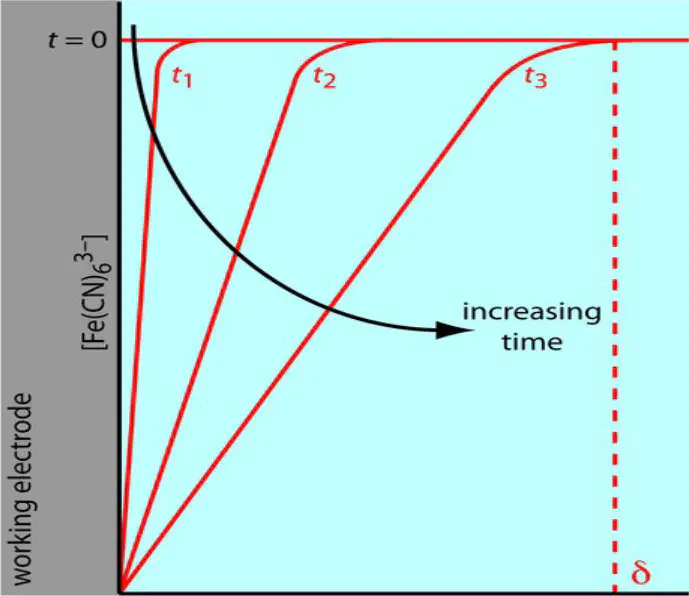
Explain why the concentration of Fe(CN)63− at the electrode surface decreases to zero after applying the potential.
Because Fe(CN)6^3- is reduced at the electrode, causing its concentration to drop to zero.
Because Fe(CN)63− is oxidized at the electrode, increasing its concentration.
Because Fe(CN)6^3- diffuses away from the electrode, increasing its concentration.
Because Fe(katex latex=\"(CN)_{6}^{3-}\") reacts with the solvent, maintaining its concentration.
What is migration in the context of mass transport in electrochemistry?
Migration occurs when a charged particle in solution is attracted to or repelled from an electrode that carries a surface charge.
Migration is the movement of solvent molecules due to temperature gradients.
Migration refers to the diffusion of gases across a membrane.
Migration is the process of electrons moving through a metallic conductor.
Unlike diffusion and convection, migration only affects the mass transport of ________ particles.
charged
neutral
large
small
In the limit where diffusion is the only significant form of mass transport, the current in a voltammetric cell is equal to i = nFAD(Cbulk–Cx=0)δ(11.36). What does 'n' represent in this equation?
The number of electrons in the redox reaction.
The concentration of the analyte.
The Faraday constant.
The diffusion coefficient.
Migration can be eliminated by adding a high concentration of an inert supporting electrolyte.
True
False
Which of the following is NOT a method to eliminate convection in an electrochemical cell?
Not stirring the solution
Using an electrochemical flow cell
Adding a high concentration of inert electrolyte
Designing experimental setups to avoid stirring
What is the typical thickness of a diffusion layer when fluid moves past an electrode, as mentioned in the passage?
0.1–1 μm
1–10 μm
10–100 μm
100–1000 μm
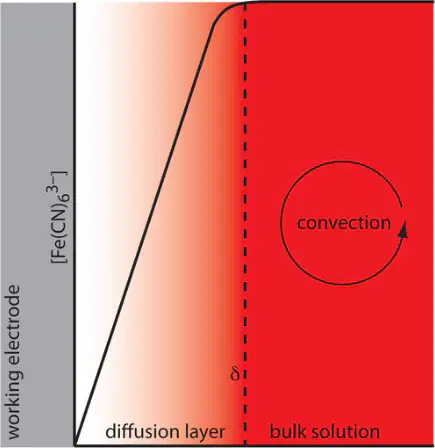
Based on the diagram, which form of mass transport is significant close to the electrode’s surface?
Diffusion
Convection
Both diffusion and convection
None of the above
If electron transfer kinetics are fast, the redox reaction is ________ and the Nernst equation applies.
electrochemically reversible
electrochemically irreversible
thermodynamically unstable
chemically inert
If electron transfer kinetics are sufficiently slow, the system is:
Electrochemically reversible
Electrochemically irreversible
At equilibrium
None of the above
In addition to current resulting from redox reactions (faradaic current), the current in an electrochemical cell includes other, nonfaradaic sources.
True
False
What is the term used for the small, short-lived current that occurs every time we change the electrode’s potential?
charging current
diffusion current
residual current
faradaic current
The migration of ions in response to the electrode’s surface charge leads to the formation of a structured electrode-solution interface called the ________.
electrical double layer (EDL)
electrolytic bridge
Faraday cage
ionic lattice
Residual current in an electrochemical cell only consists of charging current.
True
False
Which of the following is NOT a component of residual current in an electrochemical cell?
Faradaic current
Charging current
Electrical double layer
Oxidation/reduction of trace impurities
How many common shapes for voltammograms are there, according to the text?
three
one
two
four
For the voltammogram in Figure 11.42a, the current increases from a background residual current to a ________ current, iₗ.
limiting
maximum
average
transient
Because the faradaic current is inversely proportional to δ (equation 11.36), a limiting current can only occur if the thickness of the diffusion layer remains constant because we are ________ the solution.
stirring
heating
cooling
diluting
As shown in Figure 11.42b, the resulting voltammogram has a ________ current instead of a limiting current.
peak
average
oscillating
steady
For the voltammograms in Figures 11.42a and 11.42b, we measure the current as a function of the applied potential.
True
False
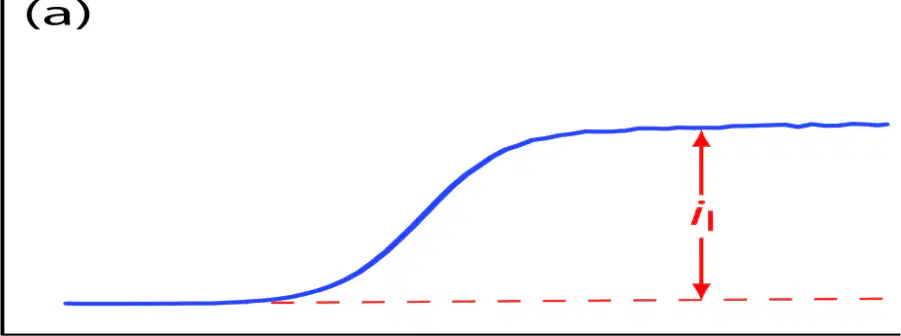
What does the red arrow labeled 'i_l' represent in the context of the current vs potential graph?
The red arrow labeled 'i_l' represents the limiting current.
The red arrow labeled 'i_l' represents the equilibrium potential.
The red arrow labeled 'i_l' represents the maximum voltage.
The red arrow labeled 'i_l' represents the threshold frequency.
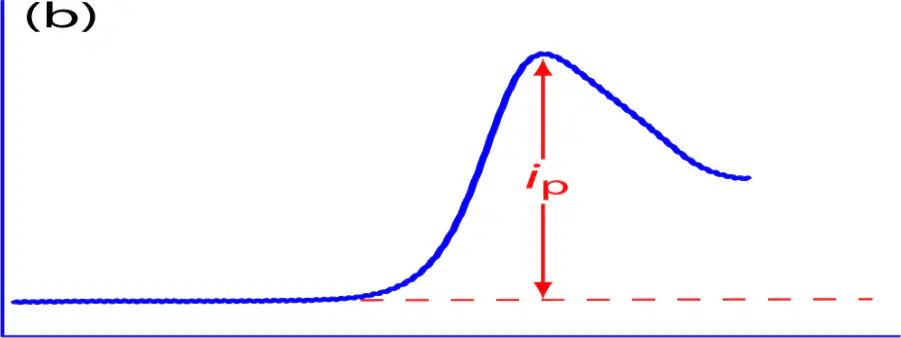
What does the red arrow labeled 'i_p' represent in the context of the current vs potential graph?
The red arrow labeled 'i_p' represents the peak current.
The red arrow labeled 'i_p' represents the minimum voltage.
The red arrow labeled 'i_p' represents the average resistance.
The red arrow labeled 'i_p' represents the time constant.
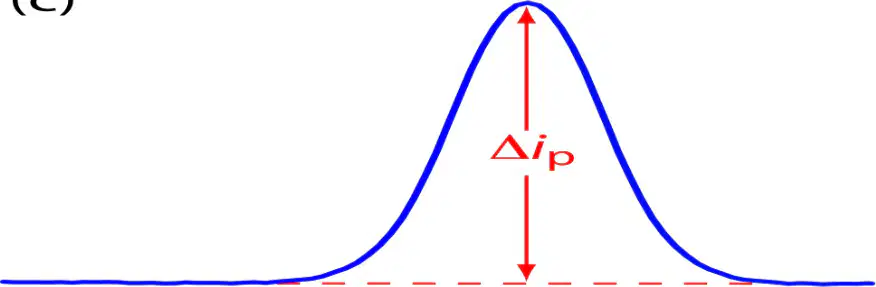
What does the red arrow labeled 'Δi_p' represent in the context of the change in current vs potential graph?
The red arrow labeled 'Δi_p' represents the change in peak current.
The red arrow labeled 'Δi_p' represents the change in voltage.
The red arrow labeled 'Δi_p' represents the change in resistance.
The red arrow labeled 'Δi_p' represents the change in time.
What does the dashed red line show in Figure 11.42?
The limiting current
The residual current
The standard-state potential
The concentration of O
Fill in the blank: In voltammetry, the limiting current (i_l) is a linear function of the concentration of ______ in bulk solution.
O
H2O
Na+
Cl-
What is the equation for the current (i) at the working electrode when O is present in bulk solution and the solution is being stirred?
i = nFAk[O]
i = nFAD[O]/δ
i = nFv[O]
i = nF[O]/k
What is the constant K_O equal to in the context of determining concentration in voltammetry?
nFAD_O/δ
nFAD_R/δ
[O]bulk
i_l
To extract the standard-state potential from a voltammogram, which equation do we need to rewrite for reaction 11.37?
Nernst equation
Arrhenius equation
Henderson-Hasselbalch equation
Michaelis-Menten equation
Fill in the blank: When the current, i, is half of the limiting current, il, the equation is i = ____ × il.
0.5
2
0.1
1
What is the assumption made about the initial solution when simplifying the equation for [R]bulk?
The initial solution is homogeneous.
The initial solution is saturated.
The initial solution is dilute.
The initial solution is concentrated.
Which variable in the equations represents the limiting current?
il
I0
V
R
What is the half-wave potential (E1/2) in voltammetry?
The half-wave potential (E1/2) is the potential at which the current is half of the limiting current in a voltammogram.
The half-wave potential (E1/2) is the potential at which the electrode is completely polarized.
The half-wave potential (E1/2) is the potential at which the current reaches its maximum value.
The half-wave potential (E1/2) is the potential at which the concentration of the analyte is zero.
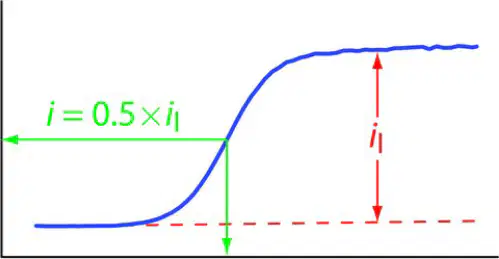
What does the limiting current (i) represent in a voltammogram?
The limiting current (i) represents the maximum current observed in a voltammogram, beyond which the current does not increase with increasing potential.
The limiting current (i) represents the minimum current observed in a voltammogram, below which the current does not decrease with decreasing potential.
The limiting current (i) represents the average current observed in a voltammogram over the entire potential range.
The limiting current (i) represents the initial current observed in a voltammogram before any potential is applied.
Write the equation for the half-wave potential (E1/2) as given in the worksheet.
E1/2 = E°/R - 0.05916 log K0KR(11.44)
E1/2 = E° + 0.05916 log K0KR(11.44)
E1/2 = E°/R + 0.05916 log K0KR(11.44)
E1/2 = E° - 0.05916 log K0KR(11.44)
In voltammetry, what are the three important experimental parameters under our control?
The three important experimental parameters are: how we change the potential applied to the working electrode, when we choose to measure the current, and whether we choose to stir the solution.
The three important experimental parameters are: the type of electrolyte used, the color of the solution, and the shape of the electrode.
The three important experimental parameters are: the temperature of the room, the brand of the voltmeter, and the time of day the experiment is performed.
The three important experimental parameters are: the voltage of the power supply, the length of the wires, and the size of the beaker.
What is the first important voltammetric technique to be developed that uses the dropping mercury electrode as the working electrode?
Amperometry
Polarography
Potentiometry
Coulometry
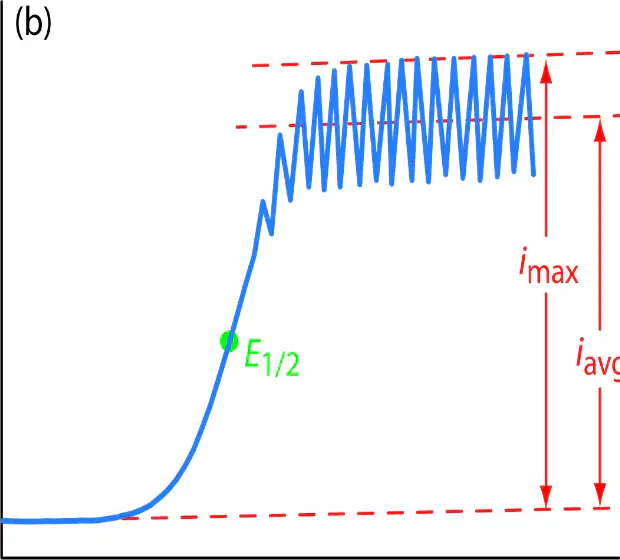
In normal polarography, what is measured while applying a linear potential ramp to the electrochemical cell?
Voltage
Current
Temperature
Pressure
Fill in the blank using the passage: The limiting current in polarography is also called the ______ current.
diffusion
migration
convection
residual
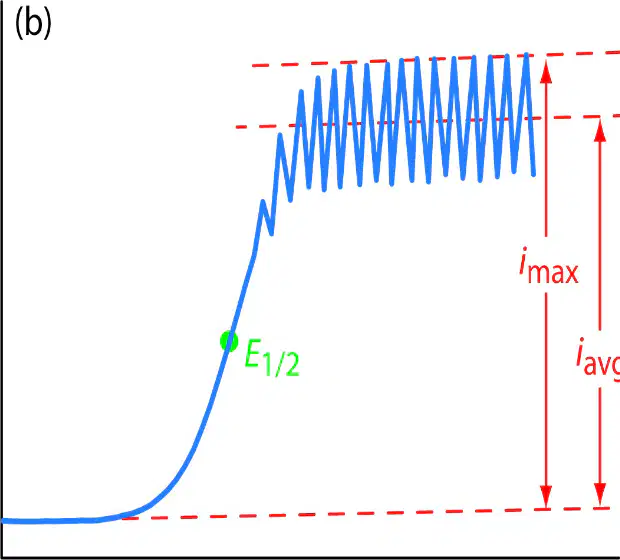
Based on the passage and Figure 11.44: The oscillations in the current during polarography are a result of the growth of the Hg drop, which leads to a time-dependent change in the area of the working electrode.
True
False
According to the passage, the limiting current in polarography can be measured using either the maximum current (imax) or the average current (iavg).
True
False
Fill in the blank: The half-wave potential, E1/2, provides qualitative information about the ________ reaction.
redox
acid-base
precipitation
combustion
Which of the following is a constant in the equations for polarography?
n
D
Kmax
t
In normal pulse polarography, the faradaic current is greater than in polarography, resulting in better sensitivity and smaller detection limits.
True
False
Fill in the blank: In differential pulse polarography, the current is measured twice per cycle: for approximately 17 ms before applying the pulse and for approximately 17 ms at the ______ of the cycle.
end
start
middle
peak
What is the typical experimental condition for the pulse-time (tp) in both normal and differential pulse polarography?
tp ≈ 50 ms
tp ≈ 5 ms
tp ≈ 500 ms
tp ≈ 0.5 ms
What does the first derivative of a sigmoidal function look like?
Step-shaped
Peak-shaped
Flat
Zigzag
Read the passage below and answer the following question: Other forms of pulse polarography include staircase polarography and square-wave polarography. One advantage of square-wave polarography is that we can make τ very small—perhaps as small as 5 ms, compared to 1 s for other pulse polarographies—which can significantly decrease analysis time. What is one advantage of square-wave polarography over other forms?
It increases analysis time
It allows τ to be very small
It requires more sample
It cannot be used for metal ions
How long does it take to complete the scan using square-wave polarography with the given parameters?
1 second
5 seconds
10 seconds
30 seconds
Name two types of compounds that can be analyzed using polarography.
Metal ions and organic compounds with reducible or oxidizable functional groups (e.g., carbonyls, carboxylic acids, carbon-carbon double bonds)
Noble gases and saturated hydrocarbons
Alkali metals and nonpolar solvents
Inert gases and simple alkanes

