
 Worksheets
General Chemistry Quiz
Total questions: 85
Worksheet time: 2hrs 28mins


The following data were measured for the reaction
BF3(g) + NH3(g) ⟶ F3BNH3(g)
What is the rate when [BF3] = 0.100 M and [NH3] = 0.500 M ?
.01704 M/s
.0852 M/s
.1704 M/s
.852 M/s
A reaction is found to be second order with respect to carbon monoxide. If the concentration of carbon monoxide is doubled, the rate of reaction __________.
doubles
remains unchanged
increases by a factor of 4
is reduced by a factor of 2
The first order rate constant for the decomposition of 0.5 M compound A at 100oC is 0.03 min-1. Calculate the half-life of A.
1.5 min
8.3 min
23.1 min
66.7 min
In a series of reaction, which is the rate determining step
The simplest reaction
The slowest reaction
The fastest reaction
The main reaction involving the major reactant
The unit of rate constant for first order reaction
(a)
In general, an increase in temperature of 10°C will have what effect on reaction rate:
A. Double the rate
B. Half the rate
C. Triple the rate
D. Increase the rate but not by a specific amount
A
B
C
D
Which of the following statements is correct about order of a reaction.
a) The order of a reaction can be a fractional number.
b) Order of a reaction is experimentally determined quantity.
c) The order of a reaction is always equal to the sum of the stoichiometric coefficients of reactants in the balanced chemical equation for a reaction.
d) The order of a reaction is the sum of the powers of molar concentration of the reactants in the rate law expression.
A, B
A, B, C
A, B, D
B, C, D
In the rate equation, when the concentration of reactants is unity then the rate is equal to
specific rate constant
average rate constant
instantaneous rate constant
None of the above
The unit of rate constant for the second order reaction will be ___________
a) s-1
b) L mol-1 s-1
c) Mol0.5 L-0.5 s-1
d) Mol L-1 s-1
For the elementary reaction the rate of
disappearance of M increases by a factor of 8 upon
doubling the concentration of M. The order of the reaction
with respect to M is:
1
3
2
4
If the concentration of a reactant is increased, the reaction rate will ___________.
increase
decrease
stay the same
Determine order of reaction for the reactant A and B based on this rate law:
Rate = K [A]2[B]1
[A] first order and [B] first order
[A] first order and [B] second order
[A] second order and [B] first order
[A] second order and [B] second order

The graph the rate of reaction below, refer to the:
zero order
first order
second order
third order
Which of the following statements regarding the half-life of first order reaction is true?
The half-life is affected by pressure.
The half-life depends on the concem9of the reactant.
The half-life is shorter at lower temperature.
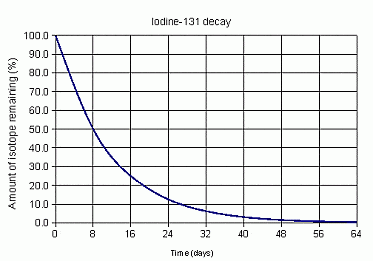
At the end of fourth half-life, the percentage of element left is 6.25% of the original quantity.
Given: A + 3B -> 2C + D
This reaction is first order with respect to reactant A and second order with respect to reactant B. If the concentration of A is doubled and the concentration of B is halved, the rate of the reaction would __ by a factor of __.
increase, 2
decrease, 2
increase, 4
decrease, 4
not change
Q2. For a reaction A +B → C, the experimental rate law is found to be R=k[A]1[B]1/2. Find the rate of the reaction when [A] = 0.5 M, [B] = 0.01 M and k=0.03.
a) 4.74 × 10⁻² (L/mol)1/2 s-1
b) 5.38 × 10⁻² (L/mol)1/2 s-1
c) 1.50 × 10⁻³ (L/mol)1/2 s-1
d) 4.86 × 10⁻² (L/mol)1/2 s-1
How are the exponents n and m determined?
For an elementary reaction 2A + B →C + D, the molecularity is
zero
one
two
three
The time taken for 10% completion of a first order reaction is 20 mins .Then for 19% completion ,the reaction will take
50 mins
30 mins
40 mins
60 mins
What happened to the rate of reaction, if concentration of reactant is 'zero order'.
rate of reaction will become double
rate of reaction will become triple
rate of reaction will become quadrapel
No affect to the rate of reaction
In a zero-order reaction for every 10° rise of temperature, the rate is doubled. If the temperature is increased from 10°C to 100°C, the rate of the reaction will become
64 time
128 times
256 times
512 times
Radioactivity of a sample (z = 22) decreases 90% after 10 years. What will be the half-life of the sample?
5 years
2 years
3 years
10 years
Which of these changes with time for a first-order reaction?
A. Rate of reaction
B. Rate constant
C. Half-life
A only
B only
A & C only
A & B only
For a chemical reaction A → B, the rate of the reaction is
2 × 10⁻³ mol dm–3 s–1 when the initial concentration is 0.05 mol dm–3. The rate of the same reaction is 1.6 × 10⁻²mol dm–3 s–1 when the initial concentration is 0.1 mol dm–3. The order of the reaction is
0
3
1
2
reaction rate constant also known as
specific reaction rate
reaction rate
rate reaction
none

Two beakers have liquids in them. When you add a base such as ammonia to beaker 1, the pH did not change. But when you add ammonia to beaker 2, the pH changes drastically. Choose the best explanation.
Beaker 1 had only water and Beaker 2 contained a buffer.
Beaker 1 contained a buffer and Beaker 2 contained only water.
Beaker 2 contained an acid.
The beaker that changed pH contained a buffer.
What is the molarity of 4 g of NaCl (MM=58.45) in 3,200 mL of solution?
0.021 M
0.214 M
0.315 M
What is the molarity of a solution made by diluting 26.5 mL of 6.00M HNO3 to a volume of 250 mL?
15.9 M
0.636 M
0.642 M
1.59 M
Molar mass of SO2 is
64 a.m.u
64 g
48 a.m.u
In reaction 2SO2+O2 → 2SO3
0.2 moles of product will be formed by
3.2 g of Oxygen
32 g of Oxygen
1.6 g of Oxygen
16 g of Oxygen
Reactant that is left unreacted in a chemical reaction is called
(a)
Select all the correct options for chemical units of concentration
Normality
Mole fraction
ppm
weight percent
For a given succinic acid solution
Its Molarity and Formality are different
Its Molarity is same as Formality
Number of moles of HCl in 500 mL of 6.0 M solution
1.2 moles
3.0 moles
0.8 moles
Normality and Molarity are related as (p is number of reaction units)
pMolarity
Molarity x p
Ca+2 → Ca value of 'p' for this reaction is _____ and hence its equivalent weight is _________its molar mass
(a)
molality is a temperature dependent concentration unit
True
False
For a redox reaction involving KMnO4 in presence of H2SO4, equivalent wt. of KMnO4 will be
One fifth of its Molecular weight
Same as its molecular weight
One third of its molecular weight
5 times its molecular weight
0.1 ppm solution means
0.1 moles of solute dissolved per litre of solution
0.1 moles of solute dissolved per 1000L of solution
0.1 millimoles of solute dissolved per 1000L of solution
0.1 mg of solute per litre of solution
Amount of CaCl2 required to prepare 1 L of 10 ppm solution w.r.t Ca2+ ions is (At. wt of Ca = 40, Cl= 35.5)
44 mg
10 mg
27.75 mg
A substance that gives solution of exact known concentration is called
(a)
The coefficients in a chemical equation represent the
masses, in grams, of all reactants and products.
relative numbers of moles of reactants and products.
number of atoms in each compound in a reaction.
number of valence electrons involved in the reaction.
8 g of sugar is dissolved in 42g of water. What is the concentration (%w/w) of the solution formed?
16%
14%
18%
20%
A bottle of concentrated nitric acid, HNO3 solution has a label of "85.00% by mass" and density of 0.8362 gmL-1. Calculate the molarity and molality of the concentrated nitric acid solution.
11.28 M and 98.95 molal
10.18 M and 85.95 molal
11.28 M and 89.95 molal
10.18 M and 86.95 molal
How many moles of hydrogen are needed to react with 2 moles of nitrogen?
To convert liters of a solution to moles, one should:
divide by the molarity
multiply by the molarity
multiply by the molar mass
divide by the molar mass then multiply by the speed of light squared
The buffer solution is able to maintain pH by some events, except . . .
The addition of a little acid
The addition of a little base
Dilution
Addition of water
The addition of excess acid
The pH solution that consist of CH3COOH 0.01 M and CH3COONa 0.01 M with Ka = 10-5 is . . .
4
5
6
8
9
a buffer solution is made by mixing HA, a weak acid, with salts containing A- ions.
HA ↔ H+ + A-
a formula that can be used for the calculation of the pH of this buffer solution is


Ionic product of water increases if
Pressure is reduced
H + is added
OH - is added
Temperature is increased
PH of 10-8M NaOH solution is
8
6.8
7
4
Identify the order from the following rate constant : k =9.3×10⁻³ L mol-1s-1
second order
first order
zero order
third order
Who invented the pH scale?
S.P.L.Sorenson
Benjamin Franklin
Henry Moseley
Wilhelmina Rontgen

pH change from 6.5 to 4.2 would indicate that a ___________ solution was added
basic
acidic
buffer
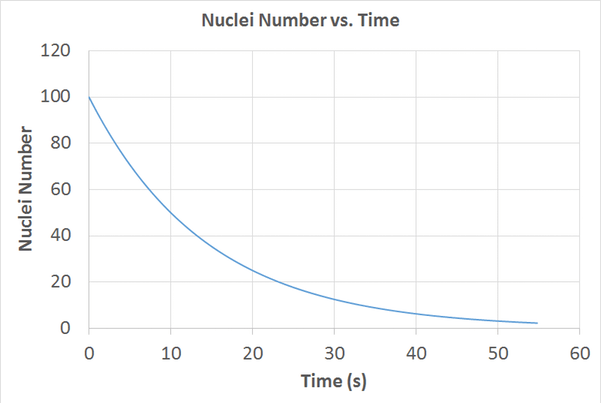
What is the Half life of this isotope?
5 seconds
10 seconds
15 seconds
20 seconds


After the third half-life, how much of the sample is left?
1/2
1/3
1/16
1/8
it quantifies the ability of a solution to resist changes in pH by either absorbing or desorbing H+ and OH- ions.
Buffer Capacity
Buffer Solution
Buffer Index
Buffer Value
What is the change in pH upon adding 0.024M of NaOH to a liter of a buffer containing 0.04M sodium bicarbonate and 0.04M acetic acid? (Ka = 1.75 X 10- 5M)
(a)
What is the pH of a buffer solution prepared with 0.05 M ammonia and 0.05 M ammonium chloride. The Kb value of ammonia is 1.80 × 10⁻⁵ at 25°C.
(a)
Molarity is measured in _____.
moles per g.
mols per L.
moles per mm.
moles per mL.
What do molarity and molality have in common?
Both have "moles solute" in the numerator
Both have "kg solvent" in the denominator
Both have "L solution" in the denominator
Both have "moles solution" in the denominator
suppose a hydrochloric acid solution contains 36 g of HCl and 64 g of H2O.what is the mole fraction of HCl?
0.78
0.99
0.22
3.6
When calculating molality, Kg of the following are included in the calculation?
solvent
solute
none of these
solvent & solute
40 grams of NaOH = ________ moles
1
2
160
1600
If 1 mole of solute is dissolved in 1 liter of water, what is the molarity?
2M
.5M
1M
It can't be determined unless you know the solute
When you make a dilution, which of these values remains constant?
The molarity (M)
The total moles of solute
The volume (V)
The concentration
As we dilute a solution.....
The volume increases and the molarity (M) increases
The volume increases and the molarity (M) decreases
The volume decreases and the molarity (M) increases
The volume decreases and the molarity (M) decreases
When a solution is heated until it boils, the molarity...
Doesn't change because everything evaporates
Decreases
Increases
Will become 1M

