
 Worksheets
Solutions and their Concentrations
Total questions: 63
Worksheet time: 32mins
Fill in the blank: One of the topics covered in Chapter 4 'Solutions and their Concentrations' is _________.
Types of Solutions
Electrolysis of Water
Periodic Table Trends
Organic Reaction Mechanisms
Fill in the blank: Chapter 4 'Solutions and their Concentrations' discusses _________, which refers to the various methods used to describe how much solute is present in a solution.
Different Ways of Expressing Concentration
Chemical Bonding
Types of Chemical Reactions
Properties of Acids and Bases
Fill in the blank: The process of making solutions is called _________, as mentioned in Chapter 4 'Solutions and their Concentrations'.
Preparation of Solutions
Evaporation
Filtration
Distillation
Fill in the blank: Chapter 4 'Solutions and their Concentrations' includes a topic on _________, which involves the measurement and calculation of how substances behave in solutions.
Activity and Activity Coefficients
Molarity and Molality
Osmosis and Diffusion
Electrolysis and Conductivity
What is a solution? A solution is a __________ mixture of two or more substances.
homogeneous
heterogeneous
colloidal
suspension
Which of the following is the substance present in a smaller amount in a solution?
A) Solute
B) Solvent
Which of the following is the substance present in a larger amount in a solution?
A) Solute
B) Solvent
A solution may be __________ (such as air), __________ (such as an alloy), or __________ (seawater, for example).
gaseous, solid, liquid
liquid, solid, gaseous
solid, gaseous, liquid
liquid, gaseous, solid
True or False: A solution is always a liquid.
True
False
Fill in the blank: A ________ solution is a solution that contains the maximum amount of a solute in a given solvent, at a specific temperature. Q = K
saturated
dilute
unsaturated
supersaturated
Fill in the blank: An ________ solution is the solution that contains less solute than it has the capacity to dissolve. Q < K
unsaturated
saturated
supersaturated
dilute
A ________ solution is the solution that contains more solute than the solvent can normally dissolve. Q > K
supersaturated
saturated
dilute
unsaturated
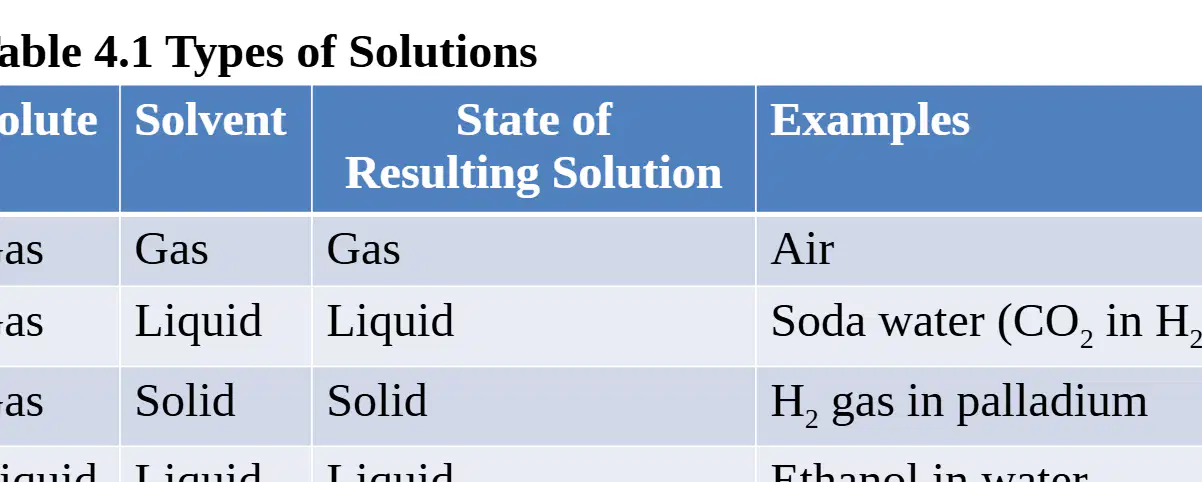
Based on Table 4.1 Types of Solutions, fill in the blank: When both the solute and solvent are gases, the state of the resulting solution is _____. Example: Air.
Gas
Liquid
Solid
Aqueous
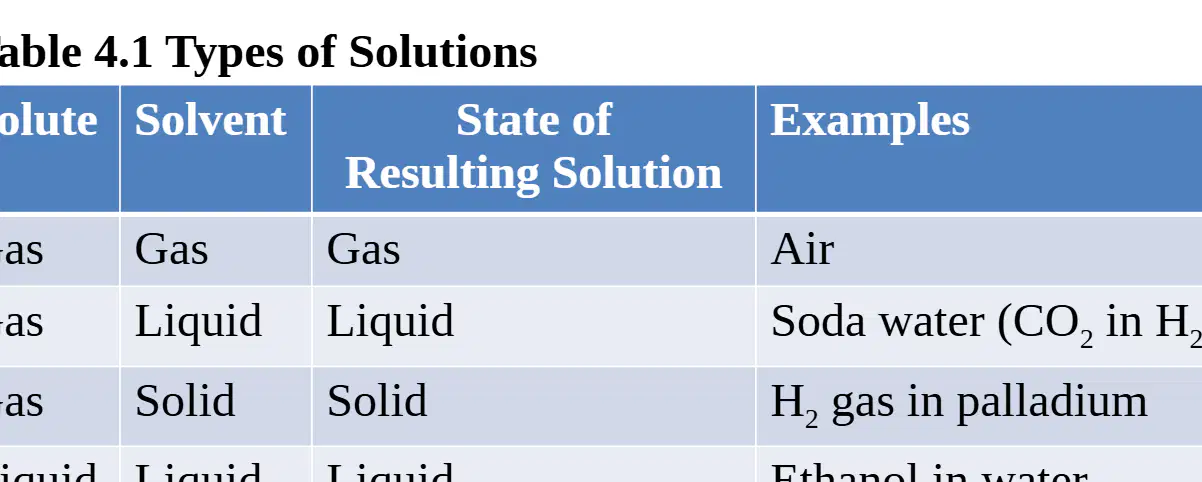
Based on Table 4.1 Types of Solutions, fill in the blank: When the solute is a gas and the solvent is a liquid, the state of the resulting solution is _____. Example: Soda water (CO₂ in H₂O).
Liquid
Solid
Gas
Aqueous
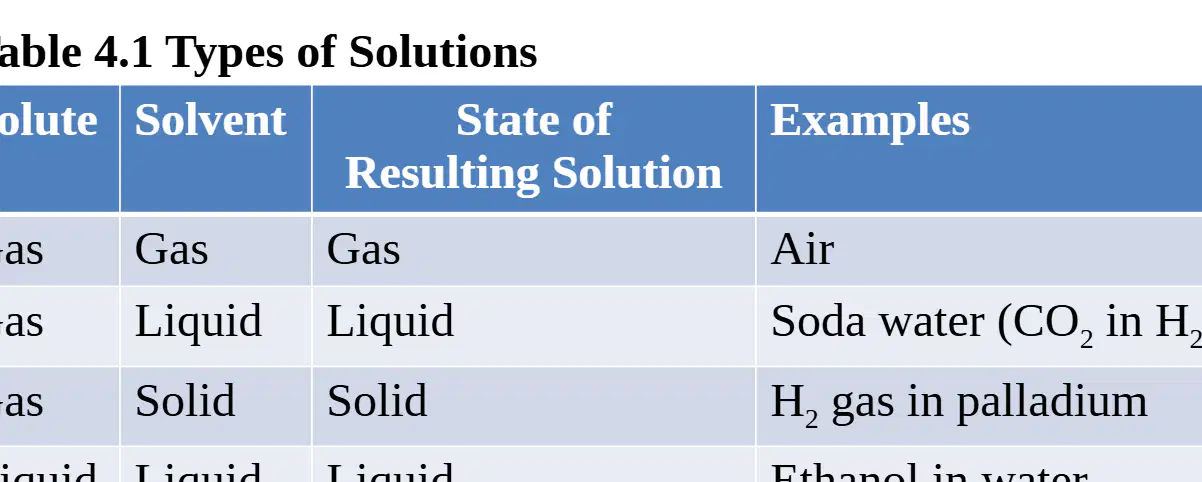
Based on Table 4.1 Types of Solutions, fill in the blank: When the solute is a gas and the solvent is a solid, the state of the resulting solution is _____. Example: H₂ gas in palladium.
Solid
Liquid
Gas
Aqueous
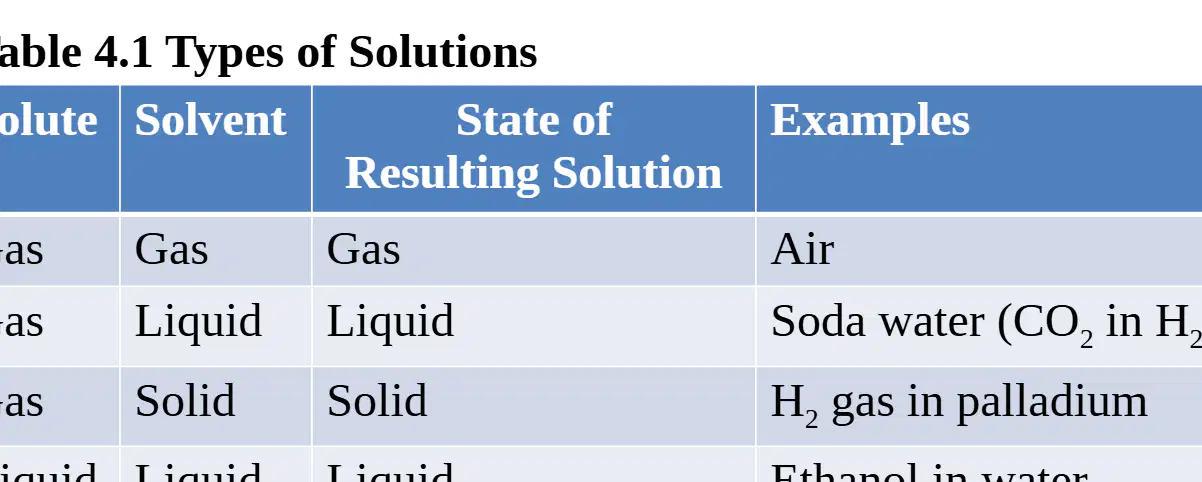
Based on Table 4.1 Types of Solutions, fill in the blank: When both the solute and solvent are liquids, the state of the resulting solution is _____. Example: Ethanol in water.
Liquid
Solid
Gas
Plasma
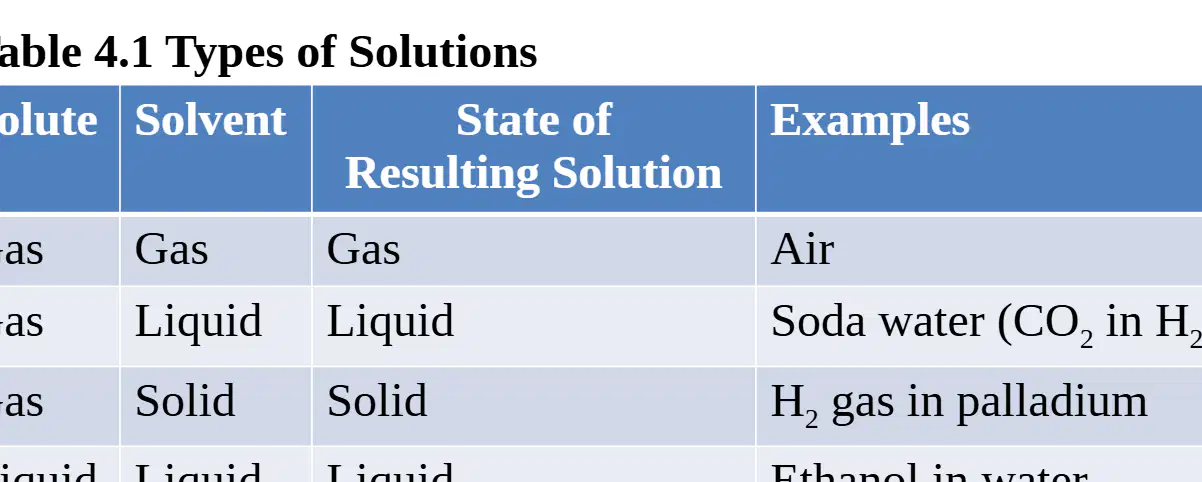
Based on Table 4.1 Types of Solutions, fill in the blank: When the solute is a solid and the solvent is a liquid, the state of the resulting solution is _____. Example: NaCl in water.
Liquid
Solid
Gas
Plasma
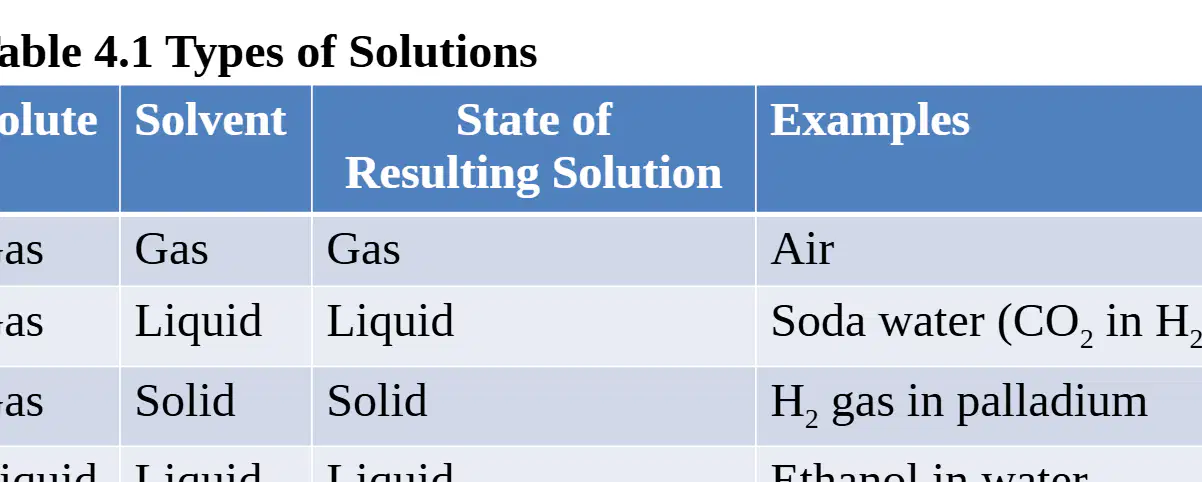
Based on Table 4.1 Types of Solutions, fill in the blank: When both the solute and solvent are solids, the state of the resulting solution is _____. Example: Brass (Cu/Zn), solder (Sn/Pb).
Solid
Liquid
Gas
Aqueous
Which of the following is NOT a type of interaction involved in the formation of solutions?
solvent-solvent interaction
solute-solute interaction
solvent-solute interaction
solute-gas interaction
If the solvent-solute attraction is stronger than the solvent-solvent attraction and solute-solute attraction, the solution process is:
unfavorable
favorable
neutral
impossible
If the solute-solvent interaction is weaker than the solvent-solvent and solute-solute interactions, the solution process is:
exothermic
endothermic
neutral
impossible
If the solution process is exothermic, Hsoln is ____ (greater than/less than/equal to) 0.
less than
greater than
equal to
not defined

Step 1 is the separation of solvent molecules. Is this process endothermic or exothermic?
Endothermic
Exothermic

Step 2 entails the separation of solute molecules. Is this process endothermic or exothermic?
Endothermic
Exothermic

Steps 1 & 2 require energy input to break attractive intermolecular forces; therefore, they are _________.
endothermic
exothermic
neutral
spontaneous
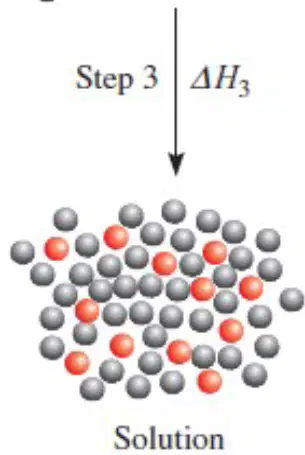
In step 3, the solvent and solute molecules mix. This step may be:
Exothermic
Endothermic
Both exothermic or endothermic
The heat of solution (Hsoln) is given by the equation: Hsoln = H1 + H2 + H3. Fill in the blanks for what H1, H2, and H3 represent.
H1 = Separation of solvent molecules H2 = Separation of solute molecules H3 = Mixing of solvent and solute molecules
H1 = Mixing of solvent and solute molecules H2 = Separation of solvent molecules H3 = Separation of solute molecules
H1 = Separation of solute molecules H2 = Mixing of solvent and solute molecules H3 = Separation of solvent molecules
H1 = Separation of solvent molecules H2 = Mixing of solvent and solute molecules H3 = Separation of solute molecules
Fill in the blank: The amount of solute present in a given amount of solvent, or a given amount of solution, is called the ________ of a solution.
concentration
temperature
density
volume
Which of the following is expressed as mol/L?
Molarity
Normality
Molality
Mole fraction
Which of the following is expressed as eq/L?
Molarity
Normality
Molality
Percent by mass
Which of the following is expressed as mol/Kg?
Molarity
Normality
Molality
Percent by volume
Fill in the blank: The ratio of the number of moles of a component to the total number of moles in the solution is called ________.
mole fraction
molarity
normality
molality
Fill in the blank: The concentration of a solution can be expressed as percent by ________ or percent by ________.
mass; volume
weight; density
temperature; pressure
length; area
Calculate the molar concentration of ethanol in an aqueous solution that contains 2.30 g of C₂H₅OH (46.07 g/mol) in 3.50 L of solution. What is the molar concentration of ethanol?
0.0143 M
0.0660 M
0.00143 M
0.143 M
Given: 2.30 g of C2H5OH and the molar mass of C2H5OH is 46.07 g/mol. Calculate the number of moles of C2H5OH.
0.04992 mol C2H5OH
0.500 mol C2H5OH
0.0200 mol C2H5OH
0.100 mol C2H5OH
What is the molar concentration of C2H5OH if 2.30 g is dissolved in 3.50 L of solution?
0.0143 M
0.0234 M
0.0078 M
0.0356 M
Which formula is used to calculate the molar concentration (M) of a solution?
M = mass/volume
M = moles/volume
M = volume/moles
M = moles × volume
The molality, m, of a solute in solution is the number of moles of solute per ________ of solvent.
kilogram
liter
gram
milliliter
What is the molality of a solution that contains 54.6 g of CH3OH in 108 g of water?
5.00 mol/kg
1.57 mol/kg
3.00 mol/kg
0.50 mol/kg
How many grams of H2O must be used to dissolve 50.0 grams of sucrose to prepare a 1.25 m solution of sucrose, C12H22O11?
27.4 grams
94.1 grams
50.0 grams
32.0 grams
Exercise: Calculate the molality of a solution that contains 56.5 g of benzoic acid, C6H5COOH, in 350 mL of ethanol, C2H5OH. The density of ethanol is 0.789 g/mL. Fill in the blank with the correct molality value.
1.7 m C6H5COOH in C2H5OH
0.5 m C6H5COOH in C2H5OH
2.3 m C6H5COOH in C2H5OH
3.0 m C6H5COOH in C2H5OH
What are the mole fractions of CH3OH and H2O in the solution containing 54.6 grams of CH3OH and 108 grams of H2O?
CH3OH: 0.25, H2O: 0.75
CH3OH: 0.33, H2O: 0.67
CH3OH: 0.50, H2O: 0.50
CH3OH: 0.20, H2O: 0.80
What are the mole fractions of ethanol, C₂H₅OH, and water in a solution prepared by mixing 55.0 g of ethanol with 45.0 g of water?
Mole fraction of ethanol (X_C₂H₅OH) = 0.322, Mole fraction of water (X_H₂O) = 0.678
Mole fraction of ethanol (X_C₂H₅OH) = 0.450, Mole fraction of water (X_H₂O) = 0.550
Mole fraction of ethanol (X_C₂H₅OH) = 0.500, Mole fraction of water (X_H₂O) = 0.500
Mole fraction of ethanol (X_C₂H₅OH) = 0.678, Mole fraction of water (X_H₂O) = 0.322

What is the formula for percent by mass of solute?
(mass of solute / mass of solute + mass of solvent) × 100%
(mass of solute / mass of soln) × 100%
(mass of solvent / mass of solute) × 100%
(mass of solute / mass of solvent) × 100%
Fill in the blank: The percent by mass is a ______ number because it is a ratio of two similar quantities.
unitless
whole
fractional
decimal
Percent by mass is also called percent by weight or the ______ percent.
weight
volume
density
mole
A solution is prepared by mixing 1.00 g ethanol with 100.0 g water to give a final volume of 101 mL. Calculate the molarity of ethanol in this solution. (Show your answer in M)
0.215 M
0.105 M
0.325 M
0.500 M
A solution is prepared by mixing 1.00 g ethanol with 100.0 g water to give a final volume of 101 mL. Calculate the mass percent of ethanol in this solution.
0.99%
1.00%
1.10%
0.90%
A solution is prepared by mixing 1.00 g ethanol with 100.0 g water to give a final volume of 101 mL. What is the mole fraction of ethanol in this solution?
0.0043
0.0217
0.0108
0.0017
A solution is prepared by mixing 1.00 g ethanol with 100.0 g water to give a final volume of 101 mL. Calculate the molality of ethanol in this solution.
0.217 mol/kg
0.010 mol/kg
0.100 mol/kg
0.500 mol/kg
What is the formula for calculating the mass percent of C2H5OH in a solution?
(mass of C2H5OH / mass of solution) × 100%
(mass of solution / mass of C2H5OH) × 100%
(mass of C2H5OH / volume of solution) × 100%
(volume of C2H5OH / mass of solution) × 100%
Calculate the mass percent of C2H5OH if 1.00 g C2H5OH is dissolved in 100.0 g H2O. Show your answer as a percentage.
0.990% C2H5OH
1.00% C2H5OH
0.900% C2H5OH
0.500% C2H5OH
What is the formula for calculating the mole fraction of C2H5OH in a solution?
nC2H5OH / (nC2H5OH + nH2O)
nH2O / (nC2H5OH + nH2O)
nC2H5OH / nH2O
nH2O / nC2H5OH
If 100.0 g H2O is used, how many moles of H2O are present?
5.56 mol
1.80 mol
0.56 mol
10.0 mol
Calculate the mole fraction of C2H5OH if 2.17×10⁻²molC2H5OH is mixed with 5.56molH2O .
0.00389
0.0123
0.278
0.00456
A solution of phosphoric acid was made by dissolving 10.0 g H₃PO₄ in 100.0 mL water. The resulting volume was 104 mL. Calculate the density of the solution. Assume water has a density of 1.00 g/cm³. (Give your answer in g/mL)
1.06 g/mL
0.96 g/mL
1.10 g/mL
1.00 g/mL
A solution of phosphoric acid was made by dissolving 10.0 g H₃PO₄ in 100.0 mL water. The resulting volume was 104 mL. Calculate the mole fraction of H₃PO₄ in the solution. Assume water has a density of 1.00 g/cm³.
0.018
0.12
0.0018
0.0025
A solution of phosphoric acid was made by dissolving 10.0 g H₃PO₄ in 100.0 mL water. The resulting volume was 104 mL. Calculate the molarity of H₃PO₄ in the solution. Assume water has a density of 1.00 g/cm³.
0.98 M
0.75 M
1.20 M
0.50 M
A solution of phosphoric acid was made by dissolving 10.0 g H₃PO₄ in 100.0 mL water. The resulting volume was 104 mL. Calculate the molality of H₃PO₄ in the solution. Assume water has a density of 1.00 g/cm³.
1.02 m
0.96 m
1.25 m
0.85 m
Normality (N) = ________
Number of equivalents of solute per liter of solution
Number of moles of solute per liter of solution
Number of grams of solute per liter of solution
Number of atoms of solute per liter of solution
Normality (N) is defined as the number of equivalents of solute per liter of solution. Fill in the blank: N x V = ________
Number of equivalents of solute
Number of moles of solute
Volume of solution in liters
Molarity of solution
Normality (N) is defined as the number of equivalents of solute per liter of solution. Example 1: A solution of sulfuric acid contains 86 g of H₂SO₄ per liter of solution. Calculate the normality of this solution.
1.76 N
0.88 N
2.00 N
0.50 N
Calculate the normality of the solution.
1.76 N
0.88 N
2.50 N
0.50 N

