
 Worksheets
PRACTICE EXAM 3
Total questions: 61
Worksheet time: 1hrs 14mins
Which polysaccharide contains glucose-alpha-1-4-glucose linkages?
cellulose
amylose
amylopectin
glycogen
Which polysaccharide is made up of dense alpha 1,4 and alpha 1,6 linkages?
cellulose
amylose
amylopectin
glycogen
this disaccharide contains glucose-beta-1,4-glucose linkages
sucrose
lactose
maltose
cellobiose

What type of monosaccharide is in the figure?
D-glucose
D-galactose
L-glucose
L-galactose

Is the monosaccharide in the figure in L or D configuration?
L
D

Is this monosaccharide a ketone or aldehyde?
aldehyde
ketone

Which disaccharide is shown
sucrose
lactose
maltose
cellobiose

What is the name of the linkage
glucose-alpha-1,4-glucose
glucose-beta-1,4-glucose
glucose-alpha-1,4-fructose
glucose-alpha-1,2,-fructose

Is this a reducing sugar or non-reducing sugar
reducing
nonreducing
neither

In this REDOX reaction, what is oxidized?
malate
NAD+
NADH
oxaloacetate

In this REDOX reaction, which is reduced?
malate
NAD+
NADH
oxaloacetate

Which step in the citric acid cycle does this reaction occur?
step 1
step 3
step 4
step 8

What is the delta G of the reaction shown?
+30.5 kJ/mol
-30.5 kJ/mol
+61.9 kJ/mol
-61.9 kJ/mol
How is NADH recycled back to NAD+ in animals?
Pyruvate is reduced to acetaldehyde
NADH is reduced to NAD+
Pyruvate is reduced to lactate
NADH is oxidized to NAD+
Which step/s in glycolysis are control steps?
Step 1
Step 2
Step 3
Step 7
Which step/s in glycolysis produce ATP?
Step 1
Step 3
Step 4
Step 7
Which enzymes are control enzymes in glycolysis?
aldolase
hexokinase
phosphoglycerate kinase
pyruvate kinase
phosphofructokinase

What enzyme is involved in this reaction?
Pyruvate kinase
Acetyl CoA dehydrogenase
Pyruvate dehydrogenase
Acetyl CoA kinase

Which step in the citric acid cycle is indicated in the image?
Step 3
Step 4
Step 5
Step 6

What enzyme catalyzes this reaction?
Acetyl CoA synthase
Oxaloacetate dehydrogenase
Citrate dehydrogenase
Citrate Synthase
What is the function of the Glyoxylate cycle?
convert pyruvate into acetyl coa
convert acetyl coa into carbohydrates
convert pyruvate into carbohydrates
convert carbohydrates into acetyl coa
Where does glycolysis occur in the cell?
cytosol
matrix of the mitochondria
inner mitochondrial membrane
inner membrane space
Where does CAC occur in the cell?
cytosol
matrix of the mitochondria
inner mitochondrial membrane
inner membrane space
Where does electron transport chain occur in the cell?
cytosol
matrix of the mitochondria
inner mitochondrial membrane
inner membrane space
What kind of enzyme/s is used in steps 2, 5, and 8 of glycolysis?
kinase
dehydrogenase
mutase
isomerase
What kind of enzyme is used in adding phosphate groups?
phosphatase
kinase
dehydrogenase
aldolase
If fructose-6-phosphate is fed into aerobic respiration in the liver, how much ATP is produced?
30 ATP
31 ATP
32 ATP
33 ATP
If glycogen is fed into aerobic respiration in the muscle, how much ATP is produced?
30 ATP
31 ATP
32 ATP
33 ATP
What is reduced in Complex I?
NADH
CoQ
CoQH2
NAD+
What is reduced in Complex III?
Cyt C [Fe(II)]
CoQH2
Cyt C [Fe(III)]
CoQ
If triosephosphate dehydrogenase is unable to function in aerobic respiration, how much ATP is made in aerobic respiration in the brain?
10
12.5
14
15
The ATP/ADP & NADH/NAD+ ratio of a resting metabolic state of the cell is
low, high
high, low
high, high
low, low
Which are the control enzymes of the citric acid cycle?
citrate synthase
succinate dehydrogenase
ketoglutarate dehydrogenase
isocitrate dehydrogenase
If glutamine is converted into alpha-ketoglutarate and fed into the CAC, how much ATP is produced?
7.5 ATP
10 ATP
12.5 ATP
15 ATP
If serine is converted to pyruvate and put into aerobic respiration, how much ATP will be made?
25 ATP
20 ATP
12.5 ATP
10 ATP
What is the ATP/ADP and NADH/NAD+ ratio in a cell in an active metabolic state?
low, high
high, low
high, high
low, low

What is being reduced in this reaction?
CoQH2
2 Cyt C [Fe(III)]
CoQ
2 Cyt C [Fe(II)]
What type of enzyme catalyzes the reaction?
oxidase
oxidoreductase
dehydrogenase
kinase
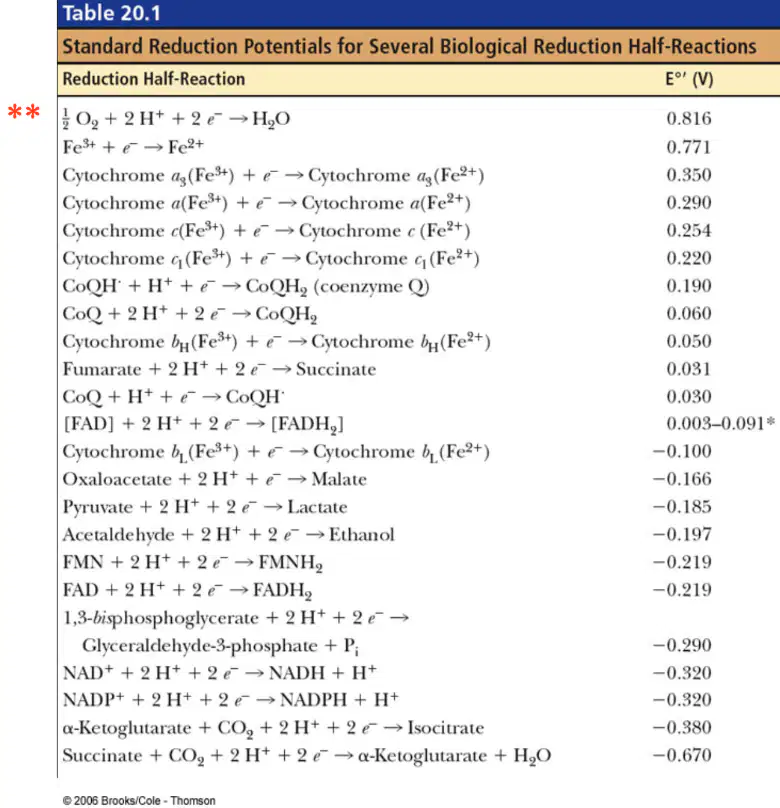
If a reaction with the following components is run: alpha-ketoglutarate, isocitrate, oxaloacetate, and malate, then what is oxidized and reduced?
oxidized:
isocitrate
reduced: oxaloacetate
oxidized:
oxaloacetate
reduced:
oxaloacetate
oxidized:
isocitrate
reduced:
malate
oxidized:
oxaloacetate
reduced:
malate
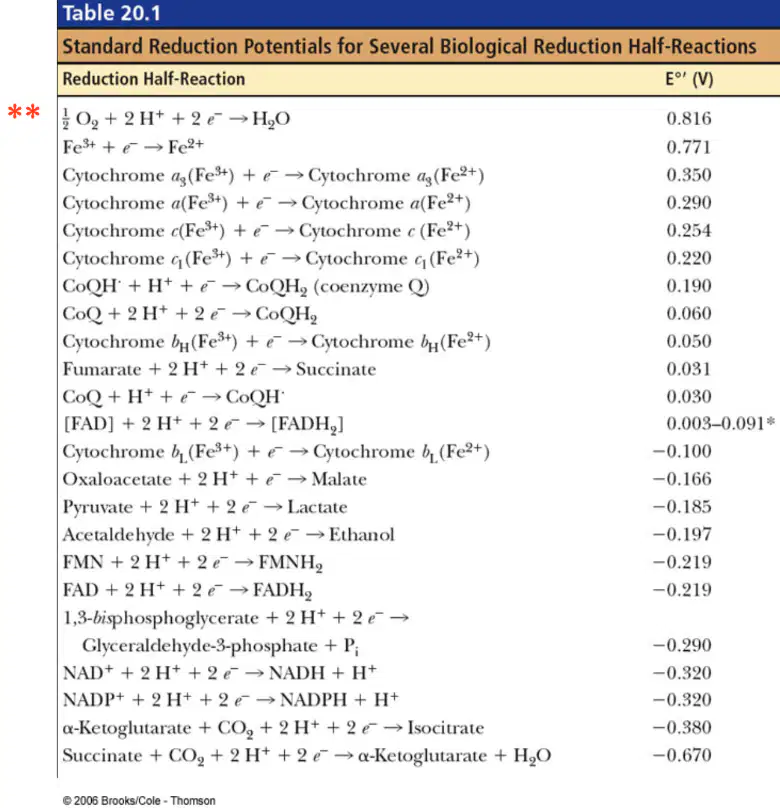
What is oxidized and reduced if the following were run in a reaction: acetaldehyde, ethanol, water, oxygen
oxidized:
Oxygen
reduced:
acetaldehyde
oxidized:
water
reduced:
ethanol
Oxidized:
ethanol
reduced:
oxygen
oxidized:
acetaldehyde
reduced:
water
Which complexes pump H+ across into the intermembrane space?
I, III, IV
II, III, IV
I,II,IV
II, III, IV
Which complexes in the electron transport chain can use FADH2?
I, III, IV
II, III, IV
I, II, IV
I, III, IV
Which part of ATP synthase contains the enzyme for making ATP?
F0
F1
O state
L state
Which conformation of F1 binds ADP and Pi and is not catalytically active?
O state
L state
T state
Which conformation of F1 is catalytically active and makes ATP?
O state
L state
T state
If maltose is fed into aerobic respiration in the kidney how much ATP is made?
30
32
60
64
If fructose is broken down through aerobic respiration in the muscle, how much ATP is made?
30
32
60
64
If fructose-1,6-bisphosphate was fed into aerobic respiration in the brain, how much ATP will be produced?
30
32
34
36
Which of the following can pass through the mitochondrial membrane?
Oxaloacetate
Malate
NAD+
NADH
pyruvate
When the electron transport chain is active, what are the conditions in the mitochondrial matrix?
basic
acidic
positive
negative
What are the reasons ATP is a high energy molecule?
electrostatic repulsion between negative charges
electrostatic repulsion between positive charges
loss of entropy of the phosphate group
increased entropy of the phosphate group
How do uncouplers disrupt oxidative phosphorylation and the electron transport chain?
H+ is pumped into inner membrane space
H+ is leaked back into matrix space
ATP produced increased
ATP produced decrease
When electrons are passed through the electron transport chain, how is the pH of the inner membrane space of the mitochondria affected?
pH increase
pH decreases
pH does not change
Arrange the following reactants of the electron transport in the order that they appear
I. Cytochrome C
II. CoQ
III. O2
I, II, III
I, III, II
II, I, III
II, III, I

The following carbohydrates are _______ of each other
enantiomers
diastereomers
anomers
epimers

The following are examples of
enantiomers
diastereomers
anomers
epimers
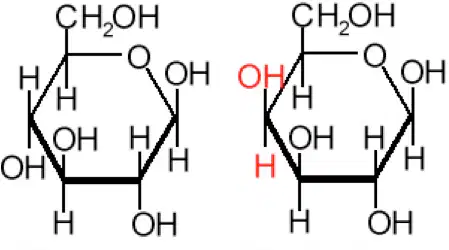
the following are examples of
enantiomers
diastereomers
anomers
epimers
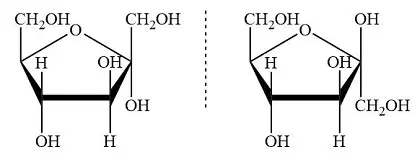
The following are _____ of each other
epimers
anomers
diastereomers
enantiomers
Which steps in the CAC produce CO2?
step 1
step 3
step 4
step 8
Pyruvate dehydrogenase kinase ______ the pyruvate dehydrogenase complex, so it _______ the CAC.
activates, activates
activates, inhibits
inhibits, inhibits
inhibits, activates
Pyruvate dehydrogenase phosphatase ______ the pyruvate dehydrogenase complex, so it _______ the CAC.
activates, activates
activates, inhibits
inhibits, inhibits
inhibits, activates

