wayground logo

Free Printable Worksheets

Font size

S
M
L
XL
Worksheets

Atoms, Elements, Ions Chp 3/4 Review Chem 1010

Total questions: 89

Worksheet time: 5hrs 22mins

Name
Class
Date
1.
Which is NOT a subatomic particle?
a)
Proton
b)
Neutron
c)
Isotope
d)
Electron
2.
The atomic number is equal to the number of _____________ in an atom.
a)
Neutrons
b)
Protons
c)
Isotope
d)
Mass Number
3.
How many valence electrons are in all alkaline earth metals?
a)
2
b)
3
c)
4
d)
1
4.
An isotope is defined as having the same number of protons, but different number of ____________.
a)
Electrons
b)
Neutrons
c)
Protons
d)
Quarks
5.
Atoms that have a filled outer main energy level are said to have?
a)
Octet
b)
Energy 
c)
Low mass
d)
Dot symbol
6.
Elements that are different chemical species, but have the same electron configuration are?
a)
Electrically neutral
b)
Ions
c)
Isoelectronic
d)
Isotopes
7.
Which is the correct order of filling an electron configuration?
a)
1s, 2s, 2p, 3p,4s, 4d, 5s
b)
2s, 2p, 3s, 4s, 1s, 3p.3d
c)
1s, 2s, 2p, 3s, 3p, 3d, 4s
d)
1s, 2s, 2p, 3s, 3p, 4s, 3d
8.
An element that has lost or gained electrons is called an?
a)
Isotope
b)
Ion
c)
Allotrope
d)
Octet
9.
What is the correct electron configuration for nitrogen.
a)
1s2, 2s3, 2p2
b)
1s2, 2s1, 3s2, 2p7
c)
1s2, 2s2, 2p3
d)
1s2,2s2,3p3
10.
Electrons that are located in the highest main energy level, that can be lost, gained or shared are called?
a)
Octet electrons
b)
Valence electrons
c)
Happy electrons
d)
Inner shell electrons
11.
Two neutral atoms that have the same atomic number and different mass numbers are
a)
Ions
b)
Isotopes
c)
Alpha particles
d)
Different elements
12.
Which of the following is a cation?
a)
Si4+
b)
Ti-48
c)
Co
d)
Ag-
13.

The image shows a beryllium atom. What will its charge be when it becomes an ion?

a)

+4

b)

+2

c)

-4

d)

-2

14.

Which of the following is a colorless gas?

a)

Kr

b)

Ca

c)

Cf

d)

Cr

15.

Which of the following atoms has 98 protons

a)

Tc

b)

Ho

c)

Ac

d)

Cf

16.
How many neutrons in C-14?
a)
6
b)
7
c)
14
d)
8
17.
Valence electrons are: 
a)
Electrons farthest away from the nucleus
b)
Electrons closest to the nucleus
c)
Electrons that just come and go - they don't stay with the atom
d)
Electrons in the second shell
18.
This could be the dot diagram of
a)
Be
b)
B
c)
C
d)
Ne
19.
This could be the dot diagram of
a)
P
b)
Ar
c)
Na
d)
B
20.

Which block does the element Zr reside in?

a)

s block

b)

p block

c)

d block

d)

f block

21.
In order of most to least penetrating radiation we have
a)
Alpha , Beta,  Gamma
b)
Beta , Gamma , Alpha
c)
Gamma, Beta, Alpha
d)
Gamma, Alpha, Beta
22.
What was Rutherford's conclusion from his Gold Foil Experiment?
a)
The atoms is mostly empty space with a very small positive and dense region.
b)
The atom is mostly empty space with a large negative and dense region.
c)
The atom is mostly empty space.
d)
The atom is very massive and alpha particles couldn't go through.
23.
This is a correct dot diagram for oxygen (O)
a)
true
b)
false
24.
This is a correct dot diagram for magnesium (Mg)
a)
true
b)
false
25.

How many main energy levels are possible?

a)

11

b)

7

c)

18

d)

6

26.

Select the ions that are isoelectronic with the noble gas, argon? (more than one answer to select).

a)

sulfide ion, S2-

b)

oxide ion, O2-

c)

chloride ion, Cl-

d)

sodium ion, Na+

e)

calcium ion, Ca2+

27.

If Calcium gives up its valence electrons, what is the Noble Gas configuration created?

a)

[K]

b)

[Ne]

c)

[Ar]

d)

[Mg]

28.
Light is emitted when an electron moves from the ________ state to the _________ state
a)
excited, ground
b)
ground, excited
29.

When an electron in a hydrogen atom jumps from an orbit farther from the nucleus to an orbit closer to the nucleus, it:

a)

emits four photons, one for each of the color lines observed in the line spectrum of hydrogen

b)

emits a single photon with an energy equal to the energy difference of the two orbits

c)

emits a number of photons dependent on the number of energy levels jumped over

d)

none of the above

30.
What particles make up light?
a)
Photons
b)
Neutrons
c)
Protons
31.
N2, Cl2, and O2 are all 
a)
diatomic molecules.
b)
ionic bonds.
c)
of equal mass.
d)
solids.
32.
What is the charge on a chloride ion?
a)
-1
b)
1
c)
+2
d)
+1
33.

Electrons NOT found in the highest main energy level are called?

a)

Nucleus electrons

b)

Inner core (shell) electrons

c)

Unreactive electrons

d)

Octet electrons

34.

Which is the CORRECT number of electrons that can fill sublevels s,p,d and f respectfully?

a)

2, 10, 14, 6

b)

6, 2, 10, 14

c)

2, 6, 10, 14

d)

10, 2, 14, 6

35.

24.1% of all the isotopes of a an element have a mass of 75.23 , 48.7% have a mass of 74.61 , and 27.2% have a mass of 75.20 .

What is the relative atomic mass of this element?

a)

74.92

b)

24.97

c)

75.01

d)

74.51

36.
Elements in the same ________ are more chemically similar.
a)
group
b)
period
c)
club
d)
table
37.
Which elements have the most similar chemical properties?
a)
K and Na
b)
K and Ca
c)
K and Cl
d)
K and S
38.

The element Tin occurs naturally as 10 isotopes. Each of these isotopes has:

a)

A different number of neutrons

b)

50 electrons

c)

50 protons

d)

All of the above

39.
An atom of argon has 18 protons and 22 neutrons. How many electrons does it have?
a)
18
b)
22
c)
40
d)
4
40.
An atom has 10 protons, 15 neutrons and 10 electrons what is its mass number.
a)
20
b)
10
c)
5
d)
25
41.

Which of the following elements is a soft, highly reactive metal that reacts with water to form hydrogen gas?

a)

Radium

b)

Bismuth

c)

Lithium

d)

Silicon

42.

Electrons of atoms must only occupy certain regions of space. This idea was stated by?

a)

Bohr

b)

Rutherford

c)

Goldstein

d)

Millikan

43.

What are the elements in group 1 (the far left) of the periodic table called?

a)

Alkali metals

b)

Alkaline earth metals

c)

Halogens

d)

Noble gases

44.

What are the elements in group 18 (the far right) of the periodic table called?

a)

Alkali metals

b)

Alkaline earth metals

c)

Halogens

d)

Noble gases

45.

What are the elements in group 17 of the periodic table called?

a)

Alkali metals

b)

Alkaline earth metals

c)

Halogens

d)

Noble gases

46.

What are the elements found along the "staircase" called? They have properties of both metals and non-metals.

a)

Metalloids

b)

Non-metals

c)

Transition metals

d)

Metals

47.
Which of the following is NOT one of the 4 most abundant elements in the human body?
a)
H
b)
C
c)
Fe
d)
O
48.
Which of the following are examples of Allotropes?
a)
Zinc and Zirconium
b)
Bromine-79 and Bromine-81
c)
Calcium Metal and Calcium Carbonate
d)
Red Phosphorus and White Phosphorus
49.
Which of the following groups DOES NOT typically form compounds?
a)
Alkali Metals
b)
Alkaline Earth Metals
c)
Halogens
d)
Noble Gases
50.
The majority of the periodic table of the elements consists of:
a)
Metals
b)
Nonmetals
c)
Halogens
d)
Metalloids
51.
The location of _____________ is group 15; period 3.
a)
N (Nitrogen)
b)
K (Potassium)
c)
P (Phosphorus)
d)
C (Carbon)
52.
Cations are
a)
negative ions
b)
gained electrons
c)
positive ions
d)
inner shell electrons
53.
If an atom has the configuration of 1s2 2s2 2p6 3s1 the atom will probably
a)
gain 1 electron
b)
lose 1 electron
c)
fill the 3p orbital
d)
lose the 2p orbital
54.
What is the number of neutrons?
a)
34
b)
79
c)
45
d)
35
55.
What type of ions do metals form?
a)
cations
b)
anions
56.
What types of ions do nonmetals form?
a)
cations
b)
anions
57.

Formula for barium sulfide

a)

B2S3

b)

BaS

c)

Ba2S

d)

BaS2

58.

Formula for lead (II) chloride

a)

PbCl2

b)

Pb2Cl

c)

Pb2Cl3

d)

Pb3Cl2

59.

Name for PBr2

a)

phosphorus bromide

b)

phosphorus dibromide

c)

phosphorus dibromine

d)

phosphorus bromine

60.

Formula for iron (II) carbonate

a)

FeCO3

b)

Fe2CO3

c)

FeCO2

d)

Fe2CO2

61.

Name the ionic compound, LiCl

a)

lithium chlorine

b)

lithium chloride

c)

lithium chlorate

d)

lithium monochloride

62.

Name the ionic compound, CaCO3

a)

calcium carbide

b)

calcium carbon trioxide

c)

calcium carbon oxide

d)

calcium carbonate

63.

What is the correct name of the compound P2O5

a)

phosphorous oxide

b)

diphosphorous pentoxide

c)

phosphorous pentoxide

64.
What is the OFFICIAL name for H2O
a)
Hydrogen Oxide
b)
Oxygen Dinitride
c)
Agua
d)
Dihydrogen Monoxide
65.

An ionic compound forms between a _______ and _______.

a)

metal and non-metal

b)

two metals

c)

two non-metals

66.
When writing Lewis Structures, only __________ electrons are used.
a)
Inner shell
b)
Core 
c)
Valence
d)
Stable
67.
Each line in a Lewis Structure represents __________ electron(s).
a)
3
b)
2
c)
1
d)
4
68.
Atoms of H only form _________ bonds.
a)
Double
b)
Single
c)
Multiple
d)
Triple
69.
Three pairs of electrons are shared in a
a)
Single bond
b)
Double bond
c)
Triple bond
70.

Which is the correct molecular structure for carbon dioxide?

a)
b)
c)
d)
71.

Which Lewis Dot Model drawing correctly shows an O2 molecule?

a)
b)
c)
d)
72.

How many total electrons are participating in bonding in the molecule CH2O?

a)

8

b)

4

c)

2

d)

3

73.
 A lone pair is defined as
a)
A pair of bonding electrons
b)
One non-bonding electron
c)
A pair of non-bonding electrons
d)
A pair of electrons on the central atom
74.
According to the octet rule most elements need _______ valence electrons.
a)
2
b)
8
c)
6
d)
18
75.
How many electrons should Nitrogen have around its Lewis dot model?
a)
1
b)
3
c)
4
d)
5
76.
What is the VSEPR theory used to predict?
a)
Bond Strength
b)
Polarity
c)
Molecular Shape
d)
Electronegativity
77.
What two types of atoms make a covalent bond?
a)
2 Nonmetals
b)
1 Nonmetal and 1 Metal
c)
2 Metals
d)
2 Noble Gases
78.
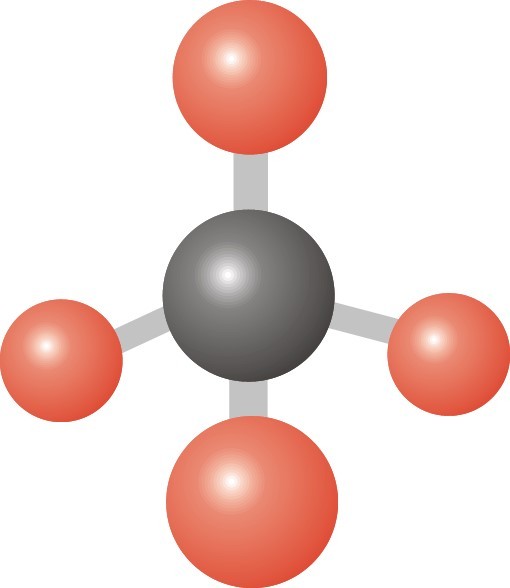
Who could this molecule be?
a)
CH4
b)
CO2
c)
PCl5
d)
BF3
79.

Will this molecule be polar or nonpolar? A molecule is polar when it has a lone pair of electrons, or when the atoms stemming from the central atom are shared unequally. PH3

a)

polar

b)

nonpolar

80.

What molecular geometry is the structure shown here? (H2O)

a)

tetrahedral

b)

trigonal planar

c)

bent

d)

trigonal pyramidal

81.

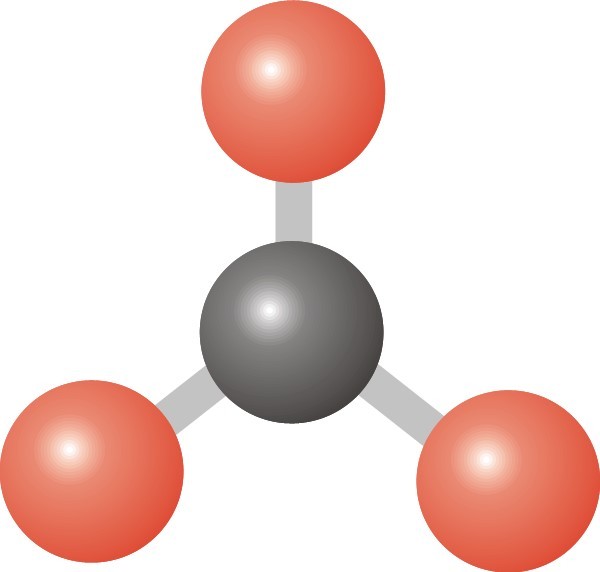
What molecular geometry is the structure shown here? (BCl3)

a)

linear

b)

trigonal planar

c)

tetrahedral

d)

trigonal pyramidal

82.
A bond where electrons are NOT shared equally? 
a)
polar covalent
b)
nonpolar covalent
83.
What molecule could this be? 
a)
BF3
b)
CH4
c)
H2O
d)
CO2
84.

Ionic Bonding involves...

a)

the transfer of protons

b)

the transfer of neutrons

c)

the transfer of electrons

d)

none of these choices

85.

What is the purpose of the picture?

a)

To represent D block electrons used in bonding

b)

To represent F block electrons used in bonding

c)

To represent valence electrons used in bonding

d)

To represent electrons in bonding to create instability

86.

What type of bond is this between the lithium and fluorine?

a)

ionic

b)

covalent

c)

metallic

d)

hydrogen bonding

87.

How many valence electrons are shown in the diagram?

a)

16

b)

7

c)

6

d)

2

88.

When writing the chemical formula of a compound that contains more than one of a particular polyatomic ion, _____ must be used.

a)

ionic charges

b)

parenthesis

c)

Greek prefixes

d)

lower case letters.

89.

How many atoms of oxygen are in a molecule of Ca3(PO4)2

a)

1

b)

2

c)

4

d)

8