
 Worksheets
Simple Machines - Updated Quiz
Total questions: 30
Worksheet time: 15mins
For an ideal machine, the ratio of mechanical advantage to the velocity ratio is
greater than 1
less than 1
equal to 1
depends on the value of load
Which of the following statements for a machine are correct? (i) Efficiency of a machine has no unit as it is a ratio. (ii) Mechanical advantage is the ratio of the effort to the load. (iii) For an ideal machine, work output = work input. (iv) The velocity ratio of a machine is the ratio of the velocity of the effort to the velocity of the load. Choose the correct option.
(i), (ii) and (iii) only
(i), (iii) and (iv) only
(i) and (iv) only
(ii) and (iii) only
A lever which always has mechanical advantage less than 1 has
load between the effort and the fulcrum
effort between the load and the fulcrum
fulcrum between the load and effort
effort and load act at same point
For class II levers
load is between the effort and the fulcrum
effort is between the load and the fulcrum
fulcrum is between the load and effort
effort and load act at same point
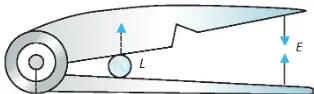
A pair of nut crackers is 12 cm long. An effort of 10 gf is required to crack a nut which is pressed at a point 3 cm from the finger. Based on this information, the mechanical advantage of the nut cracker is
3
4
36
6
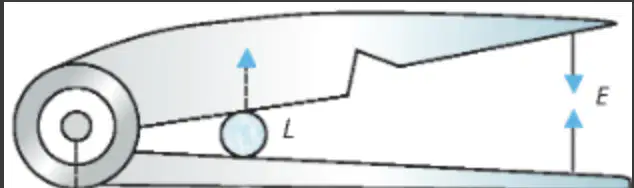
A pair of nut crackers is 12 cm long. An effort of 10 gf is required to crack a nut which is pressed at a point 3 cm from the finger. Based on this information, the load of the nut cracker is equal to
30 gf
2.5 gf
40 gf
20 gf
Which type of levers have mechanical advantage always more than 1?
Class I levers
Class II levers
Class III levers
None of these
The human forearm acts like a lever of
first order
second order
third order
None of these
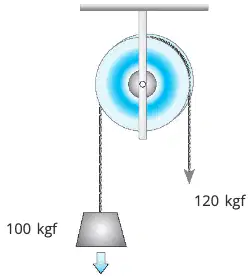
The figure shows a single fixed pulley. A man puts effort 120 kgf on this pulley and lifts a load of 100 kgf by 2 m. Based on this information, the mechanical advantage of the pulley is
0.45
0.43
0.83
0.85
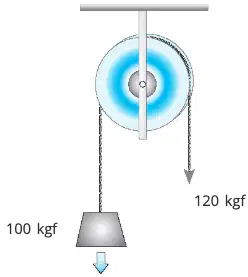
The figure shows a single fixed pulley. A man puts effort 120 kgf on this pulley and lifts a load of 100 kgf by 2 m. Based on this information, the velocity ratio of the pulley is
2
1
3
4
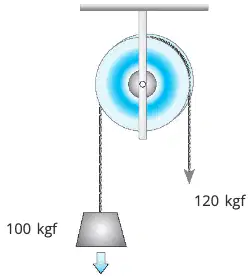
The figure shows a single fixed pulley. A man puts effort 120 kgf on this pulley and lifts a load of 100 kgf by 2 m. Based on this information, the efficiency of the pulley is
80%
85%
83%
100%
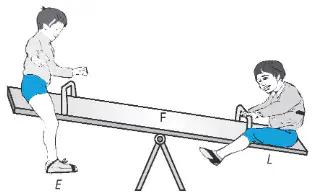
The uniform plank of a see-saw is 8 m long. A boy weighing 50 kgf sits at a distance of 2 m from the fulcrum. Where must another boy weighing 20 kgf sit, so as to balance the plank?
4 m
5 m
2.5 m
3 m
The mechanical advantage of an inclined plane is always
greater than 1
less than 1
equal to 1
depends on the value of load
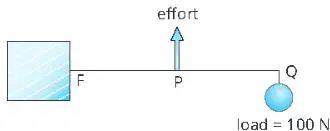
The diagram shows a simplified form of a lever with fulcrum at F, effort applied at P, and load of 100 N at Q. Answer the following based on this information: To which class of lever does it belong?
Class I levers
Class II levers
Class III levers
None of these
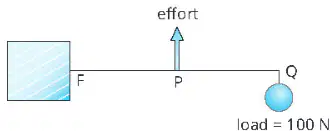
The diagram shows a simplified form of a lever with fulcrum at F, effort applied at P, and load of 100 N at Q. Which of the following belongs to this category of levers?
Bottle opener
Fire tongs
Pliers
Oar used for rowing a boat
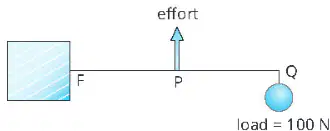
The diagram shows a simplified form of a lever with fulcrum at F, effort applied at P, and load of 100 N at Q. If FP = 5 cm and PQ = 95 cm, then the effort required to lift the load is
1900 N
1500 N
1200 N
2000 N
For greater efficiency of a block and tackle pulley system
the lower block should be of negligible weight
the upper and lower blocks should be of equal weights
the lower block should be heavier than upper block
the weight of rope should be equal to the weight of pulleys
The ideal mechanical advantage of a lever in which the effort arm is 60 cm and the load arm is 4 cm is
10
15
20
7.5
In which condition(s) the lever act as a speed multiplier?
When the effort arm is shorter than the load arm and mechanical advantage < 1
When the effort arm is longer than the load arm and mechanical advantage > 1
When the effort arm is shorter than the load arm and mechanical advantage > 1
When the effort arm is longer than the load arm and mechanical advantage < 1
A shears used for cutting a metal sheet has its blade 7 cm long while its handle is 14 cm long. If a force of 10 kgf is required to cut the metal sheet, what effort is applied to cut the sheet?
7 kgf
8 kgf
5 kgf
10 kgf
Which of the following is matched incorrectly?
See-saw: Class I Levers
A nut cracker: Class II Levers
Fire tongs: Class I Levers
Bread knife: Class III Levers
Which of the following statements is not true about a pulley?
A single fixed pulley is one which is fixed to a support.
A single movable pulley is not fixed to any support.
A movable pulley doubles the effort we exert.
A single movable pulley acts as a speed multiplier.
The correct relationship between the mechanical advantage, the velocity ratio, and the efficiency is
MA = η × VR
VR = η × MA
η = VR × MA
None of these
A single movable pulley has
velocity ratio 2, and actual mechanical advantage less than 2
velocity ratio 2, and actual mechanical advantage 2
velocity ratio 2, and actual mechanical advantage more than 2
velocity ratio less than 2, and actual mechanical advantage more than 2
For such levers if the effort arm is longer than the load arm, which of the following statement(s) is/are true? (i) The mechanical advantage is greater than 1. (ii) Mechanical advantage is less than 1. (iii) Such levers are used as force multipliers. (iv) Such levers are used as speed multipliers. Choose the correct option.
(i) and (iii) only
(ii) and (iv) only
(i) and (iv) only
(ii) and (iii) only
Which of the following statements is not true for a machine?
It always has efficiency less than 100%.
Its mechanical advantage can be less than 1.
It can also be used as a speed multiplier.
It can have a mechanical advantage greater than the velocity ratio.
A man can open a nut by applying a force of 60 kgf using a lever with handle length 0.4 m. What should be the length of the lever of another handle if the force required to open the nut is 30 kgf?
1 m
1.2 m
0.8 m
0.25 m
Which of the following is an example of a class III lever?
See-saw
Bottle opener
Nut cracker
Fishing rod
If the efficiency of a machine is 75% and the velocity ratio is 4, what is its mechanical advantage?
4.0
3.0
1.5
2.5
Which statement is correct for a single movable pulley?
It changes the direction of effort only
It has a mechanical advantage of 2 in ideal conditions
It cannot be used to lift heavy loads
It always has efficiency 100%

