
 Worksheets
16 Forensic Science Review Questions
Total questions: 16
Worksheet time: 8mins
Which statement best describes Locard’s Exchange Principle in forensic science?
Only DNA transfers during contact
Every contact leaves a trace of material
Evidence is destroyed by all contact
Traces move only from suspect to scene
What is the primary purpose of electrophoresis after PCR in lab analysis?
Separate DNA strands by size
Count total DNA strands
Measure protein volume
Identify genes on the DNA
Where are blood type proteins (antigens) located on red blood cells?
On the cell surface
Inside the nucleus
Floating in blood plasma
In the mitochondria
Which components make up blood?
Leukocytes, osteocytes, bile
Cartilage, osteocytes, plasma
Erythrocytes, neurons, plasma
Plasma, leukocytes, erythrocytes
For a c test showing DNA origin, half the DNA typically comes from which sources?
From the lab tech and from control sample
From the amniotic fluid and from embryo
From the mother and from the father
From the sibling and from the amniotic fluid
What is the most common fingerprint pattern found in populations?
Loop pattern is most common
Double loop is most common
Whorl pattern is most common
Arch pattern is most common
Which statement explains why understanding osmosis helps preserve tissues in forensic contexts?
It predicts how gases burn in air
It reveals how bones grow with pressure
It shows how water moves across membranes
It measures how light bends in liquids
Which simple procedure should be used to collect wet blood or other wet samples at a crime scene?
Pack the sample in a paper bag
Seal the sample in an airtight jar
Place the sample in a plastic wrap
Dry the sample under direct heat
What does a universal indicator primarily test?
Identifies acid or base pH
Detects protein sequences
Measures electrical resistance
Determines gas concentrations
In chromatography of water or alcohol mixtures, what is being separated?
Components by their molecular properties
Colors by their brightness levels
Liquids by their boiling temperatures
Solids by their hardness ratings
In ballistics, what does caliber describe?
Internal diameter of the barrel
Age of the ammunition batch
Length of the entire firearm
Weight of the bullet casing
A forensic anthropologist can most reliably determine which features from skeletal remains?
Age, sex, and ancestry traits
Exact height and recent weight
Current health and diet plan
Personal name and occupation
During gel electrophoresis, why do shorter DNA fragments move farther?
They carry weaker negative charges
They have higher temperatures
They experience less resistance in gel
They are pushed by stronger magnets
Which choice best matches blood typing with its key principle?
Antigens on red blood cell surface interact with antibodies
Red blood cell antigen proteins are inside cell nuclei
Antigens float in plasma fluid
Which practice reduces cross-contamination at a crime scene following Locard’s principle?
Change gloves between items handled
Use perfumes to mask odors
Speak loudly to coordinate teams
Store all items in one container
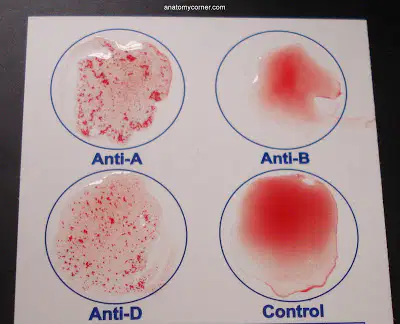
The blood type shown in the image is _______.
B negative
A negative
A positive
B positive

