
 Worksheets
Solidification and Grain Structure
Total questions: 98
Worksheet time: 49mins
Which sequence describes the two-step process of solidification in metals?
Growth followed by heterogeneous nucleation
Diffusion followed by precipitation
Nucleation followed by crystal growth
Coarsening followed by recrystallization
What forms when growing crystals in a cooling melt meet each other?
Twin planes between dendrites
Grain boundaries between crystals
Dislocation networks inside grains
Vacancy clusters at interfaces
A solid metal made of many individual crystals is called (a) .
In a solidifying crystal, atoms arrange primarily into what kind of pattern?
Irregular, highly distorted pattern
Quasi-periodic noncrystalline pattern
Random, amorphous configuration
Essentially regular crystal pattern
What term is used for individual crystals within a solid metal?
Domains
Cells
Phases
Grains
Which factor most directly controls whether the final structure is fine-grained or coarse-grained during solidification?
Cooling rate only
Mold material only
Alloy composition only
Number of nucleation sites
If only a few nucleation sites are active in a casting, the resulting grain size will be:
Fine and equiaxed near the wall
Mixed with amorphous regions
Coarse with large grains overall
Ultrafine throughout the volume
Equiaxed grains are best described as:
Hollow due to gas porosity
Highly oriented with strong texture
Roughly same size in all directions
Elongated along heat flow direction
Columnar grains tend to develop in regions with:
Isothermal conditions everywhere
Uniform cooling with grain refiner
Greater undercooling near the mold wall
Less undercooling and directional heat flow
Adding a grain refiner during casting primarily aims to:
Reduce the number of nucleation events
Promote elongated columnar grains inside
Create smaller, more uniform equiaxed grains
Increase dendrite arm spacing significantly
In a cylindrical casting, where are equiaxed grains most likely to form under rapid cooling?
In a shell near the mold wall
At the free surface only
Uniformly distributed everywhere
At the centerline far from walls
Considering the illustrated mold cross-section, which region most favors columnar grain growth?
Near the mold wall with high undercooling
Central region with directional heat extraction
Top free surface exposed to air
Bottom region with chill plate only
In the left diagram labeled (a), what do the dark dots within the liquid represent during the earliest stage of solidification?
Impurities suspended in melt
Nuclei initiating crystallization
Dislocations forming in grains
Vacancies in crystal lattice
Which statement best describes the transition shown from panel (b) to panel (c) in the first figure?
Nuclei coalesce into a single crystal
Crystals dissolve back into liquid
Crystals impinge to form grain boundaries
Liquid transforms into amorphous glass
In the numbered sequence 1→6, what feature becomes apparent at step 6 compared with step 5?
Distinct grains separated by boundaries
Random lattice orientations disappear
Uniform single-crystal orientation
Complete absence of defects everywhere
At which stage in the numbered sequence is nucleation explicitly indicated?
Stages 2 and 3
Stage 6 only
Stage 1 only
Stages 4 and 5
Fill in the blank: When independently oriented crystals meet as they grow, the interface that forms is called a (a) .
Which factor is illustrated by the varied orientations of small square lattices in steps 2–5 of the second figure?
Elastic recovery after cooling
Homogeneous boundary curvature
Isotropic single-crystal growth
Anisotropy of individual grains
Which statement best describes the core action in the Czochralski process shown in the diagram?
Seed crystal dipped then rapidly withdrawn
Seed crystal dipped then slowly withdrawn
Seed crystal formed by vapor deposition
Seed crystal pressed against solid silicon
In the Czochralski method, the seed crystal is rotated while being pulled from which phase of silicon?
Molten silicon phase
Solid silicon phase
Amorphous silicon phase
Vapor silicon phase
Fill in the blank: The Czochralski process is commonly used to produce single crystals of silicon for (a) .
Which interface is critical during crystal growth in the Czochralski process?
Solid–gas interface
Vacuum–solid interface
Solid–liquid interface
Liquid–gas interface
Which growth category involves methods like PVD and CVD according to the table?
Growth from vapor phase
Growth from liquid phase
Growth from solid phase
Growth from solution phase
Which technique pulls an ingot up from a crucible during melt growth?
Verneuil method
Bridgman method
μ-PD method
Czochralski method
Which method pulls the crystal down through a die attached to the crucible bottom?
Bridgman method
μ-PD method
Czochralski method
Flux growth method
Which is an advantage of the Czochralski method listed in the comparison table?
Suitable for mass production of large-diameter crystals
Simultaneous growth of multiple single crystals
Allows crystals in desired sectional shapes
Fast production speed
Which is a disadvantage of the μ-PD method according to the table?
Small production speed
Not suitable for large-diameter single crystals
Requires vacuum equipment
Large cutting and processing losses
Which feature explains why μ-PD yields small cutting and processing losses?
Crystals form only from vapor
Crystals grow with large diameter
Crystals have near-net shapes
Crystals require extensive polishing
Which statement best explains why crystals are never perfect?
Atoms always pack in flawless periodic lattices
Crystals form only under equilibrium conditions
Thermal motion disrupts ideal atomic arrangement
External forces eliminate all internal irregularities
Adding impurities to a metal alloy typically affects which property the most directly?
Mechanical strength and hardness
Nuclear stability of atoms
Gravitational mass of the sample
Magnetic monopole formation
Sterling silver contains 92.5% silver and 7.5% copper. Compared to pure silver, the alloy is generally
Weaker and softer
Radioactive and unstable
Stronger and harder
Less dense and gaseous
Defects and impurities can reduce conductivity in metals. Which process is used in semiconductors to control conductivity?
Irradiating with ultraviolet light
Magnetizing the crystal lattice
Annealing to remove gravity
Doping with selected impurities
Optical properties can change with imperfections because materials may alter the
Number of crystal grains
Pressure of surrounding air
Wavelengths absorbed or emitted
Magnetic field of Earth
Match each defect type to its dimensional classification.
Vacancy — 0D
Edge dislocation — 1D
Precipitate — 3D
Grain boundary — 2D
Which is a point defect (0D) in crystals?
Vacancy in the lattice
Grain boundary plane
Edge dislocation line
Precipitate volume region
Which defect is classified as a line defect (1D)?
Precipitates
Twin boundary
Voids or cracks
Edge dislocation
Which category includes grain boundaries and stacking faults?
Volume defects within bulk regions
Point defects affecting single atoms
Surface or interface defects (2D)
Magnetic defects unrelated to structure
Which statement best defines a vacancy defect in a crystal lattice?
A line of atoms shifted out of place
An extra atom in an interstitial site
An atom missing from its lattice site
A boundary between different grains
Which group lists only point defects in crystalline solids?
Crack, pore, void
Vacancy, interstitial, substitutional
Dislocation, slip band, jog
Grain boundary, twin plane, stacking fault
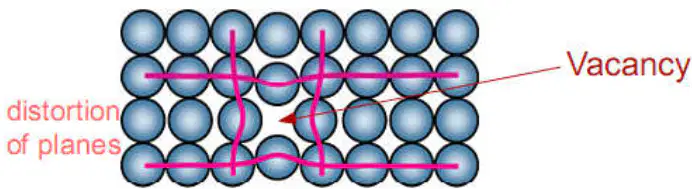
In the schematic lattice, which local effect does a vacancy typically cause?
Uniform expansion of the crystal
Formation of a dislocation line
Creation of a new grain boundary
Distortion of nearby planes
Which defect type is categorized under line defects rather than point defects?
Interstitial atoms present
Substitutional atoms replacing
Dislocations in crystals
Vacancies in lattices
For ionic crystals, which named point defect involves paired cation and anion vacancies to maintain charge neutrality?
Schottky defect formation
Frenkel defect displacement
Substitutional impurity addition
Interstitialcy mechanism
What immediate effect does increasing temperature have on the equilibrium number of vacancies in a crystal?
It removes all vacancy defects
It leaves vacancy concentration unchanged
It decreases vacancy concentration
It increases vacancy concentration
Which property of a crystal is directly reduced by the presence of vacancies, assuming composition is unchanged?
Mass density of the solid
Melting point temperature
Electrical neutrality overall
Lattice parameter value
Fill in the blank: A vacancy is a (a) atomic site within a crystalline structure.
Which statement best defines a self-interstitial point defect in a crystal?
An extra atom positioned between atomic sites
An extra atom at a substitutional site
A foreign impurity replacing a host atom
An atom missing from a lattice site
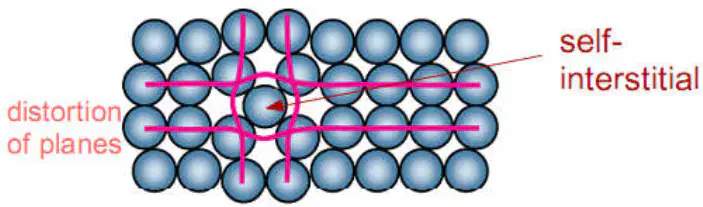
A self-interstitial causes which immediate effect on neighboring lattice planes?
No change in local geometry
Uniform expansion without strain
Perfect alignment and reduced vibration
Distortion of planes and local strain
Fill in the blank: Adding a self-interstitial generally (a) the mass per unit volume of the crystal.
How does the concentration of vacancies typically relate to self-interstitials in a crystal at equilibrium?
Inversely related through point-defect balance
Directly proportional under all temperatures
Equal in number due to conservation of atoms
Unrelated because defects form independently
Which process most likely introduces self-interstitials during solidification?
Complete absence of vacancies
Ideal lattice vibrations at zero Kelvin
Imperfect packing during crystallization
Perfect packing at low temperature
Compared to a vacancy, a self-interstitial will most directly affect density in what way?
Decrease density by expanding volume only
Increase density by adding mass locally
Decrease density by removing mass
Leave density unchanged everywhere
Fill in the blank: A vacancy defect is characterized by an atom (a) from a normally occupied lattice site.
At higher temperatures, which trend is generally observed for vacancy concentration in crystalline solids?
Increases due to thermal activation
Depends only on external pressure
Remains constant with temperature
Decreases with temperature increase
Which statement best defines a Schottky defect in an ionic crystal while preserving electrical neutrality?
Two adjacent cations exchanging their lattice sites
An extra neutral atom inserted between lattice ions
A displaced cation occupying an interstitial site
A missing cation–anion pair forming divacancies
In a Frenkel defect for an ionic solid, what happens to the cation?
It replaces another cation at a lattice site
It is removed entirely from the crystal
It pairs with an anion to form a vacancy
It leaves its site for an interstitial position
Electrical neutrality in ionic crystals means the total charge of missing and displaced species must be what?
(a)
Which defect primarily increases the density of a crystal?
Vacancy defect removes a single neutral atom
Frenkel defect leaves a cation vacancy
Schottky defect removes two opposite ions
Interstitial defect adds an extra atom
Which point defect is best described as an atom crowded into a normally unoccupied small void space?
Frenkel cation vacancy
Schottky divacancy pair
Substitutional impurity atom
Self‑interstitial within the lattice
Compared to vacancies, self‑interstitials in metals typically cause what in the surrounding lattice?
Relatively large distortions locally
Strictly thermal vibrations increase
No measurable distortions
Only long‑range elastic distortions
Which process creates a cation vacancy without changing stoichiometry in an ionic crystal?
Cation moving to an interstitial site
Cation exchanging with another cation
Cation evaporating from the surface
Anion substituting the cation site
Schottky and interstitial defects are often described as inverse phenomena because one does what while the other does what?
Removes ions vs adds an extra atom
Displaces cations vs displaces anions
Creates vacancies vs creates substitutions
Forms pairs vs forms isolated single defects
For a perfect ionic crystal, which constraint makes point defects more complex than in metals?
The need to maintain electrical neutrality
The presence of metallic bonding only
The requirement of covalent bond angles
The dominance of van der Waals forces
Which statement about Frenkel and Schottky defects is correct regarding density change?
Schottky increases density, Frenkel decreases
Frenkel greatly increases density, Schottky unchanged
Both increase density significantly
Frenkel causes little change, Schottky decreases
In the left diagram labeled Schottky defect, what feature maintains electrical neutrality in ionic crystals?
Substitutional impurities replacing anions
Equal numbers of cation and anion vacancies
Interstitial cations occupying voids
Unequal missing cations and anions
Which statement best describes a Frenkel defect as shown in the middle diagram?
Anion leaves lattice site creating paired vacancies
Cation shifts into an interstitial site leaving a vacancy
Extra host atom squeezes between lattice sites
Foreign atom substitutes for a host ion
In a Schottky defect, what happens to the crystal density compared to a perfect lattice?
Density increases due to tighter packing
Density fluctuates but averages the same
Density remains unchanged overall
Density decreases because atoms are missing
For Frenkel defects in ionic solids, which property about overall density is indicated by the diagram’s notes?
Density shows no net change overall
Density becomes anisotropic with direction
Density increases due to interstitial crowding
Density decreases because ions are removed
In the rightmost image top panel labeled Vacancy, what does the red-marked site represent?
A dislocation line through crystal planes
A vacant atomic site within the structure
A substitutional impurity occupying a site
An interstitial atom between lattice sites
Identify the defect shown in the rightmost image bottom panel where an extra atom sits between atomic sites.
Vacancy defect in metallic crystals
Self-interstitial defect in the host crystal
Edge dislocation at a slip plane
Substitutional impurity defect in alloy
Which ionic solids are typical examples of Schottky defects according to the left diagram notes?
(a)
Which statement best describes a substitutional solid solution in alloys?
Vacancy pairs form at cation and anion sites
Dislocation lines move through the lattice
Small atom squeezes into interstitial site
Foreign atom replaces a host atom site
In an interstitial solid solution, impurity atoms typically are
Smaller than host atoms
Charged like host ions
Equal to host atoms
Larger than host atoms
Which Hume–Rothery rule most directly limits substitutional impurity formation?
Cooling rate is extremely slow
Melting point difference is small
Crystal has high dislocation density
Atomic size difference under 15 percent
According to Hume–Rothery considerations, valency affects substitution by favoring
Opposite valence between solute and solvent
Higher valence solute always preferred
Lower valence solute always preferred
Similar valence between solute and solvent
Which materials property often increases with interstitial carbon in iron?
Hardness increases noticeably
Ductility increases strongly
Electrical resistivity decreases
Thermal expansion vanishes
Which diagram label indicates a Frenkel defect in an ionic crystal?
Edge dislocation cutting through planes
Cation displaced into interstitial site
Paired cation and anion vacancies
Foreign atom replaces host atom
A Schottky defect is characterized by
Interstitial cation with a vacancy
Substitutional foreign atom site
Stacking fault across close-packed planes
Paired cation and anion vacancies
Which change preserves overall crystal charge neutrality?
Replacing host atom with larger neutral atom
Forming a single anion vacancy only
Inserting one extra interstitial cation
Creating one cation and one anion vacancy
Fill in the blank: In a Frenkel defect, a (a) leaves its lattice site and occupies an interstitial position.
Which scenario best illustrates a substitutional impurity improving ductility in an alloy?
Vacancy clusters pinning dislocations
Large solute causing lattice distortion
Moderate-size solute enhancing slip
Tiny interstitial solute blocking slip
Which statement best describes a substitutional solid solution in metals?
Solute atoms replace host atoms on lattice sites
Solute atoms occupy gaps between host atoms
Solute atoms form a separate second phase
Solute atoms cluster at grain boundaries
In an interstitial solid solution, impurity atoms are located where within the crystal?
Outside the crystal surface
At dislocation cores only
Inside voids between host atoms
On regular lattice sites of host atoms
Hume-Rothery atomic size criterion for substitutional solubility requires the difference in atomic radii to be approximately within what limit?
Exactly equal to zero percent
Less than about thirty percent
Less than about fifteen percent
Less than about five percent
Which set of factors favors extensive substitutional solid solution formation?
Identical size only, regardless of structure and valence
Similar atomic size, same crystal structure, like valence
Large size mismatch, different structures, unlike valence
High electronegativity difference, dissimilar valence, any structure
Copper and nickel form a substitutional solid solution primarily because they share which combination of properties?
Large size difference and BCC structures
Close atomic radii and same FCC structure
Very different electronegativities and valence
Same atomic radius and HCP structures
Select the correct valence comparison for Cu and Ni that supports substitutional solubility.
Cu +2 and Ni −1
Cu +1/+2 and Ni +2
Cu 0 and Ni +2
Cu +3 and Ni +1
Point defects introduced by impurities can have which typical mechanical effect on metals?
Reduce elastic modulus drastically
Eliminate dislocations completely
Increase hardness and can improve ductility
Decrease hardness and increase brittleness
Creating point defects in copper can influence which property mentioned?
Melting temperature reduction
Corrosion potential only
Electrical resistivity only
Bearing performance improvement
Which statement distinguishes substitutional from interstitial impurities using a lattice diagram?
Substitutional impurities sit on host sites; interstitial in gaps
Substitutional cluster at surfaces; interstitial in grains
Both sit in gaps; neither replaces host atoms
Both replace host atoms; neither uses gaps
Electronegativity relation favorable for substitutional solid solution formation is typically what?
Similar electronegativities to limit compound formation
Very different electronegativities to promote ionicity
Unrelated to solubility; any values acceptable
Electronegativity of solute must be zero
Which statement best describes a dislocation in a crystal?
A line defect that enables slip between planes
A volume defect altering entire crystal phase
A point defect causing local vacancy formation
A surface defect increasing grain boundary area
What type of deformation is produced when dislocations move?
Viscous flow under constant stress
Permanent plastic deformation of the crystal
Thermal expansion due to heating
Elastic deformation reversible after unloading
In an edge dislocation, how is the Burgers vector oriented relative to the dislocation line?
Perpendicular to the dislocation line
Randomly oriented to the line
At forty-five degrees to the line
Parallel to the dislocation line
Which feature characterizes a screw dislocation?
A missing plane producing a vacancy
A twin boundary across grains
A spiral planar ramp from shear
An extra half-plane of atoms inserted
Complete the statement: In a screw dislocation, the Burgers vector is (a) to the dislocation line.
Which option correctly pairs defect type with typical description?
Edge: extra half-plane; Screw: spiral ramp
Edge: grain boundary; Screw: twin interface
Edge: spiral ramp; Screw: extra half-plane
Edge: vacancy cluster; Screw: interstitial loop
What observable surface feature may appear after tensile elongation due to moving dislocations in zinc?
Slip steps along the surface
Annealing twins across grains
Large pores on the surface
Oxide layers forming quickly
Which statement about mixed dislocations is correct?
They combine both edge and screw characters
They are purely edge without screw component
They eliminate plastic deformation entirely
They form only at grain boundaries

