
NEW
Font size
 Worksheets
Infection Control Overview and Objectives
Total questions: 67
Worksheet time: 34mins
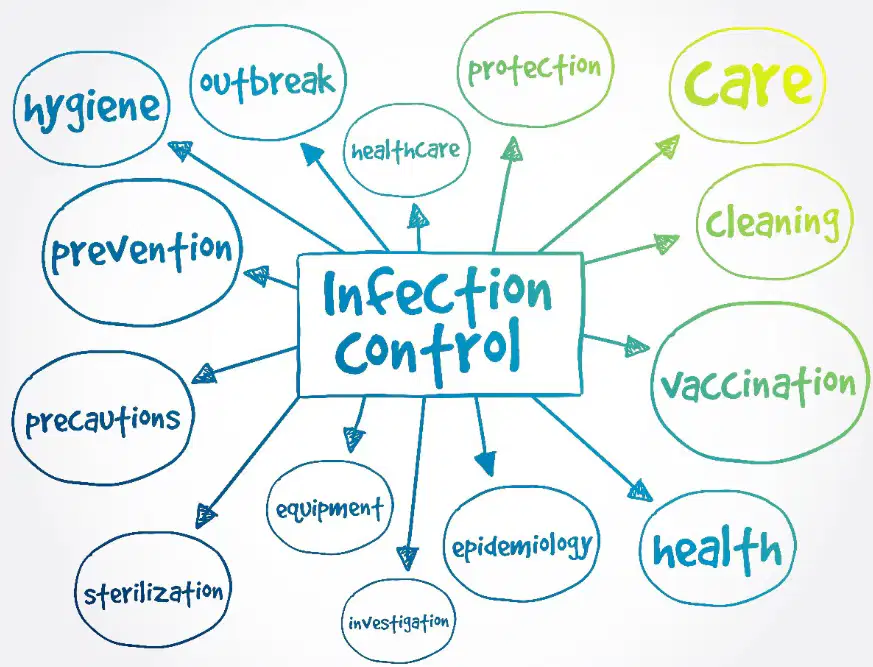
Which element directly reduces the risk of pathogen transmission by removing contaminants from surfaces in clinical areas?
Routine cleaning of high-touch surfaces
Annual staff performance reviews
Monthly budgeting for supplies
General health promotion posters

Which action best breaks the Chain of Infection at the portal of entry for healthcare workers during patient care?
Scheduling more follow-up appointments
Performing hand hygiene before and after care
Hosting community health fairs
Updating electronic medical records
A community clinic detects a rise in influenza cases. Which combined approach reflects surveillance and control principles?
Expand clinic art therapy sessions
Offer discounts on cafeteria meals
Increase parking spaces for the clinic
Report cases and initiate contact tracing
Which statement best describes the chain of infection shown in the diagram?
Infection requires host immunity to be absent
Infection stops when reservoirs are eliminated
Infection spreads when all links are connected
Infection spreads only when one link is active
Which is a causative agent category listed in the material?
Autoantibodies
Allergens
Arthropods
Bacteria
Which example correctly matches its causative agent type?
Pseudomonas aeruginosa — protozoa
Hepatitis B — fungus
Candida albicans — virus
Mycoplasma pneumonia — mycoplasma
According to the diagram, which link focuses on rapid, accurate identification of organisms?
Means of transmission
Infectious agent
Reservoirs
Portal of entry
Which source can function as a reservoir for infection?
All of the above
Animal
Human
Inanimate
Which control measure targets the reservoir link in the chain?
Air flow control
Recognition of high‑risk patients
Aseptic technique
Environmental sanitation
Which statement about bacteria versus viruses aligns with the material?
Pseudomonas aeruginosa is a protozoan agent
Candida albicans is a virus infecting lungs
Hepatitis B is a virus, not a fungus
E. coli is a virus causing hepatitis
In the chain diagram, which link lists people, equipment, and water?
Means of transmission
Reservoirs
Portal of exit
Susceptible host
Which portal of exit is most associated with coughing and sneezing?
Skin lesions and wound drainage
Needle puncture blood sites
Nose or mouth respiratory tract
Urethral meatus urinary tract
Airborne transmission primarily involves which particle characteristic?
Large droplets over five microns
Fomites on contaminated equipment
Droplet nuclei less than five microns
Vectors from biting insects
Which source of infection is best exemplified by malaria transmission?
Inanimate reservoirs from equipment
Human reservoirs with bloodstream viruses
Animal reservoirs via mosquitoes
Environmental reservoirs in water
Which portal of exit correctly matches the gastrointestinal tract?
Urethral meatus urinary pathway
Skin drainage from cut tissue
Nose or mouth respiratory pathway
Anus faeces or colostomies
A patient has an open wound and serous drainage. What is the portal of exit involved?
Urinary tract via urethra
Blood via mucous membranes
Respiratory tract via talking
Skin or tissue from a wound
Which statement best differentiates droplet from airborne transmission?
Droplet uses larger particles that fall quickly
Airborne relies on fomites touching surfaces
Airborne uses vectors such as mosquitoes
Droplet involves tiny nuclei traveling far
A needle stick injury creates which portal of exit for pathogens in blood?
Gastrointestinal vomiting pathway
Needle puncture entry in blood
Respiratory coughing pathway
Urinary urethral pathway
Which mode of transmission involves vectors like mosquitoes?
Vector-borne via biting insects
Droplet saliva and mucus spread
Fomite-borne via equipment surfaces
Airborne droplet nuclei spread
Which statement best distinguishes direct from indirect contact transmission?
Indirect involves injection through sterile needles
Direct involves contaminated articles touching a host
Indirect involves airborne droplet nuclei over distance
Direct involves person-to-person body excreta contact
A patient acquires infection after using a contaminated commode chair. What mode of transmission occurred?
Airborne transmission through inhalation
Direct contact via body excreta exposure
Indirect contact with contaminated articles
Vector-borne via mosquito mechanical transfer
Which is the most accurate example of a portal of entry by inhalation?
Pathogens crossing placenta to the fetus
Pathogens entering through respiratory mucosa
Pathogens inoculated through skin abrasions
Pathogens ingested with contaminated food
A neonate develops infection acquired in utero. Which portal of entry explains this?
Transplacental entry to the fetus
Inhalation through respiratory tract
Ingestion through gastrointestinal tract
Inoculation via broken skin
Which scenario best represents direct contact transmission in clinical care?
Shared thermometer contaminated with blood
Unprotected hand-to-hand contact with infectious secretions
Droplet spread by coughing across the room
Mosquito bite transferring dengue virus
Aedes mosquitoes transfer dengue virus between hosts. In this context, what is the vector’s role?
Airborne dispersal of viral particles
External mechanical transfer between hosts
Direct person-to-person viral exchange
Indirect contact via fomites and surfaces
Which factor most increases a host’s susceptibility after exposure by ingestion?
Immediate post-exposure hand hygiene
Effective placental antibody transfer
Intact skin providing physical protection
Compromised gastric acidity reducing barrier function
A clinician plans to break the chain of infection for contact transmission. Which action targets the portal of entry?
Use gloves to prevent mucous membrane exposure
Accelerate vector control for local mosquitoes
Identify reservoir species in the community
Audit waste management to reduce excreta
Which statement best defines standard precautions in nursing practice?
Basic practices applied to all patient care
Measures used only for confirmed infections
Procedures reserved for isolation rooms
Steps taken after a positive lab result
What does asepsis primarily mean in clinical settings?
Minimization of environmental noise
Control of patient stress responses
Absence of pathogenic microorganisms
Reduction of visible dirt on surfaces
Which action is an aseptic technique to maintain asepsis?
Sharing noncritical equipment between patients
Sterilizing reusable instruments before use
Skipping hand hygiene when gloves are worn
Leaving dressings uncovered to air-dry
A patient becomes a susceptible host primarily when which condition occurs?
Enhanced antibody production after vaccination
Temporary elevation of body temperature
Impaired or weakened immune system function
Increased dietary protein for wound healing
Which combination best addresses the chain of infection at the host and environment levels?
Handwashing and equipment sterilization
Routine screening of asymptomatic visitors
Balanced diet and regular exercise only
Antibiotics for all hospitalized patients
You are planning care for a patient of unknown infectious status. Which approach demonstrates strategic application of standard precautions?
Use PPE only if symptoms are present
Apply hand hygiene and safe equipment handling to all care
Focus precautions on respiratory procedures exclusively
Delay precautions until lab results confirm an infection
Which statement best defines medical asepsis in clinical practice?
Disinfection technique guaranteeing sterility
Antiseptic technique for invasive surgery
Sterile technique eliminating all organisms
Clean technique reducing transmission risk
Which statement best defines surgical asepsis?
Technique using non-sterile gloves routinely
Technique using clean or disinfected equipment
Technique ensuring absence of all microorganisms
Technique minimizing debris on skin surfaces
Which goal aligns with medical asepsis rather than surgical asepsis?
Eliminate all microorganisms on skin
Reduce microorganisms and remove debris
Maintain a sterile field for procedures
Use only sterile equipment throughout
Which equipment choice is appropriate for surgical asepsis?
Non-sterile gloves during procedure
Reusable equipment with alcohol wipe
Sterile equipment for all items
Clean equipment after disinfection
Which glove selection fits medical asepsis in routine care?
Non-sterile gloves or sterile as required
Only sterile gloves at all times
Double-gloving for every interaction
No gloves unless visibly soiled
A nurse prepares a wound dressing in a general ward. Which practice aligns with medical asepsis?
Establish a completely sterile field
Avoid touching any surfaces whatsoever
Use clean technique to reduce infection chain
Autoclave all instruments before use
Which scenario requires surgical asepsis instead of medical asepsis?
Performing hand hygiene before lunch
Inserting a urinary catheter in theatre
Administering oral medications on the ward
Disinfecting a stethoscope after rounds
Which comparison correctly differentiates medical from surgical asepsis?
Medical prohibits non-sterile gloves; surgical allows
Medical aims for sterility; surgical reduces risk
Medical reduces microorganisms; surgical achieves absence
Medical uses sterile equipment; surgical uses clean
Which outcome reflects the limitation of medical asepsis?
Creates a sterile environment always
Fails to reduce transmission risk
Does not destroy all microorganisms
Requires only sterile equipment
When establishing a sterile field, which principle is essential for surgical asepsis?
Ensure absence of all microorganisms
Rely solely on disinfection wipes
Persistently remove visible debris only
Use non-sterile gloves if careful
Which statement best distinguishes surgical asepsis from medical asepsis regarding skin surfaces?
Complete removal of all micro-organisms on skin
Removal of visible debris and most micro-organisms
Periodic cleansing to lower pathogen counts
Barrier application without prior skin cleaning
In ward-based medical asepsis, which equipment status is acceptable for routine procedures?
Equipment wiped with tap water
Single-use equipment reused after drying
Clean or disinfected equipment
All equipment must be sterile
Which glove policy correctly matches the setting?
Surgical asepsis uses non-sterile gloves
Medical asepsis uses only sterile gloves
Surgical asepsis requires sterile gloves
Medical asepsis forbids glove use entirely
Which gown and headwear combination aligns with surgical asepsis in theatre?
Paper gown, head cover optional
Reusable gown, cap optional
Sterile gown, cap required
Clean disposable gown, no cap
Which hand hygiene approach pairs correctly with the aseptic type?
Surgical handwashing with surgical asepsis
Surgical handwashing with medical asepsis
Medical handwashing with surgical asepsis
Alcohol rub only for surgical asepsis
For skin preparation in surgical asepsis, which solution set is appropriate?
Normal saline or chlorhexidine alone
Chlorhexidine and iodine solutions
Water and mild soap solutions
Alcohol rub without iodine solution
Which procedural context most clearly requires surgical asepsis rather than medical asepsis?
Routine vital signs measurement
Major invasive procedures in theatre
Suctioning a patient’s airway
Feeding a patient in the ward
Which principle category includes immunization, adult vaccination, and school-based vaccination programs in Singapore?
Control of infection category
Preventive measures category
Surveillance systems category
Environmental policy category
Under the National Childhood Immunization Schedule (NCIS), what is the primary public health goal achieved by broad vaccine coverage?
Maintaining herd immunity
Reducing antibiotic use
Eliminating hospital-acquired infections
Lowering healthcare costs
Which adult group is specifically prioritized for influenza and pneumococcal vaccination in Singapore?
Elderly and healthcare workers
Frequent overseas travelers
Primary school teachers
Restaurant staff
School-based vaccination programs commonly target which pathogen with the HPV vaccine?
Human papillomavirus pathogen
Mycobacterium tuberculosis pathogen
Hepatitis B virus pathogen
Poliovirus pathogen
Which agency leads vector control through mosquito breeding site eradication to manage dengue?
Health Promotion Board
Ministry of Health
Singapore Food Agency
National Environment Agency
Which measure best reduces foodborne illness risk at the national level in Singapore?
Regulations enforced by SFA
Public mask mandates
School closure policies
Airport temperature screening
Which intervention directly targets the environmental source of infectious agents in public spaces?
Mass media vaccination adverts
Contact tracing applications
Antibiotic stewardship programs
Regular disinfection and waste disposal
A municipality aims to lower dengue transmission quickly. Which strategic combination aligns with Singapore’s approach?
Routine inspections and breeding site eradication
Mass hand hygiene campaigns only
Seasonal influenza vaccination drives
Hospital visitor restrictions
Which statement best describes Stay-Home Notices in Singapore's infection control system?
Mandatory vaccination schedules for high-risk populations
Orders for exposed individuals to remain at home temporarily
Guidelines for hospital staff hand hygiene compliance
Travel advisories for international arrivals during outbreaks
In Singapore, which facilities primarily manage mild infectious disease cases during quarantine operations?
Emergency departments focused on triage
Community care centers designated for isolation
Intensive care units within major hospitals
Private clinics operating under MOH license
Which component of treatment emphasizes reducing antibiotic resistance in hospitals?
Mass vaccination campaigns for seasonal influenza
Expanded bed capacity for surge admissions
Rapid antigen testing for respiratory pathogens
Antimicrobial stewardship programs with judicious use
Under the Infectious Diseases Act in Singapore, what is required of healthcare professionals regarding notifiable diseases?
Document cases only in hospital electronic records
Notify international agencies within seven days
Inform local police units of suspected outbreaks
Report specified diseases to MOH within 24 hours
Which tool supports real-time monitoring of outbreaks by the Ministry of Health?
Paper-based weekly morbidity reports from clinics
Quarterly audits of hospital infection control teams
Communicable Disease Surveillance System digital platform
Annual national census of health workforce
During the COVID-19 pandemic, TraceTogether and SafeEntry primarily enabled which function?
Automated allocation of ICU beds for severe cases
Rapid identification and isolation of close contacts
Scheduling nationwide vaccination appointments
Mass distribution of personal protective equipment
Which statement best captures the role of national guidelines issued by Singapore’s MOH?
Financial subsidies for all infectious disease treatments
Legal penalties for non-compliant public facilities
Detailed protocols for infection prevention in healthcare
Standards for international travel quarantine hotels
Disease-specific action plans in Singapore typically include which measure?
Case isolation strategies through to mass vaccination
Monthly public lectures on hand hygiene
Universal prophylactic antibiotics for adults
Routine pediatric screening for school enrollment
What is the primary role of the National Centre for Infectious Diseases (NCID) at Tan Tock Seng Hospital?
Administrative office for public health insurance claims
Training site exclusively for medical students' rotations
Regional warehouse for medical supply distribution
Primary center for managing infectious diseases nationally

