
 Worksheets
FOT Midterm 25-26
Total questions: 61
Worksheet time: 1hrs 11mins
Bronze Age is:
the architectural period that included combining copper and tine to produce bronze
the architectural period marked by the prevalent use of iron and steel
the architectural period marked by the first use of complex machinery, factories, and urbanization
the architectural period marked by information sharing, gathering, manipulation, and retrieval.
Economic impact on technological development is:
the impact on people
the impact on policy and laws
the impact on human achievement
the impact on the economy
Cultural impact on technological development is:
the impact on people
the impact on policy and laws
the impact on human achievement
the impact on economy
Political impact on technological development is:
the impact on human achievement
the impact on people
the impact on policy and laws
the impact on economy
Social impact on technological development is:
the impact on policy and laws
the impact on human acievement
the impact on people
the impact on the economy
Iron Age is:
the architectural period that included combining copper and tine to produce bronze
the architectural period marked by the prevalent use of iron and steel
the architectural period marked by the first use of complex machinery, factories, and urbanization
the architectural period marked by information sharing, gathering, manipulation, and retrieval.
Industrial Age is:
the architectural period that included combining copper and tine to produce bronze
the architectural period marked by the prevalent use of iron and steel
the architectural period marked by the first use of complex machinery, factories, and urbanization
the architectural period marked by information sharing, gathering, manipulation, and retrieval.
Information Age is:
the architectural period that included combining copper and tine to produce bronze
the architectural period marked by the prevalent use of iron and steel
the architectural period marked by the first use of complex machinery, factories, and urbanization
the architectural period marked by information sharing, gathering, manipulation, and retrieval.
The Renaissance or Enlightenment is:
the architectural period marked by the revival of classical influence & sharing of ideas
the architectural period marked by the prevalent use of iron and steel
the architectural period marked by the first use of complex machinery, factories, and urbanization
the architectural period marked by information sharing, gathering, manipulation, and retrieval.
The Middle Ages is:
the architectural period marked by the revival of classical influence & sharing of ideas
the architectural period marked by the prevalent use of iron and steel
the architectural period after the Roman Empire. Divided into Early Middle Ages, High Middle Ages, & Late Middle Ages
the architectural period marked by information sharing, gathering, manipulation, and retrieval.
Paleolithic, Mesolithic & Neolithic are
an architectural period marked by the revival of classical influence & sharing of ideas
three time periods that are the earliest recorded time periods in human history
an architectural period after the Roman Empire. Divided into Early Middle Ages, High Middle Ages, & Late Middle Ages
an architectural period marked by information sharing, gathering, manipulation, and retrieval.
An invention is:
developing a new/useful process, tool, machine, etc that did not exist previously.
introducing new ideas/methods to an established process, tool, machine, etc to produce marketable products.
a property right granted by the government that allows the inventor to prohibit others from making, using, or selling their idea.
An innovation is:
developing a new/useful process, tool, machine, etc that did not exist previously.
introducing new ideas/methods to an established process, tool, machine, etc to produce marketable products.
a property right granted by the government that allows the inventor to prohibit others from making, using, or selling their idea.
A patent is:
developing a new/useful process, tool, machine, etc that did not exist previously.
introducing new ideas/methods to an established process, tool, machine, etc to produce marketable products.
a property right granted by the government that allows the inventor to prohibit others from making, using, or selling their idea.
The problem should be written:
[What] need(s) [who] because [why].
[Who] need(s) [what] because [why].
[What] need(s) [why] because
[who].
[Who] need(s) [why] because [what].
What is the First Step of the Engineering Design Process
Testing Solutions
Designing Solutions
Identifying the Problem
Planning Solutions
Engineer Problems can be solved using ...
A system
A machine
A structure
All of the above
A prototype is a model that
functions like the final solution would
is made of the same materials as the final product
is made after the final product is made
can only be made once
Which of the following has the EDP in the correct order?
Imagine, Ask, Research, Plan, Test and Evaluate, Create, Improve
Research, Ask, Plan, Imagine, Test and Evaluate, Create, Improve
Ask, Research, Imagine, Plan, Create, Test and Evaluate, Improve
Improve, Imagine, Research, Ask, Create, Test and Evaluate, Plan
Engineers must understand the difference between requirements and constraints. Let’s say a team of engineers is asked to design a pair of kids’ tennis shoes for less than $20. They determine that the only way to manufacture shoes for this price is to use recycled materials. What is the team’s constraint?
The shoes must be designed for kids
The shoes must be made out of recycled materials
The shoes must cost less than $20 to manufacture
Which describes the "Criteria" part of the Engineering Design Process?
Identification occurs when someone realizes that a problem exists that needs to be solved.
Definition occurs when someone realizes exactly what the problem is.
the requirements the solution must meet, such as what it must do.
the limitations on the solution, such as a maximum size or budget.
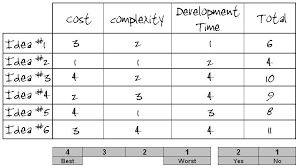
Using one of these will help your group decide on which model to build:
Design Brief
Design Evaluator
Decision Matrix
___________ is testing out your ideas many times or improving your prototype based on feedback.
brainstorming
solving
iterating
constraining
In "define the Problem", all of these are true, EXCEPT:
Identify a problem
Validate the problem
Justify the problem
Create design requirements (specifications - criteria and constraints)
Building materials

Which are examples of design constraints?
The product must be able to fit in a 1' x 1' x 1' box
The product must cost under $100 to make
The product must be under 4 pounds
all of the above
What is a key benefit of brainstorming in the Engineering Design Process?
It ensures the design is cost-effective.
It eliminates the need for testing.
It encourages diverse ideas and solutions.
It guarantees a perfect design.
You can improve your prototype by
Thinking about what worked well and what doesn't
Share your prototype and get feedback from others
Brainstorm ideas of how to fix the problems
All of the above
According to the Engineering Design Process...
You can do whatever you want
You are always right
You are always wrong
Making mistakes is ok
What are aerodynamics? (there are two correct answers)
The way of knowing how things fly depending on their shape
How we make airplanes fly
Wind waves
All of the above
What part of the airplane generates thrust?
The rudder
The elevators
The engines
The high-pressure area under the airplane
How do planes generate lift?
the shape of the wings creates a high-pressure area above the wings.
The shape of the wings creates a low-pressure area below the plane.
The shape of the wings creates a high-pressure area below the wings.
The engines create lift.
An object at rest remains at rest, and an object in motion remains in motion at constant speed and in a straight line unless acted on by an unbalanced force.
First Law of Aerodynamics
Second Law of Aerodyamics
First Law of Motion
Second Law of Motion

Which word goes where the question mark is?
Drag
Friction
Gravity
Trajectory
The aerodynamic force that opposes an aircraft’s motion through the air?
Drag
Friction
Gravity
Trajectory
Energy stored in an object due to its position is called?
Potential Energy
Kinetic Energy
Gravitropism
Aerodynamic Force
What type of energy is associated with the motion of an object due to its position?
Potential Energy
Kinetic Energy
Gravitropism
Aerodynamic Force
What is the study of the properties of moving air and the interaction between the air and solid bodies moving through it?
Dynamics
Economics
Thermodynamics
Aerodynamics
The force that pulls the plane downward
lift
thrust
gravity
drag
The force that pushes a plane upward
lift
thrust
weight
drag
The force that pushes a plane forward
lift
thrust
weight
drag
What is the change in velocity per unit of time?
Mass
Gravity
Friction
Acceleration
Which describes the "Criteria" part of the Engineering Design Process?
Identification occurs when someone realizes that a problem exists that needs to be solved.
Definition occurs when someone realizes exactly what the problem is.
the requirements the solution must meet, such as what it must do.
the limitations on the solution, such as a maximum size or budget.
_________________________ is how people change the world around them to meet their needs or to solve problems
Systems
Processes
Technology
Science
Repeating the construct and test step of the Design Process until the prototype meets all of the project criteria.
Criteria
Constraints
Dimension
Iteration
A group of students are designing a solar cooker. As part of the design process, the students must test a prototype to see if it is able to boil water. What should the students do just before they test it?
Test and evaluate the prototype.
Imagine possible solutions.
Change the prototype and retest it.
Plan and make a prototype.
Identify and research a need.
Which of the following is most likely part of the testing and evaluation stage of designing a cell phone?
Writing an advertisement for the phone.
Figuring out the features of the phone.
Finding the material to be used for the case.
Using electricity volts to try to make the phone fail.
Which of the following is NOT a step of the engineering design process?
Find the limits to the design.
Make a test model.
Discuss ideas.
Find a store to sell the product.
Answer the following about TOOTHEPASTE:
1) What PROBLEM does toothepaste help solve?
2) How might engineers TEST a prototype for toothepaste?
3) Why would it be important to ITERATE to improve a toothepaste prototype?
A person who designs, builds, or maintains engines, machines or public works is a(n) ______________.
client
designer
engineer
builder
A (n)_______________ is a paying customer who made a request for a specific engineering design to solve a problem.
engineer
client
builder
creator
Which of the following choices is correct about the Engineering Design Process?
You must go clockwise and use every step only once.
You must go counterclockwise and use every step as much as you want.
You may go in any direction including going back to previous steps.
You may go in any direction, but you may not go back to previous steps.
Why do engineers often create many different prototypes before seeing which one works best?
So they can save time by testing them all at the same time.
So they can make more money.
There are many people wanting the product.
They like building them better than testing them.
Scenario: Johnny came up with an idea to make a solar oven for a science project at school. According to the Engineering Design Process, which of the following should be Johnny´s next step?
Make a plan.draw a diagram.
Research designs/imagine possible solutions.
Create a prototype.
Test the design.

Which order of engineering process is correct?
Plan, Create, Imagine, Ask, Retest, Improve, Test
Ask, Imagine, Plan, Create, Test, Improve, Retest
Ask, Plan, Imagine, Create, Test, Improve, Retest
Create, Plan, Ask, Imagine, test, improve, retest
Ask, Imagine, Plan, Create, Test, Improve, Retest

What is the reason for worrying about considerations?
Good for the product but do not have to follow
The product has total price - start to end, useful, and has to be durable
There is some laws made way back that engineers have to follow
It is good when products are unsafe
What two things determine whether or not engineering solutions are successful?
If it stays within the constraints
If it looks cool
If it solves a problem
If it meets the criteria

Which answer (or answers) best describes criteria?
how the model could fail
the limits of the model
what the model must look like
what the model must do
Engineer Problems can be solved using ...
A system
A machine
A structure
All of the above

