
NEW
Font size
 Worksheets
Page 1
Total questions: 28
Worksheet time: 14mins
A lab aims to differentiate breast carcinoma subtypes using immunohistochemistry. Which marker panel is most relevant?
ER, PR, HER2 receptors
ALT, AST liver enzymes
IgE, eosinophil count
HbA1c, fasting glucose
Why is specificity critical when selecting antibodies for IHC?
To control section thickness during microtomy
To bind the intended antigen and avoid cross-reactivity
To reduce microscope magnification requirements
To enhance tissue fixation and dehydration speed
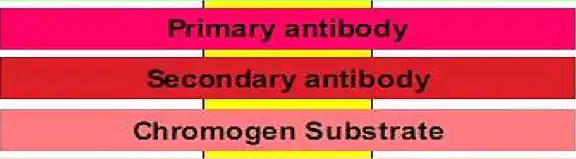
What is the function of the secondary antibody in this workflow?
Bind primary antibody and enable detection
Retrieve antigens masked by fixation
Block endogenous tissue enzymes
Provide nuclear counterstain color
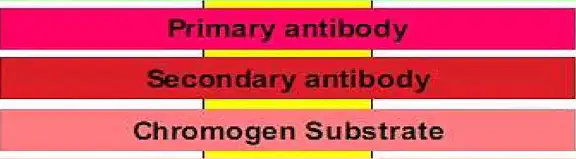
Which reagent generates the visible color that marks antigen presence?
Mounting medium under coverslip
Counterstain applied to background
Primary antibody binding the epitope
Chromogen substrate reacting with enzyme

What step enhances overall tissue visualization without targeting the antigen?
Secondary antibody conjugate addition
Counterstain applied after chromogen
Antigen retrieval with heat buffer
Primary antibody incubation stage
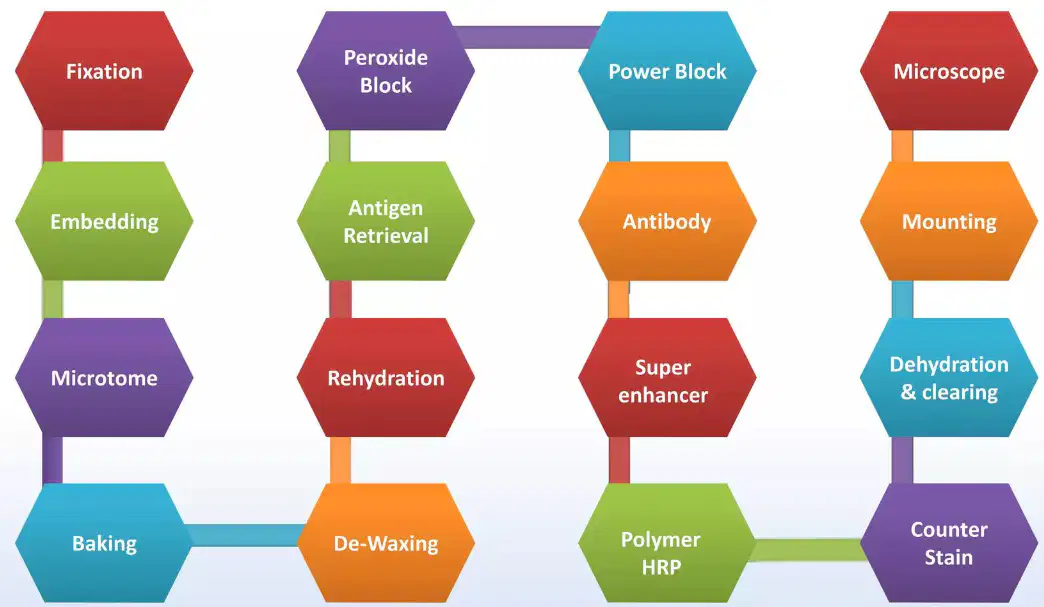
Which step immediately follows embedding in a standard immunohistochemistry workflow?
De-waxing in xylene or substitutes
Fixation of fresh tissue samples
Baking slides to promote adhesion
Microtome sectioning of tissue blocks
Most antibodies used in routine IHC are optimized for which fixation condition?
Formaldehyde-fixed tissues
Unfixed frozen tissues
Alcohol-fixed smears
Heat-fixed cytology slides
If formaldehyde is unavailable, which risk increases most concerning antigen integrity during IHC preparation?
Guaranteed overfixation artifacts
Immediate epitope retrieval success
Greater modification of antigen
Automatic signal amplification
After mounting, how are tissues further adhered to slides before staining?
Air-drying overnight at room temperature
Exposure to UV light for fixation
Incubation at 4°C for 24 hours
Baking at 60°C for a short time
Which sequence best describes early slide preparation steps for IHC?
Cut sections, counterstain, mount coverslip
Cut sections, bake at 60°C, deparaffinize
Deparaffinize, cut sections, bake at 60°C
Bake at 60°C, deparaffinize, cut sections
Which pair correctly lists the two general methods of antigen retrieval?
pH buffering and dehydration
Heat and enzyme digestion
UV exposure and freeze–thaw
Sonication and centrifugation
Choice of antigen retrieval method should primarily depend on which factor?
Availability of laboratory personnel
Age of the tissue donor
Color preference for the chromogen
Nature of the antigen to be demonstrated
A sample fixed with formaldehyde shows poor staining due to masked epitopes. What is the most appropriate first step?
Skip blocking to enhance signal intensity
Switch to a different chromogen system
Increase secondary antibody concentration
Apply antigen retrieval before primary antibody
Which misconception about antigen retrieval is accurate to challenge?
It replaces the requirement for proper fixation
It eliminates need for blocking endogenous enzymes
It permanently alters antibody affinity profiles
It partially reverses fixation effects, not fully
According to the visual, which protein solution is commonly used for blocking?
Gelatin at thirty percent
Albumin at fifty percent
Casein at two percent
Normal serum at ten percent
Which statement best differentiates peroxide block from protein block?
Targets site occupancy versus enzyme activity
Both enhance chromogen polymerization
Both target enzyme activity uniformly
Targets enzyme activity versus site occupancy
Which statement best describes how polyclonal antibodies are generated for immunohistochemistry?
By recombinant expression in bacterial plasmids
By injecting an animal with antigen and collecting sera
By cloning a single B-cell in hybridoma culture
By chemical synthesis of conserved peptide epitopes
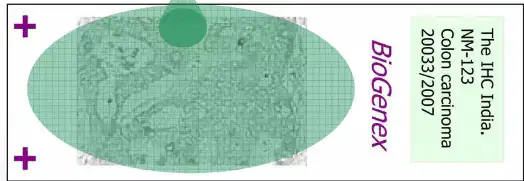
In immunohistochemistry, the primary antibody’s role is to bind directly to what target on the tissue section?
Secondary antibody Fc regions on slides
Chromogenic substrate molecules added later
Specific antigen epitopes within the specimen
Blocking buffer proteins coating the tissue
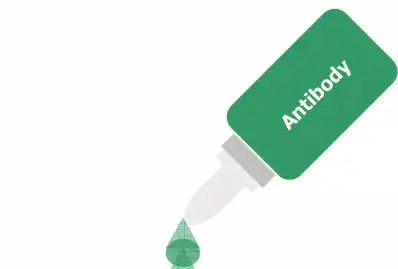
Which step would immediately follow applying the primary antibody to a tissue section in a standard IHC workflow?
Microscopy before any washing steps
Fixation of tissue with formalin again
Incubation to allow antigen–antibody binding
Direct chromogen development without incubation
Hybridomas used to make monoclonal antibodies are formed by fusing which types of cells?
Antigen-specific B cells with myeloma cells
Macrophages with epithelial tumor cells
Fibroblasts with plasma cells
T cells with dendritic cells
In immunohistochemistry, what is the role of a primary antibody applied to a tissue section on a glass slide?
Stabilize tissue fixation crosslinks
Visualize antigen with chromogenic dye
Block nonspecific protein binding sites
Bind the target antigen present in tissue
Monoclonal antibodies are generated using which production method?
In vitro antigen denaturation protocols
Phage display polyclonal enrichment
Serum collection after animal immunization
Hybridoma technology with single cell clones
Which limitation is more likely when using polyclonal antibodies for immunohistochemistry?
Produced only by hybridoma cloning
Inability to detect damaged antigens
Failure to bind any antigen epitope
Higher background staining variability
What is a principal limitation of the direct method?
Complex optimization of multiple reagents
High background from endogenous biotin
Lower sensitivity due to little amplification
Requires species cross-adsorbed secondaries
Which pairing lists techniques associated with the indirect method?
PAP/APAAP, ABC, Streptavidin–Peroxidase
ELISA, Western blot, Flow cytometry
Fluorescence in situ hybridization
Direct immunofluorescence only
Which interaction is exploited in the biotin–avidin procedure to achieve high-affinity binding in immunohistochemistry?
Streptavidin with collagen
Biotin with avidin binding
Protein G with Fc antibodies
Complement with antigen complexes

Which statement best describes alkaline phosphatase as a label in immunohistochemistry?
It yields red or blue precipitates with substrates
It only produces black deposits with DAB
It emits ultraviolet fluorescence without chromogen
It cannot produce colored reaction products
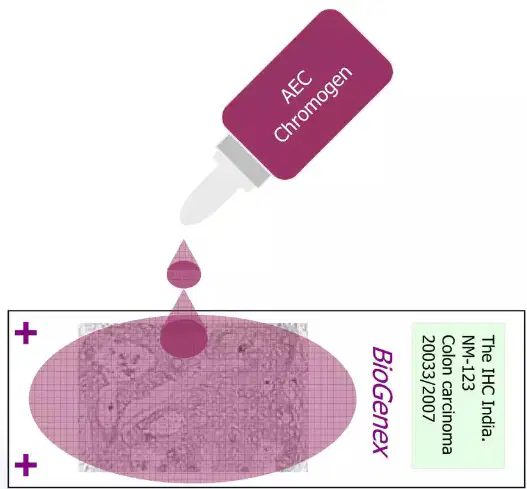
A lab needs a red reaction product to avoid melanin interference. Which system fits this need?
Alkaline phosphatase with appropriate chromogen
Peroxidase with DAB producing brown deposit
Peroxidase without chromogen for clear background
Lysozyme-based system generating green fluorescence

