
Font size
 Worksheets
2.4 Clean Technology & Environmental Impact Scales
Total questions: 38
Worksheet time: 19mins
Emma is designing a new product for her company. She wants to ensure her design uses clean technology. Which statement best defines clean technology in product design?
Methods focused only on lowering labor expenses
Processes that reduce waste and non‑renewables
Systems that maximize production regardless of waste
Technologies that prioritize speed over efficiency
Samuel is researching industries where clean technology is commonly used. The industry explicitly mentioned as a field where clean technology can be found is (a) .
Grace is a designer working for a company that is noticing the depletion of natural resources. What should be Grace's priority in her design work?
Focusing on aesthetics before performance
Reducing product variety for market simplicity
Outsourcing manufacturing to lower wages
Generating energy‑efficient products and services
The combination of factors said to drive Aria's efforts to develop more energy‑efficient technologies for her community is (a) .
Arjun runs a manufacturing company. Recently, he noticed that there is new legislation and increased community pressure regarding environmental impact. Which is a reason Arjun may decide to clean up his company's processes?
Goal to extend product obsolescence cycles
Need to eliminate all automation steps
Desire to increase packaging complexity
Response to legislation or community pressure
Zoe is managing a factory and wants to ensure that her operations have a neutral or minimized impact on the environment. Which action should Zoe take?
Substituting recycled water with groundwater
Shifting to non‑renewable inputs exclusively
Increasing residuals intensity in operations
Conserving natural resources in production
Noah is analyzing his company's environmental performance. He wants to identify which operational metric directly relates to climate‑relevant emissions. Which should he focus on?
Restricted substances content in products
Recycled or reused content in products
Proportion of natural land in inputs
Greenhouse gas intensity of operations
Abigail lives near a factory that often produces loud noises and unpleasant smells. Which geographical scale matches with the noise and smell problems she experiences?
Continental environmental impacts
Global environmental impacts
Local environmental impacts
Fluvial environmental impacts
Jackson is a farmer who uses a lot of fertilizer on his fields. Recently, his region has also been experiencing droughts. Over‑fertilization of soil and drought risks in Jackson's area are categorized under which scale?
Fluvial environmental problems
Global environmental problems
Local environmental problems
Regional environmental problems
Grace notices that the river near her town is becoming polluted due to waste from nearby factories. The pollution of this river and its watershed corresponds to which geographical scale?
Fluvial scale of environmental problems
Continental scale of environmental problems
Global scale of environmental problems
Local scale of environmental problems
Aria is studying environmental issues that affect entire continents. She wants to identify which set of problems best represents continental‑scale environmental challenges. The set she should choose is (a) .
Charlotte is researching how different products impact the environment. She wants to know which global‑scale environmental problem products can contribute to. Which should she focus on?
Climatic change and sea level rise
Neighborhood noise and foul odors
Regional watershed eutrophication
Localized soil compaction near sites
Elijah is a sustainability consultant advising a government and several businesses after the Earth Summit (Rio 1992). Which goal should Elijah recommend to best capture the Summit's outcome for their operations?
Shift all transportation fully to electric vehicles
Eliminate all fossil fuels within five years globally
Mandate a single global carbon pricing mechanism
Make eco-efficiency a guiding principle for operations
James is attending an international climate conference where countries are discussing the Kyoto Protocol (1997). Which statement describes a binding feature of the Kyoto Protocol that James learns about?
All nations set identical targets with equal timelines
Temperature caps were fixed at exactly 1.5 degrees
Industrialised countries accepted legally binding emission limits
Developing countries faced penalties for missed targets
Match each city council action with its likely impact on emissions under Kyoto-era strategies.
Expand deforestation to create farmland
Leads to increased emissions due to loss of carbon sinks
Support renewable energy and improve efficiency
Helps reduce emissions and supports climate goals
Delay public transport investment until 2030
Slows progress in reducing transportation emissions
Increase subsidies for coal to reduce prices
Encourages use of fossil fuels, increasing emissions
Match each climate agreement or objective with its corresponding temperature target as discussed in international summits.
Reduce warming to below 1.0°C by 2015 worldwide
Kyoto Protocol's short-term temperature goal
Cap warming to 2.0°C relative to 1990 averages
European Union's proposed cap in the early 2000s
Hold warming to exactly 3.6°C using 1990 baselines
Hypothetical scenario for high-emission pathways
Limit warming to below 2.0°C relative to pre-industrial
Copenhagen Accord (2009) central objective
Daniel is a city planner attending a conference about sustainable urban development. He is tasked with recommending an initiative from Rio 1992 that directly targets urban air pollution and congestion. Which should he choose?
Ban bicycles from central business districts
Subsidize diesel cars to improve access
Expand highway lanes for private vehicles
Rely more on public transportation systems
Jackson is a government official in a developing country. His nation wants to meet post-1997 climate commitments but does not want binding targets. Which stance matches the approach of developing countries under the Kyoto Protocol?
Avoid any actions on energy efficiency or forests
Commit to reduce emissions without legal limits
Adopt identical binding caps as industrialised states
Set monetary penalties for missed domestic targets
Charlotte manages a manufacturing plant and is considering different approaches to reduce pollution. Which statement best defines end-of-pipe technologies in manufacturing?
Methods adding cleanup at the process end
Switching factories to renewable energy only
Designing products to avoid waste at source
Organizing supply chains for lower logistics fuel
Emma manages a factory and is considering two approaches to handle pollution: end-of-pipe strategies and cleaner production. What is a key drawback of end-of-pipe strategies compared with cleaner production?
They act only after pollutants are generated
They require fewer trained operators overall
They eliminate all waste at the design stage
They always cost less to implement first
Michael is managing a chemical manufacturing plant and wants to reduce the environmental impact of the facility. Which example aligns with cleaner production rather than pollution control?
Redesigning a process to use less toxic solvents
Installing a larger smokestack scrubber unit
Diluting emissions with additional airflow
Adding filters to an existing wastewater outlet
Nora works at a power plant that is implementing carbon capture and storage technology. What is the primary goal of this technology at her workplace?
Prevent CO2 from entering the atmosphere
Convert all CO2 into solid carbonates onsite
Eliminate the need for renewable energy sources
Increase exhaust dilution to meet standards
Anika is managing a factory's pollution control system. She needs to decide at which stage to implement end-of-pipe controls to minimize environmental impact. Which stage placement best characterizes end-of-pipe controls?
Last stage before waste leaves the system
Parallel stage during supplier certification
First stage during material selection decisions
Mid-stage during component machining steps
Evelyn is designing a new factory and wants to minimize its environmental impact. Why would proactive methods be considered more meaningful for impact reduction in her project?
They avoid impacts by design from the outset
They disperse pollutants to safer concentrations
They shift waste to different disposal sites
They delay costs until after production
Grace is working on an environmental project and needs to choose the right approach for her company. Which pair correctly matches the approach Grace could use with its orientation?
Cleaner production—reactive orientation
Carbon capture—design-stage orientation
End-of-pipe control—preventive orientation
Pollution prevention—proactive orientation
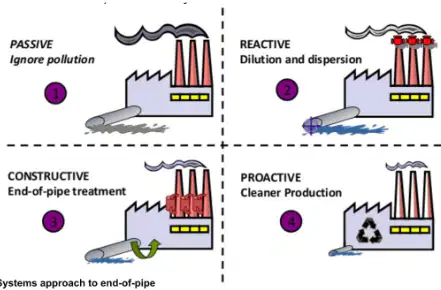
Charlotte is managing a factory and is reviewing a systems diagram that shows passive, reactive, constructive, and proactive responses to pollution. She wants to implement cleaner production methods. Which quadrant should Charlotte focus on?
Constructive quadrant with outlet treatment
Proactive quadrant with source reduction
Passive quadrant that ignores pollution
Reactive quadrant with dilution approaches
Aiden is part of a city council committee deciding on new environmental policies. The committee is considering adopting cleaner production programs for local industries. Which reason best explains why cities around the world are shifting toward cleaner production programs?
They rely on constant dilution of exhaust gases
They operate only in large power plants
They mainly focus on end-of-process equipment
They reduce air, water, land pollution efficiently
Benjamin wants to reduce pollution at his factory. The scenario that best illustrates pollution prevention at a household or industrial scale is (a) .
Grace is managing waste at a manufacturing plant. She is considering different approaches to improve the plant's waste management. Which statement best defines an incremental solution in manufacturing waste management?
One-time upgrade of a single machine only
Gradual improvement of technologies over time
Complete replacement of existing processes immediately
Outsourcing waste treatment to external vendors
Match each manufacturing scenario with its corresponding advantage or outcome.
Predictable development with low uncertainty
Adopting incremental solutions allows manufacturers to plan and forecast with confidence.
Guaranteed monopoly with no competitors
A company is the only provider of a product and faces no competition.
Zero need to monitor legislation changes
A business never has to track changes in laws or regulations.
Instant creation of entirely new industries
A new technology immediately leads to the birth of a brand-new sector.
Match each disadvantage or feature with the correct approach to implementing incremental solutions in a manufacturing company.
Training investments are never needed
Feature often incorrectly assumed with incremental improvements
Frequent small changes may be required
Common disadvantage of incremental solutions
Patent protection is automatic and broad
Benefit not typically associated with incremental changes
Market becomes less crowded quickly
Market effect not usually seen with incremental approaches
Aria works in a manufacturing plant that has been facing persistent production delays. The management is considering different ways to address the issue. What would be considered a radical solution in this context?
A new and often untried approach
A minor tweak to existing settings
A routine maintenance schedule
A vendor-managed recycling pickup
Maya is leading a team to develop a new product. She can choose between making small improvements to the existing product or implementing a completely new, radical solution. Which benefit is more associated with radical solutions than incremental ones?
Guaranteed short-term cost savings
Simpler compliance paperwork
Lower need for research budgets
High potential for market growth
Match each risk or benefit with its correct description regarding implementing a radical new solution to improve production efficiency.
Elimination of training needs
No need to train employees when adopting the new solution.
Immediate regulatory exemption
Government rules do not apply to the new solution right away.
High uncertainty of success
Unclear if the new solution will work as intended.
No capital investment required
The new solution can be implemented without spending money upfront.
William is part of a team tasked with reducing pollution and waste in a large manufacturing facility. The team is considering different approaches. If William wants to implement system-level solutions, he should focus on (a) .
Priya is a policy maker considering the implementation of favourable tax concessions for industries. What is the intended purpose of these concessions in system-level policies?
Subsidize end-of-pipe treatment exclusively
Encourage integrating pollution controls into processes
Offset profits lost from exporting recycled materials
Reward companies for advertising sustainability slogans
During an international summit, representatives from several countries are trying to agree on pollution reduction targets. What challenge are they most likely to face?
Conflicts over caps or limits between countries
Simple settlements reached in private emails
Unanimous approval without lengthy summits
No differences in national economic impacts
Benjamin is a manager at a manufacturing company. He is considering two approaches to improve production: making small, incremental changes to existing processes, or implementing radical, innovative solutions. Which statement best contrasts incremental and radical solutions for manufacturers?
Incremental guarantees patents; radical reduces uncertainty consistently
Incremental eliminates competition; radical relies on mature markets
Incremental requires massive R&D; radical avoids equipment upgrades
Incremental offers predictable change; radical offers high growth potential

