
 Worksheets
SFC Craig LET IV Midterm 2025-2026
Total questions: 45
Worksheet time: 32mins
Name the four levels of communication.
Superficial, fact, thought, feeling
Intuitive, sub-conscious, non-verbal, verbal
Direct, indirect, subliminal, overt
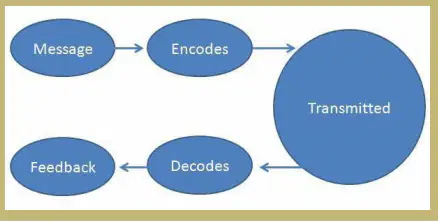
What process does this graphic represent?
Transference Process
Communication Process
Intelligence Process
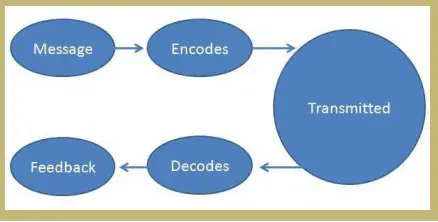
In World War II, our armed forces used Native Americans from the Navajo tribe to send Top Secret messages over the radio in their native language. The Axis Powers intelligence forces did not have anyone who spoke the language of the Navajo, so they could not determine what information was contained in the messages. What parts of the communication process were these Native Americans?
(a)
Name three characteristics of informative feedback.
Describes all incorrect behaviors, lists many behaviors, and allows the subject to make a choice of which behavior to address.
Is limited, includes specific behaviors, and provides suggestions.
Describes all incorrect behaviors, lists many behaviors, and demands specific actions.
Is limited, includes specific behaviors, and demands specific actions.
Name the five competencies for managing emotions.
Self-awareness, self-regulation, self-motivation, empathy, and effective relationships
Self-awareness, self-regulation, self-motivation, sympathy, and effective communication skills
Self-enlightenment, self-discipline, self-esteem, empathy, and effective relationships
None of the choices
You submitted a major project in one of your JROTC courses. When you received your grade, your instructor gave you a "C+" and added the comment: "You did an acceptable job on this project."
Which of the following options describes a guideline for feedback that would have made this feedback more useful to you?
Cover the major strengths and weaknesses. Try to be specific, giving examples if possible.
If part of the feedback is written, it should be consistent with the oral feedback.
Do not criticize something that cannot be corrected.
Avoid trying to discuss everything. A few well-made points may be more beneficial than numerous, inadequately developed points.
Read the information below and decide which option is most correct.
"Dan, a Cadet leader, is a very strong Republican. In providing feedback on some papers submitted by fellow students, he made a strong effort to remain constructive when responding to papers that presented a liberal point of view."
Replace "constructive" with "objective"
Replace "constructive" with "comprehensive"
Replace "constructive" with "flexible"
Replace "constructive" with "effective"
The lesson informs us not to use these words when giving feedback. Hint do not forget (or) and place them in order.
(a)
Read the following sentence and select the best option for completing the statement.
"Feedback that is provided at the end of the learning process, such as comments accompanying a final grade, is not as helpful as feedback provided during the learning process."
True: Feedback that is provided at the end of the learning process is usually more biased than the feedback provided during the learning process.
True: Feedback that is provided at the end of the learning process does not allow the student to take corrective action to improve their performance.
False: Feedback provided at the end of the learning process is more helpful because it is official and includes a final grade.
False: Feedback provided at the end of the learning process is usually more comprehensive than feedback provided during the learning process.
Read the following statement and select the best option.
"Effective feedback focuses primarily on the learner's weaknesses and areas that need improvement."
True: Feedback is more effective when it deals primarily with weaknesses because learners are already aware of their strengths.
True: Feedback that focuses primarily on the learner's weaknesses is more honest and believable than feedback that focuses on the learner's strengths.
False: Feedback is more effective when it deals primarily with strengths because it encourages learners to continue to do the things that they are doing right.
False: Effective feedback addresses both learner strengths and weaknesses and includes suggestions for improvement so that learners know what they did right as well as what they need to improve.
You are developing a lesson plan to teach orienteering to your fellow Cadets. You will begin the lesson by having students share experiences with hiking or orienteering. Next, a guest speaker will share their adventures with orienteering. Students will then perform research on orienteering, and will watch a video demonstration on orienteering techniques. Finally, students will complete a practice activity on using a compass. As you review your lesson plan with your JROTC instructor, she suggests that you are missing one of the phases in a four phase lesson plan.
Which phase do you determine needs to be added to your lesson plan?
Inquire
Gather
Process
Apply
Inquire, Gather, Process, and Apply are four phases of a (a) plan.
Which of the following are team-building exercises?
She wants students to respond to questions about the Bill of Rights. Think-Pair-Share is a strategy for facilitating question response and discussion in a group setting.
She wants students to establish effective team relationships that incorporate elements of the Bill of Rights. Think-Pair-Share is an effective team building strategy.
She wants students to learn lesson material about the Bill of Rights. Think-Pair-Share is a cooperative learning strategy that can help accomplish this goal.
She wants students to think about the relationship between the Bill of Rights and sharing. Think-Pair-Share is a strategy for learning about sharing.
(a) is the attitudes and behaviors of people in a group situation.
What are the advantages and disadvantages of cooperative learning?
You have been accepted to an university . You are awaiting for financial aid information to see if you will receive any assistance. You have been to the university and met with an advisor who gives you an approved degree plan. Which of the following should have the least influence on your schedule?
The degree plan
A work-study job
Extracurricular activities and athletics
Your high school GPA
You were a good high school student with a 3.83 GPA. You applied for several schools and financial aid. Part of your college is paid for and you will not have any debt upon graduation. What most likely happened?
Your parents took out college loans to pay for everything.
You received several grants and scholarships because of your academic record.
You found out that college is not as expensive as you thought.
You found a college that doesn't charge tuition to people like you.
An institution of higher learning providing facilities for teaching and research, and authorized to grant academic degrees: specifically one made to an undergrad division that confers bachelor's degrees, and a graduate division that comprises of graduate and professional schools, each one may confer master's and doctorates' degrees.
college
distance learning
university
admission
Which university in NJ has the largest enrollment numbers?
(a)
Which is the highest degree to be earned?
(a)
T or F: Even handicapped men must register for Selective Service.
True
False
Captain Daniels always wanted to be a Soldier. He also wanted to be a dentist. He found out that he could be a dentist in the Army, even if he didn't have ANY previous military experience. So he finished school, joined the Army, and started at the rank of Captain.
What route did he take to become an Army Officer?
ROTC
Officer Candidate School (OCS)
Service Academy
Direct Appointment
After you registered for the Selective Service, you talked to a friend who said, "I'm not going to register, because I've had so many surgeries on my knees that I would never physically qualify to serve." What should you tell him?
Ask him how many, and if it's more than two, tell him he's right.
Tell him, "That sounds like a good reason."
Tell him that all male citizens of the U. S. have to register with the Selective Service within 30 days of their 18th birthday and if he doesn't, he would be breaking the law.
Ask him if he's interested in joining the military. If he is, tell him that the Selective Service is where the armed forces get their recruits, and he may not qualify for military benefits if he doesn't register.
How soon within turning 18 must a man register with the Selective Service System?
(a)
Study the table and select the option (A-D) that correctly indicates the type of career path described.
Military Career Paths:
X. I joined the Army straight out of high
school. My specialty is Infantry, a
combat arms career group. I have been
promoted regularly throughout my 10-
year career, and now I train and
supervise lower ranking enlisted
members.
Y. I graduated with a two-year degree in
aviation from a technical school. I
served for five years in the enlisted
ranks before I was allowed to apply for
my current position. Now I fly
helicopters.
Z. I graduated 2nd in my class in college. I
was battalion commander for my ROTC
Battalion. I am now a company
executive officer.
X = Warrant Officer;
Y = Commissioned Officer;
Z = Enlisted
X = Noncommissioned Officer;
Y = Warrant Officer;
Z = Commissioned Officer
X = Commissioned Officer;
Y = Noncommissioned Officer;
Z = Warrant Officer
X = Warrant Officer;
Y = Enlisted;
Z = Commissioned Officer
Describe the rank of a Cadet Corporal. Hint - use the vocabulary word and the word is plural.
(a)
Describe the rank of a Cadet Sergeant Major
Three Chevrons, Three Bars (Rockers), and a Star
Three Chevrons, Three Bars (Rockers), and a Diamond
Three Chevrons, Three Bars (Rockers), a Wreath, and a Star
Three Chevrons, Three Bars
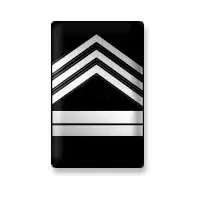
What is this is rank?
Cadet Sergeant
Cadet Private
Cadet Sergeant First Class
Cadet Reyes
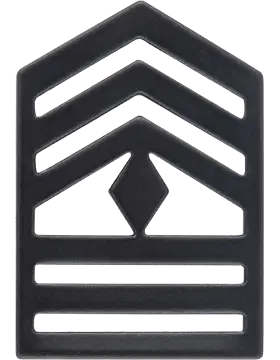
The rank shown is the senior enlisted advisor of a ____________ and they work side by side with a _____________.
company, Captain
battalion, Lieutenant Colonel
brigade, Colonel
platoon, First Lieutenant
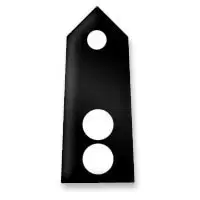
JROTC Officer Rank?
Cadet First Lieutenant
Cadet Captain
Cadet Sergeant
Cadet Private
Which of the following rules for placement of awards, insignias, and decorations is not correct?
Awards are worn in order of precedence from top to bottom and from right to left
Brass articles like the lapel insignia, belt buckle, and cap insignia should be highly shined and free of tarnish
On the male uniform, center the nameplate horizontally on the right side with the bottom of the nameplate on the imaginary line
On the female uniform, the Honor Unit Star is worn one-half inch above the nameplate and centered.
What is a gigline in a Class B Uniform?
A method for catching frogs
How straight one stands while at attention
The alignment of one's hands with the seam of the uniform trousers.
The alignment of the edge of the uniform shirt, the belt buckle, and the flap of the zipper on trousers.
The supply officer is responsible for ensuring that Cadets' uniforms are cleaned and pressed.
True
False
On the female uniform, where is the nameplate placed on the class A uniform?
On the left pocket over the heart.
One to Two inches above the top button and center on the right chest
One inch on top of and covering the pocket flap seam on the right pocket.
Even with the top button and center on the right chest
What regulations covers the wear of the military uniform?
CRB 123-4 and AR 670-1
JROTC 350-1 and AR 670-1
CCR 145-2 and AR 670-1
SFC (R) Craig and AR 670-1
The lesson informs us that Army JROTC came in existence due to the passage of this act: (a) .
What year were women allowed in JROTC per the lesson?
(a)
He is credited as the father of JROTC. Name this person. Hint, his rank was Captain.
(a)
If someone asked you about what you expect to get out of Army JROTC, which one of the following responses would you use to best inform them about the mission and purpose of JROTC?
"We expect to learn military skills as future soldiers, sailors, airmen, and Marines for our armed forces. That's the purpose of JROTC."
"We expect to participate in an alternative method of normal classroom learning. That's the purpose of JROTC."
"We expect to develop our personal growth skills as we participate in a variety of experiences and leadership situations to help us be better citizens. That's the mission of JROTC."
"We expect to save our future employers training dollars by learning leadership skills in JROTC. That's the mission of JROTC."
Teamwork is the ability to work well with others towards a common goal. It is one of the hallmarks of Army JROTC. If you were describing some of the activities you do in JROTC to develop teamwork, what would you most likely be talking about?
Classes that teach the dangers of substance abuse
Goal-setting and financial planning
Drill and ceremonies, first aid, and map reading
The importance of diet and exercise in maintaining good health
What law changed JROTC programs being taught by active duty members to retirees? Hint, do not worry about the apostrophe!!!
(a)
JROTC is a program that teaches high school students the values of good citizenship while giving them an introduction to the U.S. Army. The letters JROTC stand for ______.
Junior Reserve Officers' Training Corps
Junior Reserve Outcome Training Corps
Junior Results Ongoing Testing Corps
One of the goals of the JROTC curriculum is to encourage students to graduate from (a) .
One of the outcomes of the Army JROTC program is to get young people to join the Army after they have completed high school.
True
False
Being the only one of its kind is the definition of (a) .

