
 Worksheets
Basic Concepts of Kinetics and Force
Total questions: 15
Worksheet time: 8mins
Which statement best defines kinetics in human movement analysis?
Study of what causes motion
Measurement of distances moved
Study of positions without cause
Enumeration of joint angles only
In the relationship F = ma, what does the symbol a represent?
Acceleration of the body
Area under the curve
Angle of application
Average velocity
A sprinter accelerates from the blocks. Which component in F = ma increases to raise the force on the sprinter?
Acceleration produced by push
Area of the starting blocks
Angle between limbs
Average step cadence
During a jump landing, which is an external contact force affecting the body?
Ground reaction force
Intramuscular pressure
Sarcomere tension
Ligament shear force
Which description correctly pairs a force characteristic with its meaning?
Direction: location where force touches
Direction: amount of force
Magnitude: orientation of force
Point of application: where force acts
Which example best represents a non‑contact external force on the body?
Gravitational attraction
Joint capsule shear
Muscle fiber tension
Tendon compressive load
A sprinter pushes harder against the starting blocks and accelerates faster. Which statement best models the underlying principle?
Momentum never changes with force
Greater force causes greater acceleration
Equal forces create equal reactions
Force starts, changes, or stops motion
What does the magnitude of joint torque quantify?
Amount of compressive loading on bone
Amount of twisting along a joint
Amount of shear force through cartilage
Amount of linear displacement produced
Which statement correctly links kinematic analysis to force estimation?
Kinematics records chemical energy
Kinematics gives mass directly
Kinematics provides acceleration data
Kinematics measures torque output
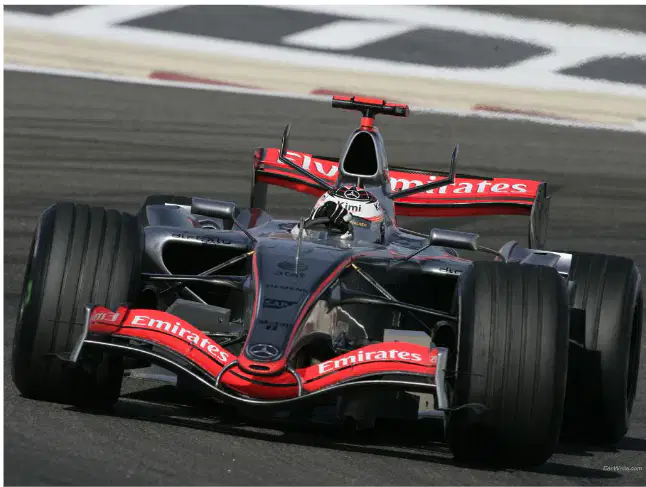
Two cars take the same corner. Car A has a wider wheelbase and identical tires. Which outcome is most likely regarding cornering speed?
Car A speed unchanged because width is irrelevant
Car A corners slower because reduced inertia
Car A must slow more due to added mass
Car A can corner faster with more lateral grip
A skater pulls arms in during a spin. What happens to moment of inertia and angular acceleration under constant torque?
I decreases, acceleration decreases
I increases, acceleration decreases
I unchanged, acceleration unchanged
I decreases, acceleration increases
Which scenario yields the smallest radius of gyration for the leg about the hip?
Ankle weighted far from axis
Knee extended with mass far from hip
Knee flexed with mass near hip
Leg abducted increasing distance
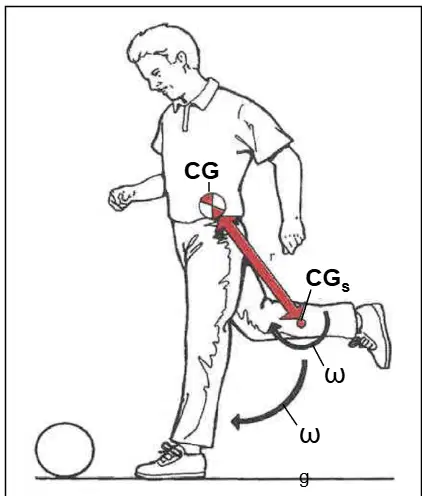
A soccer player swings the leg to kick. According to the diagram, angular momentum equals the sum of local segment rotation and whole-body rotation about the center of gravity. Which expression matches this idea?
H = Is + ωs + mr²
H = Iω + mk²
H = Isωs + mr²ωg
H = Iωg − Isωs
For a rotating athlete with conserved angular momentum H, which equation expresses the tradeoff between I and ω?
I/ω is constant during motion
Iω² is constant in free flight
I+ω is constant for any rotation
Iω is constant when H is conserved
Which scenario exemplifies zero external torque on an athlete?
A gymnast airborne during a somersault
A diver pressing the board downward
A skater pushing against the ice
A cyclist pedaling on a climb

