
Font size
 Worksheets
US History Midterm Review
Total questions: 93
Worksheet time: 47mins
By the early 1900s, Americans had transformed the United States into the world’s leading
gross national product.
industrial nation.
laissez-faire country.
military establishment.
_____ was equally as important as natural resources in the nation’s rapid industrialization.
A new tariff law
Increased population
New technology
The political system
One reason for America’s industrial success was its
abundant raw materials.
access to oceans.
small workforce.
wide open spaces.
According to the concept of laissez-faire, prices and wages are best determined by the
federal government.
free market.
gross national product.
individual states.
In the late 1800s, many rural Americans moved to big cities in search of
better-paying jobs.
political power.
high society.
shorter work hours.
Nativists reacted to immigration in the late 1800s by
grouping immigrants into their own sections of cities.
urging immigrants to assimilate into American society.
pressuring the government to limit or cut off immigration.
seeking to convert Catholic immigrants to Protestantism.
The United States became an imperial power as a result of
the Boxer Rebellion.
the Open Door policy.
the Pan-American conference.
the Spanish-American War.
In 1896, the Supreme Court’s decision in Plessy v. Ferguson upheld the doctrine of
civil rights.
“equal protection.”
the right to vote.
“separate but equal.”
What effect did the automobile industry of the 1920s have on American society?
People could live farther from their places of work.
People moved from the suburbs to the city.
The mail delivery system expanded across the country.
Workers did not commute anymore.
The flowering of African American arts in the 1920s became known as the
Glory Days.
Great Awakening.
Great Migration.
Harlem Renaissance.
Most Americans of the 1920s wanted to avoid future wars by
banning Japan from the League of Nations.
dividing Germany among the Allies.
avoiding involvement in world affairs.
forbidding Germany to rebuild its armed forces.
Progressives generally believed that industrialization and urbanization had created many social problems, including working-class poverty and
the decline of religious faith.
the failure of many businesses.
the filth and crime of urban society.
the spread of violent racism.
What were crusading journalists who investigated social conditions and political corruption called?
efficiency progressives
muckrakers
reformers
suffragists
In the late 1800s, the United States began asserting itself politically and militarily beyond North America. For example, the United States took over the independent kingdom of Hawaii and fought a war against Spain in the Caribbean and the Pacific Ocean. Identifying, selecting THREE that apply, reasons why the United States participated in expansionist policies such as these.
With a growing population due to industrialization there was a greater demand for land.
Global competition for markets.
An expanded navy and military power.
A sense of cultural superiority
The movement to ban alcohol sales in the 1920s would eventually lead to the passage of the 18th amendment to the US Constitution. This time period where alcohol was effectively illegal in the United States was called...
Progressivism
Fundamentalism
Prohibition
Nativism
Match the words that have the same meaning: Choose the correct match for the term Urban.
Workers
City
Factory
Farming
Match the words that have the same meaning: Choose the correct match for the term Agrarian.
Workers
City
Factory
Farming
Match the words that have the same meaning: Choose the correct match for the term Industrial.
Workers
City
Factory
Farming
Match the words that have the same meaning: Choose the correct match for the term Labor.
Workers
City
Factory
Farming
Match the correct vocabulary term to the correct explanation: Which term is described by “A belief that competition and survival of the fittest determined a person’s place in society.”
Gilded Age
Social Darwinism
Gospel of Wealth
Match the correct vocabulary term to the correct explanation: Which term is described by “Describes a time when the U.S. looked great from the outside, but life for many Americans inside was actually very difficult.”
Gilded Age
Social Darwinism
Gospel of Wealth
Match the correct vocabulary term to the correct explanation: Which term is described by “A belief that the rich have a responsibility to use their excess wealth to help the poor.”
Gilded Age
Social Darwinism
Gospel of Wealth
A source that is an immediate, first-hand accounts of a topic, from people who had a direct connection with it is called a...
secondary source
primary source
A source that is one step removed from a historical event or era. It often contains a layer of interpretation and analysis.
primary source
secondary source
Which of the following are examples of primary sources? Choose THREE that apply.
receipt
photograph
diary entry
school issues textbook
classroom teacher
Which of the following is a definition of thesis?
an argumentative assertion about a topic
states the conclusions that you have reached about your topic
a specific statement that can be proven with evidence
all of these are definitions of a thesis
Laws governing segregation and discrimination were known as Jim Crow Laws.
True
False
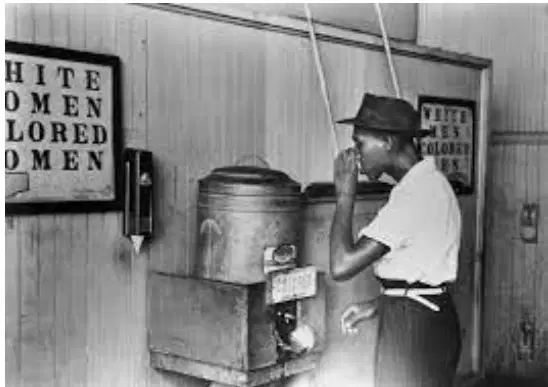
This image is a example of...
a Jim Crow Law
a literacy test
a poll tax
Did progressive reformers want the government to be MORE or LESS involved in the economy and society?
LESS
MORE
As a result of the changing nature of work during the time period following the Civil War, some members of the working class formed unions to address work-related issues. Problem: Many jobs are dangerous and unhealthy. Which union solution best addresses this problem?
Set a minimum wage.
Fire and other safety codes require employers to be responsible for the safety and well being of their staff.
Limit work day to a 8 hours.
As a result of the changing nature of work during the time period following the Civil War, some members of the working class formed unions to address work-related issues. Problem: Pay is too low to make a living. Which union solution best addresses this problem?
Set a minimum wage.
Fire and other safety codes require employers to be responsible for the safety and well being of their staff.
Limit work day to a 8 hours.
As a result of the changing nature of work during the time period following the Civil War, some members of the working class formed unions to address work-related issues. Problem: Working long hours causes exhaustion and accidents. Which union solution best addresses this problem?
Set a minimum wage.
Fire and other safety codes require employers to be responsible for the safety and well being of their staff.
Limit work day to a 8 hours.
Economic and political domination of a strong country over a weaker one is known as...
social darwinism
progressivism
imperialism
Which of the following is a reason FOR annexation of Hawaii?
The Hawaiian monarchy was against being ruled the United States.
Hawaii had no valuable natural resources but would be valuable as a place to dump America's industrial waste.
Hawaii would make an excellent port to refill and resupply our trade and military ships.
Analyze the quote. Was this person FOR or AGAINST the annexation of Hawaii? "I regarded the proposed annexation of Hawaii as not only opposed to our national policy but as a perversion of our national mission."
FOR
AGAINST
The Spanish - American War was a pivotal moment in American history because...
it signalled the emergence of the U.S. as a global power.
it was the first time that the U.S. lost a war.
it was the first time Americans protested against the government.
Why has Cuba always been of "intense interest" to the United States?
Cuba's proximity to Florida makes it an ideal travel destination for the American people.
Cuba's large and well equipped military is a threat to the United States.
Because Cuba is just 90 miles away from Florida, it could become a strategic threat if it falls into the wrong hands.
Which territory was gained by the U.S. as a result of victory in the Spanish - American War?
Guam
ALL of the above
The Philippines
Puerto Rico
Which of the following benefits would the U.S. receive from the construction of the Panama Canal?
It would give the U.S. the ability to defend American territories around the world.
It would create shorter and more efficient trade routes that would benefit the American economy.
BOTH of these would be benefits the U.S. would receive from the construction of the Panama Canal.
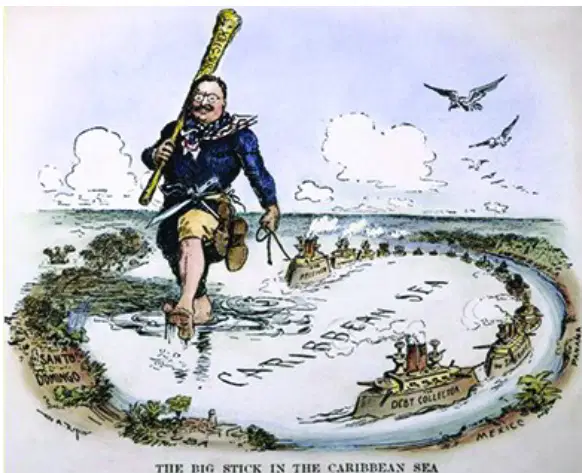
This cartoon represents Theodore Roosevelt's Big Stick Policy. What does the Big Stick symbolize?
America's economic power.
America's military power

What are the characters in cartoon doing to China?
They are arguing about which nation has rights to the pizza industry in China.
They are carving out sections - or spheres of influence.

Which event of 1915 - depicted in the image below - changed American attitudes about U.S. involvement in WWI?
The British blockade of German ports.
The admission by some American manufacturers that they were selling contraband goods to Germany.
A German U-boat sank the British passenger ship Lusitania, killing over 1,000 passengers — including 128 Americans.
In January of 1919, delegates from around the world traveled to Paris to discuss the end of WWI. What was the name of the document that detailed the terms of peace?
The Paris Peace Agreement
The Treaty of Versailles
The 14 Points
Which of the following best describes the League of Nations?
An international group to act as a "watchdog" to ensure that Germany did not emerge as a militaristic ever again
An international league that would help preserve world peace by pledging to respect and protect each others territory and political independence
An international membership of nations that vowed to use their militaries to collect the reparations - or war fines - owed by Germany
The Treaty of Versailles faced opposition in the U.S. Senate. Their opposition focused on...
the absence of Republican representative at the peace conference.
concerns over U.S. involvement in the League of Nations.
the fact that the U.S. did not get any new territory in the terms of the treaty.
The United States never became a member of the League of Nations.
TRUE
FALSE
Which of the following is an example of social unrest caused by racial intolerance in the the 1920s?
immigration quotas
incarceration of immigrants
urban race riots
The ____________ of African Americans to northern cities heightened racial tensions there and led to a series of urban race riots in 1919. Lynchings and the enforcement of Jim Crow legislation continued in the South during the postwar era. Racial intolerance also was seen in the revival of the Ku Klux Klan across the United States.
Great Migration
Absence
An increase in immigration to the United States from southern and eastern Europe preceded World War I. ____________ after the war was reflected in the passage of immigration quotas. Intolerance toward immigrants, Catholics and Jews was exhibited by groups such as the Ku Klux Klan.
Appreciation of diversity
Nativism
Which of the following is a reason that many Americans defended limits on immigration in the 1920s?
Many believed that immigrants brought too many job opportunities to the country.
Many believed that immigrants held radical political beliefs.
Many believed that immigration should be illegal.
Harlem Renaissance — Which social change occurred alongside this movement?
more women will run for political office
pride in African American culture
increase in organized crime
race riots in northern cities
Great Migration — Which social change occurred alongside this movement?
more women will run for political office
pride in African American culture
increase in organized crime
race riots in northern cities
Women's Suffrage — Which social change occurred alongside this movement?
more women will run for political office
pride in African American culture
increase in organized crime
race riots in northern cities
Prohibition — Which social change occurred alongside this movement?
more women will run for political office
pride in African American culture
increase in organized crime
race riots in northern cities
Why did people join unions? Select THREE concepts that best answer the question.
wages
benefits
conditions
better housing
income gap
Over time, Germany’s strong buildup of armed forces, a tactic called Blank 1, led Britain to become involved in the alliance system. Which choice correctly completes Blank 1?
militarism
nationalism
imperialism
What system of manufacturing adopted by Henry Ford divided operations into simple tasks and cut unnecessary motion to a minimum?
assembly line
product placement
construction design
apprentice system

Which of the following is true about African American soldiers during World War I?
They served only in noncombat positions.
They enlisted voluntarily.
They received a standard rank.
They served in segregated units from white male soldiers.
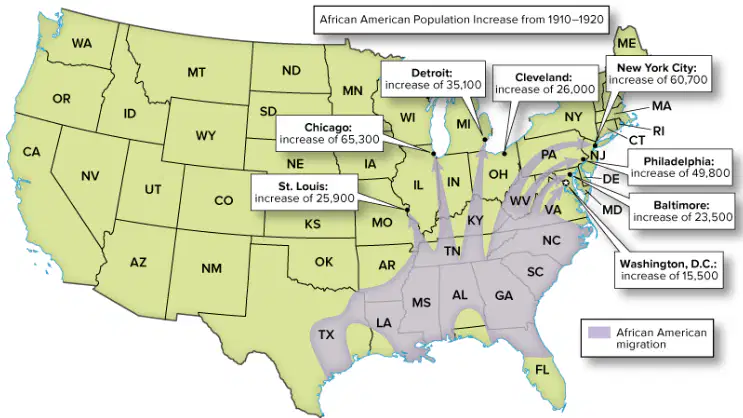
What were some causes of the event illustrated in the map of the Great Migration? Select all that apply.
The desire of African Americans in the South to escape segregation
Immigrants from Eastern Europe took farming jobs formerly held by African Americans
The greater availability of higher paying factory jobs in the North
Black nationalism and the “back to Africa” movement led by Marcus Garvey
The first declaration of war in World War I came after which event?
the assassination of Archduke Ferdinand
Russia signed a treaty to support Austria
Germany invaded Belgium
Germany invaded Russia
“Selling” support for World War I to the American people was done through
commercials on tv
text messages
propaganda
none of the above
During the Depression, newly homeless people built shantytowns, which they called Blank 1 after the president they blamed for their plight. Which option correctly completes Blank 1?
Hoovervilles
cooperatives
Quakertowns
In search of work or a better life during the Depression, many homeless, unemployed Americans, known as Blank 2, began walking, hitchhiking, or “riding the rails.” Which option correctly completes Blank 2?
hoboes
migrants
bailiffs
For each item, indicate whether it is a man‑made or environmental cause of the Dust Bowl: Severe drought
man‑made
environmental
For each item, indicate whether it is a man‑made or environmental cause of the Dust Bowl: Deep‑plowing of fields
man‑made
environmental
For each item, indicate whether it is a man‑made or environmental cause of the Dust Bowl: The Homestead Act
man‑made
environmental
For each item, indicate whether it is a man‑made or environmental cause of the Dust Bowl: Topsoil erosion
man‑made
environmental
For each item, indicate whether it is a man‑made or environmental cause of the Dust Bowl: High winds
man‑made
environmental
For each item, indicate whether it is a man‑made or environmental cause of the Dust Bowl: Soil turned to dust
man‑made
environmental
President Hoover wanted state and city governments rather than the federal government to provide money directly to impoverished families, known as
bonuses
credits
income
relief
As the bull market of the late 1920s continued to soar, many investors began buying stocks on margin, making only a small cash down payment and borrowing the rest.
True
False
Buying on margin was a method of buying stocks
with mostly borrowed money
without using a broker
by pooling money with others
without any risk
The stock market took its steepest dive on October 29, 1929, the day now known as
Red Thursday
Black Tuesday
Black Friday
Bloody Sunday
As a result of the stock market crash, some banks suffered more losses than they could absorb and
tried to attract more depositors.
had to approve more loans.
needed to increase interest rates.
were forced to close.
At the time of the stock market crash, the government did not insure bank deposits, so
banks kept only a fraction of depositors’ money in reserve.
customers lost their savings if a bank collapsed.
banks had to make money by making loans and investing.
customers turned to their stockbrokers for help.
One reason for the tension between the European powers was their intense pride in their homelands, called
imperialism.
nationalism.
progressivism.
socialism.
The Triple Entente included
Britain, France, and Russia.
Britain, France, and the U.S.
Germany, Bulgaria, and Italy.
Germany, Turkey, and Russia.
Match each statement with the correct item: Bosnian revolutionary behind assassination of Archduke Franz Ferdinand
propaganda
Lusitania
Gavrilo Princip
Match each statement with the correct item: British ship sunk by Germany, killing over 1,000 passengers
propaganda
Lusitania
Gavrilo Princip
Match each statement with the correct item: information designed to influence opinion
propaganda
Lusitania
Gavrilo Princip
During World War I, women officially served in the armed forces for the first time in
combat positions.
training operations positions.
officer and management positions.
clerical and nursing positions.
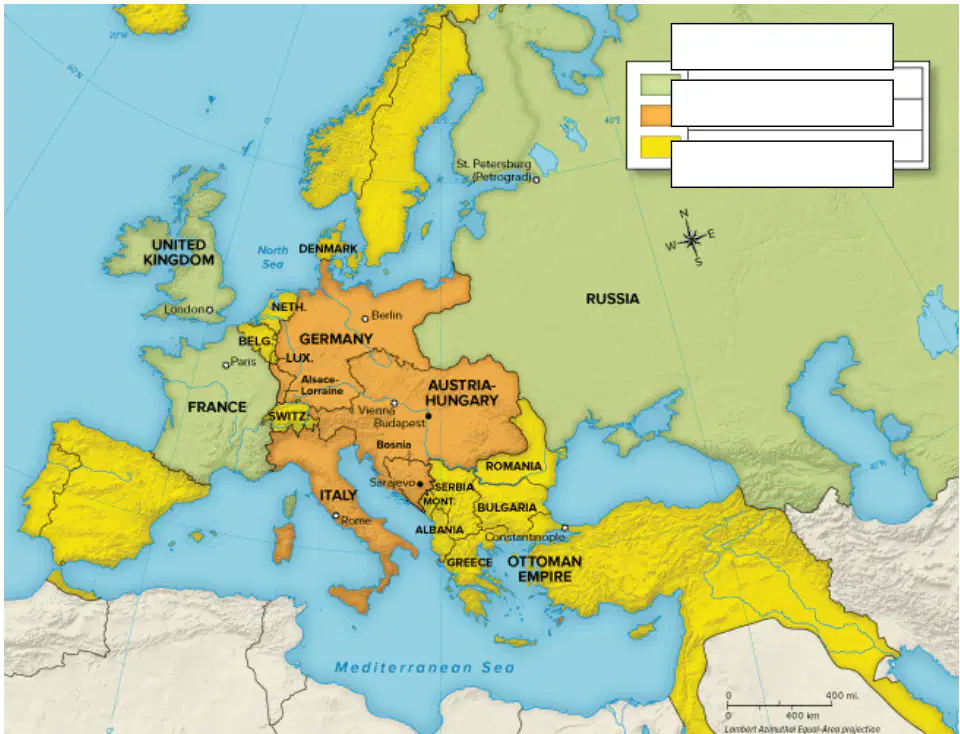
Using the map of Europe with color-coded regions and a blank legend, identify which color corresponds to Triple Alliance.
orange
green
yellow
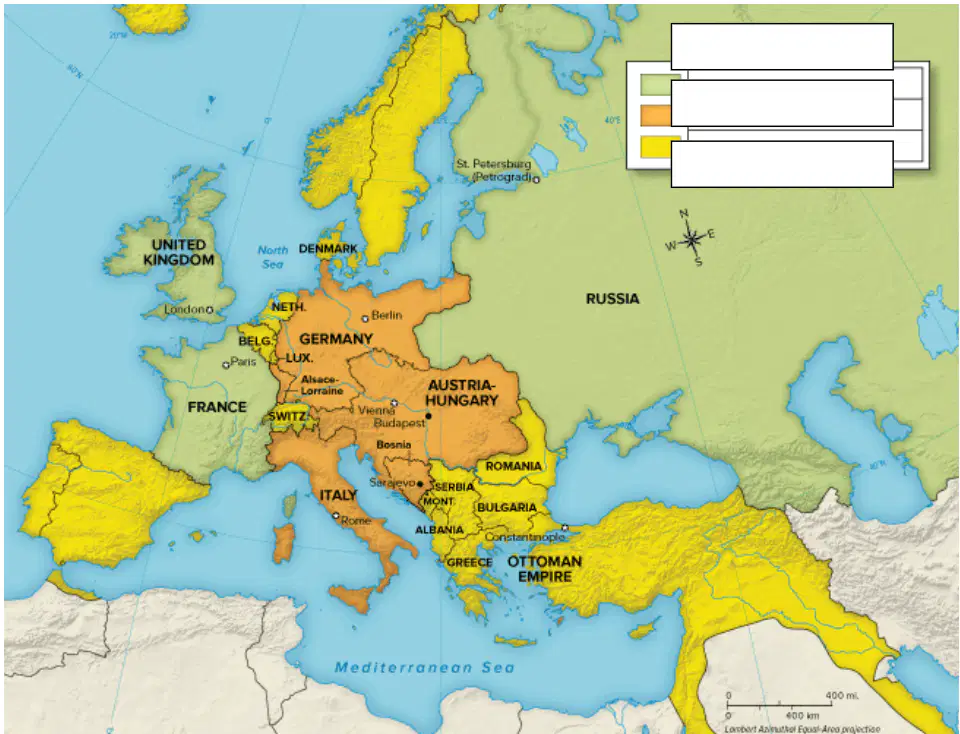
Using the map of Europe with color-coded regions and a blank legend, identify which color corresponds to Triple Entente.
orange
green
yellow
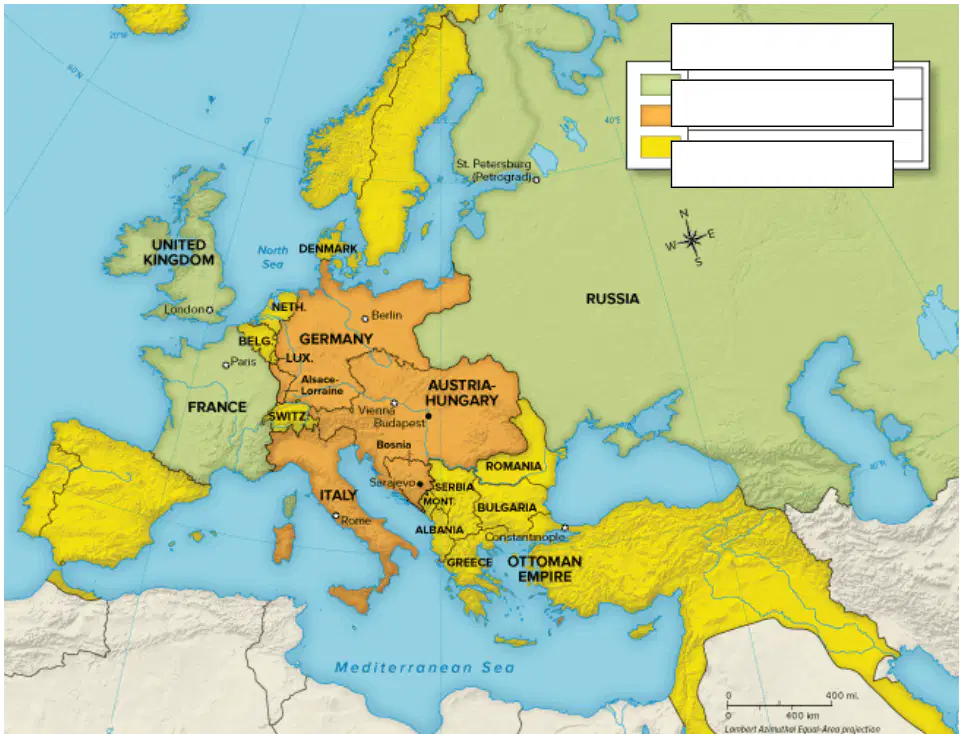
Using the map of Europe with color-coded regions and a blank legend, identify which color corresponds to Other European States.
orange
green
yellow
To mobilize for war, Congress passed the Selective Service Act of 1917, which required all men between 21 and 30 to register for the
draft
army
debentures
To help fund the war efforts, the government borrowed over $20 billion through the sale of
war bonds
debentures
penny stocks
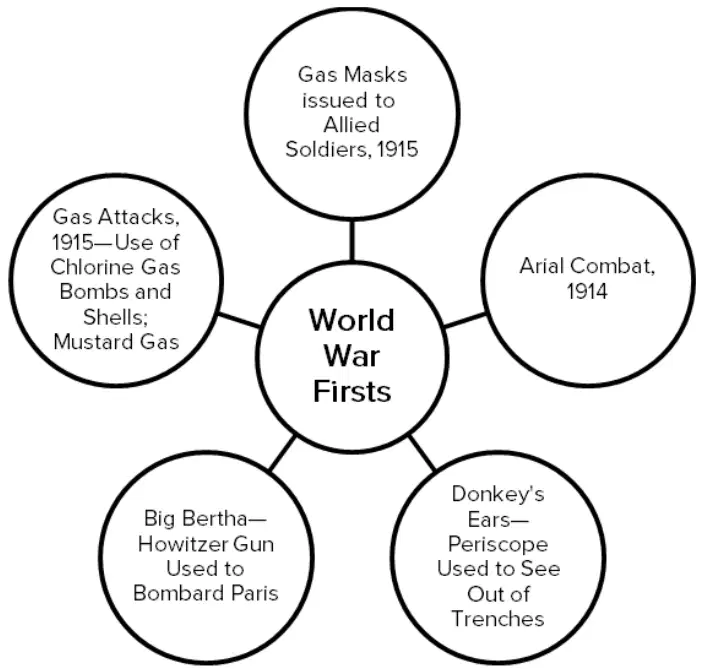
Study the graphic. What was used to defend soldiers against the use of mustard gas and chlorine bombs during World War I?
howitzer guns
gas masks
periscopes
zeppelins
Why did the Senate reject the Treaty of Versailles?
to avoid the dues for membership in the League of Nations
to express opposition to the harsh sanctions imposed on Germany
to keep the United States free from foreign entanglements
to increase United States military forces in Europe
Trenches were dug during World War I to protect soldiers from
tanks.
airplanes.
artillery fire.
poison gas.
As strikes erupted across the United States in 1919, the fear that Communists might seize power led to the
Red Scare.
Red Nativism.
Red Socialism.
Red Communism.
The Zimmermann telegram proposed that Canada become an ally of Germany in the event of war between the United States and Germany.
True
False
To help pay the costs of the war, Congress
encouraged meatless Tuesdays.
lowered taxes.
outlawed unions.
sold Liberty Bonds.
Which amendment repealed Prohibition?
Twenty-second Amendment
Twenty-first Amendment
Nineteenth Amendment
Eighteenth Amendment

