
 Worksheets
🚀1.9 - Partner Competition
Total questions: 125
Worksheet time: 2hrs 36mins

Multi-Select: Select the activities that will NEGATIVELY impact your learning success.


Community Snacks - Class Distractions
Multi-Select: Select the activities that will NEGATIVELY impact your learning success.


Multi-Select: Select the activities that will NEGATIVELY impact your learning success.


Multi-Select: Select the activities that will POSITIVELY impact your learning success.
Multi-Select: Select the activities that will POSITIVELY impact your learning success.

Multiple Choice: Identify which represents, "Permission to Speak"?


Multiple Choice: Identify which represents, "Please Be Quiet, Classmate"?

Non-Verbal Cues.
Match each of these non-verbal cues with the correct meaning.

Permission to speak

Quiet Please, Classmate.

Restroom

Tissue

Water

Who is the person MOST responsible for your academic success?🥰
(a)

Multiple Choice: What percentage should be your MINIMAL goal for all homework, activities and assessments in Science?
75%
80%
85%
100%

Positively RIGHT vs. Negatively WRONG
Classify each of these items as a RIGHT choice or a WRONG choice.


Being Respectful of EVERYONE

Pushing YOUR SEAT under the Table after use.


Talking when the Teacher Talks.

Match each of these non-verbal symbols/images with its meaning.

May I use the Restroom.

Water, Please.

Tissue, Please.

May I speak?

Please Quiet, Classmate.

Match each of these Canvas Norms with its meaning.

THIS is Where We Start

Re-Watch Videos

Homework Links

Games to Continue to Learn/Study

Quick Link to In-Class Games

Identify each of these icons.

Quizlet

Quizizz

Wooclap

Outlook - Mail

Quizalize

Match each of these parts with its corresponding part.
State of Matter, definite Shape, definite Volume.
Solid
State of Matter, indefinite Shape, definite Volume.
Liquid
State of Matter, indefinite Shape, indefinite Volume.
Gas
One Form of Matter.
State of Matter
Exactly Measurable.
Definite
Match each of these parts with its corresponding part.
Outline of an object.
Shape
Amount of space something takes up.
Volume
Amount of amounts in an object.
Mass
Anything with mass and volume.
Matter
Exactly Measurable.
Definite

For each of these concepts match its corresponding meaning.
Density
The amount of mass per unit of volume of an object
Mass
The amount of atoms in an object.
Volume
The amount of space an object takes up.
Gravity
A measurement of the pull on an object's mass.
Water Displacement
Method used to determine the volume of an irregularly shaped object - uses graduated cylinder.

Properties and Changes
Sort each of these examples in the correct grouping. Physical and Chemical Properties & Physical and Chemical Changes.

Toxicity

Flammability

Corrosiveness

Reactivity

Combustibility

Green Color

Shapes

Size

Descriptions about Features

State of Matter

Measurements/ Number Descriptions
Description that indicates its ability to participate in a chemical reaction.
Description that remarks of features.

State Changes

Identity stays the Same

May be Reversible
Action that will not result in an altering of identity.

Cutting Hair

All Cooking

Has Signs (Indicators)

Changes
Sort each of these examples in the correct grouping. Physical and Chemical Changes.
State Changes
Identity stays the Same
May be Reversible
Action that will not result in an altering of identity.
Cutting Hair
All Cooking
Has Signs (Indicators)

Painting a Wall

Melting Ice Cream

Windows Condensating
Creates a NEW Substance

Grilling

Fizzing

Smoke Forming

Forming a Precipitate

pH Change

Automatic Color Change

Souring Milk

Rusting

Broken Glass


pure element

pure compound

mixture of elements

mixture of compounds

mixture of elements and compounds

Match each of these definitions with its term.
Pure substance made of one type of atom.
element
Two or more different elements chemically combined.
compound
Two or more different substances physically combined.
mixture
Exactly Measurable.
definite
Another term for homogeneous mixture.
solution

Match each of these images with its correct classification.

Mixture of Compounds

Compounds

Elements

Mixture of Elements

Mixture of Elements and Compounds

Match each lab tool with its name.

Microscope

Graduated Cylinder

Triple Beam Balance

Flask

Metric Ruler

Match each of the following with its function.
Measures Length.
Metric Ruler
Measures Volume of Liquids or Irregular-shaped Solids.
Graduated Cylinder
Measures Mass.
Triple Beam Balance
Magnifies extremely small objects, allowing for larger viewing.
Microscope
Used to carry or contain liquids and substances.
Beaker

Match each of these terms with its definition.
The amount of atoms in an object.
Mass
The amount of space something takes up.
Volume
The distance measured between two points.
Length
A description of matter.
Property
An action of matter.
Change

Match each of these HELPFUL parts of our Canvas Page.

Brain Activator (START of each Class).

Quizlet Sets - To-do after 2-100%s on HW

Re-Watching our Day's Videos.

HW Section.

SMART COOKIE - Alert of the Dojo Amount.

Match each image with its meaning.

Solid Particles

Liquid Particles

Gas Particles

Graduated Cylinder

Triple Beam Balance

Match each state of matter with its particle arrangement.

Solid

Liquid

Gas

Identifying the States of Matter.
Accurately select characteristics of each State of Matter.
Defintion: Definite, Definite
Definition: Indefinite, Definite
Definition: Indefinite, Indefinite
Particles: Packed Close
Movement: Vibrates
Intermolecular Force: Strongest

Temperature: Coolest
Particles: Loosely Touching
Movement: Slide Past One Another
Intermolecular Forces: Medium

Particles: Farthest apart
Movement: Zippy Bumper Cars
Intermolecular Forces: Weakest

Temperature: Warm
Temperature: Hottest
Labeling the State Change Triangle.
Indicate the parts of this State Change Triangle.
Place your Label on each numbered part.
Freezing
Sublimation
Deposition
Boiling/Evaporation
Condensation
Melting

Arrange the states of matter in order, MOST compacted (close) to LEAST compacted (farthest away).
SOLID
L I Q U I D
G A S
Labeling the Heating Curve.
Indicate the parts of this Heating Curve.
Place your Label on each numbered part.
L -> G (Boiling)
Solid
Liquid
Gas
S -> L (Melting)
Labeling the Cooling Curve.
Indicate the parts of this Cooling Curve.
Place your Label on each numbered part.
L -> S (Freezing)
G -> L (Condensation)
Solid
Liquid
Gas
Labeling the Triple-Point Diagram.
Indicate the parts of this Phase Diagram.
Place your Label on each lettered part.
Solid
Liquid
Triple-Point
Gas

Understanding the Atom's Structure.
Accurately identify the property of each subatomic particle.
Negatively charged subatomic.
e-
Located in the Electron Cloud.
Smallest of the three subatomics.
Positively charged subatomic.
p+
Located in the Nucleus with n0.
Unique to each element.
Neutrally charged subatomic.
n0
Located in the Nucleus with p+.
Does not affect the charge of the Nucleus.

Blue subatomic particle

Green subatomic particle

Red subatomic particle

Match the following.
Subatomic particle with +1 Charge.
Proton
Subatomic particle with -1 Charge.
Electron
Subatomic particle with 0 Charge.
Neutron
Center Region of Atom, Positively Charged.
Nucleus
Outer Region of Atom, Negatively Charged.
Electron Cloud

Match each of these state changes with its meaning.
State Change, Solid to Gas.
Sublimation
State Change, Gas to Solid.
Deposition
State Change, Gas to Liquid.
Condensation
State Change, Liquid to Gas (Artificial Heat).
Boiling
State Change, Liquid to Gas (Natural Heat).
Evaporation

Match the term with its meaning.
Subscript
Lowered number in formula, indicates how many of each element is present.
Coefficient
Large number in FRONT of molecule, used as a multiplier.
Chemical Formula
Symbols and subscripts that tell what's in a molecule.
Symbol
The Letter Abbreviation of each Element - starts with a capital letter.
Bond
Interaction between 2 or more Elements' electrons.
Correctly identify these samples (for simplicity: we'll assume "mixture" is refers to heterogenous mixtures, as all samples of more than one, could be identified as a "mixture"😉).

Compounds

Mixture of Elements

Mixture of Elements and Elemental Molecules

Mixture of Elemental Molecules

Elemental Molecules
Use this Image to Label the Parts of an Atom.
Match the following

Gas

Solid

Liquid
Match the following.
Center Region of Atom, Positively Charged.
Nucleus
Outer Region of Atom, Negatively Charged.
Electron Cloud
The Number of Protons.
Atomic Number
The amount of Nucleons.
Mass Number
Occurs with different amounts of Neutrons.
Isotope
Match the following.
Class of Element, Shiny, Ductile, Malleable, and Great Electrical Conductor.
Metal
Class of Element, Dull, Brittle and Poor Electrical Conductor.
Non-Metal
Class of Element, Properties in Between M+ and NM-, Semi-Conductors.
Metalloid
Small number in chemical formula, indicates the number of atoms present for the element it follows.
Subscript
Large number in FRONT of chemical formula, used as a multiplier for the ENTIRE compound.
Coefficient
Match the term with its meaning.
Subscript
Lowered number in formula, indicates how many of each element is present.
Coefficient
Large number in FRONT of molecule, used as a multiplier.
Chemical Formula
Symbols and subscripts that tell what's in a molecule.
Symbol
The Letter Abbreviation of each Element - starts with a capital letter.
Bond
Interaction between 2 or more Elements' electrons.

Correctly match each part with its correct match.
Outermost electrons, responsible for all chemical reactions.
Valence Electron
Two Types, Covalent or Ionic.
Bond
Shiny, Ductile, Malleable and Great Electrical Conductors.
Metal
Located to the RIGHT of the Metalloids, except for Hydrogen (H).
Non-Metal
Located on the Stair-Step: B, Si, Ge, As, Sb, Po, Te, At.
Metalloid
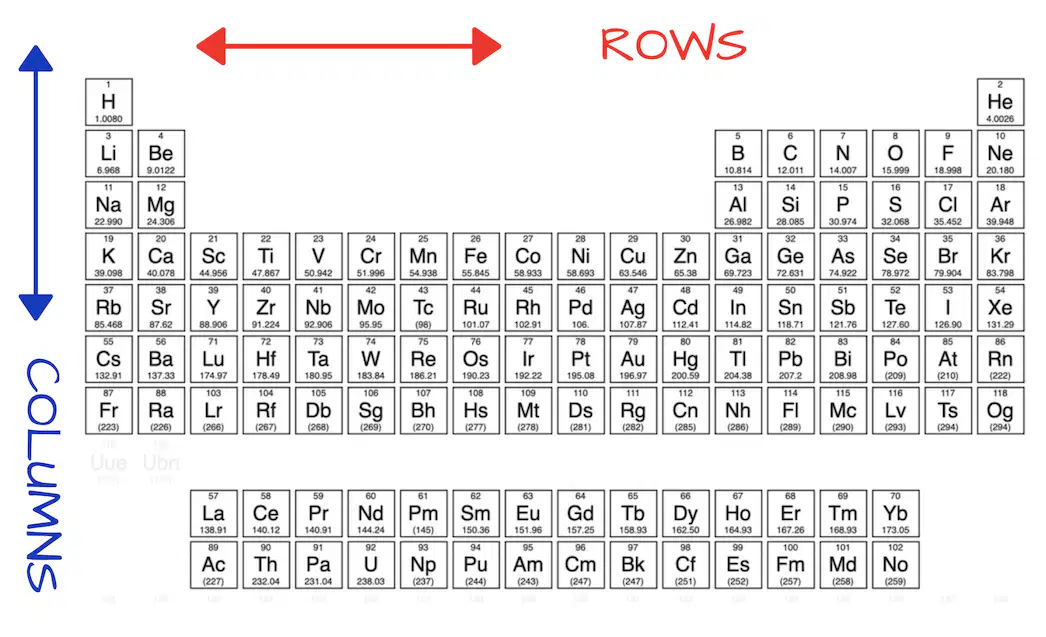
Identifying Properties of the Element Classes.
Correctly identify each of the characteristics of each element class.
Ductile
Malleable
Shiny
Great Electrical Conductors
M+
Includes Transitions
Includes Lanthanide and Actinide Series
Properties of Metals and non-Metals
ML
Semi-Conductors
8 Elements
B, Si, Ge, As, Sb, Te, Po, At
Staircase that separates the Periodic Table into 2-Halves
Most populated Class
Mostly on the LEFT of the PT
Brittle
Dull
Poor Electrical Conductors
NM-
Includes Noble Gases

Match each of these parts with its correct match.
On the Periodic Table, left to right
Row
On the Periodic Table, up and down
Column
Outermost electrons; responsible for reactions
Valence Electrons
Number of protons; periodic table is arranged by this number
Atomic Number
Total amount of p+ and n0
Mass Number

Match each of these Transformations of State with its correct State Change.
G → S
Deposition
S → G
Sublimation
G → L
Condensation
L → G
Vaporization
S → L
Melting

Match each of these definitions with its term.
Forces of attraction.
Intermolecular Forces
State of Matter, STRONGEST Forces of Attraction.
Solid
State of Matter, WEAKEST Forces of Attraction.
Gas
Pure Substance, 1 Kind of Atom.
Element
Pure Substance, 2 or More Different Atoms.
Compound

Match each definition with its term.
Sample of matter has definite physical and chemical properties.
Pure Substance
Two or more substances, physically combined.
Mixture
Mixture with uniformity (same through and through).
Homogeneous Mixture
Mixture with easily seen parts.
Heterogeneous Mixture
Another term for Elemental Molecule.
Diatomic Molecule

Match the following
P.T Family, MOST reactive non-metal
Halogens
P.T Family, MOST reactive metal
Alkali
P.T Family, NON-reactive (inert)
Noble Gas
Understanding the Atom's Structure.
Accurately identify the property of each subatomic particle.
Negatively charged subatomic.
e-
Located in the Electron Cloud.
Smallest of the three subatomics.
Positively charged subatomic.
p+
Located in the Nucleus with n0.
Unique to each element.
Neutrally charged subatomic.
n0
Located in the Nucleus with p+.
Does not affect the charge of the Nucleus.
Blue subatomic particle
Green subatomic particle
Red subatomic particle

Match each of these parts with its meaning.
Abbreviation for Metal.
M+
Abbreviation for Non-Metal.
NM-
Abbreviation for Metalloid.
ML
Abbreviation for Law of Conservation of Mass.
LOCM
Abbreviation for Balanced
=

Match each term with its definition.
Big number in front of a formula; multiplies all the atoms present.
Coefficient
Small, lowered number written behind its element, indicates the number of atoms present.
Subscript
Symbols and subscripts written together to express the kinds and numbers of each element present.
Chemical Formula
Formulas that are wrote in a chemical sentence to show activity.
Chemical Equation
In a chemical equation, when the kinds and numbers of the elements present on the reactant and products sides are the SAME.
Balanced Equation
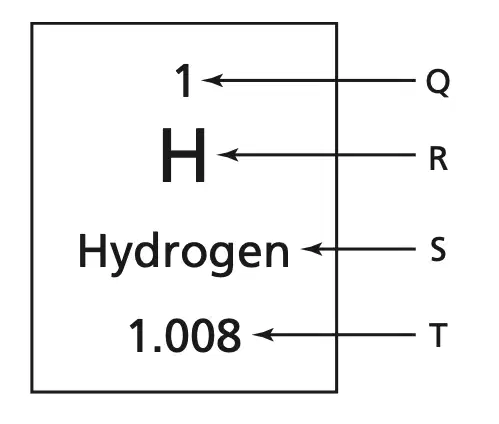
Match each of these Element Square Characteristics with its correct Label.
Atomic Number (p+)
Q
Element Symbol
R
Element Name
S
Atomic Mass (ROUNDED to determine MASS NUMBER)
T

Match each of these terms with its definitions.
Force between two atoms.
Chemical Bond
In a chemical reaction, the start.
Reactant
In a chemical reaction, the end.
Product
Bond between M+ and NM-
Ionic Bond
Bond between NM- and NM- or ML and NM-
Covalent Bond

Match each of these functions with its organelle.
Brain of the cell; controls all cellular functions.
Nucleus
Site of photosynthesis; process that converts carbon dioxide and water to glucose.
Chloroplasts
Detoxifiers of the cell; trashman.
Lysosomes
Jelly of the cell; maintains organelle motility and cellular shape.
Cytoplasm
Powerhouse of the cell; converts cellular food into cellular energy (ATP).
Mitochondria

Match each of these functions with its organelles.
Factory that prepares proteins for distribution throughout the cell.
Endoplasmic Reticulum
Located in the center of the nucleus; most concentrated area of DNA.
Nucleolus
Synthesizes proteins.
Ribosomes
Provides structure and supports cellular pressure.
Cell Wall
Flatten-sacs that are packaging agents; shipping proteins and lipids in and out of the cell.
Golgi Body

Match each term with its correct definition.
Prokaryote
A single-celled organism that does not have a nucleus or membrane-bound organelles.
Eukaryote
Organism made of cells that have nucleus enclosed by membrane.
Cell
Basic building block of living things.
Organism
One individual living thing; anything that can carry out life processes independently.
Organelle
Tiny parts of a cell with a specific function.

Match each of these organelles with its specific function (job).
Vacuole
Stores water, food and waste
Mitchondria
Converts cell food into cell energy (ATP)
Nucleolus
Location of MOST of cell DNA
Golgi Body
Packages and ships substances in and out of cell
Cell Wall
Provides rigid structure and maintains plant pressure
Match each of these organelles with its specific function (job).
Mitchondria
Converts cell food into cell energy (ATP)
Nucleus
Controls all cell activity
Golgi Vesicles
"Fedex Trucks". Shipper of the substances in and out of cell
Lysosome
Removes waste and toxins from cell
Plasma Membrane
Regulates which substances may come in and out of cell

Match each term with its correct definition.
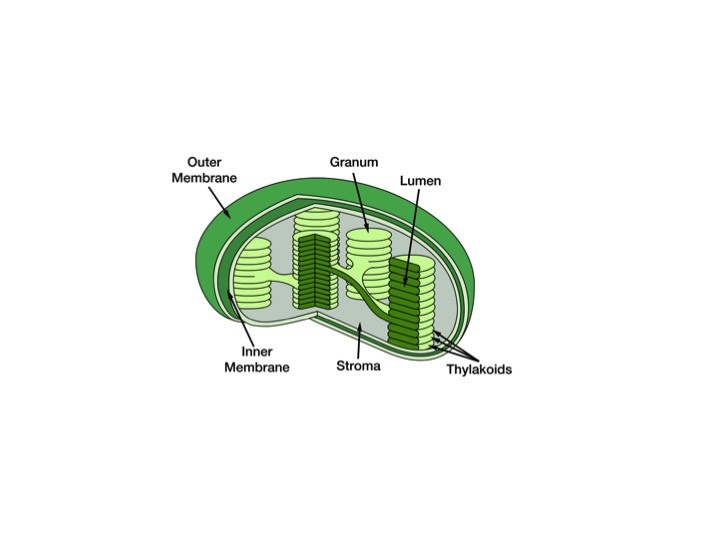
Thylakoids
Flat sacs inside chloroplast
Cristae
Zig-zag folds of the mitochondria
Photosynthesis
Process of converting sunlight to plant food
Cytoplasm
Jelly of cell; Maintains pressure and allows organelles to move
ATP
Cellular energy molecule

Place these Hierarchical Levels in order, from MOST members to LEAST members.
Kingdoms
Phylum
Family
Genus
Species

For each Biological Hierarchical Level match its image.

Population

Tissue

Community

Biome

Organ System
For each Biological Hierarchical Level match its image.
Population

Biosphere

Organism

Organ System

Ecosystem

Match each of these terms with its correct definition.
Heterotroph
Organism must consume others for food (energy)
Autotroph
Organism may make its own food (energy)
Decomposer
Organism that consumes dead or breaks down nutrients for food (energy)
Diversity
Numbers and kinds of organisms
Bio-
Means "living or life"

Correctly match each of the levels with its example.

Organism

Cell

Tissue

Population

Ecosystem

Match each protist with its image.

Euglena

Ameba

Paramecium

Match each missing word statement with the correct term.
A balanced chemical reaction obeys the law of ___.
conservation of matter
Within the electron cloud there are different ___ of electrons.
energy levels
Rusting metal is an example of a ___ change.
chemical
Sugar dissolving, water boiling and ice melting are examples of ___ changes.
physical

Match each set of properties to the correct kingdom.
Non-motile
Cells have nuclei
Multicellular
Cell wall
Reproduces sexually
Plantae
Cells have nuclei
Membrane-Bound Organelles
No cell wall
Unicellular
Protista
Multicellular
Reproduces via spores
Heterotrophic
Cells have nuclei
Fungi
Multicellular
No cell wall
Small vacuoles
Reproduces sexually
Motile
Animalia
Unicellular
No Nuclei
Reproduces asexually
Pathogenic
Eubacteria
Match each set of properties to the correct kingdom.
Non-motile
Cells have nuclei
Multicellular
Cell wall
Reproduces sexually
Plantae
Cells have nuclei
Membrane-Bound Organelles
No cell wall
Unicellular
Protista
Multicellular
Reproduces via spores
Heterotrophic
Cells have nuclei
Fungi
Multicellular
No cell wall
Small vacuoles
Reproduces sexually
Motile
Animalia
Unicellular
No Nuclei
Reproduces asexually
Pathogenic
Eubacteria

Match each of these terms with the correct meaning.
Covalent Bond
Type of Bond, Sharing of Electrons.
Ionic Bond
Type of Bond, Transferring of Electrons.
Reactant
The start of a chemical reaction (LEFT).
Product
The end of a chemical reaction (RIGHT).
Chemical Equation
An expression that depicts a chemical reaction -
Start → End.

Select the people MOST responsible for your academic performances. (Select all that apply)
ME
me
Me
Duh- Me!

A student uses this diagram of a car using gasoline to model cellular respiration.
How does the diagram model cellular respiration?
The car uses gasoline to make food the car needs for movement.
The car uses gasoline to release energy for movement.
The car uses gasoline to to build structures the car needs for movement.
The car uses gasoline top store waste products made through movement.

Two students study a figure that shows the structure of a single-celled organism. It contains organelles required to perform photosynthesis, release energy from food, move, maintain homeostasis, and store genetic material.
The students agree that the organism is nor part of Kingdom Plantae. Which cell parts are missing from the organism that are commonly found in plant cells?
chloroplast and mitochondrion
cell wall and central vacuole
cell wall and chloroplast
chloroplast and flagellum

The food web shows the movement of matter in an ecosystem.
Which movement of matter could be added to the food web?
A connection between alligators and insects because both animals release carbon dioxide during photosynthesis.
A connection between rabbits and squirrels because they both rely on the same food sources to perform cellular respiration.
A connection from plants to alligators because plants produce oxygen during photosynthesis, which is used by alligators.
A connection from insects to rabbits because they both consume plants to perform cellular respiration.

Scholar Habits.
Select which actions are SCHOLAR (Positive) and which are NOT (Negative).


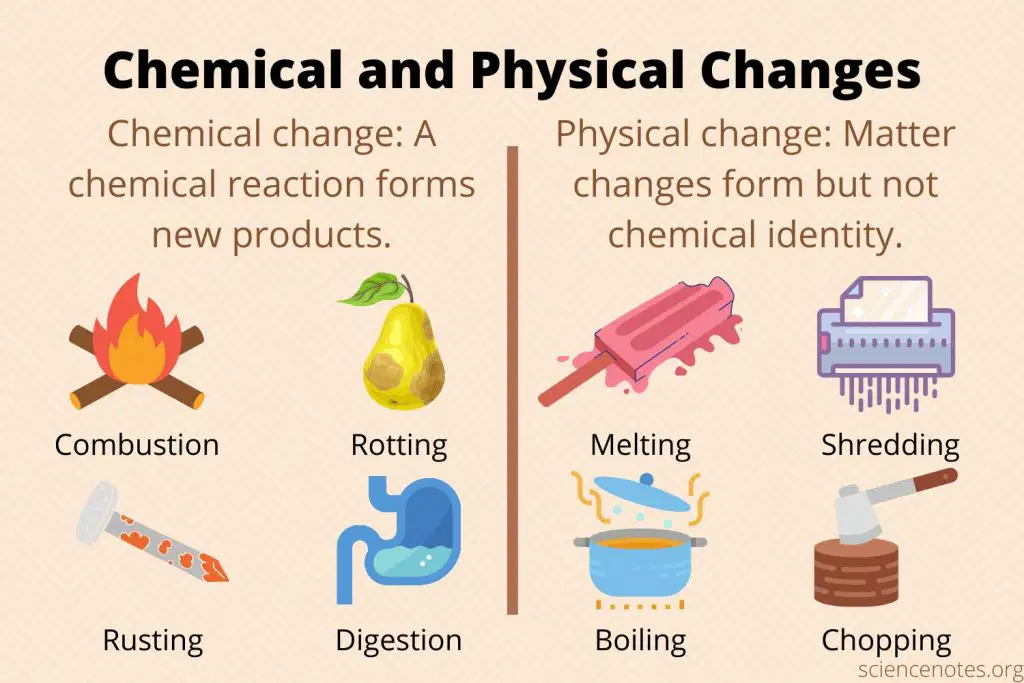
Identification of Physical and Chemical Changes
Classify each of these ACTIONS of matter as PC or CC.


Action does not result in NEW Substance
Action results in NEW substance

Match each of these terms with its definition.
Photosynthesis
Process results in creation of C6H12O6
Cellular Respiration
Process results in creation of ATP
Chloroplast
Location of Photosynthesis
Mitochondria
Location of Eukaryotic Cell Respiration
Cytoplasm; Cell Membrane
Location of Prokaryotic Cell Respiration

It requires CO2 (Carbon Dioxide)
It does not require CO2 (Carbon Dioxide)
It requires O2 (Oxygen)
It does not require O2 (Oxygen)

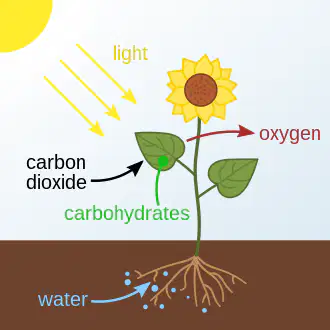
Which choice correctly shows the gases that enter and exit plants during photosynthesis?
Enter: Oxygen
Exit: Carbon dioxide
Enter: Water vapor
Exit: Glucose
Enter: Carbon dioxide
Exit: Oxygen
Enter: Light
Exit: Water vapor

What are the products (what is released) of cellular respiration? (Mark all of them!)
oxygen
glucose
carbon dioxide
water
ATP (energy)

Which of the following exhibits the correct order of the Organization Levels of Life? (simplest to complex)
Cell > Tissue > organ > organ system > organism
organism > organ system > organ > tissue > cell
Cell > organ > tissue > organ system > organism
Cell > organ > tissue > organ system > organism

Adam is helping his uncle in his restaurant, where he notices many examples of physical and chemical changes. Which one of the following describes both a physical and chemical change?
Raisins, almonds, and pumpkin seeds are mixed together. The mixture is then distributed among five containers.
Butter is softened and mixed into a cookie recipe. Then, it is placed in the refrigerator to cool.
Sugar cubes are crushed, then put into a pan to cook. The sugar begins to melt and then burns.
Match each of these functions with its organelles.
Factory that prepares proteins for distribution throughout the cell.
Endoplasmic Reticulum
Located in the center of the nucleus; most concentrated area of DNA.
Nucleolus
Synthesizes proteins.
Ribosomes
Provides structure and supports cellular pressure.
Cell Wall
Flatten-sacs that are packaging agents; shipping proteins and lipids in and out of the cell.
Golgi Body

Which of these statements is TRUE (Select all that apply)?
Oxygen and water are converted into glucose sugar and carbon dioxide.
Carbon dioxide and water are converted into glucose sugar and oxygen.
6CO2 + 6H2O + SUNLIGHT ENERGY → C6H12O6 + 6O2
Glucose sugar is broken down into water and oxygen.
Carbon dioxide and oxygen are converted into water and glucose sugar.

Which of these factors would increase the rate of photosynthesis (Select all that apply)?
Increasing the amount of carbon dioxide
Decreasing the amount of oxygen
Increasing the amount of sunlight
Increasing the amount of glucose sugar
Increasing the amount of water
Which of these factors would not affect the rate of photosynthesis (Select all that apply)?
Increasing the amount of oxygen
Decreasing the amount of soil
Increasing the amount of sunlight
Increasing the amount of glucose sugar
Increasing the amount of water

Identify the reactants of photosynthesis (Select all that apply).
Carbon Dioxide
Glucose Sugar
Water
Sunlight Energy
Oxygen

Which of these statements is TRUE (Select all that apply)?
All multicellular organisms have specialized cells.
Kingdoms are the highest taxa of classification.
Bacteria are eukaryote-celled organisms.
Taxonomy is the science of describing, classifying, and naming organisms.
Only organisms in kingdom Plantae are autotrophic.
Identify the products of photosynthesis (Select all that apply).
Carbon Dioxide
Glucose Sugar
Water
Sunlight Energy
Oxygen


Biologist are continually looking at the variety of life on Earth and trying to determine the best way to group it based on different characteristics. Recently, biologists have divided all life into three main groups, called domains. What are the three domains?
plants, animals, bacteria
prokaryotic, eukaryotic, viral
Bacteria, Achaea, Eukarya
biotic, abiotic, viral

What are the kingdoms that are eukaryotic? (select all that apply)
animalia
Fungi
Protista
Plantae
Eubacteria


Arrange these levels in order, from greatest to least.
community
population
organism
organ
cell
Correctly match each of the levels with its example.

Organism

Cell

Ecosystem

Population

Biome
Match the following.
Subatomic particle with +1 Charge.
Proton
Subatomic particle with -1 Charge.
Electron
Subatomic particle with 0 Charge.
Neutron
Center Region of Atom, Positively Charged.
Nucleus
Outer Region of Atom, Negatively Charged.
Electron Cloud
Match each of these Transformations of State with its correct State Change.
G → S
Deposition
S → G
Sublimation
G → L
Condensation
L → G
Vaporization
S → L
Melting
Understanding the Atom's Structure.
Accurately identify the property of each subatomic particle.
Negatively charged subatomic.
e-
Located in the Electron Cloud.
Smallest of the three subatomics.
Positively charged subatomic.
p+
Located in the Nucleus with n0.
Unique to each element.
Neutrally charged subatomic.
n0
Located in the Nucleus with p+.
Does not affect the charge of the Nucleus.
Blue subatomic particle
Green subatomic particle
Red subatomic particle
Identifying the States of Matter.
Accurately select characteristics of each State of Matter.
Defintion: Definite, Definite
Definition: Indefinite, Definite
Definition: Indefinite, Indefinite
Particles: Packed Close
Movement: Vibrates
Intermolecular Force: Strongest
Temperature: Coolest
Particles: Loosely Touching
Movement: Slide Past One Another
Intermolecular Forces: Medium
Particles: Farthest apart
Movement: Zippy Bumper Cars
Intermolecular Forces: Weakest
Temperature: Warm
Temperature: Hottest
Match each of these organelles with its specific function (job).
Mitchondria
Converts cell food into cell energy (ATP)
Nucleus
Controls all cell activity
Golgi Vesicles
"Fedex Trucks". Shipper of the substances in and out of cell
Lysosome
Removes waste and toxins from cell
Plasma Membrane
Regulates which substances may come in and out of cell
Match each of these organelles with its specific function (job).
Vacuole
Stores water, food and waste
Mitchondria
Converts cell food into cell energy (ATP)
Nucleolus
Location of MOST of cell DNA
Golgi Body
Packages and ships substances in and out of cell
Cell Wall
Provides rigid structure and maintains plant pressure
Match each term with its correct definition.
Prokaryote
A single-celled organism that does not have a nucleus or membrane-bound organelles.
Eukaryote
Organism made of cells that have nucleus enclosed by membrane.
Cell
Basic building block of living things.
Organism
One individual living thing; anything that can carry out life processes independently.
Organelle
Tiny parts of a cell with a specific function.
Match each term with its correct definition.
Prokaryote
A single-celled organism that does not have a nucleus or membrane-bound organelles.
Eukaryote
Organism made of cells that have nucleus enclosed by membrane.
Cell
Basic building block of living things.
Organism
One individual living thing; anything that can carry out life processes independently.
Organelle
Tiny parts of a cell with a specific function.

Match each of these terms with its correct definition.
unicellular
organism made of one cell
multicellular
organism made of many cells
cell
basic building block of all living things
microscope
tool used for making really small things → BIG
hierarchy
order of organization
Match each of these terms with its correct definition.
unicellular
organism made of one cell
multicellular
organism made of many cells
cell
basic building block of all living things
microscope
tool used for making really small things → BIG
hierarchy
order of organization
Match each of these terms with its correct definition.
ATP
Energy Molecule of the cell
Homeostasis
Maintenance of the internal environment
DNA
Blueprint of creation for the cell
Internal
Means "inside"
Chloroplast
Location of photosynthesis
Match each of these organelles with its specific function (job).
Vacuole
Stores water, food and waste
Mitchondria
Converts cell food into cell energy (ATP)
Nucleolus
Location of MOST of cell DNA
Golgi Body
Packages and ships substances in and out of cell
Cell Wall
Provides rigid structure and maintains plant pressure
Place these Hierarchical Levels in order, from MOST members to LEAST members.
Kingdoms
Phylum
Family
Genus
Species

Match each of these organelles with its relatable role.
Ribosomes
Small Protein Factory
Cytoplasm
Jelly
SER
Factory for Lipids
Cell/ Plasma Membrane
Doorman
Golgi Body
Fedex Shipper
Labeling the Animal Cell.
Place a dot on the organelle.
RER
SER
Nucleolus
Nucleus
Cytoplasm
Golgi Body
Labeling the Animal Cell.
Place a dot on the organelle.
RER
SER
Nucleolus
Nucleus
Cytoplasm
Golgi Body
Labeling the Animal Cell.
Place a dot on the organelle.
Plasma Membrane
Lysosome
Mitochondria
RER
SER
Nucleolus
Labeling the Animal Cell.
Place a dot on the organelle.
Plasma Membrane
Lysosome
Mitochondria
RER
SER
Nucleolus

a
b
c
d

a
b
c

a
b
c
d

a
b
c
d

a
b
c
d

a
b
c
d

a
b
c
d

