
 Worksheets
Biology Midterm Review Packet — Extracted Questions
Total questions: 126
Worksheet time: 1hrs 3mins
The variable that a scientist changes in an experiment is the:
Control
Dependent variable
Independent variable
Constant
Which safety rule is MOST important when heating chemicals?
Always wear goggles
Eat before the lab
Smell chemicals directly
Leave materials unattended
The dependent variable is:
What you measure
What you keep the same
What you change on purpose
The control group
Explain the difference between the independent and dependent variables using the fertilizer example.
Independent variable: type of fertilizer; dependent variable: plant height
Independent variable: plant height; dependent variable: type of fertilizer
Independent variable: number of plants; dependent variable: type of soil
Independent variable: sunlight; dependent variable: pot size
Why is it important to have constants in a well-designed experiment?
Constants ensure only the independent variable affects the dependent variable, making the experiment fair
Constants increase the number of variables measured
Constants allow the procedure to change mid-experiment
Constants eliminate the need for a control group
Describe one safety rule and explain why it matters.
Wear goggles to protect your eyes from chemicals or glass
Eat before the lab to have more energy for experiments
Smell chemicals directly to identify them quickly
Leave materials unattended so they can cool on their own
A group of students is given a sample of an unknown substance. The students are asked to gather evidence to determine whether the substance is living or nonliving. Which of the following are characteristics that indicate a substance is living? Select two.
Growth
Reproduction
Cells present
Use of energy
Homeostasis
A group of students is given a sample of an unknown substance. The students are asked to gather evidence to determine whether the substance is living or nonliving. Which investigation would best classify the substance as living or nonliving?
Observe over time for growth, reproduction, response to stimuli, or energy use
Measure its mass once and compare to a textbook value
Heat the sample briefly and see if it melts
Place the sample under a light and note its color
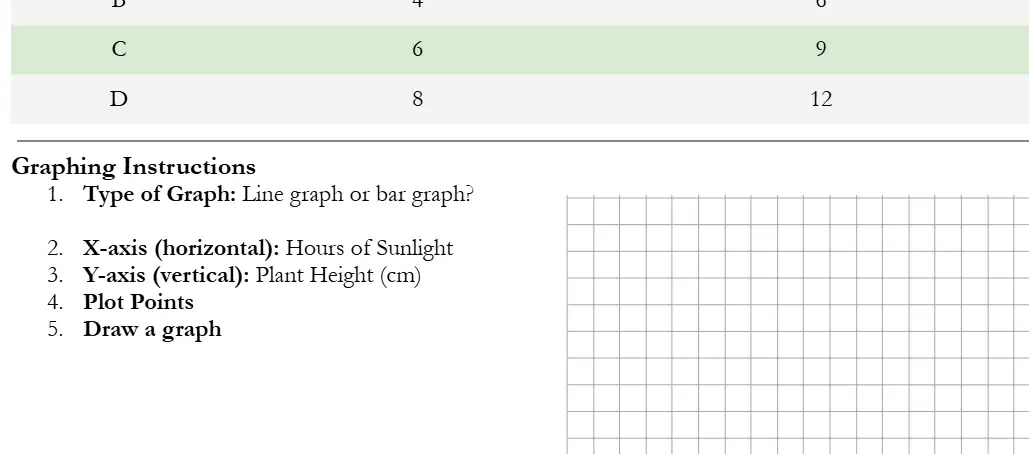
Example Experiment: Plant Growth and Light. Question: Does the amount of sunlight affect the growth of a plant? Data Table shows Hours of Sunlight (2, 4, 6, 8) and Height After 7 Days (4 cm, 6 cm, 9 cm, 12 cm). Which type of graph should be used to display this data?
Line graph
Bar graph

Example Experiment: Plant Growth and Light. Question: Does the amount of sunlight affect the growth of a plant? Which variable should be placed on the X-axis (horizontal) when graphing this data?
Hours of Sunlight
Plant Height (cm)
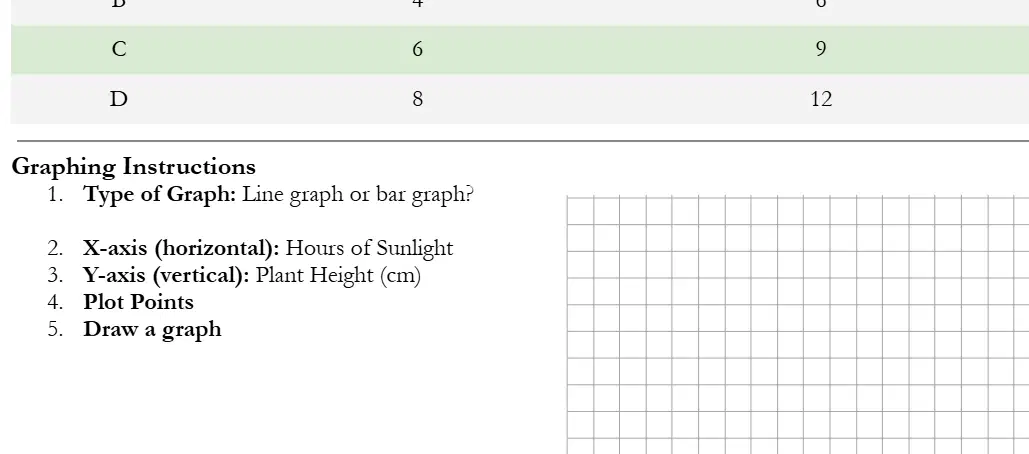
Example Experiment: Plant Growth and Light. Question: Does the amount of sunlight affect the growth of a plant? Which variable should be placed on the Y-axis (vertical) when graphing this data?
Plant Height (cm)
Hours of Sunlight
Example Experiment: Plant Growth and Light. Identify the independent variable and the dependent variable for this experiment.
Independent variable: hours of sunlight; dependent variable: plant height
Independent variable: plant height; dependent variable: hours of sunlight
Independent variable: type of plant; dependent variable: hours of sunlight
Independent variable: soil type; dependent variable: plant height
Example Experiment: Plant Growth and Light. Based on the trend shown by the data, what happens to plant growth as hours of sunlight increase?
Plant height increases
Plant height decreases
Plant height stays constant
Plant height varies randomly
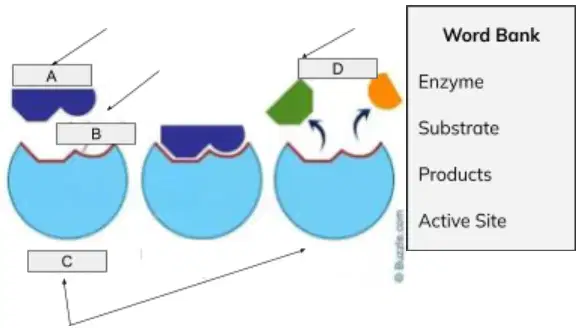
Identify the parts of the diagram below using the word bank (Enzyme, Substrate, Products, Active Site). What does label A represent?
Enzyme
Substrate
Products
Active Site

Identify the parts of the diagram below using the word bank (Enzyme, Substrate, Products, Active Site). What does label B represent?
Enzyme
Substrate
Products
Active Site
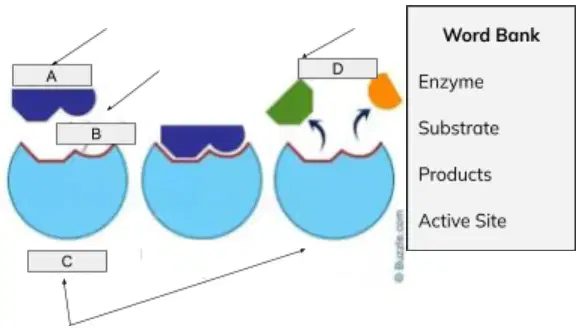
Identify the parts of the diagram below using the word bank (Enzyme, Substrate, Products, Active Site). What does label C represent?
Enzyme
Substrate
Products
Active Site

Identify the parts of the diagram below using the word bank (Enzyme, Substrate, Products, Active Site). What does label D represent?
Enzyme
Substrate
Products
Active Site
A _____ is made up of many small molecules joined together.
monomer
polymer
During dehydration synthesis, two monomers are _____ and a molecule of _____ is removed.
joined and water
broken apart and carbon
joined and carbon
broken apart and water
During hydrolysis, a polymer is _____ and a molecule of _____ is added.
joined and water
broken apart and carbon
joined and carbon
broken apart and water

In the diagram below, identify and describe the reaction taking place.
Dehydration synthesis: two monomers join to form a polymer, releasing water
Hydrolysis: a polymer breaks into monomers by adding water
Combustion: molecules react with oxygen to release energy and water
Photosynthesis: monomers are formed using light energy and carbon dioxide

In the diagram below, identify and describe the reaction taking place.
Dehydration synthesis: two monomers join to form a polymer, releasing water
Hydrolysis: a polymer breaks into monomers by adding water
Combustion: molecules react with oxygen to release energy and water
Photosynthesis: monomers are formed using light energy and carbon dioxide
Which biomolecule is the main source of quick energy?
Lipids
Carbohydrates
Proteins
Nucleic acids
The monomers of proteins are:
Monosaccharides
Nucleotides
Fatty acids
Amino acids
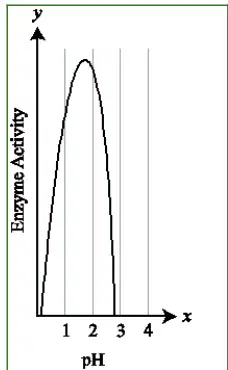
Pepsin is an enzyme that helps break down proteins into simpler peptides. The graph shows the pH range in which pepsin functions in the human stomach. What will most likely happen when pepsin mixes with food in the stomach and moves to the small intestine, which has a pH of 6.0?
Pepsin will change its pH range.
Pepsin will become inactive.
Pepsin will work more efficiently at a higher pH.
Pepsin will digest substances other than protein.
Carbohydrates and proteins are two types of macromolecules. Which functional characteristic of proteins distinguishes them from carbohydrates?
Large amount of stored information
Ability to catalyze biochemical reactions
Efficient storage of usable chemical energy
Tendency to make cell membranes hydrophobic
Which process best describes the assembly of proteins from amino acids?
Atoms are linked to form a compound.
Monomers are linked to form a polymer.
Atoms are added to a monomer until it becomes a polymer.
Molecules are added to a compound until it becomes a monomer.
Enzymes can be denatured when:
The temperature or pH changes too much
Too many substrates are available
There is no ATP
Glucose levels increase
Which option correctly explains the property of carbon that allows the formation of these biomolecules
Carbon forms multiple bonds, all of which are ionic due to its atomic weight.
Carbon is highly polar, which allows it to form bonds with different elements.
Carbon has a small atomic size, which allows it to bond with multiple elements.
Carbon is tetravalent, allowing it to form multiple covalent bonds with other atoms.
Which statement best compares a carbohydrate and a nucleic acid?
The sequence of monomers in a carbohydrate stores genetic information, and the bonds in a nucleic acid store energy.
The bonds in a carbohydrate store energy, and the sequence of nucleotides in a nucleic acid stores genetic information.
A carbohydrate has a unique structure to assist diffusion across a plasma membrane, and a nucleic acid has a unique structure to assist chemical reactions.
A carbohydrate has a unique structure to assist chemical reactions, and a nucleic acid has a unique structure to assist diffusion across a plasma membrane.
Each cell in the human body contains thousands of different enzymes responsible for regulating reactions within the cell. Which statement explains why a single enzyme is unable to regulate a variety of reactions?
The binding of a product and an enzyme is specific.
The binding of a substrate and an enzyme is specific.
The enzyme is consumed by the products of the reactions.
The enzyme is consumed by the substrates of the reactions.

Which biological molecules are most likely represented by molecules 1 and 2? Molecule 1: a molecule made mostly of carbon with two nonpolar chains and a polar head; cellular use: is a component of plasma membranes. Molecule 2: a polar molecule made of repeating units of sugar bonded to a phosphate and a nitrogenous base; cellular use: stores genetic information.
Molecule 1: lipid; molecule 2: nucleic acid
Molecule 1: lipid; molecule 2: protein
Molecule 1: carbohydrate; molecule 2: nucleic acid
Molecule 1: carbohydrate; molecule 2: protein
Describe how enzymes work using the terms enzyme, substrate, and products. Explain how enzymes affect the rate of a chemical reaction and why they are specific to certain reactions.
Enzymes bind to specific substrates at their active sites, form products, and lower activation energy to speed reaction rates.
Enzymes increase activation energy and bind to any molecule to produce products.
Enzymes are consumed during reactions and therefore slow down reaction rates.
Enzymes bind products and convert them to substrates, and they work the same for all reactions.
Why is diet important for biomolecule balance in the body?
A balanced diet supplies different biomolecules needed for energy, growth, repair, enzymes, and cell structures.
Diet eliminates the need for enzymes in cells by providing ready-made products.
Eating only one type of food keeps biomolecule levels constant for all needs.
Diet only affects carbohydrate levels and does not influence other biomolecules.
Organelles – Match the cell organelle in Column A with its correct function in Column B. Select the function that best matches: Nucleus.
Directs all cell activities and stores genetic information (DNA)
Produces energy in the form of ATP by breaking down glucose
Packages, modifies, and ships proteins and other molecules
Controls what enters and exits the cell; provides protection and support
Organelles – Match the cell organelle in Column A with its correct function in Column B. Select the function that best matches: Mitochondria.
Produces energy in the form of ATP by breaking down glucose
Contains chlorophyll and carries out photosynthesis
Breaks down waste materials and cellular debris using digestive enzymes
Synthesizes lipids and detoxifies harmful substances; does not have ribosomes
Organelles – Match the cell organelle in Column A with its correct function in Column B. Select the function that best matches: Ribosome.
Produces proteins by assembling amino acids in the correct order
Modifies proteins made by ribosomes and transports them around the cell
Packages, modifies, and ships proteins and other molecules
Maintains cell shape, provides structural support, and assists in cell movement
Organelles – Match the cell organelle in Column A with its correct function in Column B. Select the function that best matches: Endoplasmic Reticulum (ER) – Rough.
Modifies proteins made by ribosomes and transports them around the cell
Synthesizes lipids and detoxifies harmful substances; does not have ribosomes
Breaks down fatty acids and hydrogen peroxide
Stores water, nutrients, or waste; larger in plant cells
Organelles – Match the cell organelle in Column A with its correct function in Column B. Select the function that best matches: Endoplasmic Reticulum (ER) – Smooth.
Synthesizes lipids and detoxifies harmful substances; does not have ribosomes
Modifies proteins made by ribosomes and transports them around the cell
Breaks down waste materials and cellular debris using digestive enzymes
Directs all cell activities and stores genetic information (DNA)
Organelles – Match the cell organelle in Column A with its correct function in Column B. Select the function that best matches: Golgi Apparatus.
Packages, modifies, and ships proteins and other molecules
Produces proteins by assembling amino acids in the correct order
Controls what enters and exits the cell; provides protection and support
Contains chlorophyll and carries out photosynthesis
Organelles – Match the cell organelle in Column A with its correct function in Column B. Select the function that best matches: Lysosome.
Breaks down waste materials and cellular debris using digestive enzymes
Breaks down fatty acids and hydrogen peroxide
Maintains cell shape, provides structural support, and assists in cell movement
Produces energy in the form of ATP by breaking down glucose
Organelles – Match the cell organelle in Column A with its correct function in Column B. Select the function that best matches: Cell Membrane.
Controls what enters and exits the cell; provides protection and support
Packages, modifies, and ships proteins and other molecules
Stores water, nutrients, or waste; larger in plant cells
Directs all cell activities and stores genetic information (DNA)
Organelles – Match the cell organelle in Column A with its correct function in Column B. Select the function that best matches: Chloroplast (plant cells only).
Contains chlorophyll and carries out photosynthesis
Produces energy in the form of ATP by breaking down glucose
Maintains cell shape, provides structural support, and assists in cell movement
Breaks down waste materials and cellular debris using digestive enzymes
Organelles – Match the cell organelle in Column A with its correct function in Column B. Select the function that best matches: Vacuole.
Stores water, nutrients, or waste; larger in plant cells
Controls what enters and exits the cell; provides protection and support
Synthesizes lipids and detoxifies harmful substances; does not have ribosomes
Packages, modifies, and ships proteins and other molecules
Organelles – Match the cell organelle in Column A with its correct function in Column B. Select the function that best matches: Cytoskeleton.
Maintains cell shape, provides structural support, and assists in cell movement
Modifies proteins made by ribosomes and transports them around the cell
Breaks down fatty acids and hydrogen peroxide
Directs all cell activities and stores genetic information (DNA)
Organelles – Match the cell organelle in Column A with its correct function in Column B. Select the function that best matches: Peroxisome.
Breaks down fatty acids and hydrogen peroxide
Breaks down waste materials and cellular debris using digestive enzymes
Produces energy in the form of ATP by breaking down glucose
Contains chlorophyll and carries out photosynthesis
Multiple Choice Practice – Which statement is part of the cell theory?
All organisms have the same number of cells
Cells come from other cells
Cells do not need energy
All cells contain chloroplasts
Prokaryotic cells do NOT have:
Ribosomes
DNA
A nucleus
A cell membrane
How does a mitochondrion facilitate the movement of some materials between cells?
It supplies the energy needed for moving molecules through membranes
It manufactures the proteins needed to form channels in cell membranes
It supplies digestive substances that break large molecules into smaller units
It produces fibers that attach to molecules and move them through the cytoplasm
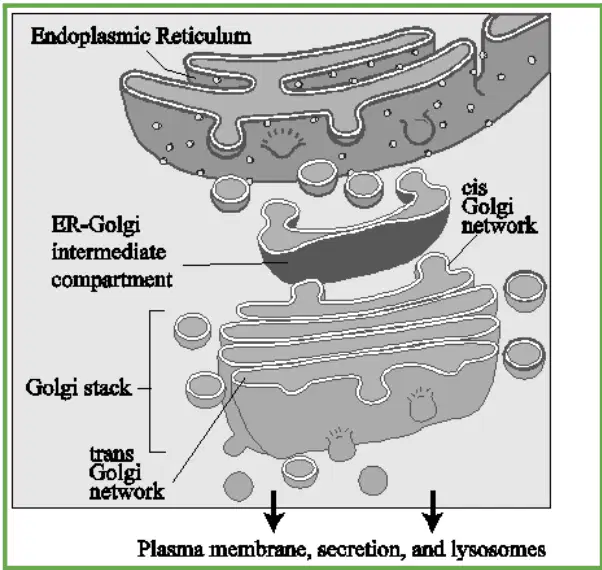
The Golgi apparatus is a membrane-bound organelle within a cell. Transport vesicles budding off from the rough endoplasmic reticulum fuse on one side of the Golgi apparatus and leave from the other side. Which purpose is served by the fusion and movement of the vesicles from one side of the Golgi apparatus to the other?
Production proteins from lipids
Sorting and modification of proteins
Degradation of proteins into amino acids
Assembly of amino acids into polypeptides
The endoplasmic reticulum is a network of membranes within the cell, and it is often classified as rough or smooth, depending on whether there are ribosomes on its surface. Which statement best describes the role of rough endoplasmic reticulum in the cell?
It stores all proteins for later use
It provides an attachment site for larger organelles
It aids in the production of membrane and secretory proteins
It stores amino acids required for the production of all proteins
The rough endoplasmic reticulum and Golgi apparatus work together in eukaryotic cells. What is one way that the rough endoplasmic reticulum assists the Golgi apparatus?
It assembles nucleic acids from monomers
It breaks down old, damaged macromolecules
It packages new protein molecules into vesicles
It determines which protein molecules to synthesize
Which activity would a cell be unable to perform if a mutation occurred that caused the Golgi apparatus to stop functioning?
Packaging proteins for transport out of the cell
Processing mRNA as it is transcribed from DNA strands
Providing the location for the delivery of amino acids by tRNA
Producing a template to guide the sequencing of amino acid chains
Which best explains why an animal cell is a eukaryotic cell?
It contains DNA, which carries hereditary information
It contains ribosomes, which function in protein synthesis
It has genetic information, which is enclosed within a membrane-bound organelle
It has a plasma membrane, which functions to control what enters and leaves the cell
A plant’s leaves may wilt if the plant is not watered. Which organelle affected by this lack of water causes the plant to wilt?
Nucleus
Vacuole
Cell wall
Cell membrane
Which statement best compares eukaryotic cells and prokaryotic cells?
Eukaryotic cells are smaller than prokaryotic cells
Prokaryotic cells are more complex than eukaryotic cells
Prokaryotic cells contain a distinct central organelle, and eukaryotic cells do not
Eukaryotic cells contain membrane-bound organelles, and prokaryotic cells do not
Explain why the nucleus is often called the "control center" of the cell.
It stores DNA that contains instructions for all cell activities
It produces ATP through cellular respiration
It packages proteins and lipids for transport
It digests waste and foreign materials

Describe the relationship between structure and function for any organelle.
Specific structural features enable an organelle to perform its function efficiently
Structure and function are unrelated in organelles
All organelles have identical structures because they share the same function
Function determines structure, but structure does not influence function
Explain the similarities and differences between plant and animal cells. Focus on their organelles.
Both plant and animal cells have a nucleus, mitochondria, ribosomes, cell membrane, endoplasmic reticulum, and Golgi apparatus
Only plant cells have a cell wall, chloroplasts, and a large central vacuole
Only animal cells have lysosomes and many small vacuoles
Only animal cells have chloroplasts that carry out photosynthesis
Passive transport does ____ require energy from the cell.
not
always
extra
sometimes
In passive transport, substances move from ____ concentration to ____ concentration (down their concentration gradient).
high to low
low to high
equal to equal
low to lower
Movement of molecules like oxygen or carbon dioxide directly across the cell membrane is called ____.
simple diffusion
osmosis
facilitated diffusion
exocytosis
Diffusion of water across a selectively permeable membrane is called ____.
osmosis
simple diffusion
endocytosis
active transport
Movement of molecules with the help of transport proteins but still down the gradient is called ____.
facilitated diffusion
simple diffusion
endocytosis
exocytosis
Active transport requires ____ (ATP) from the cell.
energy
water
proteins
solutes
In active transport, substances move from ____ concentration to ____ concentration (against the concentration gradient).
low to high
high to low
equal to equal
high to higher
Which process moves Na+ out of the cell and K+ in?
sodium–potassium pump
endocytosis
exocytosis
simple diffusion
Cell "engulfs" material is called ____.
endocytosis
exocytosis
osmosis
facilitated diffusion
Cell "expels" material is called ____.
exocytosis
endocytosis
osmosis
simple diffusion
Tonicity refers to the concentration of ____ in a solution compared to the inside of a cell. It affects water movement.
solutes
cells
energy
gases
In a hypertonic solution, water moves ____ the cell.
out of
into
in and out equally
not at all
In a hypertonic solution, the cell will ____.
shrink
swell
remain the same size
burst
In a hypotonic solution, water moves ____ the cell.
into
out of
in and out equally
not at all
In a hypotonic solution, the cell will ____.
swell
shrink
remain the same size
dehydrate
In an isotonic solution, water moves ____.
in and out equally
only into the cell
only out of the cell
not at all
In an isotonic solution, the cell will ____.
remain the same size
swell
shrink
burst
Does passive transport require energy?
No
Yes
Give one example of a molecule that moves by diffusion.
oxygen
carbon dioxide
glucose
sodium ion
Which type of transport moves substances against the concentration gradient?
active transport
passive transport
facilitated diffusion
osmosis
What will happen to a cell in a hypertonic solution?
shrink
swell
remain the same size

Identify the solution type shown in diagram A.
hypotonic
isotonic
hypertonic
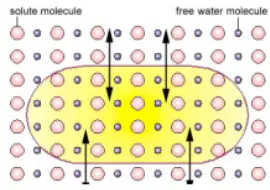
Identify the solution type shown in diagram B.
isotonic
hypotonic
hypertonic

Identify the solution type shown in diagram C.
hypertonic
hypotonic
isotonic
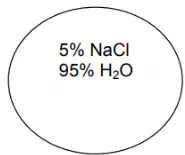
Compare inside vs. outside shown: Inside circle is 5% NaCl and 95% H2O; outside circle is 95% NaCl and 5% H2O. Water will flow ____ the cell.
out of
into
in and out equally

Using the same comparison (inside 5% NaCl, 95% H2O; outside 95% NaCl, 5% H2O), the cell will ____.
shrink
swell
remain the same size

Compare inside vs. outside shown: Inside circle is 5% NaCl and 95% H2O; outside circle is 5% NaCl and 95% H2O. Water will flow ____.
in and out equally
into the cell
out of the cell
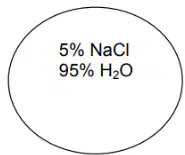
Using the same comparison (inside 5% NaCl, 95% H2O; outside 5% NaCl, 95% H2O), the cell will ____.
remain the same size
swell
shrink
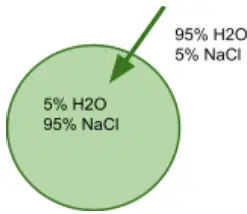
For the described case: inside the cell is 5% water and outside the cell is 5% NaCl. Water will flow ____ the cell.
into
out of
in and out equally

Using the same case (inside 5% H2O, outside 5% NaCl), the cell will ____.
grow
shrink
remain the same size
Multiple Choice Practice: Which transport requires energy?
Diffusion
Osmosis
Active transport
Facilitated diffusion
Multiple Choice Practice: A plant cell in a hypertonic solution will:
Swell
Shrink
Stay the same
Burst
Multiple Choice Practice: The plasma membrane is made mostly of:
Phospholipids
Starch
Cellulose
Nucleic acids
Short Answer Practice: Explain why diffusion is considered passive.
It moves from high to low concentration without requiring energy.
It requires ATP to move molecules against the concentration gradient.
It uses protein pumps to force molecules across the membrane.
It happens only in plant cells and not in animals.
Short Answer Practice: Describe what happens to an animal cell in a hypotonic solution.
Water enters the cell; it swells and may burst.
Water leaves the cell; it shrinks.
No change occurs; the cell stays the same size.
The cell wall prevents any swelling or bursting.
Short Answer Practice: How does the membrane help maintain homeostasis?
By controlling what enters and exits the cell to maintain proper internal conditions.
By producing glucose for the cell’s energy needs.
By storing all of the cell’s genetic information.
By making ribosomes for protein synthesis.
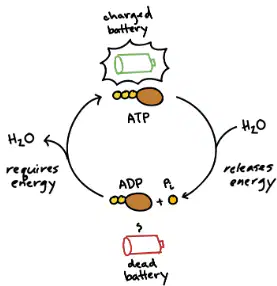
Check-In Question: What does ATP stand for, and why is it important for cells?
Adenosine Triphosphate; it is the main energy-carrying molecule that powers cell processes.
Adenine Tripeptide; it is a structural protein in membranes.
Adenosine Diphosphate; it carries no usable energy for cells.
Adenosine Triphosphate; it is a lipid that forms the cell membrane.
Check-In Question: What happens when the bond between the second and third phosphate in ATP is broken?
Energy is released and ATP becomes ADP.
Energy is stored and ATP gains a fourth phosphate.
No energy change occurs; ATP stays the same.
The molecule breaks into glucose and phosphate.
Check-In Question: Why is ADP considered “uncharged”?
It has only two phosphates, so it stores less usable energy than ATP.
It has three phosphates and releases more energy than ATP.
It cannot gain a phosphate under any conditions.
It is a type of lipid rather than a nucleotide.
Check-In Question: How is ADP turned back into ATP?
A phosphate group is added back onto ADP using energy.
A phosphate group is removed to reduce energy needs.
ADP is converted into glucose through photosynthesis.
Water attaches to ADP without any energy input.
Check-In Question: Where does the energy come from to reattach the phosphate?
Cellular respiration, especially from the breakdown of glucose.
Light energy captured directly by ribosomes.
Diffusion across the membrane.
Mechanical energy from cell movement only.
Final Question: Why does the ATP–ADP cycle need to happen constantly in cells?
Cells continuously use energy to perform life functions and must regenerate ATP so they do not run out.
ATP is unstable and breaks down even when cells are at rest, so it must be replaced every hour.
The cycle only operates during daylight, so it needs to speed up at night.
Cells produce excess ATP that must be recycled to prevent damage.
Final Question: Summarize the ATP–ADP cycle in your own words.
ATP releases energy when a phosphate breaks off to form ADP; energy from food adds the phosphate back to reform ATP, and this repeats continuously.
ATP permanently loses a phosphate to become ADP and cannot be recharged; cells rely on stored heat instead.
ATP gains energy without adding any phosphate; ADP is only produced in plant cells.
ATP and ADP are unrelated molecules; cells use glucose directly without cycling.
The main purpose of photosynthesis is to make
ATP directly
Oxygen only
Glucose
Carbon dioxide
ATP releases energy when
A bond is formed
A phosphate is removed
Water is made
Sunlight hits chlorophyll
Fermentation occurs when
There is plenty of oxygen
No glucose is available
Oxygen is low or absent
Too much ATP is produced
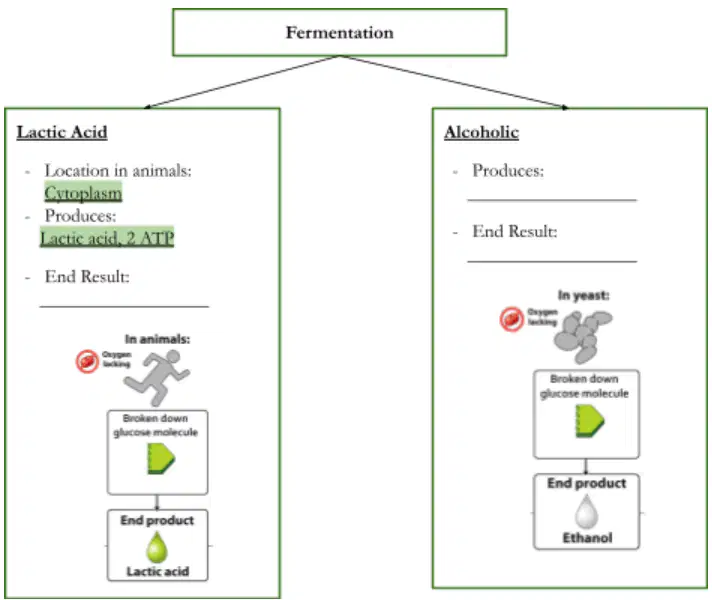
In animals, lactic acid fermentation has the end result
Ethanol
Lactic acid
Oxygen
Glucose

In yeast, alcoholic fermentation has the end result
Lactic acid
Ethanol
Oxygen
Water
Alcoholic fermentation produces
Ethanol
CO2
Lactic acid
2 ATP
Which statements correctly compare photosynthesis and cellular respiration? Select all that apply.
Photosynthesis converts light energy into chemical energy stored in glucose and occurs in plants and some algae.
Cellular respiration breaks down glucose into ATP to provide energy for cells and occurs in both plants and animals.
Photosynthesis requires CO2 and H2O and produces O2 , while respiration requires O2 and produces CO2 and H2O .
Cellular respiration converts light energy directly into glucose and occurs only in animals.
Why are mitochondria important for both plants and animals? Select all that apply.
They are the site of cellular respiration, where energy from glucose is converted into ATP.
Both plant and animal cells need ATP to carry out essential processes like growth, movement, and active transport.
They directly perform photosynthesis to make glucose in animal cells.
They store genetic information used for inheritance.
Which statements describe the difference between ATP and ADP and why ATP is important for cells? Select all that apply.
ATP (adenosine triphosphate) has three phosphate groups and stores high energy in the bonds between phosphates.
ADP (adenosine diphosphate) has two phosphate groups and is considered uncharged because it has less stored energy.
Breaking the bond between the second and third phosphate of ATP releases energy to power cellular activities, converting ATP to ADP.
ATP has two phosphate groups and ADP has three phosphate groups.
How is ADP recharged back into ATP?
A phosphate group is added to ADP using energy from cellular respiration (or photosynthesis in plants).
A phosphate group is removed from ADP using sunlight energy.
ADP is converted to glucose in the chloroplast.
Energy from oxygen attaches ADP to water.
Why does the ATP–ADP cycle need to happen constantly in cells? Explain what would happen if cells could not recycle ATP.
Recycling ATP maintains a continuous energy supply for movement, transport, and synthesis; without recycling, cells would run out of usable energy and die.
ATP can only be used for storing genetic information, so recycling prevents DNA loss.
ATP recycling is only needed during cell division and has no effect on daily cell functions.
Cells store unlimited ATP, so recycling would not affect energy availability.
Compare aerobic and anaerobic respiration by stating oxygen use and typical ATP yield for each.
Aerobic respiration uses oxygen and produces about 36 ATP per glucose; anaerobic respiration occurs without oxygen and produces about 2 ATP with byproducts like lactic acid or ethanol.
Aerobic respiration occurs without oxygen and produces about 2 ATP; anaerobic respiration uses oxygen and produces about 36 ATP.
Both aerobic and anaerobic respiration use oxygen and produce the same amount of ATP.
Aerobic respiration uses oxygen but produces no ATP; anaerobic respiration produces ATP only during photosynthesis.
Which is an example of negative feedback?
Blood clotting
Childbirth
Sweating to lower body temperature
Release of oxytocin
Homeostasis means:
Changing constantly
Maintaining internal stability
Breaking down molecules
Speeding up reactions
Explain why negative feedback is important for survival.
It reverses changes to maintain internal stability and helps prevent damage from extreme conditions.
It amplifies changes so body temperature rises uncontrollably.
It stops all cellular processes to conserve energy during stress.
It only affects blood sugar and has no role in temperature or water balance.
Describe how plants use transpiration for homeostasis.
By losing water through transpiration to cool leaves, move nutrients, and maintain water balance, adjusting to environmental conditions.
By storing excess oxygen in roots during transpiration to increase photosynthesis at night.
By reducing leaf surface area to avoid nutrient transport entirely.
By preventing any water movement so leaf temperature constantly rises.
Give an example of how two body systems work together to maintain balance.
The respiratory and circulatory systems work together to maintain oxygen and carbon dioxide levels in the blood.
The integumentary and skeletal systems combine to digest food.
The urinary and reproductive systems primarily regulate atmospheric pressure.
The muscular system alone maintains blood glucose without other systems.
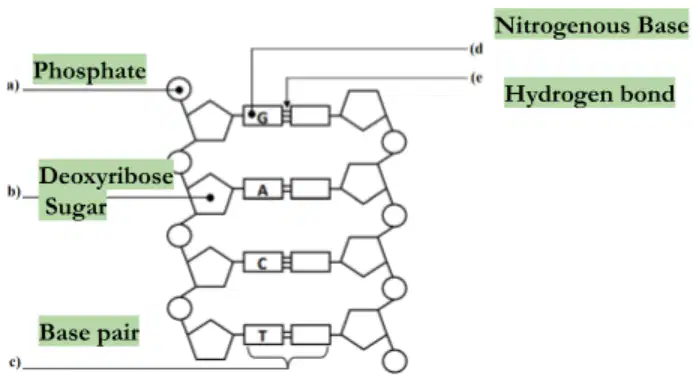
In the DNA diagram, identify the part labeled a).
Base pair
Phosphate group
Deoxyribose sugar
Nitrogenous base

In the DNA diagram, identify the part labeled b).
Deoxyribose sugar
Hydrogen bond
Nitrogenous base
Phosphate group
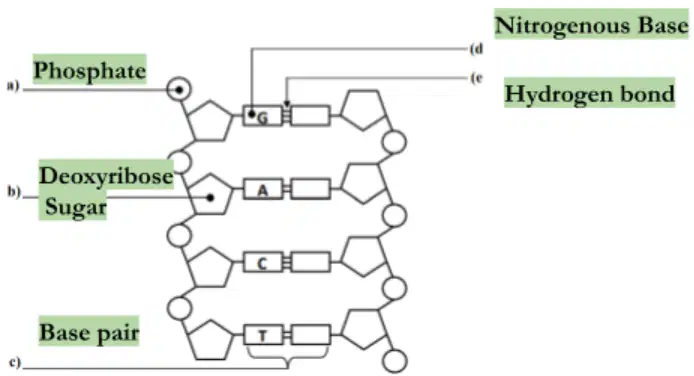
In the DNA diagram, identify the part labeled c).
Base pair
Phosphate group
Hydrogen bond
Nitrogenous base
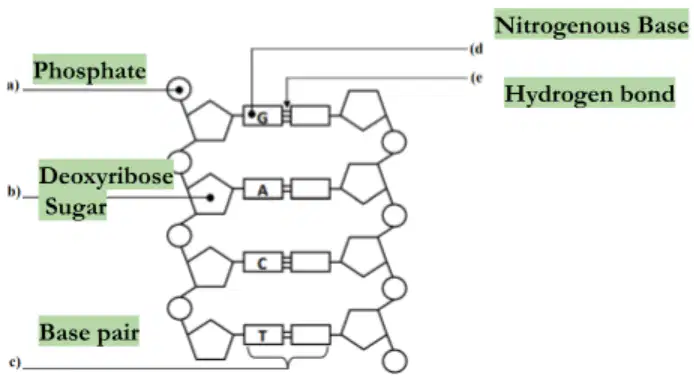
In the DNA diagram, identify the part labeled d).
Hydrogen bond
Base pair
Nitrogenous base
Deoxyribose sugar
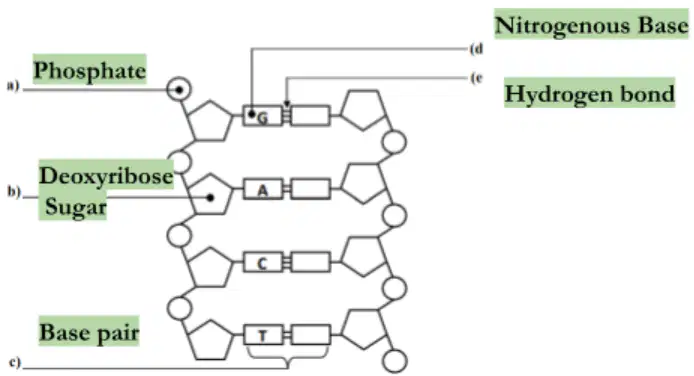
In the DNA diagram, identify the part labeled e).
Hydrogen bond
Phosphate group
Deoxyribose sugar
Nitrogenous base
Fill in the missing nitrogenous base: In DNA, which base pairs with adenine?
Thymine
Cytosine
Guanine
Uracil
Fill in the missing nitrogenous base: In DNA, which base pairs with cytosine?
Thymine
Uracil
Guanine
Adenine

