
 Worksheets
Page 1
Total questions: 150
Worksheet time: 1hrs 15mins
The wise saying on the page describes knowledge as something that grows daily and cannot be taken away. Which idea best captures this message?
Treasure lasts only if it is kept unused always
Power expands when people carry heavy burdens
Wealth grows only when guarded by strong rulers
Knowledge increases with sharing every single day
Which statement explains why the saying calls knowledge the “greatest wealth”?
It cannot be stolen or confiscated by anyone
It is heavy to carry and difficult to share
It can be taxed and measured like gold coins
It loses value when it is used by students
The page lists a rishi from Hampi, the Buddha from Bhutan, and Mahavira from Bihar. What does this grouping suggest about Indian cultural roots?
They suggest all beliefs began in modern capitals
They prove culture is based only on warrior kings
They show one city produced all major teachers
They reflect diverse regions shaping shared traditions
What are the Vedas most likely to be, based on the big question asking for their message?
Maps showing mountain passes and rivers
Royal laws about trade and taxation
A set of stone tools used in farming
Ancient sacred texts with teachings and hymns
The big question mentions new schools of thought in the 1st millennium BCE. Which development fits this time period in India?
Discovery of satellites and digital networks
European colonization and industrial reforms
Rise of Buddhism and Jainism with ethical paths
Invention of gunpowder and modern factories
Which core principle is shared by both Buddhism and Jainism as schools of thought from ancient India?
Strict worship of one creator deity alone
Mandatory rule by hereditary warrior kings
Only focusing on military conquest and glory
Emphasis on non-violence and ethical living
Why might folk and tribal traditions be important to Indian culture, as asked in the big questions?
They preserve local arts, rituals, and community values
They replace all classical texts with new rules
They stop cultural change and innovation completely
They only exist in large imperial capitals
How does the idea that knowledge “does not weigh anything” help people in society?
It cannot be taught because it is too complex
It can be carried and shared widely without burden
It must be locked away to stay valuable forever
It requires heavy tools to transport between towns
Looking at the statues of the Buddha and Mahavira, what practice appears central to their teachings?
Weapon training for protecting temple wealth
Meditation and inner discipline for spiritual growth
Competitive sports for achieving political power
Trade negotiations for building sea empires
The chapter is titled “India’s Cultural Roots.” Which approach would best help you investigate these roots further?
Compare teachings from texts and regional traditions
Use myths alone without checking any evidence
Ignore old ideas and study only modern technology
Focus on one ruler’s biography for all history
Why is Indian culture compared to an ancient tree with roots and branches?
It means all parts developed at the exact same time
It proves the culture is only a few centuries old
It shows many diverse parts united by one core
It suggests the culture has only one single tradition
What do the roots of Indian culture symbolize in the tree analogy?
Seasonal festivals changing every year
Modern technology linking communities
Military power guiding all branches
Foundations that nourish a common trunk
Who are described as spiritual seekers in the text?
People sharing ideas about life and the world
Only priests performing ritual ceremonies
Government officials managing public policy
Artists composing classical dance pieces
Archaeologists suggest India’s cultural roots trace back to which ancient civilization?
Indus or Harappan or Sindhu-Sarasvati
Medieval Delhi Sultanate
Mauryan Empire under Ashoka
Gupta period of classical arts
What does the word Veda most closely mean, based on its Sanskrit root vid?
Divine song
Ritual sacrifice
Royal decree
Knowledge or understanding
How many Vedas are traditionally recognized?
Three: Rig, Yajur, Sama
Seven: including Upanishads
Four: Rig, Yajur, Sama, Atharva
Five: adding Brahmana texts
What is a key feature of the Vedas’ content and form?
Thousands of hymns recited orally
Historical maps engraved on stone
Mathematical proofs written in verse
Royal laws issued on copper plates
Which Veda is often considered the most ancient among the four?
Atharva Veda is considered oldest
Sama Veda is considered oldest
Yajur Veda is considered oldest
Rig Veda is considered oldest
In which region were the Vedic hymns composed, according to the text?
Sapta Sindhava region
Ganga river delta
Eastern coastal plains
Deccan plateau region
Why is it difficult to give an exact date for the composition of the Rig Veda?
It was lost and later rewritten
It began during a known royal reign
It was fixed by a single inscription
Experts propose varied dates
Why were the Vedic texts preserved with hardly any alterations over many generations?
They were rewritten by new poets annually
They were written on stone tablets forever
They were guarded by royal armies daily
They were memorised through rigorous training
In 2008, what did UNESCO recognise Vedic chanting as?
An ancient scientific experiment on sound
A world heritage of written literature
A masterpiece of oral and intangible heritage
A modern musical innovation for schools
Who composed the Vedic hymns mentioned in the text?
Farmers and artisans from villages
Kings and warriors of empires
Merchants and sailors of trade routes
Rishis and rishikas in early Sanskrit
Which pair includes deities addressed in Vedic hymns?
Zeus and Athena together
Thor and Freya together
Ra and Isis together
Indra and Agni together
What did the deities sustain along with truth and order in human life, according to the text?
Ritam and the cosmos together
Wealth and trade exclusively
War and conquest repeatedly
Dharma in the village only
What idea is expressed by the Rig Veda verse 'ekam sat viprā bahudhā vadanti'?
Many gods exist as separate realities
Truth changes with every generation
The supreme reality is one with many names
Only one sage can know the truth
Which definition of ‘Cosmos’ matches the sidebar note?
A myth about gods and heroes
A ritual performed during festivals
The world as an ordered harmonious system
A star visible only at night
What does UNESCO stand for, as explained in the sidebar?
Universal Network for Science and Culture Office
Union of Nations for Education and Culture
United Nations Educational, Scientific and Cultural Organization
United Nations Economic and Cultural Society
How does the text describe the Rig Veda’s call for social values among people?
It promotes unity among people
It encourages rivalry among clans
It forbids contact with strangers
It demands silence during rituals
Which statement best explains the worldview highlighted on the page?
Different deities oppose each other
Nature is separate from human life
Truth is often another name for God
Values begin with wealth and power first
Which term best describes the larger groups or clans that organized early Vedic society?
Ashrams, meaning spiritual retreats
VarNas, meaning social classes
Karmas, meaning ritual duties
Janas, meaning organized clans
Which text lists over 30 janas such as the Bharatas and the Kurus?
Atharva Veda, healing chants book
Ramayana, epic about Rama
Rig Veda, an ancient hymn collection
Manusmriti, law and duty treatise
What common feature linked each clan in early Vedic society?
Association with a northwest region
Ownership of vast farmlands
Practice of Buddhism exclusively
Use of common written scripts
Read the quote: "Come together, speak together; common be your mind..." What central idea does it promote?
Unity in purpose and thought
Competition among rival clans
Isolation to maintain purity
Obedience to a single ruler
Place the births of Buddha and Mahāvīra on a timeline based on the diagram.
Around 500 BCE in the timeline
Around 1000 BCE in the timeline
Around 1 CE in the timeline
Around 500 CE in the timeline
Which statement about the Upanishads fits the timeline diagram?
They developed across the late Vedic era
They arose only after 1 CE period
They began strictly at 1500 BCE point
They were created in a single decade
According to the diagram, what do the dashed lines labeled "Vedic schools of thought" suggest?
A brief trend lasting few years
One fixed school with no change
A movement limited to one city
Multiple schools evolving over time
Why might different janas be tied to regions in the northwest of the subcontinent?
Geography shaped settlement patterns
Writing systems prevented travel
Royal edicts forced uniform culture
Monsoons prohibited migration entirely
Which pair correctly identifies examples of janas named in the material?
Guptas and Mauryas listed
Cholas and Pallavas listed
Bharatas and Yadus listed
Sakas and Kushans listed
What does the instruction "may your thoughts be united" imply for community decision-making?
Silence preferred over open dialogue
Authority rests with a war chief
Decisions by secret individual votes
Consensus built through shared intent
Which term from Vedic texts refers to a collective gathering or assembly?
Rājā, a ruling monarch
Sabhā, a formal assembly
Agni, the fire deity
Samiti, a private council
In early Vedic society, which role best matches the description 'someone who uses traditional practices to relieve or heal diseases'?
Barber, grooming service provider
Weaver, textile craft worker
Healer, traditional health practitioner
Priest, spiritual ritual leader
Which pair correctly identifies words that give clues about governance among janas?
Sabhā and samiti, collective gatherings
Upanishads and karma, sacred teachings
Rājā and yajña, ritual offerings
Agni and Vedanta, philosophical schools
Which example is NOT listed as a profession mentioned in Vedic texts?
Potter, ceramic making
Merchant, long-distance trading
Dancer, performing arts
Agriculturist, food cultivation
Daily Vedic rituals commonly involved which practice?
Meditation on tat tvam asi
Prayers and offerings to Agni
Public debates in sabhā
Royal decrees by rājā
What is yajña (often read as ‘yagya’) primarily directed towards?
Kings, for political authority
Deities, for benefit and wellbeing
Teachers, for knowledge transmission
Ancestors, for lineage continuity
Which statement reflects a Vedanta view described in the Upanishads?
Karma is unrelated to actions
Brahman is the divine essence
Agni governs royal assemblies
Samiti manages ritual offerings
What do the Upanishads introduce and build upon within Vedic culture?
Titles for rulers like rājā
New laws for governance
Concepts like rebirth and karma
Techniques for pottery and weaving
Which idea is correctly matched with its meaning as presented?
Karma, unrelated to personal results
Brahmā, identical to brahman essence
Sabhā, the deity associated with fire
Rebirth, taking birth again and again
Why did Vedic rituals become more complex over time?
Practices evolved in form and detail
Offerings shifted from Agni to Brahmā
Professions disappeared from society
Assemblies replaced rulers entirely
What does the Upanishadic phrase "aham brahmāsmi" most directly express about the Self?
The Self is separate from brahman
The Self is identical with brahman
The Self serves brahman as a devotee
The Self seeks brahman through rituals
Which idea follows from the teaching that all beings share the same divine essence?
Rituals are the only path
Isolation between individuals is natural
Interdependence connects everything
Material wealth defines virtue
The phrase "tat tvam asi" is best understood as which message?
You cannot know That fully
You are separate from Truth
You are That, the divine reality
You must worship That with fear
A common prayer begins with "sarve bhavantu sukhinah." What is its main wish?
Let sages gain knowledge
May all creatures be happy
Let rulers be powerful
May rituals be performed
Which statement describes the Upanishadic concept of ātman?
A set of ritual rules for worship
A personal deity outside oneself
The divine essence within each being
A social law of ancient kingdoms
Yoga, as a school of thought, developed methods primarily to achieve what?
Political unity among tribes
Trade prosperity through planning
Realisation of brahman in consciousness
Military discipline for warriors
Several schools of thought from the 1st millennium BCE later formed the basis of which tradition?
Zoroastrianism
Confucianism
Hinduism
Jainism
Which feature distinguishes Buddhism from the Vedic schools mentioned?
It accepts the authority of the Vedas
It rejects the authority of the Vedas
It focuses only on fire rituals
It worships multiple Vedic deities
Siddhārtha Gautama’s early life is described as that of a young prince. Where was he born?
Lumbini near the Himalayan foothills
Taxila in northwest India
Pataliputra on the Ganges plains
Kanchipuram in southern India
How does linking ātman with brahman shape ethical attitudes toward others?
It prioritises material success
It promotes indifference to others
It encourages compassion for all beings
It justifies strict social divisions
In the story of Shvetaketu, what core idea does Uddalaka teach using the example of a seed and clay?
Clay creates objects that change their inner essence
All things share one subtle essence called brahman
Seeds are empty until planted in proper soil
Only visible objects have essence within themselves
Why does Uddalaka test Shvetaketu after twelve years of study?
To see if he can recite all four Vedas
To prepare him for a public debate
To assign him duties in the gurukula
To check understanding beyond pride and memorization
How does the banyan seed analogy support the teaching about brahman?
It claims the seed changes into clay and then pots
It proves that seeds are hollow and meaningless
It shows the vast tree is contained in the tiny seed
It explains why only big things have real essence
Which statement best captures the conclusion Uddalaka gives Shvetaketu?
Everything consists of a subtle essence; you are that
Different pots have different essences inside
You must recite scriptures flawlessly to find truth
Reality is only what we can see and measure
What misconception does the clay-and-pots example correct?
Only shapes determine what a thing truly is
Each form is made from a completely different matter
Clay becomes pot and loses its original substance
Many forms can share the same underlying substance
In the Katha Upanishad story, why does Nachiketa go to Yama’s world?
He is sent to study with a new guru for years
He wants to find the banyan seed’s secret
He seeks treasure promised by sages of the forest
His father angrily offers him to the god of death
What question drives Nachiketa’s quest when meeting Yama?
Why clay pots differ in color and weight
What happens after death and what is the true self
Which god grants the fastest worldly success
How to perform every ritual without mistakes
How do these Upanishadic stories highlight the importance of asking questions?
They show inquiry leads to deeper understanding of reality
They prove only memorization brings spiritual insight
They suggest children should stay silent during rituals
They warn that questions always anger wise teachers
Which link between everyday examples and spiritual ideas is emphasized?
Using trade and markets to reveal karma’s rules
Using royal laws to describe cosmic cycles
Using battles and weapons to define moral duty
Using seeds and clay to explain unseen essence
What does "You are that" suggest about Shvetaketu’s identity?
He is separate from nature and other beings
His identity depends on titles earned in study
He becomes brahman only after perfect rituals
His true self is the same subtle essence as all
In the story of Nachiketa and Yama, what key idea about ātman is emphasized?
It changes with seasons and time
It is visible only to sages
It is hidden within all creatures
It is born and dies with the body
Which statement best explains why Nachiketa returned joyfully to his father after meeting Yama?
He received wealth from the king
He was praised by many scholars
He learned that ātman is immortal
He won a royal prize for bravery
Gārgī’s questions to Yājñavalkya focused primarily on which topic?
Stories of heroic warriors
Ancient laws of kingship
Nature of the world and brahman
Ritual steps for sacrifices
During King Janaka’s contest, how did Yājñavalkya initially respond when Gārgī pressed him with questions?
He left the court immediately
He answered every question patiently
He challenged her to a duel
He asked her to stop asking further
What idea about brahman is highlighted in Yājñavalkya’s explanation?
Brahman makes everything possible
Brahman is a ritual fire only
Brahman creates seasons and rivers
Brahman is a powerful king
Why did King Janaka announce a prize in the described event?
To crown a new ruler
To honor the bravest soldier
To reward the best philosopher
To celebrate a harvest festival
Which pair correctly matches thinker and role in the narrative?
Nachiketa—king and judge
Janaka—forest hermit
Gārgī—warrior commander
Yama—teacher of ātman
What reasoning best supports the claim that ātman is immortal?
It is neither born nor dies
It controls the body’s senses
It depends on ritual offerings
It grows stronger with age
In the debate, what shift occurs after Gārgī resumes her questions?
Janaka stops the contest permanently
Scholars turn to discuss warfare
The court dismisses Gārgī from the hall
Yājñavalkya explains brahman’s foundational role
Which conclusion about Indian philosophical traditions is supported by the scenes depicted?
They ban women from scholarship
They prioritize only ritual practices
They value debates on reality and self
They avoid questioning spiritual ideas
Siddhartha Gautama first saw an old man, a sick man, and a dead body while riding in a chariot. What change did this experience lead him to make?
He began building new temples in the city
He chose to leave palace life as an ascetic
He trained as a royal warrior commander
He expanded palace celebrations and festivals
In this context, what does the term ascetic most closely mean?
A teacher of advanced philosophical logic
A leader enforcing strict political laws
A person leading a disciplined spiritual life
A healer practicing complex medical rituals
After meditating under a pipal tree at Bodh Gaya, what realization did Siddhartha reach about the causes of suffering?
Desire and karma are the only causes
Ignorance and attachment are key causes
Poverty and illness are the main causes
War and injustice are universal causes
What name did Siddhartha receive after attaining enlightenment, and what does it mean?
Mahavira, meaning the great hero
Bodhisattva, meaning compassionate guide
Brahman, meaning supreme soul
Buddha, meaning enlightened or awakened
Which idea taught by the Buddha is often translated as non-violence and originally means non-hurting or non-injuring?
Nirvana
Samsara
Ahimsa
Dharma
Why did Siddhartha travel on foot and meet other ascetics and scholars after leaving the palace?
To gather followers for a new kingdom
To search for the root cause of suffering
To trade goods across distant regions
To learn ancient military strategies
Which reasoning best explains why ignorance (avidya) and attachment were seen as causes of suffering?
They limit clear understanding and create clinging
They promote community rituals and festivals
They increase physical strength and endurance
They reduce social status and wealth directly
The Buddha emphasized sincere inner discipline. Which practice aligns most closely with this emphasis?
Carefully following daily meditation routines
Strictly obeying external political authorities
Frequently participating in competitive sports
Regularly attending expensive ceremonial events
At what age did Siddhartha witness the sights that changed his outlook on life?
21 years old
18 years old
29 years old
35 years old
Where is Bodh Gaya located, the site where Siddhartha meditated and attained enlightenment?
In Gujarat on India’s western coast
In Kerala in southern India
In Bihar in eastern India today
In Punjab in northern India
Which quote best reflects the Buddhist idea that inner transformation is more valuable than external victory?
Ritual baths cleanse sins for true purity
Obeying kings ensures harmony in society
Conquering oneself is greater than conquering others
Winning wars brings lasting peace and honor
What does the statement “Not by water is one made pure” suggest about purification?
Purity comes from sacred river ceremonies
Purity depends on social status and lineage
Purity arises from truth and dharma within
Purity is achieved through temple donations
Why did the Buddha establish the Sangha?
To manage trade along river routes
To create a community to practice and spread teachings
To collect taxes for local rulers
To protect monasteries from invading armies
Which pair correctly matches the community members of the Sangha?
Bhikshus are monks, bhikshunis are nuns
Bhikshus are teachers, bhikshunis are students
Bhikshus are monks, bhikshunis are queens
Bhikshus are priests, bhikshunis are merchants
What commitment does a monk traditionally make?
Train soldiers for battlefield success
Serve as village head and judge
Take vows to follow a strict, disciplined life
Perform daily rituals for river deities
Which idea from the page emphasizes inner ethics over ritual action?
Festivals are the path to enlightenment
Bathing in sacred waters ensures holiness
Truth and dharma determine personal purity
Royal patronage guarantees spiritual merit
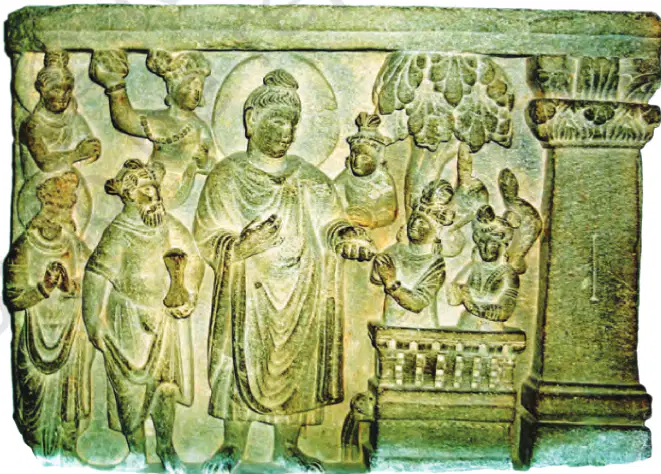
What evidence on the page indicates Buddhism’s lasting influence?
A decree banning river rituals
A stone panel showing the Buddha teaching
A map of ancient trade routes
A list of royal donations to temples
How does the idea of ‘conquering oneself’ connect to monastic discipline?
Self-conquest depends on military training
Personal victory requires accumulating wealth
Inner mastery aligns with vows and strict conduct
Self-rule comes from winning public debates
Which description best distinguishes monks and nuns in this context?
Monks and nuns are royal officials
Monks and nuns are village festival organizers
Monks and nuns are traders on river routes
Monks and nuns are dedicated religious practitioners
What is the main purpose of the Sangha in the spread of Buddhism?
To regulate travel along sacred rivers
To control farming and irrigation systems
To preserve and teach the Buddha’s message
To enforce laws across kingdoms
Prince Vardhamana left his royal home at about what age to seek spiritual knowledge?
At the age of 30 years
At the age of 40 years
At the age of 16 years
At the age of 20 years
After years of ascetic discipline, Vardhamana achieved what is described as 'infinite knowledge' or supreme wisdom. What title did he become known by?
Bodhisattva, the awakened one
Shramana, the silent sage
Tirthankara, the river guide
Mahavira, the great hero
Where was Prince Vardhamana’s birthplace located, according to the text?
Near Vaishali in modern-day Bihar
Near Ujjain in modern-day Madhya Pradesh
Near Taxila in modern-day Pakistan
Near Pataliputra in modern-day Bihar
Which statement best explains the meaning of the word ‘Jain’ or ‘jaina’ as given in the passage?
It comes from jyoti, meaning inner light
It comes from jina, meaning conqueror
It comes from jiva, meaning living soul
It comes from jana, meaning common people
What kind of conquest does jina refer to in Jain thought?
Conquest of trade routes and wealth
Conquest of rival religious groups
Conquest of kingdoms and lands
Conquest of ignorance and attachments
Which teachings are central in Jainism as listed in the passage?
Meditation, pilgrimage, fasting
Varnashrama, yajna, dana
Ahimsa, anekantavada, aparigraha
Yoga, bhakti, pranayama
The text notes that Jain ideas were shared to a large extent with which traditions?
Hindu temple architecture and Vedic rituals
Buddhism and the Vedantic school of thought
Sikh teachings and Sufi mysticism
Zoroastrian fire worship and Greek philosophy
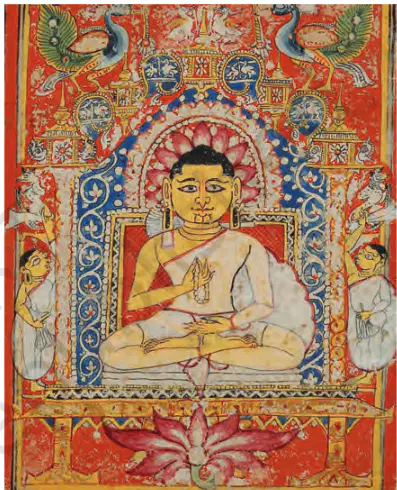
Based on the painting caption, who is depicted in the traditional painting shown?
Mahavira in a seated posture
A Vedic sage performing rites
Buddha teaching disciples
A Jain monk walking barefoot
Why might Jainism be described as having roots more ancient than Buddhism, according to the passage?
It has more written scriptures
It adopted royal patronage earlier
It spread to more countries first
Its origins are said to be much older
What is one suggested classroom activity from the 'Let’s Explore' section related to Buddhism?
Write a poem on Mahavira’s ascetic life
Compare Jain and Vedantic rituals
List trade goods linked to Jain merchants
Plot places where Buddhism is a major religion
Which idea is emphasized by Mahavira’s saying about sentient creatures?
Guidelines for hunting to maintain population
Permission to harm pests for human comfort
Strict rules for animal sacrifices in rituals
Respect for nonviolence toward all beings
What does Anekantavada primarily teach?
Truth has many perspectives and aspects
Truth is fixed by a single authority
Truth depends only on personal feelings
Truth is unknowable to human beings
Which practice is closest to Aparigraha?
Owning more to feel secure
Collecting rare items eagerly
Saving wealth to gain status
Limiting possessions to necessities
Jainism’s view on living organisms highlights which relationship?
Interdependence among all creatures
Isolation of species without links
Dominance of humans over nature
Competition for survival alone
Scientists studying nature confirm which Jain insight?
Flora and fauna support one another
Humans can live without ecosystems
Animals act only by instinct
Plants depend only on sunlight
A well-known Jataka tale begins with the Buddha in which role?
King of a large troop of monkeys
Prince seeking a sacred fruit
Hermit meditating in a forest
Farmer caring for a village
In the Jataka story, what made the fruit reach the stream?
A ripe fruit fell from the tree
Monkeys carried baskets to market
A storm knocked down branches
The king ordered fruit collection
Why did the monkey king instruct that no fruit should escape?
To protect the tree’s unique bounty
To trade fruit with nearby humans
To test loyalty through strict rules
To challenge rival monkey troops
How do Anekantavada and Aparigraha together shape behavior?
Seek multiple truths and live with minimal needs
Follow one rigid truth and accumulate wealth
Adopt private beliefs and hoard possessions
Ignore differing views and pursue luxury goods
Which statement applies both to Jain ethics and Buddhist tales?
Prosperity is the highest spiritual aim
Military power proves moral superiority
Compassion for living beings guides choices
Myths exist only to entertain readers
In the story, how did the monkey-king save his troop when soldiers attacked near a stream?
He hid the monkeys in the tree
He built a raft from branches
He fought the soldiers with sticks
He used his body as a bridge
Why did the human king order his soldiers to find the tree from which the fruit came?
He wanted to build a new palace
He sought to cut timber for war
He loved the fruit’s taste
He feared the monkeys’ growing power
What consequence did the monkey-king face after acting as a bridge?
He was rewarded with jewels
He became the new human king
He was severely bruised and died
He escaped and lived in exile
Which leadership quality is most highlighted by the monkey-king’s actions?
Strategic hoarding of resources
Cruel punishment of enemies
Selfless protection of subjects
Strict obedience to tradition
In the Jain story, who was Rohineya before meeting Mahāvīra?
A royal minister from the city
An extraordinarily skilled burglar
A farmer guarding the fields
A wandering monk seeking truth
How did Rohineya first encounter Mahāvīra’s teachings?
He learned them from a traveling trader
He read them in a royal decree
He heard a few sentences from a sermon
He studied them in a monastery school
What plan did the minister use to try to expose Rohineya?
A public duel in the marketplace
A clever scheme to force confession
An ambush in the city gates
A trap set in the forest at night
What helped Rohineya detect and defeat the minister’s plan?
A lucky message from a friend
Advice from the city guards
His skill with secret weapons
Mahāvīra’s words remembered
After feeling remorseful, what steps did Rohineya take?
He kept stealing but hid better
He challenged the minister to trial
He confessed crimes and returned treasures
He fled to another kingdom
What theme is illustrated by Rohineya’s transformation?
Power comes from fear
Only kings deserve forgiveness
Wealth brings true knowledge
Right action and right thinking matter
The stone panel shows a lion and deer calmly sharing a bowl. Which message best fits this scene?
Humans dominate animals for survival needs
Nature is chaotic and full of random fights
Harmony through compassion among all beings
Strength conquers weakness by forceful rule
In Buddhism and Jainism, what does ahimsa include beyond avoiding physical violence?
Following festival rules without question
Donating only to animal shelters
Practicing loud chants every morning
Refraining from negative thoughts toward anyone
A student notices jealous thoughts and decides to change them into kind ones. This action best demonstrates which idea?
Ahimsa as mental non-violence
Pilgrimage to sacred caves
Ritual fasting requirements
Karma as material exchange
Why might the panel with peaceful animals be placed in a Jain temple?
It symbolizes universal non-violence and harmony
It warns visitors about dangerous wildlife nearby
It shows farming techniques used by monks
It records a royal hunt from local history
Monks in Buddhism and Jainism traveled widely. What was a main purpose of these journeys?
Searching for rare spices to sell
Spreading teachings across different regions
Competing in athletic contests for fame
Collecting taxes from village traders
Some monks built monasteries in faraway places, while others lived ascetic lives in rock-cut caves. What common goal did both paths serve?
Supporting spiritual practice and community life
Expanding military forts for protection
Storing grain for seasonal trade
Training artisans in metalcraft
Archaeologists found names carved in rock-cut caves. What does this evidence help historians understand?
Number of wild animals in surrounding forests
Exact diet of villagers near the caves
Identity of monks who lived and slept there
Weather patterns during every monsoon
Which situation best applies the idea of ahimsa to everyday life?
Stopping hurtful gossip and choosing kind words
Avoiding homework to reduce stress levels
Throwing away books after reading them
Winning arguments by speaking louder
If you were designing a new monastery in a remote area, which feature would reflect ascetic living described here?
High towers for military guards
Large market halls for busy trade
Simple stone sleeping platforms in caves
Decorated banquet rooms for feasts
The text suggests that negative thoughts can be noticed and changed. What is the first step in this process?
Telling friends to think for you each day
Reading only rules without self-reflection
Observing oneself carefully to spot such thoughts
Ignoring feelings until they disappear alone
Which statement best explains why some scholars prefer the term ‘schools of thought’ over ‘religions’ for Indian traditions?
It highlights many interconnected aspects beyond worship
It limits discussion to temples and rituals only
It excludes ethical and social dimensions completely
It focuses only on the historical timeline of faiths
The Ellora caves shown in the image include spaces used by which traditions?
Only Hindu shrines
Only Buddhist monasteries
Only Jain temples
Hindu, Buddhist, and Jain traditions
Which aspect is specifically mentioned as part of Indian belief systems?
Technological, industrial, commercial aspects
Militaristic, economic, athletic aspects
Philosophical, spiritual, religious aspects
Geographic, climatic, agricultural aspects
Why might the word ‘religion’ be considered too limiting in the Indian context?
Indian traditions are only personal beliefs
Indian traditions reject social organization entirely
Indian traditions avoid any ethical teachings
Indian traditions integrate diverse aspects of life
What did the Cārvāka (Lokāyata) school believe about existence?
Only the material world exists, no afterlife
The soul travels through many heavens
The universe is created by sacred rituals
Spiritual worlds are more real than matter
Which conclusion can you draw about intellectual life from the mention of Cārvāka?
Ancient India had diverse and open debates
Only one orthodox path was permitted
Philosophy was banned by rulers
All schools agreed on an afterlife
What happened to the Cārvāka school over time?
It expanded across the entire world
It replaced all spiritual traditions
It became the state religion
It lost popularity and disappeared
Which pair correctly matches term and meaning as used on the page?
Schools of thought: strictly political strategies
Philosophy: athletic training and competition
Belief systems: combined ethical, social, spiritual ideas
Religion: only temple rituals and festivals
If a tradition emphasizes ethical rules, meditation, and community roles, which label fits best per the page?
Belief system or school of thought
Exclusive military institution
Geographical culture zone
Purely economic organization
Looking at the Ellora caves, what inference about Indian civilization is most supported?
Caves were used solely for trade markets
Architecture ignored spiritual purposes
Different traditions coexisted and shared spaces
Only one tradition controlled sacred sites

