
 Worksheets
SOLAR SYSTEM
Total questions: 151
Worksheet time: 2hrs 35mins


Anthony claims that the patterns of stars in the sky only appear to move, but the patterns do not change. Which piece(s) of evidence would best support this claim?
observations that some stars can be seen in every season
Observations that the pattern of stars in the sky stay the same although they appear to shift across the sky nightly.
Observations that different stars appear in different seasons, but the patterns of the stars remain the same.
A ____ is a huge system of gas, dust, stars, and objects orbiting stars that is held together by the force of gravity.
galaxy
comet
meteor
gas giant
Which planet is an inner planet?
Uranus
Venus
Saturn
Neptune
Which planet is the solar system's largest rocky planet?
Mars
Earth
Mercury
Jupiter
Which choice best describes the parts of the Milky Way?
Earth, its moon, the sun, and Jupiter
Gas, dust, stars, and objects that orbit stars
Asteroids, comets, objects that orbit stars, and the stars
The inner planets, the outer planets, gas, and dust
Which list shows the correct order of planets from the sun?
Mercury, Venus, Earth, Mars
Earth, Mars, Venus, Jupiter
Mars, Venus, Earth, Saturn
Uranus, Jupiter, Neptune, Saturn
Brianna and Mari want to develop a model of how Earth moves in space. In their model, Brianna will represent Earth and Mari will represent the sun. Which of the following should NOT be part of Brianna and Mari's model?
Brianna walks in a circle around Mari.
Brianna spins in circles.
Mari stands still.
Mari walks in a circle around Brianna.
Which is an object in the solar system that is a frozen mass of ice and dust?
an asteroid
a comet
a moon
a planet
What do Jupiter, Saturn, Uranus, and Neptune have in common?
They all have rocky surfaces.
They all appear to be similar to Earth.
They all are gaseous planets.
They all appear to be made of rock and ice.
Why does the sun seem to change position in the sky?
Earth's rotation
Earth's orbit
The sun's rotation
The sun's orbit
Which list shows in correct order the fewest stars to the greatest number of stars?
Our solar system, the universe, the Milky Way Galaxy
The universe, the Milky Way Galaxy, our solar system
Our solar system, the Milky Way Galaxy, the universe
The Milky Way Galaxy, our solar system, the universe
What causes it to appear as if the sun rises and sets each day?
Earth's gravity
The spinning motion of Earth
The revolution of the Earth around the sun
Earth's distance from the sun
When Earth spins, it turns around an imaginary line called a(n)
rotation
axis
orbit
ellipse

The picture shows a tree and its shadow at two different times of day.
Which sentence explains why the shadow changes?
As Earth rotates, the sun is lower in the sky in the morning.
As Earth rotates, the sun is higher in the sky in the morning.
As the sun rotates, it is lower in the sky in the morning.
As the sun rotates, it is higher in the sky in the morning.

Chris is learning about Earth's movement in science class. He records some information in a chart about Earth's movement.
What information in Chris's chart is in the WRONG row of the table?
Causes day and night
Cause shadows to change
Causes change in seasons
Causes sunrise and sunset

Look at the picture of the moon.
What will the moon look like in approximately 14 days?
New Moon
1st Quarter Moon
3rd Quarter Moon
Full Moon
Dylan observes a fully lit moon. When can he expect to see the moon look like this again?
In about 12 hours
In about 24 hours
In about 15 days
In about 30 days

Markos observed the image of the moon above. He is curious to know what the moon looked like several nights before. Which best describes the shape of the moon that occurred BEFORE Markos observed the moon phase below?
The moon looked exactly the same.
The moon was a full moon (brightly lit circle).
The moon was more than half lit on the right side.
The moon was less than half lit on the right side.
Diego sent a map of constellations visible in Florida to his cousin in the Southern Hemisphere. His cousin said he could not use the map. Why couldn’t he?
The stars on the map can only be seen in Florida.
The stars on the map can only be seen in the Northern Hemisphere.
There are no constellations visible from the Southern Hemisphere.
The constellations change shape as you move from north to south.

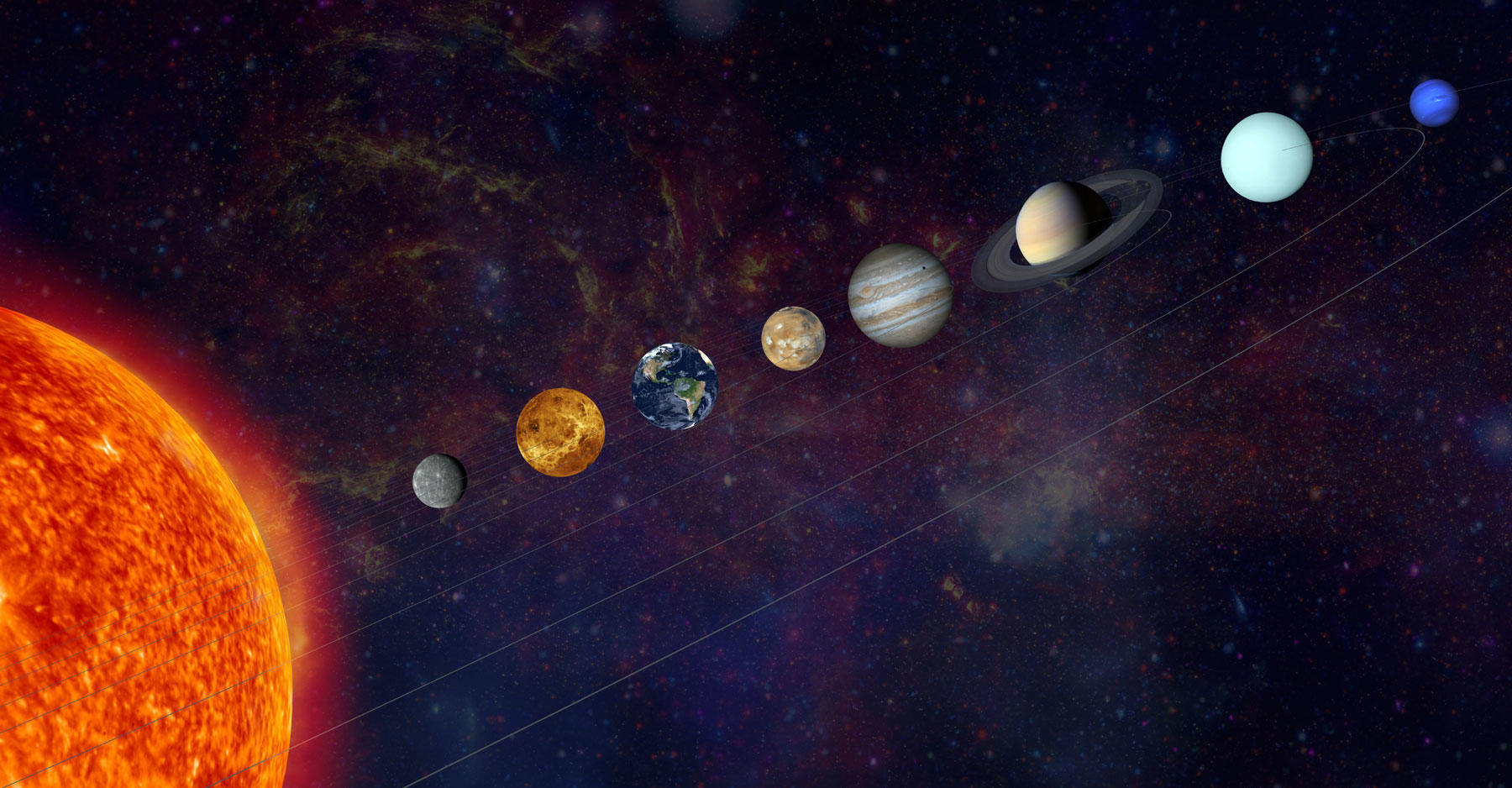
The planets are all equally distanced from each other.


This cold, blue planet was discovered by a mathematical prediction.
Neptune
Jupiter
Mars
Venus
Mercury,Saturn
Jupiter, Uranus, Neptune
Jupiter, Neptune,
Mercury,Saturn,
Uranus
Mars,Jupiter,
Saturn,Uranus
Neptune

Models of the solar system with Sun at the center are called _____________________ models.
geocentric
heliocentric
terrestrial
none of the above

Models of the solar system with Earth at the center are called _____________________ models.
geocentric
heliocentric
terrestrial
none of the above
How many known planets are in our solar system?
4
7
8
9
What dwarf planet was downgraded from planetary status in 2006?
Mercury
Uranus
Neptune
Pluto
According to the nebular theory, did the planets start forming before or after the Sun ignited?
The planets started forming during the time the Sun ignited.
The planets started forming before the Sun ignited.
The planets started forming after the Sun ignited.
What happens to the amount of the Sun's mass as it "burns"?
The mass of the Sun is constant.
It is converted into kinetic energy of the Sun.
It is converted into radiant energy.
It is converted into gravitational energy.
What is the age of the Sun?
Nearly 5 billion years old.
Nearly 500 million years old.
Nearly 1 billion years old.
Nearly 10 billion years old.
Where is the Sun located when you view a full Moon?
During a full Moon, the Sun, Earth, and the Moon are lined up, with Earth in between.
During a full Moon, the Sun, the Moon, and Earth are lined up, with the Moon in between.
During a full Moon, the Moon, the Sun, and Earth are lined up, with the Sun in between.
During a full Moon, the angle between the Sun, the Moon, and Earth is 90∘.
Why don't eclipses occur monthly, or nearly monthly?
Eclipses occur each time when the Moon is located at the intersection of the Moon's orbital plane and Earth's orbital plane, which is relatively rare event.
Eclipses occur only when the Moon is located at the intersection of the Moon's orbital plane and Earth's orbital plane, and the angle between the Sun, the Moon, and Earth is 90∘, which is relatively rare event.
Eclipses occur only when the Moon is located at the intersection of the Moon's orbital plane and Earth's orbital plane, and the Sun is located on the same line with Earth and the Moon, which is relatively rare event.
None of the above.
Between the orbits of what two planets is the asteroid belt located?
The asteroid belt is located between the orbits of Earth and Mars.
The asteroid belt is located between the orbits of Jupiter and Saturn.
The asteroid belt is located between the orbits of Saturn and Uranus.
The asteroid belt is located between the orbits of Mars and Jupiter.

Identify the phase of the moon in picture 2
Waxing Gibbous
Waning Crescent
Waxing Cresent
Waning Gibbous
Because Pluto has not cleared its orbital path of debris, it was reclassified from a planet to a . . .
asteroid.
meteor.
moon.
dwarf planet.
The astronomer _______________________ first proposed that Earth and the other planets orbit the sun.
Copernicus.
Einstein.
Kepler.
Newton.
Identify the phase of the moon in picture 9
Waxing Gibbous
Waning Crescent
Waxing Cresent
Waning Gibbous
The nebular hypothesis explains
why the planets are spherical in shape.
why the solar system is in a flattened disk.
how the sun and planets formed from a cloud of gas and dust.
all of the above.
One of the main differences between the outer and inner planets is __________.
the inner planets all have water
the inner planets are much bigger than the outer planets
the outer planets are gas planets
the outer planets have do not have rings and the inner planets do
Where is the asteroid belt found?
Between Earth and Mars
Between Uranus and Neptune
Between Mercury and Venus
Between Mars and Jupiter
What planet has a very hot surface and is most like Earth in size?
Venus
Mercury
Mars
Uranus
Which property makes Earth unique compared to other planets in the solar system?
It orbits the Sun.
It is a rocky planet
It has liquid water
It rotates on its axis.
Which contributes to Earth’s ability to sustain life?
The atmosphere allows all of the sun’s radiation to enter due to Earth’s distance from the sun.
The atmosphere prevents all space debris from reaching the surface due to the ozone layer.
The atmosphere is extremely thin due to the temperatures of the sun.
The atmosphere is breathable due to the unique mixture of gases.
What is the correct order of the planets in the Solar System, starting closest to the Sun?
Mars, Mercury, Earth, Venus, Jupiter, Saturn, Uranus, Neptune,
Mercury, Venus, Earth, Mars, Jupiter, Saturn, Uranus, Neptune
Mercury, Mars, Venus, Earth, Jupiter, Saturn, Uranus, Neptune,
Mercury, Venus, Earth, Mars, Jupiter, Neptune, Uranus, Saturn
Which planet has extreme temperatures because it has no atmosphere?
Earth
Jupiter
Saturn
Mercury
Which planet has the most extensive ring structure, the second largest in solar system, has at least 31 moons (the largest being Titan), and has thick outer rings of hydrogen, helium, ammonia, methane, and water vapor?
Jupiter
Neptune
Saturn
Pluto
What do Mercury, Venus, Earth, and Mars all have in common?
They are all very cold planets.
They are considered terrestrial planets, that is rocky or have metals with hard surface.
They are about the same size.
They are considered gas giants
The four inner planets are rocky and small. Which description best fits the next four outer planets?
They are also rocky and small.
They are very large and has no moons
They are small and made of ice.
They are very large, made of gases with no solid surface
Which planet is the largest planet in the solar system and is the fifth planet?
the sun
Uranus
Jupiter
Earth
Which is the eighth planet from the Sun and orbits the Sun once every 164.8 years and is blue in color?
Neptune
Jupiter
Saturn
Mars
Which of the following is ordered from largest to smallest?
Universe -> Galaxy -> Solar System -> Planet
Planet -> Galaxy -> Solar System -> Universe
Planet -> Solar System -> Galaxy -> Universe D.) Universe
Universe -> Solar System -> Galaxy -> Planet
Which planet is home to the tallest mountain , has the largest dust storms in the solar system and is also known as the 'Red Planet' because of the presence of iron oxide in it's rock.
Earth
Venus
Jupiter
Mars
The inner planets are also called a
Gas giants
Terrestrial planets
Large planets
Asteroid
Name for region containing all 8 planets, the sun, asteroids, and other celestial objects?
The Solar System
The Degoba System
Asteroid Belt
Kuiper Belt system
A student is looking at a model of the solar system noted there is a belt of objects in orbit in between Mars and Jupiter. What are these orbiting objects?
Comets
Moons
Asteroids
Pluto
The sun is a...
planet
star
comet
asteroid
What is the object that all planets in our solar system orbit?
The moon
The sun
The Milky Way
Mercury
Which of the these planets would have the greatest gravitational pull on a nearby object?
Mars
Mercury
Jupiter
Neptune
Which planet is the first (1st) from the Sun?


Which planet is the third (3rd) from the Sun?


Which planet is the second (2nd) from the Sun?
Which planet is the fifth (5th) from the Sun?

Which planet is the eighth (8th) from the Sun?


Which planet is the seventh (7th) from the Sun?
Which planet is the sixth (6th) from the Sun?
Which planet is the fourth (4th) from the Sun?
What is the center of our Solar System?

What separates the inner planets from the outer planets?

Which of the following lists the correct order of the planets from the sun?
Mercury, Venus, Mars, Earth, Jupiter, Saturn, Uranus, Neptune
Mercury, Venus, Earth, Mars, Saturn, Jupiter, Uranus, Pluto
Mercury, Venus, Earth, Mars, Jupiter, Saturn, Uranus, Neptune
Mars, Venus, Earth, Mercury, Jupiter, Saturn, Uranus, Neptune
Select all of the following that are considered "inner planets".
Venus
Neptune
Earth
Saturn
Which group of planets are only made of gases and liquids and have no solid surface?
Uranus, Neptune, Saturn
Earth, Mercury, Mars
Neptune, Venus, Jupiter
Mercury, Uranus, Earth
Which group of planets has a terrestrial, or rocky, surface?
Mercury, Venus, Neptune
Saturn, Jupiter, Uranus
Neptune, Earth, Pluto
Venus, Mars, Mercury
Based on the planet size comparison diagram, which planet is the largest?
Mars
Uranus
Jupiter
Neptune
Which best describes the inner and outer planets?
the inner planets are gaseous and much closer together than the outer planets
the inner planets are much smaller and more spread out than the outer planets
the outer planets are terrestrial and much further apart than the inner planets
the outer planets are much larger and more spread out than the inner planets
Which planet has the shortest day of all the planets?
Uranus
Neptune
Jupiter
Earth
Which planet does not have any moons or rings?
Mercury
Neptune
Earth
Saturn
Which planet is the furthest from the sun?
Venus
Neptune
Saturn
Pluto
Which planet has a huge storm called "The Great Red Spot"?
Mars
Venus
Jupiter
Mercury
Which is the smallest planet?
Saturn
Uranus
Earth
Mercury
Based on the diagram of the planet orbits around the sun, which planet has the largest orbit around the sun?
Saturn
Neptune
Mercury
Earth
Which planet is the only planet that is able to support life?
Mars
Venus
Earth
Uranus
Which planet has the tallest mountain in the solar system?
Saturn
Neptune
Venus
Mars
One planet's axis is tilted 98 degrees, so it essentially rotates on its side. Which planet is this?
Uranus
Earth
Mars
Neptune
Which planet has the most moons?
Venus
Saturn
Mercury
Mars
What can be found between the inner and outer planets (between Mars & Jupiter)?
Comets
Asteroid belt
Neptune
The sun
Select the following planets that have rings.
Neptune
Saturn
Jupiter
Mercury
Uranus
Which planet hits the the coldest temperatures?
Saturn
Earth
Mars
Uranus
Which planet is the hottest in our solar system?
Mars
Venus
Uranus
Mercury
The planets are all equally distanced from each other.


How many moons does Earth have?
1
2
3
4
Which is the closest planet to the Sun?
Earth
Mars
Mercury
Venus
Which is the farthest planet to the Sun?
Uranus
Neptune
Saturn
Jupiter
Which is the smallest planet?
Mars
Venus
Neptune
Mercury
Which is the biggest planet?
Jupiter
Neptune
Saturn
Uranus
Which is the hottest planet?
Mars
Venus
Mercury
Jupiter
Which planet has a big red spot on its surface?
Mars
Neptune
Uranus
Jupiter
Which planet is mainly composed of gas?
Jupiter
Venus
Earth
Mars
Which planet is the fifth planet to the Sun?
Uranus
Neptune
Saturn
Jupiter
Which planet is the brightest planet?
Mars
Saturn
Venus
Jupiter
How many planets are there in our Solar System?
7
8
9
10

