
 Worksheets
apwhmu9
Total questions: 150
Worksheet time: 2hrs 32mins
Which natural resource or crop have developing nations been able to trade in the global economy on terms most favorable to themselves?
cocoa
coffee
diamonds
oil
What role did herbicides play in the Green Revolution?
They promoted the growth of invasive plants.
They targeted invasive plants and prevented weeds.
They decreased the amount of water available to crops.
They increased the growth of weeds.
Which technology facilitated international business by bringing people closer together?
Cell phone and internet
Television
Radio
Satellite communication
Which diseases are associated with poverty and have vaccines or treatments?
Alzheimer's, Parkinson's, and dementia
COVID-19, influenza, and common cold
Diabetes, cancer, and hypertension
Malaria, tuberculosis, cholera, and polio
What trend is associated with diseases in wealthier countries?
Predominantly infectious diseases
Decrease in medical advancements
Higher rates of poverty-related illnesses
Diseases associated with longer life like heart disease and diabetes
What role does the United Nations primarily play?
Developing technology for developing countries
Promoting global trade
Protecting human rights and ending conflicts
Focusing solely on environmental issues
What has been a cultural impact of globalization?
Decrease in the influence of English language
Increasing dominance of Western, especially American, culture
Uniformity in traditional cultural practices globally
Reduction in international cooperation
The development of a worldwide economy where resources flow fairly freely across borders.
Globalization
Economy
GDP
Economic Independence
Which statement best describes the overall effect of globalization?
Globalization makes producing, buying, and selling of goods easier and more economical.
Globalization affects most countries in the world in the same ways.
Globalization helps countries preserve their traditional cultures.
Globalization hurts the economy of most underdeveloped countries.
Global warming refers to
natural variations in the global climate over time.
the rise in global temperatures caused by atmospheric pollution such as the emissions of cars and factories.
the risk of a nuclear war when the planet is politically "hot."
the increase in temperature caused by volcanic activity on the oceans' floors.
Which technology facilitated international business by bringing people closer together?
Cell phone and internet
Television
Radio
Satellite communication
What is the Green Revolution associated with?
Reduction in technological advancements
Growth of global communication networks
Increase in food production
Decrease in medical improvements
Which diseases are associated with poverty and have vaccines or treatments?
Alzheimer's, Parkinson's, and dementia
COVID-19, influenza, and common cold
Diabetes, cancer, and hypertension
Malaria, tuberculosis, cholera, and polio
What is a significant environmental concern discussed in the unit?
Increase in global forest cover
Reduction in fossil fuel usage
Improvement in global air quality
Climate change due to greenhouse gases
Which economic theory promotes less government regulation?
Liberalism
Socialism
Communism
Totalitarianism
What is NAFTA an example of?
Military alliance
Environmental treaty
Cultural exchange program
Free trade agreement
What has the U.N. Declaration of Human Rights contributed to?
Reduction in environmental policies
Decrease in global trade
Global expectation of freedom
Increase in technological innovation
What trend is associated with diseases in wealthier countries?
Predominantly infectious diseases
Decrease in medical advancements
Higher rates of poverty-related illnesses
Diseases associated with longer life like heart disease and diabetes
What role does the United Nations primarily play?
Developing technology for developing countries
Promoting global trade
Protecting human rights and ending conflicts
Focusing solely on environmental issues
What has been a cultural impact of globalization?
Decrease in the influence of English language
Increasing dominance of Western, especially American, culture
Uniformity in traditional cultural practices globally
Reduction in international cooperation
What is a major concern related to globalization?
Decrease in global population
Reduction in technological advancements
Stagnation of cultural diversity
Income inequality
The development of a worldwide economy where resources flow fairly freely across borders.
Globalization
Economy
GDP
Economic Independence
Which statement best describes the overall effect of globalization?
Globalization makes producing, buying, and selling of goods easier and more economical.
Globalization affects most countries in the world in the same ways.
Globalization helps countries preserve their traditional cultures.
Globalization hurts the economy of most underdeveloped countries.
The overthrow of the Shah of Iran in 1979 resulted in a
Communist government allied with the Soviet Union
monarchy opposed to constitutional changes
government run by Islamic fundamentalist leaders
government influenced by Iraq and Syria
How can countries benefit from trading when one has a comparative advantage in producing jeans and the other in shoes?
By not trading and focusing on their own production
By trading jeans for shoes to maximize their production strengths
By both producing only jeans
By both producing only shoes
What was one of the primary benefits of new chemical fertilizers introduced during the Green Revolution?
They decreased the growth rate of plants.
They made plants grow faster.
They increased the need for manual labor.
They reduced crop yields.
What role did herbicides play in the Green Revolution?
They promoted the growth of invasive plants.
They targeted invasive plants and prevented weeds.
They decreased the amount of water available to crops.
They increased the growth of weeds.
In the late 20th century, the Green Revolution had the greatest impact on
grain production in India
political freedom in Russia
economic reforms in Cuba
traditional customs in Japan
Which of the following statements is NOT true of modern terrorism? Modern terrorists routinely employ violence against civilian targets. Modern terrorists use sophisticated modern weapons and technologies. Modern terrorists are not confined to any one state and operate effectively across borders. Modern terrorists have been largely successful in achieving their political objectives.
Modern terrorists routinely employ violence against civilian targets.
Modern terrorists use sophisticated modern weapons and technologies.
Modern terrorists are not confined to any one state and operate effectively across borders.
Modern terrorists have been largely successful in achieving their political objectives.
Global warming refers to
the rise in global temperatures caused by atmospheric pollution such as the emissions of cars and factories.
a decrease in global temperatures due to increased ice coverage.
the fluctuation of weather patterns over a short period of time.
the increase in biodiversity in various ecosystems.
The World Trade organization's purpose is to
promote free international trade
regulate international tariffs
restrict trade between countries
encourage local businesses only
Which of the following statements about the Iranian Revolution of 1979 is most accurate?
It marked the end of British colonization in Iran
It overthrew a monarchy and installed a liberal democracy
It was guided by a non-Western ideology
Its leaders withdrew Iran from OPEC
These groups were similar as they both supported movements for democracy: Polish Solidarity and Tiananmen Square.
Polish Solidarity and Tiananmen Square
Arab Spring and Occupy Wall Street
Civil Rights Movement and Women's Suffrage
French Revolution and Russian Revolution
The European Union began with the development of a ______________.
common market
single currency
trade agreement
customs union
Which of the following is an impact of population growth in the developing world?
rising status of females
decreasing numbers of refugees in the developed world
declining importance of the IMF
rapid and haphazard urbanization
The World bank is a program from the UN that provides loans around the world with a purpose to _____________________.
Fight Poverty
Promote Economic Growth
Support Education Initiatives
Enhance Military Capabilities
How did Catholic Church leaders demonstrate sensitivity to demands of the poor for social justice in twentieth-century Latin America?
formation of a 'liberation theology'
establishment of wealth redistribution programs
creation of a social justice committee
promotion of individualism over community support
What happens when a member country does not agree with a decision made by the EU government?
The country must carry out the decision anyway.
The country can ignore the decision without consequences.
The country can veto the decision indefinitely.
The country must negotiate a new decision with the EU.
One significant result of the electronic information age is that
Information is more accessible than ever before.
People communicate more effectively across distances.
All these answers are correct.
Privacy concerns have increased significantly.
Neocolonialism is best-defined as
economic dependence of developing nations after decolonization
the political control of one country over another
the cultural assimilation of indigenous peoples
the establishment of military bases in foreign countries
Who was the leader of China during the 1980s known for strengthening China's economy through the Four Modernizations?
Deng Xiaoping
Mao Zedong
Zhou Enlai
Jiang Zemin
Why did the United States bomb and invade Afghanistan in 2001?
They believed the government was offering safety to al-Qaeda, the organization that attacked the United States on September 11, 2001.
They wanted to establish a democratic government in Afghanistan.
They aimed to control the opium trade in the region.
They were responding to a request from the United Nations.
In what region have US forces seen military action most frequently in the post-Cold War era?
Pacific rim
Latin America
Middle East and Central Asia
Western Europe
Which natural resource or crop have developing nations been able to trade in the global economy on terms most favorable to themselves?
gold
coffee
oil
cotton
The United Nations was created primarily to
promote global trade
improve international cooperation
establish military alliances
regulate international law
Who created the "Universal Declaration of Human Rights?"
UN
NATO
EU
WHO

What is a major reason for the trend illustrated by the graph?
an increase in global interdependence resulting from modern technology and expanded trade agreements
a decrease in international trade due to economic sanctions
a rise in local production and consumption patterns
a shift towards isolationist policies in major economies
What is the Green Revolution?
a program that encourages farmers to adapt modern agriculture methods
a movement to promote organic farming
a government initiative to reduce agricultural subsidies
a campaign to increase the use of traditional farming techniques
Who invented the first radio signals in Italy in 1895?
Guglielmo Marconi
Alexander Fleming
Gregory Pincus
Albert Einstein
Which technological innovation was first developed for the U.S. Defense Department during the Cold War and later became a global network connecting millions of computers?
Internet
Radio
Antibiotics
Vaccines
Who invented the birth control pill that provided a more reliable barrier to pregnancy?
Gregory Pincus
Guglielmo Marconi
Alexander Fleming
Louis Pasteur
What was the main goal of the Green Revolution that started in the mid-20th century?
To develop new varieties of crops with higher yields and resistance to pests and drought
To invent the radio
To discover antibiotics
To create the internet
Which medical innovation of the 20th century helped eradicate deadly diseases and became widely produced by governments after 1900?
Vaccines
Antibiotics
Birth control pill
Radio
Who accidentally discovered the first antibiotic in 1926?
Alexander Fleming
Guglielmo Marconi
Gregory Pincus
Norman Borlaug
What is the term for occurrences of diseases in which many people in the same place at the same time are affected?
Epidemics
Vaccines
Antibiotics
Green Revolution
Which disease is spread by mosquitoes in tropical areas and killed more than 600,000 people each year in the early 21st century, mostly young African children?
Malaria
Smallpox
Influenza
Polio
What is tuberculosis?
A disease associated with poverty; an airborne infection that spreads through coughs and sneezes and affects the lungs.
A disease caused by contaminated water.
A form of dementia.
A disease caused by a virus infecting fruit bats.
Which disease is responsible for about 95,000 deaths per year and is mainly contracted by poor people in developing countries through contaminated water?
Cholera
Ebola
HIV/AIDS
Heart Disease
Which disease was discovered in the Congo in 1976 and is caused by a virus that infects the African fruit bat?
Ebola
Tuberculosis
Alzheimer’s Disease
Heart Disease
What does HIV/AIDS stand for?
Acquired immunodeficiency syndrome
Acute intestinal infection syndrome
Human infectious virus syndrome
Heart infection virus syndrome
Which disease is typically associated with a longer life expectancy, lifestyle, and genetics?
Heart Disease
Cholera
Ebola
Tuberculosis
What is Alzheimer’s Disease?
A progressive and irreversible brain disorder characterized by gradual deterioration of memory, reasoning, language, and physical functioning.
A disease caused by contaminated water.
A disease caused by a virus infecting fruit bats.
A disease associated with poverty.
What is deforestation?
The loss of Earth's trees as a result of cutting down trees so the land could be used for agriculture.
The removal of natural vegetation cover through expansion of agricultural lands.
The result of factories and automobiles releasing gases.
Lack of access to clean drinking water.
What is desertification?
The removal of the natural vegetation cover through expansion and intensive use of agricultural lands in arid and semi-arid lands.
The loss of Earth's trees for agriculture.
The result of factories releasing gases.
A form of dementia.
What are greenhouse gases?
Gases that build up in the atmosphere and let the heat of the sun reach Earth, but trap it from escaping Earth.
Gases that cause heart disease.
Gases that cause desertification.
Gases that cause Alzheimer’s Disease.
What is water scarcity?
Lack of access to clean and accessible drinking water.
The loss of Earth's trees.
A disease caused by a virus.
A form of dementia.
What are fossil fuels?
Coal, oil, petroleum, and natural gas formed in the geological past from the remains of living organisms.
Gases that build up in the atmosphere.
Diseases caused by viruses.
Clean sources of drinking water.
What is the main focus of the Green Party that emerged in the 20th century?
Economic growth
Environmental issues
Military expansion
Technological innovation
What was the primary goal of the Kyoto Protocol signed in 1997?
Increase global trade
Reduce climate emissions by 2012
Promote free market economies
End the Cold War
Which economic system is based on supply and demand with minimal government control?
Command economy
Free market economy
Mixed economy
Traditional economy
Who was a strong advocate of free market economies and developed "Reaganomics" in the United States?
Margaret Thatcher
Deng Xiaoping
Ronald Reagan
Augusto Pinochet
Which British leader pledged to limit social welfare, restrict union power, and end inflation?
Ronald Reagan
Margaret Thatcher
Deng Xiaoping
Augusto Pinochet
What was Deng Xiaoping's economic policy in China often summarized as?
"Let some people get rich first"
"Workers of the world unite"
"Peace, land, and bread"
"Economic self-sufficiency"
Who took power in Chile after a U.S.-backed coup and moved the country toward a free-market approach?
Margaret Thatcher
Augusto Pinochet
Deng Xiaoping
Ronald Reagan
What does economic liberalization refer to?
Increasing government control over the economy
The opening up of a country's economy
Nationalizing industries
Restricting foreign trade
What is a multinational corporation?
A company that only operates in one country
A government agency
A corporation that makes or sells goods or services in more than one country
A local business
Which of the following is an example of a knowledge economy job?
Farmer
Factory worker
Engineer
Miner
When was the World Trade Organization (WTO) established?
1985
1995
2005
1975
What does NAFTA stand for?
North American Free Trade Agreement
National American Federal Trade Association
North Atlantic Free Trade Alliance
National Association for Free Trade
Which organization is a group of ten nations in Southeast Asia established in 1967 to promote trade?
Association of Southeast Asian Nations (ASEAN)
European Union (EU)
African Union (AU)
North American Free Trade Agreement (NAFTA)
Which company is a Swiss-based multinational corporation that is the largest food company in the world?
Nestle
Mahindra and Mahindra
Unilever
PepsiCo
What does Mahindra and Mahindra primarily produce?
Cars, farm equipment, military vehicles, and electrical energy
Food and beverages
Textiles and clothing
Pharmaceuticals
What are Maquiladoras?
Factories in Mexico that used low-wage Mexican labor to produce tariff-free goods for foreign export
Farms in Brazil that grow coffee for export
Textile mills in India that produce cotton goods
Technology parks in China for electronics manufacturing
What is the UN Universal Declaration of Human Rights?
A foundational document adopted by the UN in 1948 which laid out basic rights and fundamental freedoms for all human beings
A treaty to promote free trade among nations
A declaration to end world hunger
A document establishing the International Criminal Court
What is Global Feminism?
A series of demonstrations around the world that stand up for women’s rights
A movement to promote global trade
A campaign to end world poverty
A program to increase literacy rates
What was the main focus of the Negritude Movement?
Emphasizing “blackness” and rejecting colonial French authority
Promoting women’s rights in Africa
Encouraging economic development in Asia
Supporting environmental conservation
What is Liberation Theology?
A movement that combined inherent rights with religious ideology in Latin America in the 1950s and 1960s
A campaign to promote free trade in Europe
A philosophy to increase agricultural production
A movement to end apartheid in South Africa
What did the US Voting Rights Act of 1965 ban?
Discrimination in voting in the United States
Child labor in factories
Segregation in schools
Taxation without representation
What was Apartheid?
A South African system instituted in 1948 that enforced the segregation of people based on race
A movement for women’s rights in Europe
A trade agreement between African nations
A campaign to end poverty in Asia
What is Caste Reservation in India?
A system where the government guarantees a percentage of jobs and education for people whose caste has resulted in an underprivileged life
A program to promote tourism in India
A law to ban child labor in factories
A movement to end apartheid in South Africa
What is Greenpeace known for?
Combating deforestation, desertification, global warming, whaling, and overfishing
Promoting free trade among nations
Providing food aid to developing countries
Supporting women’s rights worldwide
Who was the first African woman to win the Nobel Peace Prize and founded the Green Belt Movement?
Wangari Maathai
Malala Yousafzai
Ellen Johnson Sirleaf
Leymah Gbowee
What is the definition of Popular Culture?
The culture of the everyday people rather than the educated elite.
The culture of the educated elite only.
The culture of ancient civilizations.
The culture of government officials.
What is Consumer Culture focused on?
What people buy and own rather than where they live or what they believe.
The traditions of a country.
The language people speak.
The food people eat.
Reggae music is associated with which religion?
Rastafari
Buddhism
Christianity
Islam
What is the popular name given to the film industry in Bombay (Mumbai)?
Bollywood
Hollywood
Nollywood
Tollywood
Which social networking website enables users to share information and photos and keep in touch with family and friends?
What is Online Commerce?
Shopping moved online through sites like Alibaba and eBay.
Shopping only in physical stores.
Trading goods in local markets.
Selling only handmade products.
What are Global Brands?
Products or services known and sold in all parts of the world by a particular company.
Products only sold in local markets.
Brands that are only popular in one country.
Brands that are not advertised.
What is Weibo?
Microblog in Chinese; a Chinese version of Twitter.
A type of Chinese food.
A Chinese movie.
A Chinese festival.
What does Brexit refer to?
The exit of Britain from the European Union in 2016.
The entry of Britain into the United Nations.
The formation of the European Union.
The exit of France from the European Union.
What is Fair Trade?
A way of buying and selling products that makes certain that the people who produce the goods receive a fair price.
Trading goods without any payment.
Trading only luxury goods.
Trading only within a country.
What is Sustainable Development?
Development that meets the needs of the present without compromising the ability of future generations to meet their own needs.
Development that only focuses on economic growth.
Development that ignores environmental concerns.
Development that benefits only the current generation.
What does Debt Relief/Restructuring mean?
A situation in which part of a debt is written off or the amount owed is reduced.
Taking on more debt.
Ignoring all debts.
Increasing the interest rate on debts.
What is the United Nations?
An international governing body formed in 1945 to increase political and economic cooperation among its member countries.
A sports organization.
A trade union.
A private company.
What is the General Assembly in the United Nations?
A forum for making decisions at which each of the 193 members of the United Nations has a representative.
The main military branch of the United Nations.
The financial department of the United Nations.
The headquarters of the United Nations.
What is the primary responsibility of the Security Council in the United Nations?
Maintenance of international peace and security.
Organizing sports events.
Managing world trade.
Promoting cultural festivals.
What is the World Bank?
An international organization dedicated to providing financing, advice, and research to developing nations to aid their economic advancement.
A commercial bank for individuals.
A bank for only European countries.
A bank that only deals with gold.
What is the main goal of the International Monetary Fund (IMF)?
To achieve sustainable growth and prosperity for all of its 190 member countries.
To provide military assistance to countries in need.
To regulate international trade laws.
To create new currencies for global use.
How does the International Monetary Fund (IMF) support its member countries?
By promoting financial stability and monetary cooperation.
By building infrastructure in rural areas.
By providing free education to all citizens.
By organizing international sports events.
What is the primary function of the bank mentioned in the document?
To offer developmental assistance to middle- and low-income countries.
To provide loans for luxury goods.
To manage stock exchanges.
To regulate internet usage.
What is the World Fair Trade Organization?
An organization advocating fair wages, safe conditions, and labor rights in developing countries affected by globalization.
A global trade organization focused on reducing tariffs and trade barriers.
A non-profit organization promoting luxury goods from developed countries.
A governmental body regulating international trade agreements.
What medical technologies prolonged life in the 20th century?
Vaccines and antibiotics.
Surgical procedures and chemotherapy.
Physical therapy and acupuncture.
Homeopathy and herbal remedies.
Musical examples of globalized culture?
Reggae (Jamaica)
K-Pop (South Korea)
Samba (Brazil)
Fado (Portugal)
Example of a global economic institution?
International Monetary Fund (IMF)
World Trade Organization (WTO)
World Bank
Bank for International Settlements (BIS)
What organization preceded the United Nations?
The League of Nations.
The World Health Organization.
The International Monetary Fund.
The North Atlantic Treaty Organization.
Film examples of globalized culture?
Hollywood (U.S.) and Bollywood (India)—international success and influence.
Nollywood (Nigeria) and K-Dramas (South Korea)—local success only.
French New Wave and Italian Neorealism—regional influences.
Anime (Japan) and Telenovelas (Latin America)—limited global reach.
What are two shipping innovations that increased globalization?
Air travel after WWII and standardized shipping containers.
The invention of the steam engine and the development of railroads.
The introduction of GPS technology and online shopping.
The use of drones for delivery and electric vehicles.
What is a multinational corporation? Example?
A business operating in multiple countries. Example: Nestle (Switzerland to Africa to global markets).
A company that only operates within its home country.
A small business that exports products to other countries.
A government agency that manages international trade.
Diseases associated with aging populations?
Heart disease and Alzheimer’s—linked to increased lifespans in wealthier nations.
Diabetes and obesity—common in younger populations.
Asthma and allergies—primarily affecting children.
Flu and common cold—seasonal illnesses affecting all ages.
How did industrial production change in the late 20th century?
It moved to developing nations (e.g., Vietnam, Mexico) for cheaper labor.
It became more automated and relied on robotics.
It focused on sustainable practices and reduced emissions.
It shifted back to developed nations for higher quality control.
What global human rights document was created by the UN in 1948?
The Universal Declaration of Human Rights
The International Covenant on Civil and Political Rights
The Convention on the Elimination of All Forms of Discrimination Against Women
The Geneva Conventions
Who are the five permanent members of the UN Security Council?
U.S., China, Russia, France, and the United Kingdom.
Germany, Japan, Brazil, and India.
Canada, Australia, Italy, and Spain.
South Africa, Mexico, Argentina, and Nigeria.
What is a 'knowledge economy'? Example?
An economy based on agricultural production. Example: Brazil's coffee exports.
An economy based on intellectual labor. Example: Finland's post-WWII tech investment.
An economy focused on manufacturing goods. Example: China's industrial growth.
An economy driven by natural resources. Example: Saudi Arabia's oil production.
How did globalization encourage gender reform?
Global feminist movements, supported by the UN, helped secure women's voting rights and improve access to education and professional roles.
Globalization led to increased economic competition, which reduced the focus on gender issues.
The rise of social media platforms allowed for the spread of traditional gender roles.
Globalization resulted in a decrease in women's participation in the workforce.
What is the role of the International Monetary Fund (IMF)?
To support member states economically, promote free trade, and stabilize global currency values.
To provide military support to member countries in conflict.
To regulate international immigration policies among member states.
To oversee global environmental policies and initiatives.
What economic policies became popular in the late 1900s?
Keynesian economics—government spending and intervention.
Free market economics—deregulation, reduced tariffs, privatization.
Protectionist policies—high tariffs and trade barriers.
Socialist policies—state control of resources.
Disease associated with poverty in the 20th century?
Malaria—mainly impacts poor, tropical regions due to lack of resources.
Tuberculosis—common in urban areas with high population density.
HIV/AIDS—primarily affects developed countries with high drug use.
Cholera—often found in regions with poor sanitation and clean water access.
What does the UN Security Council do?
Responsible for peacekeeping, it can deploy troops and impose sanctions.
It primarily focuses on economic development and trade agreements.
It serves as a forum for international cultural exchange.
It is responsible for organizing global sporting events.
What is the World Bank and what is its purpose?
A financial institution created by the UN to aid Europe post-WWII and now provides loans and support to developing nations to fight poverty and promote development.
A global organization that focuses solely on environmental issues and climate change.
A private bank that offers investment opportunities to wealthy individuals.
An agency that provides military support to countries in conflict.
Example of globalization spreading disease?
1918 Influenza Pandemic—spread globally via WWI routes, killing ~50 million people.
COVID-19—originated in Wuhan, China, and spread worldwide in 2020.
Ebola outbreak—primarily spread in West Africa in 2014.
Zika virus—transmitted by mosquitoes, primarily affecting South America.
What was the leading cause of the unprecedented increase in global population in the twentieth century?
The end of international epidemics
Global warming and other types of climate change
The impact of medical innovations and public health measures
The reduction of world hunger
Which of the following is characteristic of the Green Revolution of the 1960s through the 1980s?
It restored tropical forests destroyed by slash-and-burn agriculture.
It prevented oil exploration in the natural habitats of endangered species.
It sought to limit the use of nuclear energy.
It used new technologies to increase agricultural yields in developing regions.

(click image to enlarge) Keshavarz’ analysis in the third paragraph of the difficulties of growing Iran’s population best reflects which of the following demographic realities in the early twentieth century?
Effective forms of birth control gave women greater control over their fertility.
Diseases associated with poverty and underdevelopment were still prevalent in most world regions.
Military conflicts led to population decreases in many countries, followed by postwar baby booms.
The Green Revolution dramatically increased agricultural productivity and led to rapid population growth.

(click image to enlarge) In the late twentieth century, which of the following factors would most directly enable governments around the world to achieve the public policy goals outlined in Keshavarz’ article?
The spread of radical nationalist and religious movements
The political and legal emancipation of women
Advances in medicine, such as vaccines and antibiotics
Advances in communication, such as television and the Internet
“I belong to those scientists who consider that the drying up of the Aral Sea is far more advantageous than preserving it. First, in its zone, good fertile land will be obtained. . . . Cultivation of cotton alone will pay for the existing Aral Sea, with all its fisheries, shipping, and other industries. Second, the disappearance of the Sea will not affect the region’s landscapes.”
A. Babayev, president of Soviet Turkmenistan’s Academy of Sciences, late 1950s
Question: Which of the following was the most direct result of the attitude toward the environment reflected in the passage?
A push for new varieties of food crops resulting in the Green Revolution
Desertification and increased competition for natural resources
Implementation of government-led land collectivization policies
A rise in Cold War tensions between the Soviet Union and neighboring countries
Which of the following was a significant environmental effect of the globalization of the world’s economy in the period 1980 to the present?
There was a significant improvement in air and water quality worldwide.
While air and water quality generally improved in the developed world, they deteriorated in many parts of the developing world.
Emissions of greenhouse gasses that contribute to global warming generally decreased.
While biodiversity decreased in the developing world, it generally increased in the developed world.

(click image to enlarge) The views expressed in the two passages were most directly enabled by which of the following economic trends in the late twentieth century?
Many of the defeated countries in the Second World War received generous economic assistance from the United States after the war.
Governments in newly independent postcolonial states sought to limit their countries’ economic reliance on the former colonial powers.
The governments of many developed Western countries adopted policies of economic liberalization and deregulation.
Governments in Asia cooperated with private businesses in an effort to maximize exports and acquire foreign currencies from Europe and the United States.

(click image to enlarge) The corporate philosophy reflected in the two passages most directly contributed to which of the following?
The inability of the Soviet-planned economy to compete successfully with the economies of the United States and other Western countries
The shift of manufacturing capacity from the postindustrial countries of the West to the new manufacturing centers in Asia and Latin America
The passage of stronger measures to safeguard workers’ and consumers’ rights in many developed countries
Increased popular hostility toward economic migrants and migrations in many countries

(click to enlarge) In the late twentieth and early twenty-first centuries, which of the following was most directly a response to the business philosophy expressed in the two passages?
Trade unionism
Liberation theology
International Socialism
Antiglobalization activism
“The poor live their Christian faith and proclaim their hope in the midst of inhuman misery and poverty, resulting from above all the unjust social structures that favor a privileged minority.”
Gustavo Guitiérrez, Peruvian priest and founder of the liberation theology movement, 1985
Which of the following examples best represents the philosophy of liberation theology as expressed by Guitiérrez in the passage above?
Latin American Communist leaders redistributed land to their poorest citizens.
Latin American religious clergy fought for economic and social justice.
Latin American churches promoted material wealth for their faithful congregants.
Latin American governments guaranteed freedom of religion for their citizens.
Which of the following factors contributed most to women gaining the right to vote in industrialized countries between 1914 and 1950 ?
In the First and Second World Wars, women made highly visible contributions to the war effort.
The birth rate declined significantly.
Women’s life expectancies increased at a faster rate than did the life expectancies of men.
New psychological research discredited earlier theories of a link between gender and intelligence.
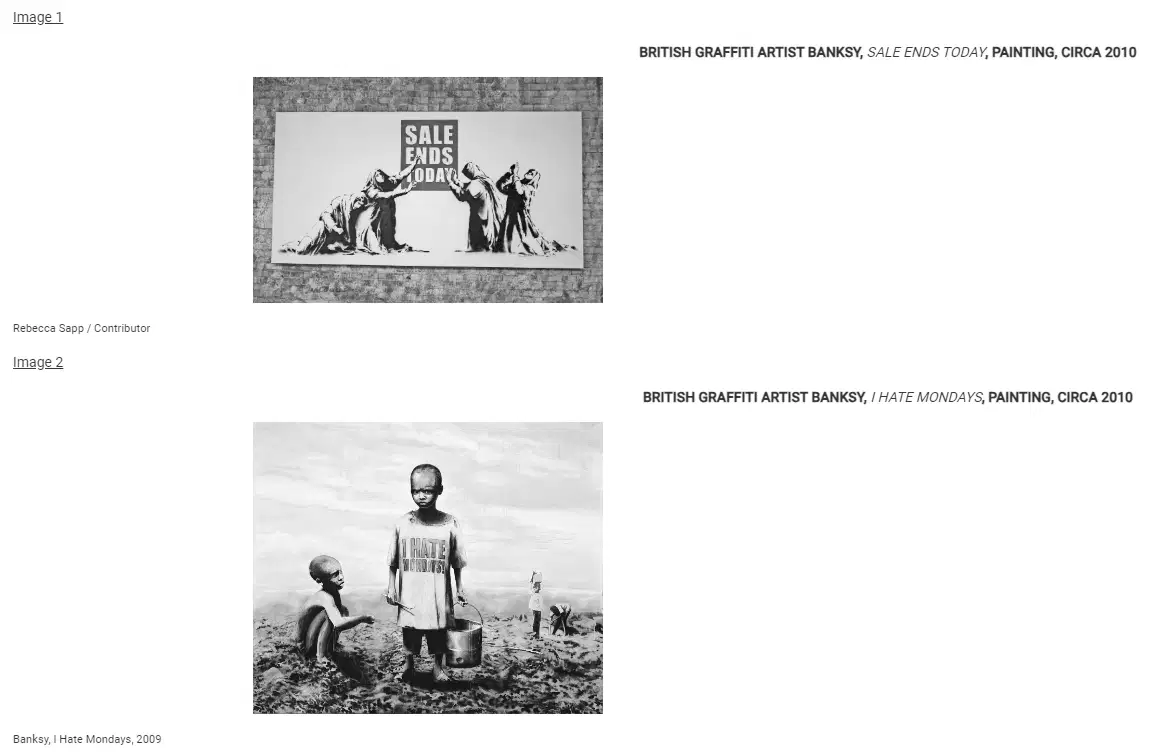
Which of the following twentieth-century processes contributed most directly to the adoption of the system of cultural values to which Banksy alludes in Image 1 ?
The expansion of European empires led to the expansion of market economies worldwide.
Greater industrial productivity and new technologies led to increased availability of consumer goods.
Cold War rivalries led to ideological and economic competition between the Soviet Union and the United States.
The continued volatility of economic cycles led many governments to enact social welfare legislation for their citizens.
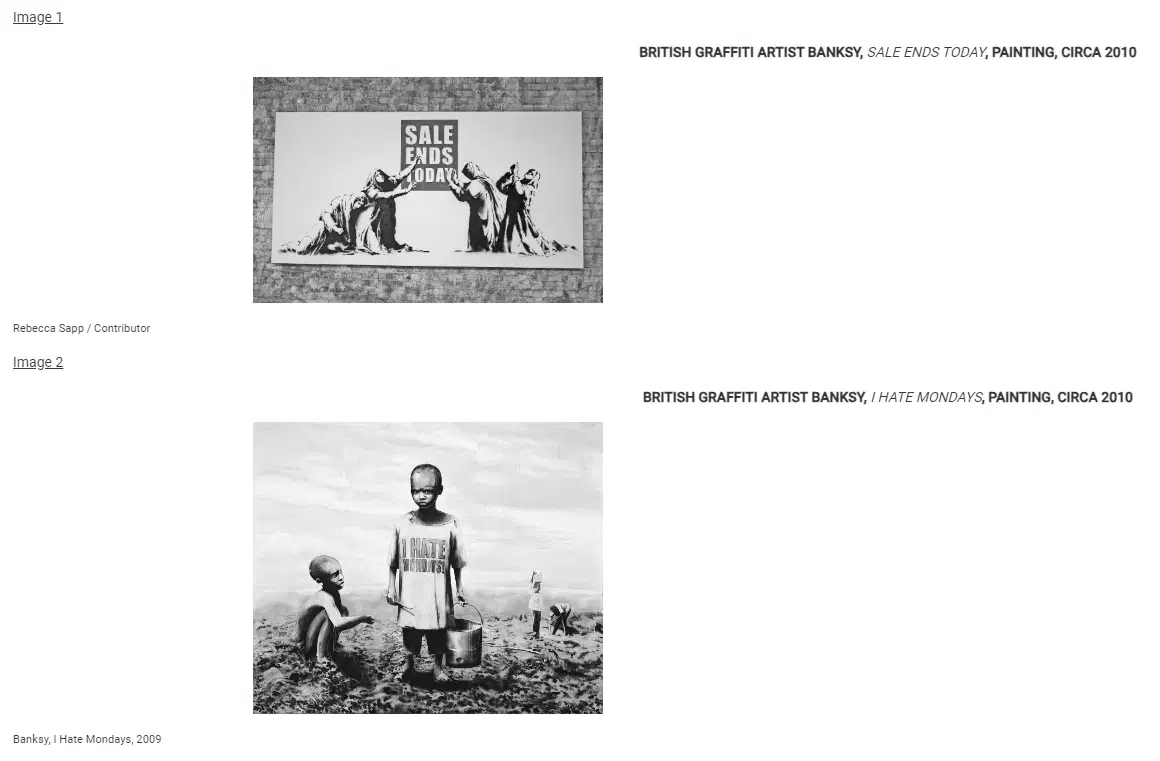
(click image to enlarge) Based on the images, Banksy’s work best illustrates which of the following?
The trend in modern art toward experimentation with abstract techniques and styles
The spread of social protests against the inequalities of global economic integration
The attainment of greater economic and political equality for women worldwide
The expansion of educational opportunities in developing African, Asian, and Latin American countries

(click image to enlarge) Which of the following international organizations were founded upon principles that were in direct opposition to the approach to international politics advocated in the second paragraph?
Regional trade agreements such as ASEAN and Mercosur
International economic institutions promoting free trade, such as the International Monetary Fund and the World Bank
Cold War military alliances such as NATO and the Warsaw Pact
Collective security and cooperation organizations, such as the League of Nations and the United Nations
“While the dynamic force in Globalization 1.0 was countries globalizing and the dynamic force of Globalization 2.0 was companies globalizing, the dynamic force in Globalization 3.0 — the thing that gives it its unique character — is the newfound power for individuals to collaborate and compete globally.”
Thomas Friedman, journalist, 2005
Which of the following contributed most to the development of the process that Friedman labels Globalization 3.0?
The invention of the Internet and the increased availability of personal computers
The creation of multinational corporations and international stock markets
The United Nations’ adoption of the Universal Declaration of Human Rights
The creation of supranational entities such as the European Union

